Kansas Quitclaim Deed from Corporation to LLC
Overview of this form
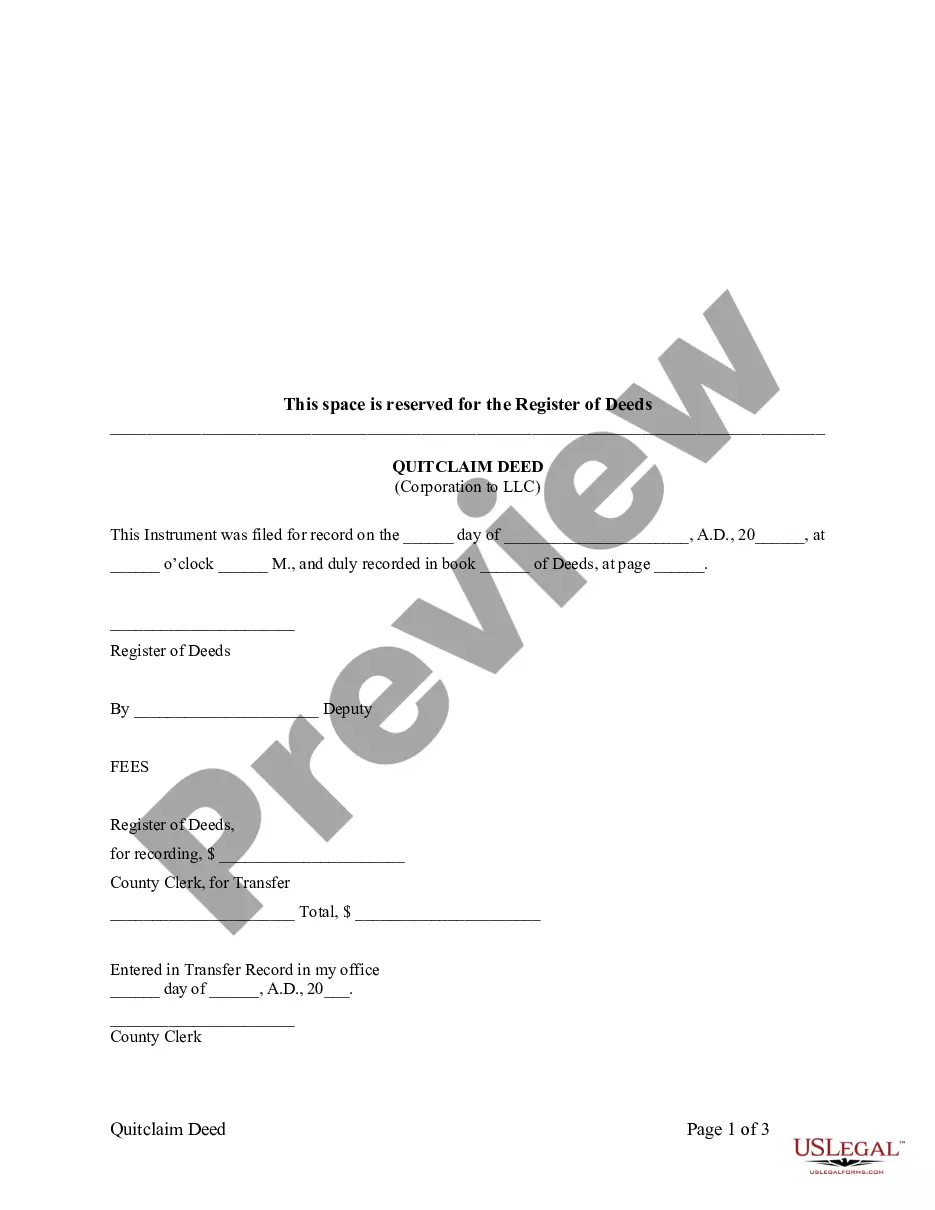
The Quitclaim Deed from Corporation to LLC is a legal document used to transfer property ownership from a corporation to a limited liability company (LLC). This form allows the Grantor, a corporation, to convey or "quitclaim" the described property to the Grantee, an LLC, while reserving any rights to minerals that may exist on the property. It is important for corporations and LLCs seeking property transfers without warranty or guarantee of ownership, distinguishing it from warranty deeds, which provide guarantees about property titles.
Key parts of this document
- Identification of the Grantor (the corporation) and the Grantee (the LLC).
- Legal description of the real estate being conveyed.
- Statement of reservation for oil, gas, and minerals by the Grantor.
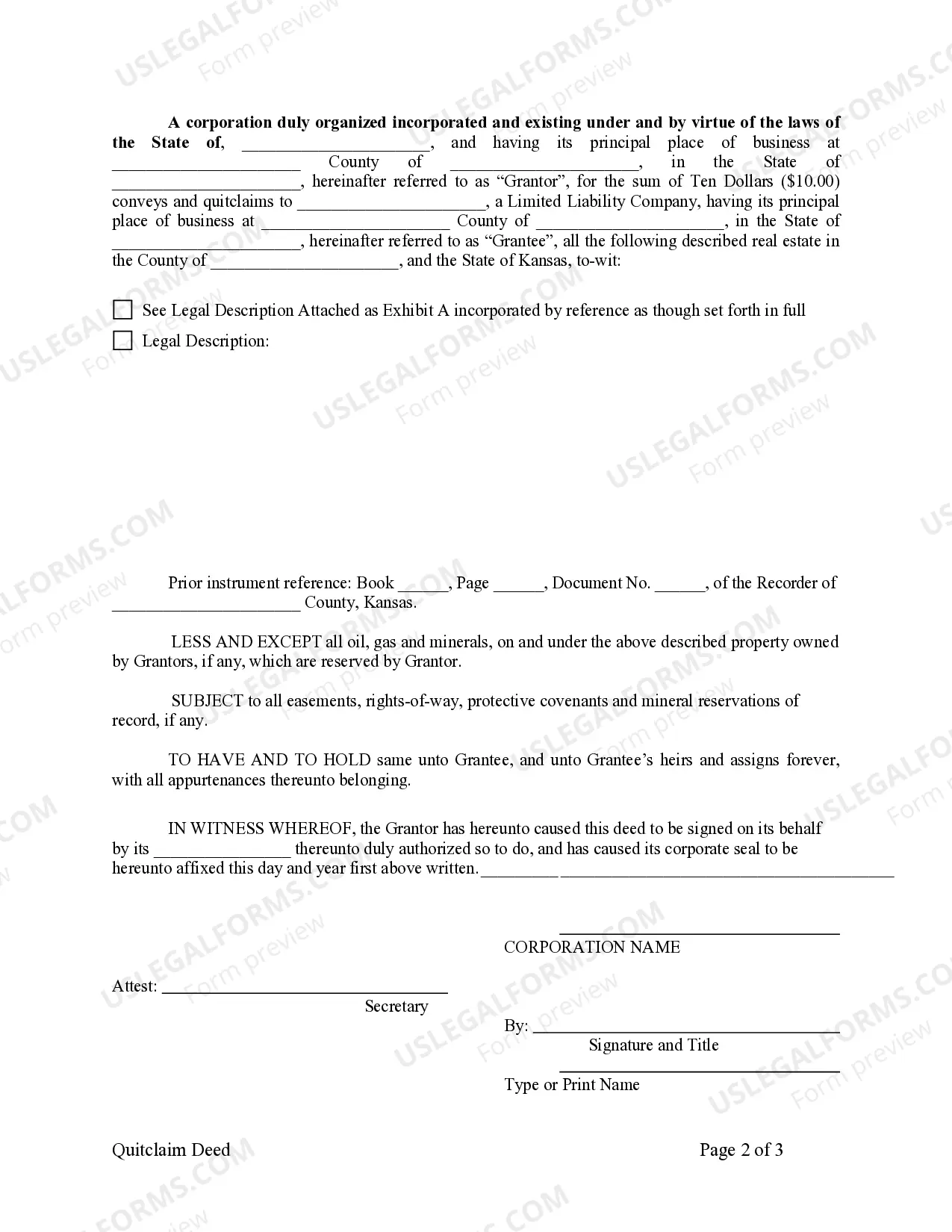
- Signatures of authorized representatives of both parties.
- Notary acknowledgment to validate the document if required.



When this form is needed
This Quitclaim Deed should be used when a corporation wants to transfer property ownership to an LLC without any warranty or guarantees. Common scenarios include business restructurings, consolidation of assets, or simplifying ownership divisions. It is particularly useful for businesses wanting to facilitate quick property transfers with minimal legal complexity.
Intended users of this form
- Corporations looking to transfer property to their own or another LLC.
- Limited Liability Companies receiving property to manage or develop.
- Business owners and legal representatives involved in asset relocations.
- Real estate professionals assisting in property transactions involving businesses.
Completing this form step by step
- Identify the parties involved: the corporation (Grantor) and the LLC (Grantee).
- Provide the legal description of the property being transferred.
- Specify any reservations, such as oil, gas, or mineral rights by the Grantor.
- Sign and date the document, ensuring it is executed by an authorized representative of the corporation.
- Consider notarization for legal validity as required by state law.
Does this document require notarization?
Notarization is required for this form to take effect. Our online notarization service, powered by Notarize, lets you verify and sign documents remotely through an encrypted video session, available 24/7.
Get your form ready online
Our built-in tools help you complete, sign, share, and store your documents in one place.
Make edits, fill in missing information, and update formatting in US Legal Forms—just like you would in MS Word.
Download a copy, print it, send it by email, or mail it via USPS—whatever works best for your next step.
Sign and collect signatures with our SignNow integration. Send to multiple recipients, set reminders, and more. Go Premium to unlock E-Sign.
If this form requires notarization, complete it online through a secure video call—no need to meet a notary in person or wait for an appointment.
We protect your documents and personal data by following strict security and privacy standards.

Make edits, fill in missing information, and update formatting in US Legal Forms—just like you would in MS Word.

Download a copy, print it, send it by email, or mail it via USPS—whatever works best for your next step.

Sign and collect signatures with our SignNow integration. Send to multiple recipients, set reminders, and more. Go Premium to unlock E-Sign.

If this form requires notarization, complete it online through a secure video call—no need to meet a notary in person or wait for an appointment.

We protect your documents and personal data by following strict security and privacy standards.
Typical mistakes to avoid
- Failing to include the complete legal description of the property.
- Not obtaining the necessary signatures from authorized representatives.
- Omitting the reservation of rights for minerals when applicable.
- Forgetting to notarize the document when required by state law.
Benefits of completing this form online
- Convenient access to legal templates that can be completed at any time.
- Editable forms that allow customization to meet specific needs.
- Reliable solutions drafted by licensed attorneys, ensuring legal compliance.
- Easy downloads so users can quickly obtain necessary documentation.
Legal use & context
- A quitclaim deed transfers ownership without warranties, meaning the Grantee assumes the risk.
- It is often used in simple transfers between related entities, such as corporations and LLCs.
- Legal enforcement of this deed depends on compliance with state-specific recording requirements.
Summary of main points
- The Quitclaim Deed from Corporation to LLC effectively transfers property ownership.
- Ensure all legal descriptions and entity details are accurately filled out.
- Notarization may not be required but is advisable for record validity.
- Always check specific state laws regarding property transfers to ensure compliance.
Looking for another form?
Form popularity
FAQ
Recording A quitclaim deed must be filed with the County Recorder's Office where the real estate is located. Go to your County Website to locate the office nearest you. Signing (§ 58-2205) A quitclaim deed is required to be authorized with a notary public present.
It's usually a very straightforward transaction, but it's possible for a quitclaim deed to be challenged. If a quitclaim deed is challenged in court, the issue becomes whether the property was legally transferred and if the grantor had the legal right to transfer the property.
Fill out the quit claim deed form, which can be obtained online, or write your own using the form as a guide. The person giving up the interest in the property is the grantor, and the person receiving the interest is the grantee.
But you might be wondering if an owner can transfer a deed to another person without a real estate lawyer. The answer is yes. Parties to a transaction are always free to prepare their own deeds.A quitclaim deed, for example, is far simpler than a warranty deed.
Quitclaim deeds, therefore, are commonly used to transfer property within a family, such as from a parent to an adult child, between siblings, or when a property owner gets married and wants to add their spouse to the title. Married couples who own a home together and later divorce also use quitclaim deeds.
A Quitclaim Deed must be notarized by a notary public or attorney in order to be valid.Consideration in a Quitclaim Deed is what the Grantee will pay to the Grantor for the interest in the property.
A warranty deed is a legal document used to transfer, or convey, rights in real property from a grantor (seller) to a grantee (buyer). For Kansas residential property, the primary methods for holding title in co-ownership are tenancy in common and joint tenancy.
They are commonly used to add/remove someone to/from real estate title or deed (divorce, name changes, family and trust transfers). The quitclaim deed is a legal document (deed) used to transfer interest in real estate from one person or entity (grantor) to another (grantee).