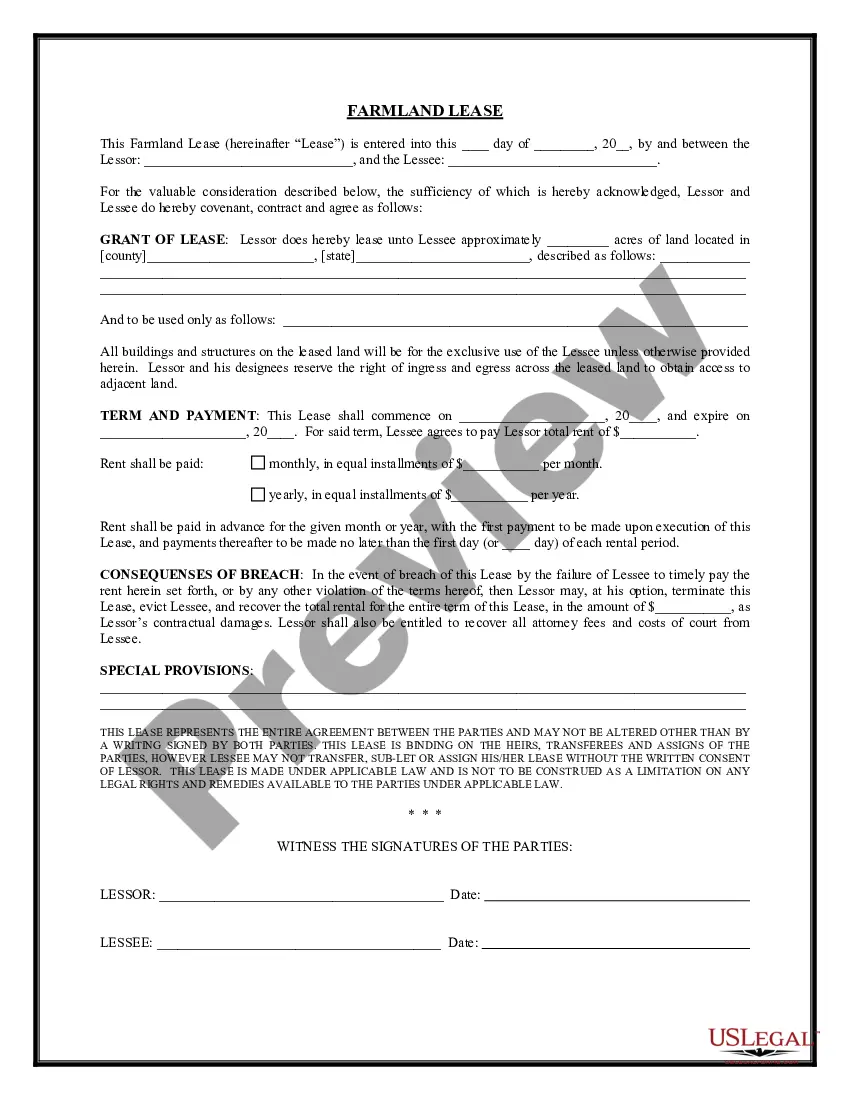
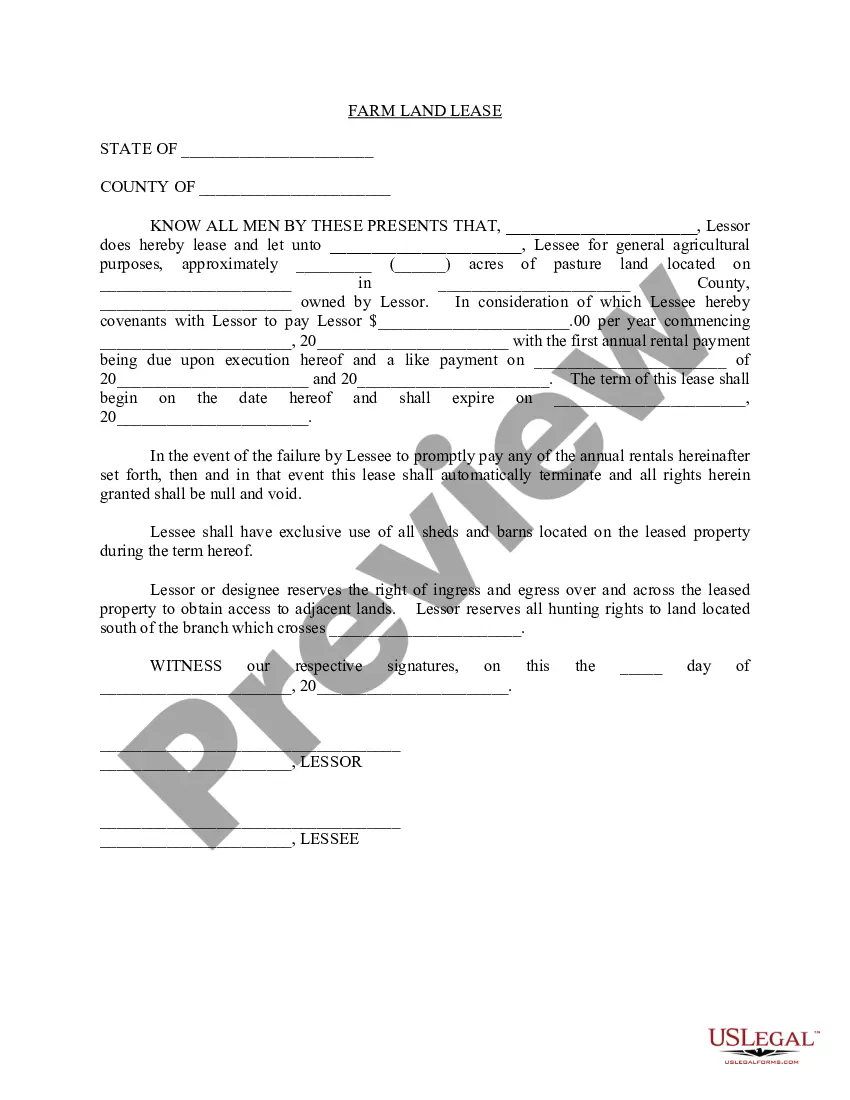
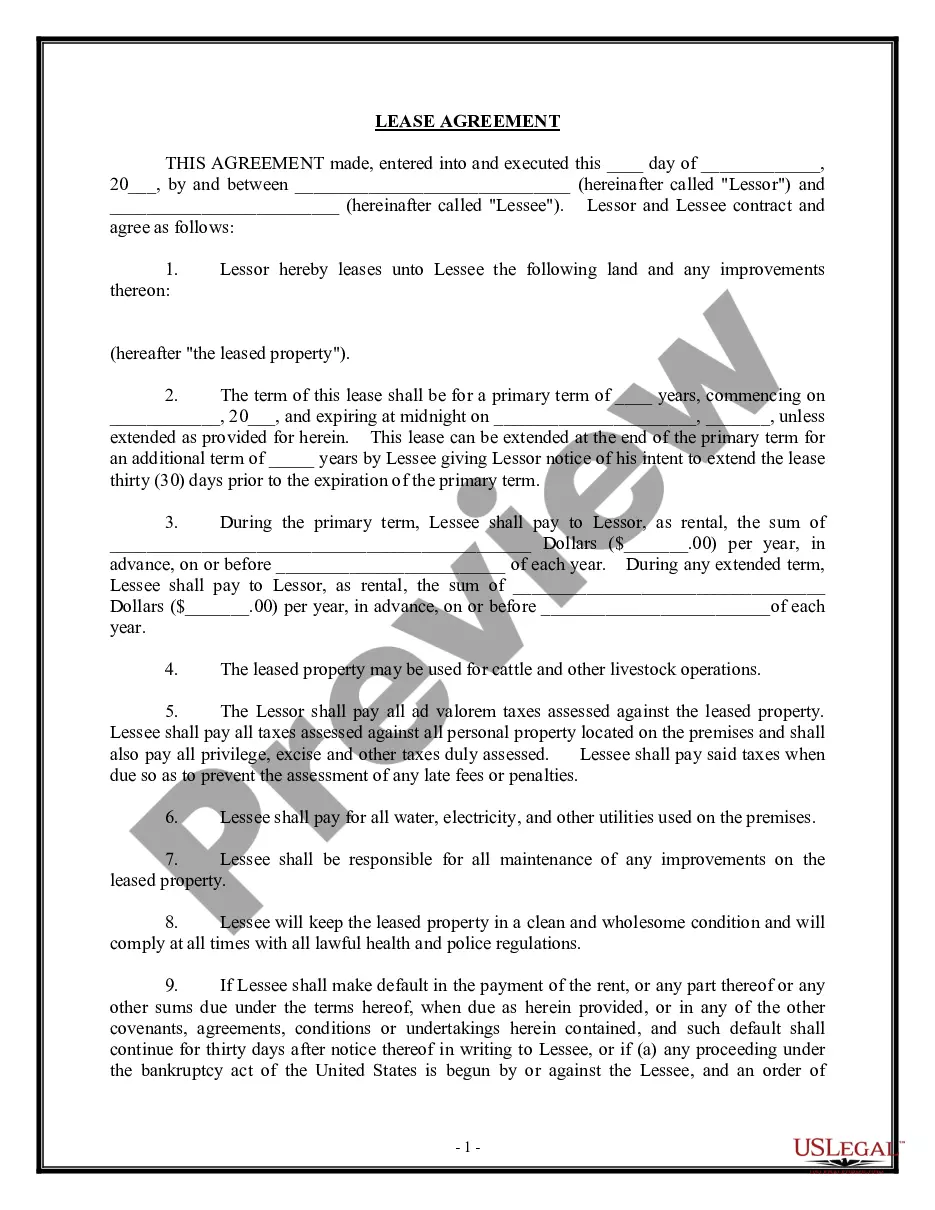
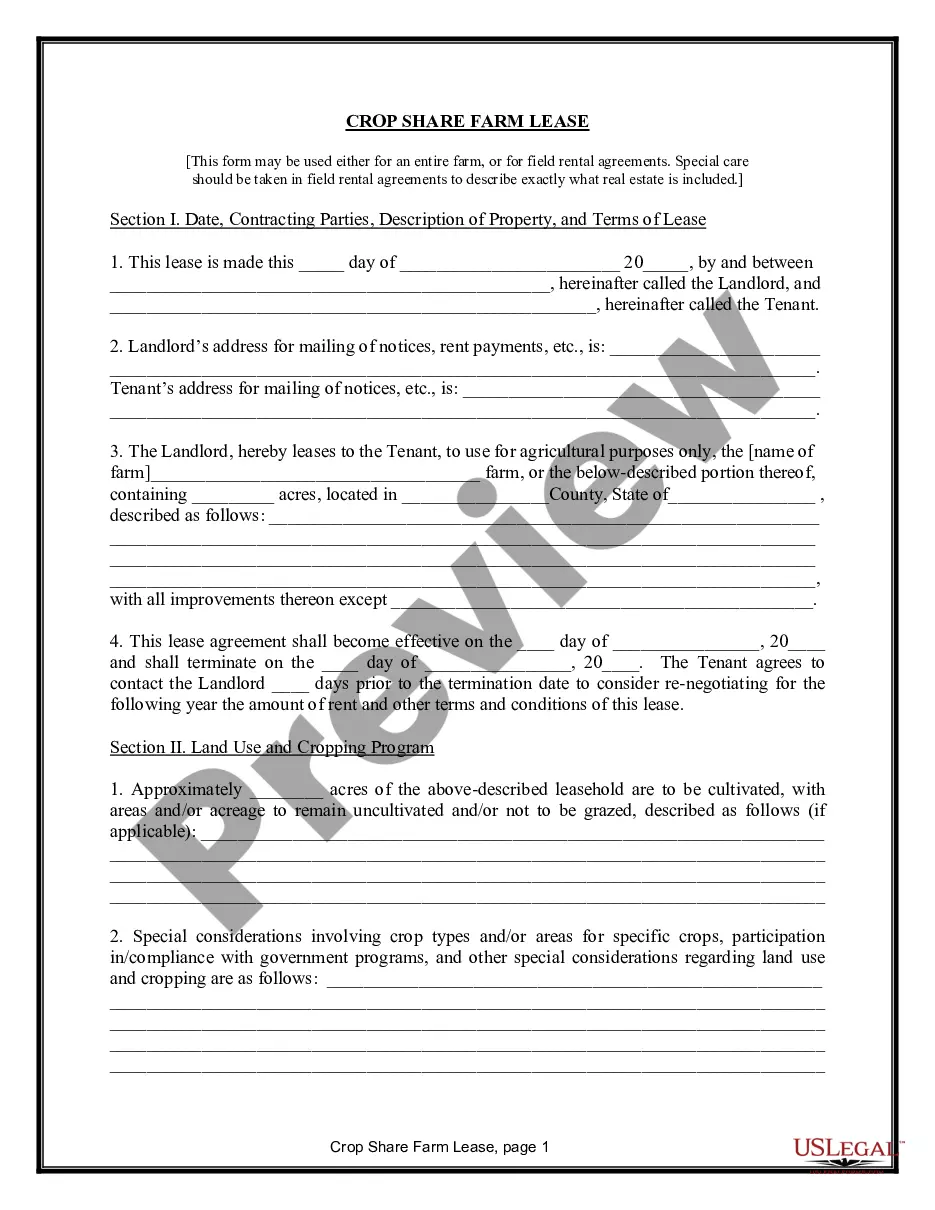
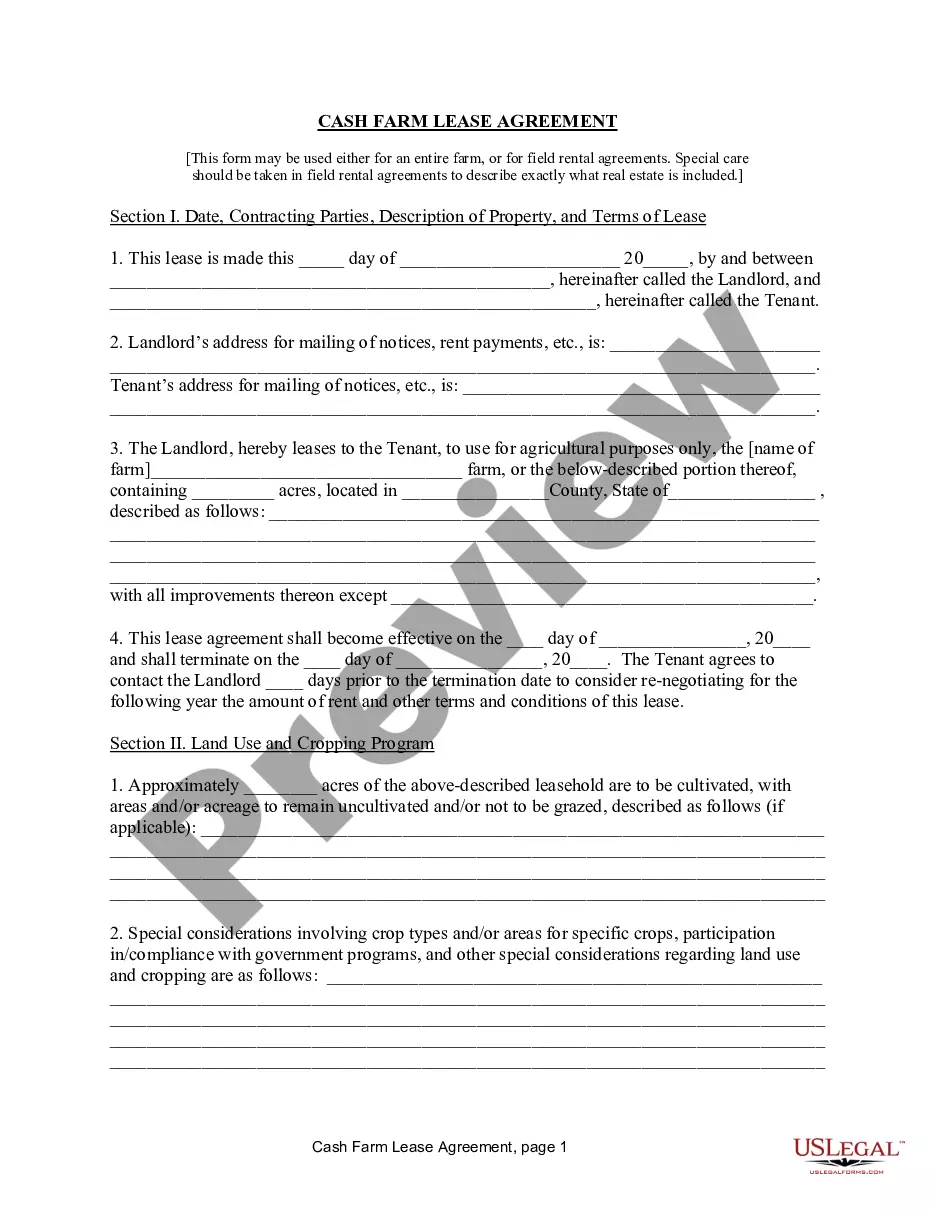
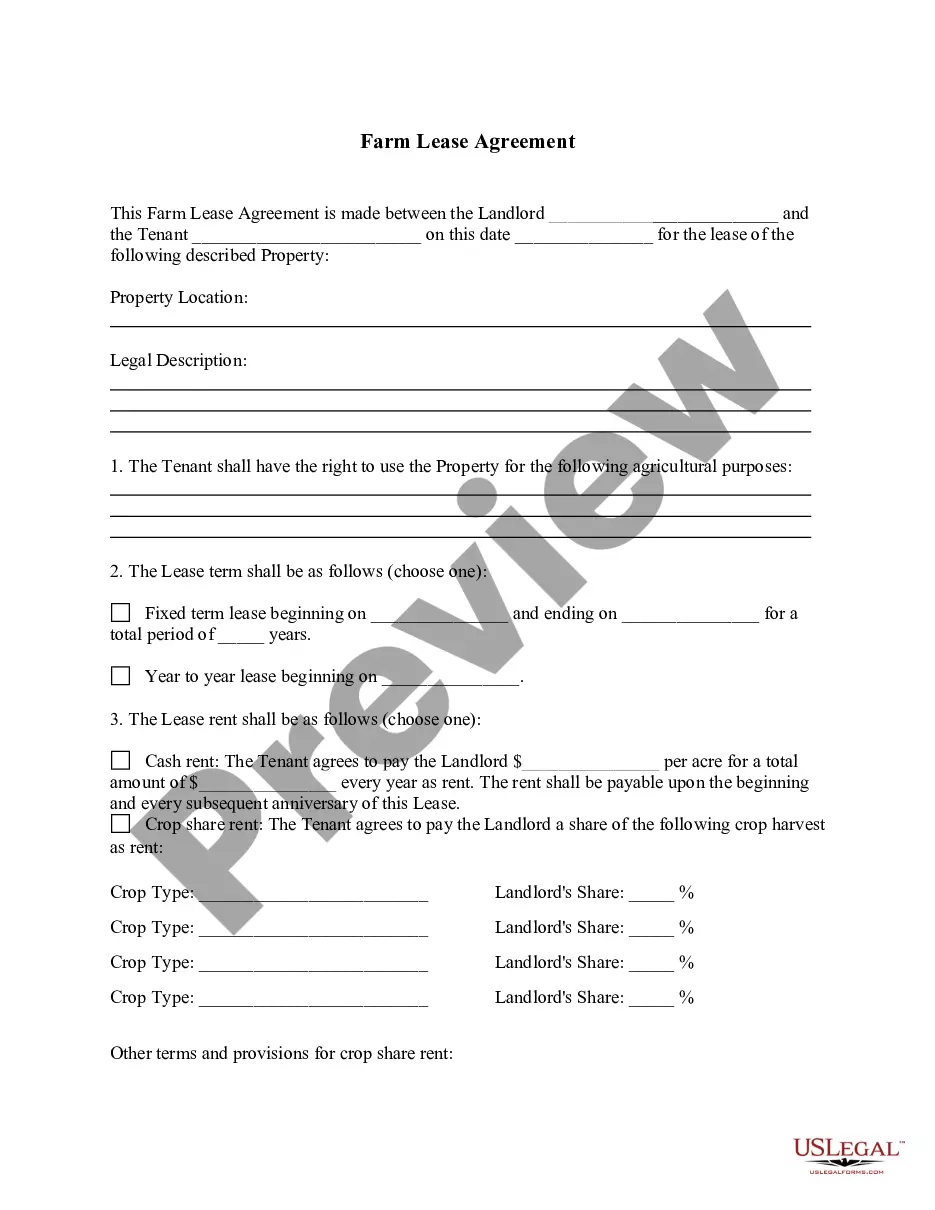
Simple lease of farmland from landowner to tenant for purposes of farming and/or livestock.
Indiana Simple Farm Lease or Rental
State:
Multi-State
Category:
Control #:
US-801LT
Format:
Word;
Rich Text
208 downloads
Description
Get your form ready online
Our built-in tools help you complete, sign, share, and store your documents in one place.
Built-in online Word editor
Make edits, fill in missing information, and update formatting in US Legal Forms—just like you would in MS Word.
Export easily
Download a copy, print it, send it by email, or mail it via USPS—whatever works best for your next step.
E-sign your document
Sign and collect signatures with our SignNow integration. Send to multiple recipients, set reminders, and more. Go Premium to unlock E-Sign.
Notarize online 24/7
If this form requires notarization, complete it online through a secure video call—no need to meet a notary in person or wait for an appointment.
Store your document securely
We protect your documents and personal data by following strict security and privacy standards.

Make edits, fill in missing information, and update formatting in US Legal Forms—just like you would in MS Word.

Download a copy, print it, send it by email, or mail it via USPS—whatever works best for your next step.

Sign and collect signatures with our SignNow integration. Send to multiple recipients, set reminders, and more. Go Premium to unlock E-Sign.

If this form requires notarization, complete it online through a secure video call—no need to meet a notary in person or wait for an appointment.

We protect your documents and personal data by following strict security and privacy standards.
Looking for another form?
How to fill out Simple Farm Lease Or Rental?
If you wish to finalize, download, or print sanctioned document templates, utilize US Legal Forms, the top assortment of legal forms that are available online.
Employ the site's straightforward and user-friendly search to locate the documents you require. Various templates for business and individual purposes are categorized by type and claims, or keywords.
Utilize US Legal Forms to find the Indiana Simple Farm Lease or Rental in just a few clicks.
Every legal document template you purchase is yours permanently. You can access each form you obtained within your account. Click on the My documents section and choose a form to print or download again.
Complete and download, and print the Indiana Simple Farm Lease or Rental using US Legal Forms. There are millions of professional and state-specific forms you can use for your business or personal needs.
- If you are already a US Legal Forms customer, Log In to your account and click the Download button to retrieve the Indiana Simple Farm Lease or Rental.
- You can also access forms you have previously purchased from the My documents tab in your account.
- If this is your first time using US Legal Forms, follow the instructions below.
- Step 1. Ensure you have selected the form for the correct city/state.
- Step 2. Utilize the Preview function to review the content of the form. Don’t forget to read the description.
- Step 3. If you are dissatisfied with the form, use the Search box at the top of the screen to find other versions of the legal form template.
- Step 4. Once you have located the form you need, click the Buy now button. Choose the pricing plan you prefer and provide your information to register for an account.
- Step 5. Process the payment. You may use your credit card or PayPal account to complete the transaction.
- Step 6. Select the format of your legal form and download it to your device.
- Step 7. Complete, modify, and print or sign the Indiana Simple Farm Lease or Rental.
Form popularity
FAQ
Most farmers find that a combination of both ownership and leasing is desirable, especially when capital is limited. For many new farmers, especially in areas where land is quite expensive, leasing land is often the best option.
A farm lease is a written agreement between a landowner and a tenant farmer. Through a farm lease, the landowner grants the tenant farmer the right to use the farm property. Key terms of basic leases include the length of the lease, rent amounts and frequency of payment, how to renew or end the lease, and more.
The advantages of the first are that the tenant in many cases is free to manage the farm as he pleases, and as a long-time proposition he may pay less rent than under crop-sharing arrangements. The chief disadvantage is that the tenant agrees to pay a definite sum before he knows what his income will be.
The traditional share arrangement for a grain crop like corn or wheat is one-third to the landowner and two-thirds to the tenant. Usually, the expenses paid, and crop received, are equal to the share i.e. the landowner would pay one-third of the expenses and receive one-third of the crop.
Crop-share arrangements refer to a method of leasing crop land where the production (crop) is shared between the landowner and the operator. Other income items, such as government payments and crop residue, are also often shared as are some of the production expenses.
With a land lease agreement (also known as a ground lease), you purchase the home but rent the land. One of the main advantages is the lower price of this unique arrangement. One of the main disadvantages is that you will not be able to build valuable equity in the land on which you live.
Farmland has historically been a good investment. Unfortunately, not many investors have been able to benefit from this asset class, given the high upfront costs of buying farmland.
A written lease agreement must contain:The names and addresses of both parties;The description of the property;The rental amount and reasonable escalation;The frequency of rental payments, i.e. monthly;The amount of the deposit;The lease period;The notice period for termination of contract;More items...
The average rental rate in Saskatchewan is $51.90 per acre, with a median rate of $50.00.
While farmland may stretch far and wide, farmers and ranchers themselves make up just 1.3% of the employed US population, totaling around 2.6 million people. Today, there are about 2 million farms in operation in the US, a steep decline from 1935, when the number of farms peaked at nearly 7 million.