Indiana Order Dismissing Proceeding Supplemental Pursuant to T.R. 41e
What this document covers
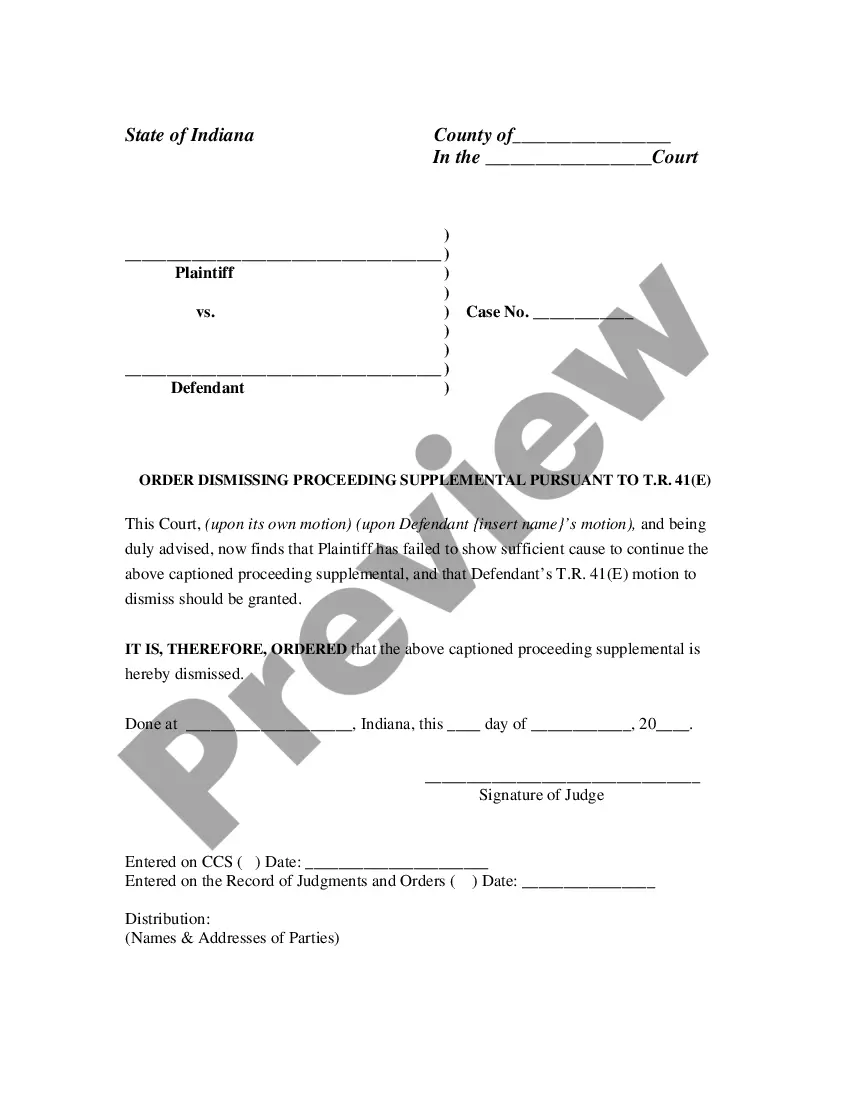
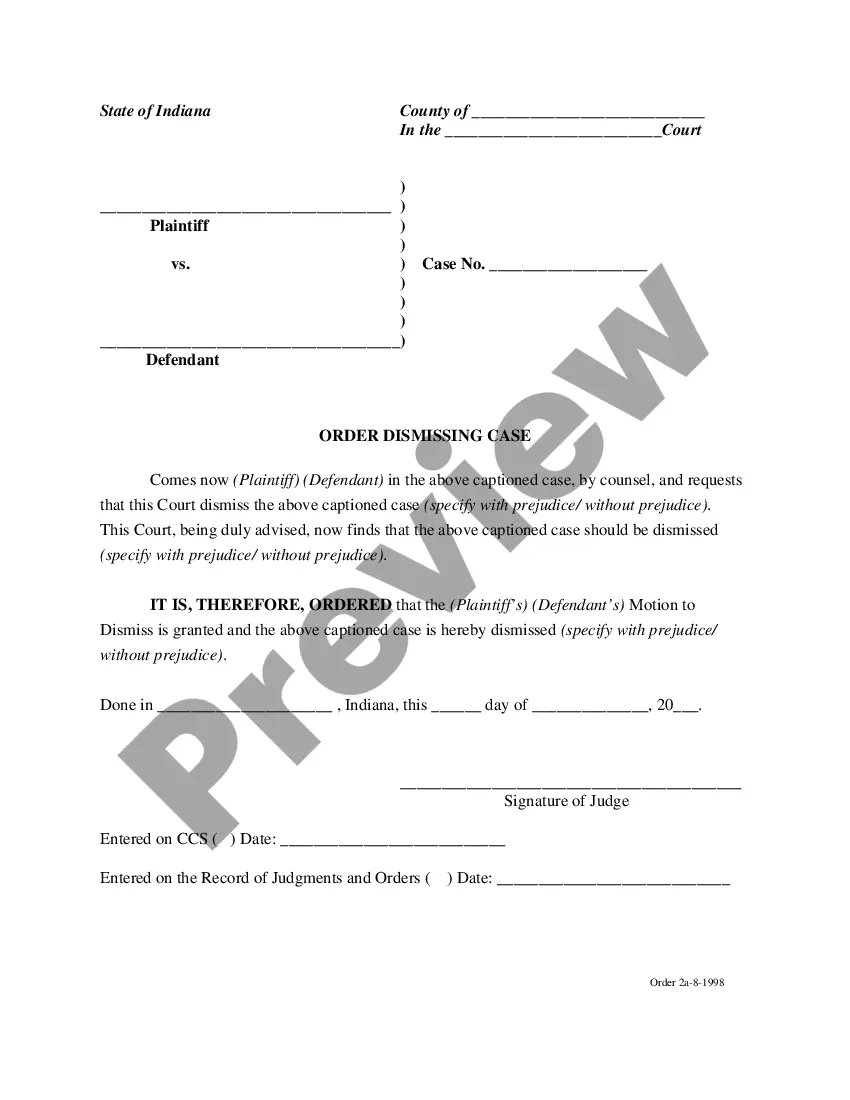
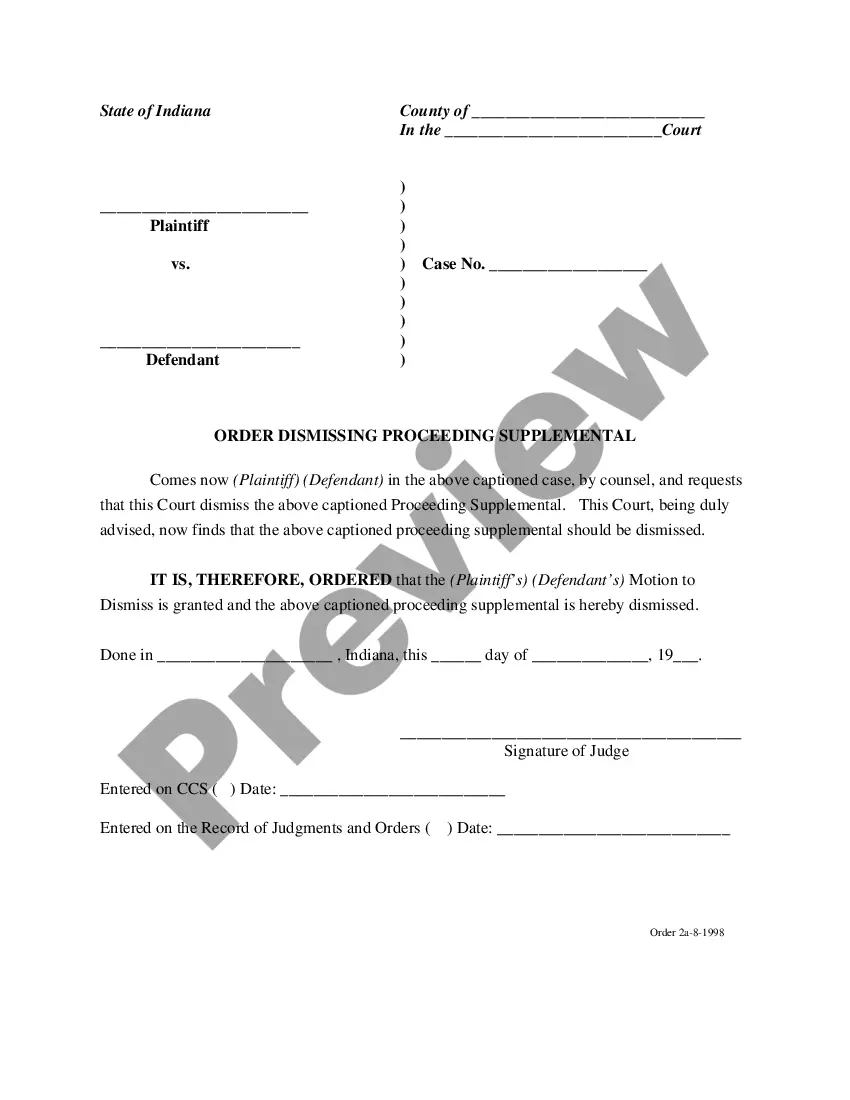
The Order Dismissing Proceeding Supplemental Pursuant to T.R. 41e is a legal document used in Indiana to formally dismiss a supplementary proceeding when the plaintiff has not shown sufficient cause to continue. This order ensures that any proceedings related to the matter are closed, streamlining the judicial process and preventing unnecessary delays. Unlike other dismissal orders, this specific form adheres to Indiana's Trial Rule 41(e), providing clear guidelines for dismissal within this jurisdiction.
Main sections of this form
- Identification of the court and the parties involved (plaintiff and defendant).
- Case number for reference.
- Statement addressing the findings of the court regarding the plaintiff's failure to show cause.
- Order for dismissal of the proceeding supplemental.
- Signature line for the judge, confirming the dismissal order.
- Sections for recording the distribution of the order to the relevant parties.
When to use this document
This form should be used when a defendant has motioned for dismissal of a proceeding because the plaintiff has not demonstrated sufficient grounds to continue. It is applicable in situations where legal proceedings have been initiated but are found to lack merit, ensuring that the court's time and resources are not expended on unsubstantiated claims.
Who can use this document
- Defendants in a legal proceeding who seek to have the case dismissed.
- Plaintiffs in cases where they recognize that continuation may not serve their interests.
- Legal professionals representing either party in the context of Indiana courts.
Completing this form step by step
- Fill in the names of the parties involved in the proceeding.
- Enter the case number assigned by the court.
- Specify the grounds for dismissal as noted by the court.
- Include the judge's signature and date to finalize the dismissal.
- List the addresses of all parties to ensure proper distribution of the order.
Does this form need to be notarized?
This form does not typically require notarization unless specified by local law. It is advisable to check with the court or a legal professional regarding any specific requirements that may apply to your case.
Get your form ready online
Our built-in tools help you complete, sign, share, and store your documents in one place.
Make edits, fill in missing information, and update formatting in US Legal Forms—just like you would in MS Word.
Download a copy, print it, send it by email, or mail it via USPS—whatever works best for your next step.
Sign and collect signatures with our SignNow integration. Send to multiple recipients, set reminders, and more. Go Premium to unlock E-Sign.
If this form requires notarization, complete it online through a secure video call—no need to meet a notary in person or wait for an appointment.
We protect your documents and personal data by following strict security and privacy standards.

Make edits, fill in missing information, and update formatting in US Legal Forms—just like you would in MS Word.

Download a copy, print it, send it by email, or mail it via USPS—whatever works best for your next step.

Sign and collect signatures with our SignNow integration. Send to multiple recipients, set reminders, and more. Go Premium to unlock E-Sign.

If this form requires notarization, complete it online through a secure video call—no need to meet a notary in person or wait for an appointment.

We protect your documents and personal data by following strict security and privacy standards.
Mistakes to watch out for
- Failing to include the case number or party names correctly.
- Not stating the grounds for dismissal adequately.
- Leaving out the judge's signature or date of the order.
- Neglecting to distribute the order to all relevant parties.
Benefits of using this form online
- Easy access to the latest updates and compliance with Indiana law.
- Convenience of downloading and filling the form at your own pace.
- Editable templates that allow for customization based on specific case details.
- Secure storage for legal documents and peace of mind regarding data safety.
Looking for another form?

Form popularity
FAQ
'Dismissed without prejudice' in Indiana implies that a case can be refiled in the future. This designation allows parties to maintain their rights to pursue the matter again. When you see an Indiana Order Dismissing Proceeding Supplemental Pursuant to T.R. 41e, it can often be under this condition, indicating that the closure is not permanent. Thus, you have the opportunity to bring your case back to court if needed.
'Dismissed with prejudice' in Indiana indicates that a case is permanently closed and cannot be refiled. This outcome often results from a judgment on the merits, providing a final resolution. Such dismissals relate directly to the Indiana Order Dismissing Proceeding Supplemental Pursuant to T.R. 41e, emphasizing the importance of this designation in legal proceedings. Always consider consulting with legal resources for clarity on your specific situation.
An answer is filed by the defendant after s/he has been served with a copy of the complaint. If you have been served with a summons and complaint, you have twenty-one (21) days to file an answer. The United States government, its agencies, and employees have sixty (60) days to file an answer.
The court shall enter an order of dismissal at plaintiff's costs if the plaintiff shall not show sufficient cause at or before such hearing. The purpose of this rule is to ensure that plaintiffs will diligently pursue their claims.
Read the summons and make sure you know the date you must answer by. Read the complaint carefully. Write your answer. Sign and date the answer. Make copies for the plaintiff and yourself. Mail a copy to the plaintiff. File your answer with the court by the date on the summons.
If a summons has already been issued by the Clerk of the Court but another summons is needed, perhaps because there was an error in the original one, it was served on the wrong party or to the wrong address or not served within the required time frame, the plaintiff may file a Request for Alias Summons to request that
Unless otherwise stipulated or ordered by the court, a party may serve on any other party no more than 25 written interrogatories, including all discrete subparts. Leave to serve additional interrogatories may be granted to the extent consistent with Rule 26(b)(1) and (2).
If you don't file a response 30 days after you were served, the Plaintiff can file a form called Request for Default.The Plaintiff will win the case. Then, the Plaintiff can enforce the judgment against you. This can mean getting money from you by garnishing your paycheck or putting a lien on your house or car.
A responsive pleading required under these rules, shall be served within twenty 20 days after service of the prior pleading. Unless the court specifies otherwise, a reply shall be served within twenty 20 days after entry of an order requiring it.
Generally, you have 30 days AFTER the date you are served to file a response with the court. The 30 days include weekend days and court holidays. If the last day falls on a day that the court is closed, you have until the next day that the court is open.