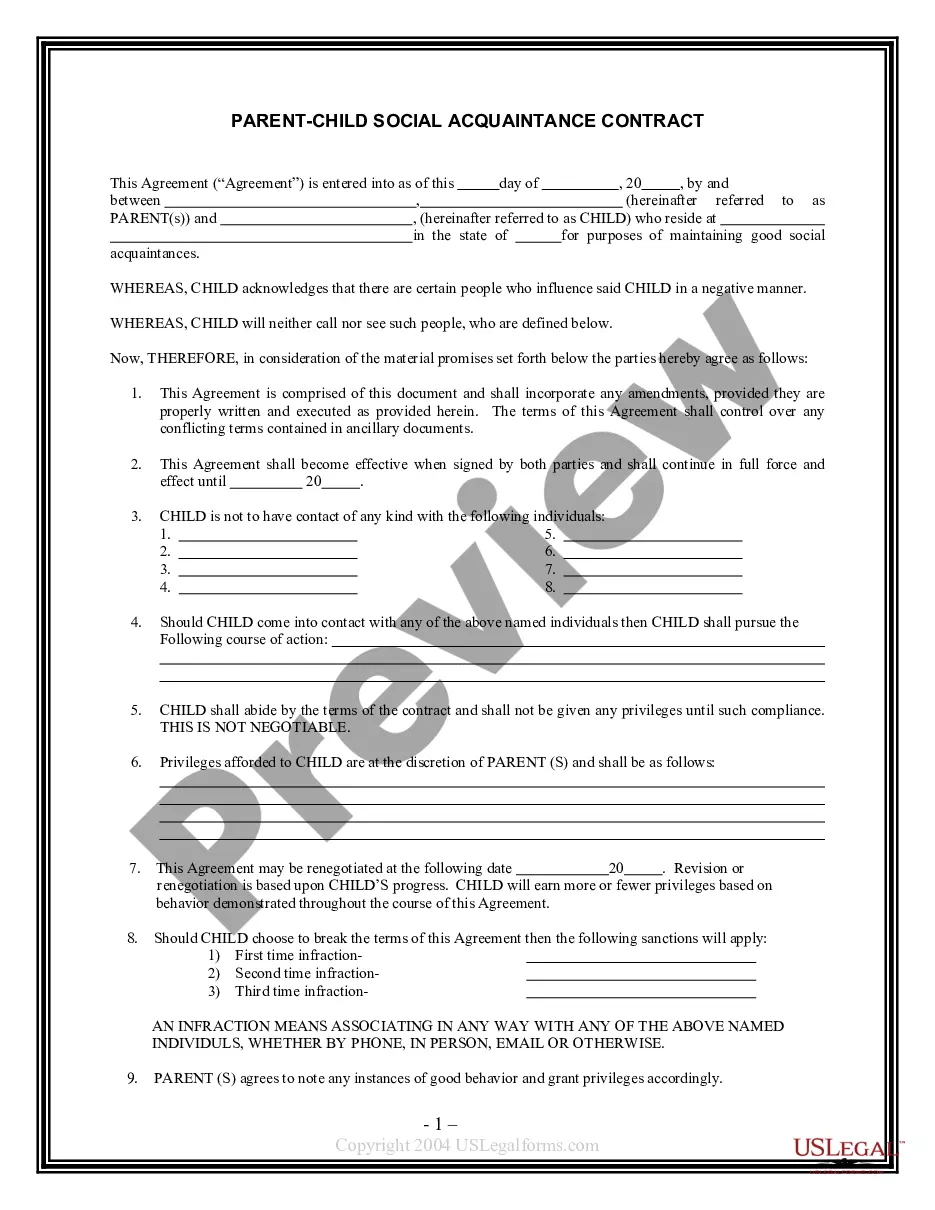
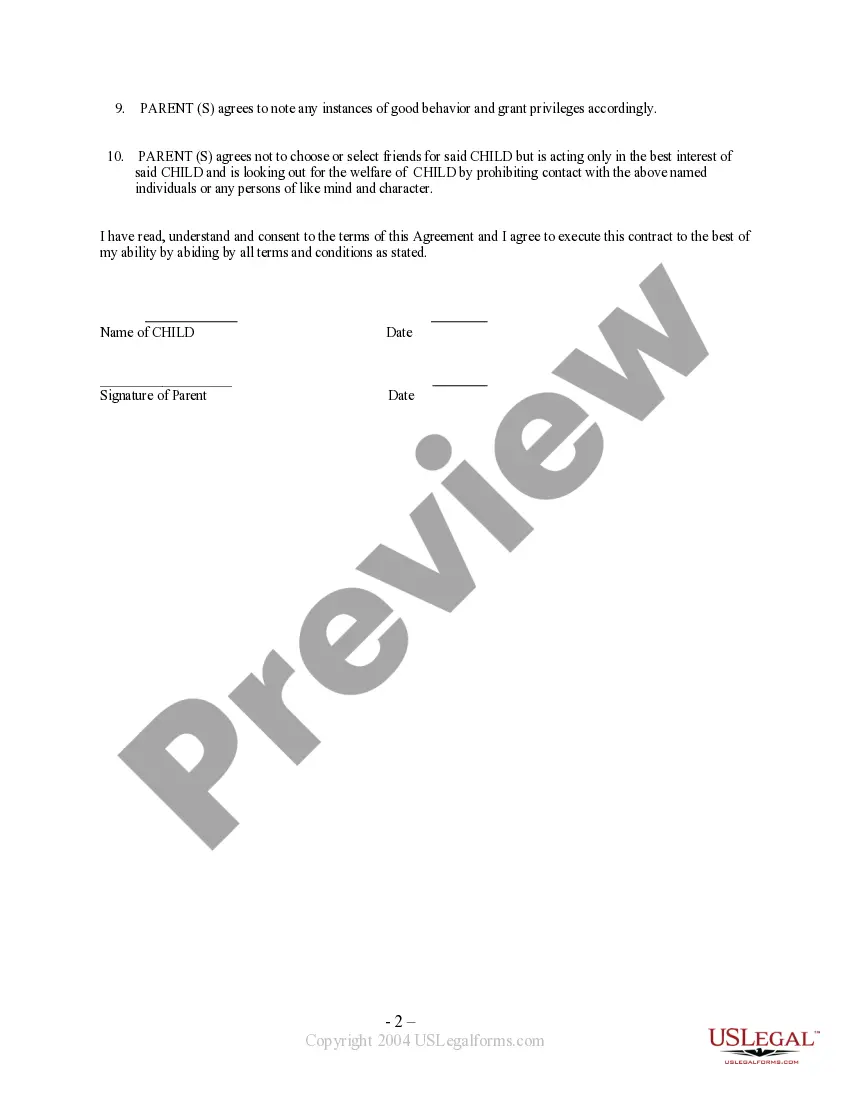
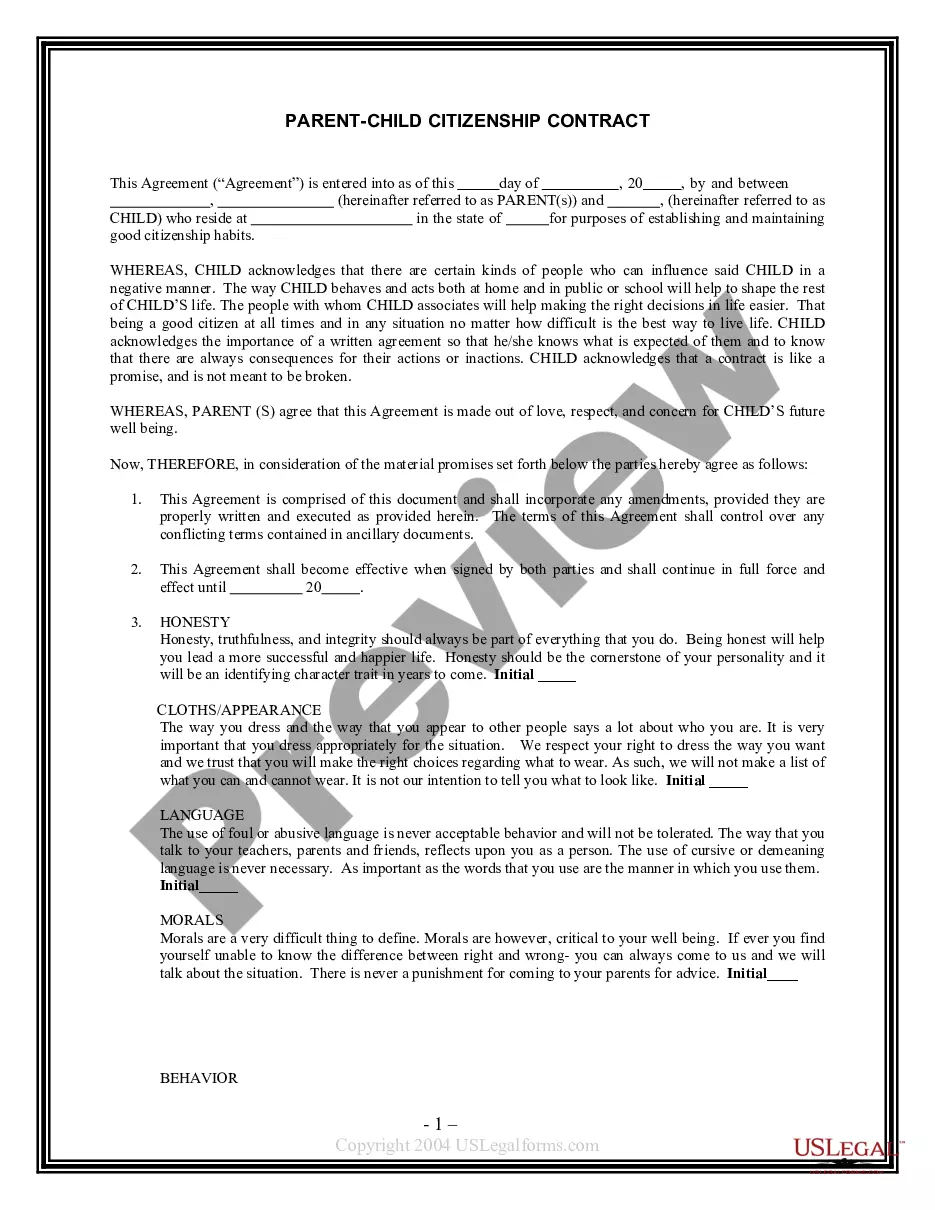
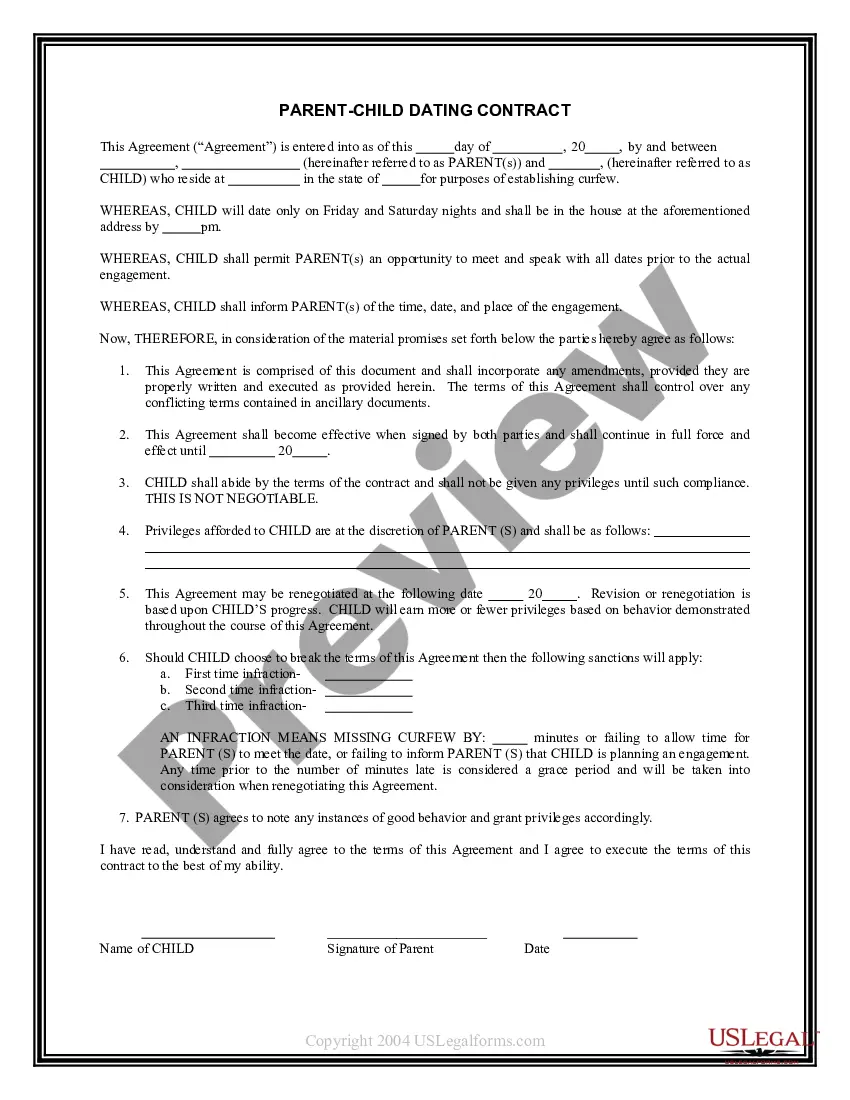
This is a contract between parent(s) and child acknowledging that there are certain people from whom child should refrain from associating. This contract affords privileges for good behavior and for abiding by its terms while listing the repercussions for breaking the contract.
Illinois Parent - Child Social Acquaintance Contract
Category:
State:
Multi-State
Control #:
US-PC09
Format:
Word;
Rich Text
Instant download
Description
Free preview
Get your form ready online
Our built-in tools help you complete, sign, share, and store your documents in one place.
Built-in online Word editor
Make edits, fill in missing information, and update formatting in US Legal Forms—just like you would in MS Word.
Export easily
Download a copy, print it, send it by email, or mail it via USPS—whatever works best for your next step.
E-sign your document
Sign and collect signatures with our SignNow integration. Send to multiple recipients, set reminders, and more. Go Premium to unlock E-Sign.
Notarize online 24/7
If this form requires notarization, complete it online through a secure video call—no need to meet a notary in person or wait for an appointment.
Store your document securely
We protect your documents and personal data by following strict security and privacy standards.

Make edits, fill in missing information, and update formatting in US Legal Forms—just like you would in MS Word.

Download a copy, print it, send it by email, or mail it via USPS—whatever works best for your next step.

Sign and collect signatures with our SignNow integration. Send to multiple recipients, set reminders, and more. Go Premium to unlock E-Sign.

If this form requires notarization, complete it online through a secure video call—no need to meet a notary in person or wait for an appointment.

We protect your documents and personal data by following strict security and privacy standards.
Looking for another form?





How to fill out Parent - Child Social Acquaintance Contract?
Selecting the appropriate legal document template can be a challenge. Obviously, there are numerous formats accessible online, but how do you acquire the legal form you require? Make use of the US Legal Forms site. The service offers a wide range of formats, including the Illinois Parent - Child Social Acquaintance Contract, which you can utilize for business and personal purposes. All the forms are reviewed by experts and comply with federal and state regulations.
If you are already registered, Log In to your account and click the Acquire button to obtain the Illinois Parent - Child Social Acquaintance Contract. Use your account to browse through the legal forms you may have purchased previously. Go to the My documents tab of your account and retrieve another copy of the document you need.
If you are a new user of US Legal Forms, here are simple instructions for you to follow: First, ensure you have chosen the correct form for your city/state. You can review the form using the Preview option and read the form description to confirm it is right for you. If the form does not meet your needs, use the Search field to find the suitable form. Once you are confident the form is adequate, click on the Get now button to obtain the form. Select the pricing plan you prefer and input the necessary information. Create your account and pay for an order using your PayPal account or credit card. Choose the file format and download the legal document template to your device. Finally, complete, modify, print, and sign the obtained Illinois Parent - Child Social Acquaintance Contract.
Overall, US Legal Forms provides a comprehensive resource for accessing legal document templates tailored to meet diverse needs.
- US Legal Forms is the largest repository of legal forms where you can find a variety of document formats.
- Utilize the platform to download properly crafted documents that adhere to state regulations.
- Ensure that the selected form meets your requirements before proceeding.
- Use the preview and description tools for better understanding.
- Pay attention to the pricing plan that suits you best.
- Maintain a record of your downloaded forms in your account.
Form popularity
FAQ
In Illinois, a father may lose parental rights if he is absent for a significant period, typically defined as one year or more without contact or support. This absence can be a factor in legal proceedings regarding parental rights. It is crucial to understand that each case is unique, and various circumstances can influence the outcome. For those navigating these complex situations, an Illinois Parent - Child Social Acquaintance Contract can help clarify roles and responsibilities, ensuring that both parents are protected and informed.
The fictive kin law in Illinois allows individuals who are not related by blood or marriage to establish legal relationships similar to family ties. This law recognizes the importance of social connections in a child’s life, especially in foster care situations. By facilitating these bonds, the Illinois Parent - Child Social Acquaintance Contract helps foster meaningful relationships, ensuring that children maintain connections with important figures in their lives. This can provide emotional stability and support to the child, enhancing their overall well-being.
What is a parenting contract? 25cf A parenting contract is an agreement between a parent or carer and. either the LEA or the governing body of a school. 25cf Your child's school or LEA may offer a parenting contract if your. child is truanting or if they have been excluded from school.
The 17 year old runaways have the following legal options: Contact the local police or shelter to help them return home. The court may grant guardianship but the parents will still have to provide for the child. The child may ask for emancipation in an emancipation proceeding where they get to become adults.
Foster Parents and relative caregivers who use social media sites can post photos and videos that include children and youth in foster care those sites, if the following conditions are met: The children are not identified by name. The children are not identified as foster children.
Five Building Blocks They are: 2022 Placement Decision Making. Parent-Child Visitation. Intensive Services. Resource Parent/Birth Parent Collaboration.
Emancipation is for mature minors ages 16 and 17. It allows them to legally live away from their parents and, for the most part, be treated like an adult.
A special emancipation order can be issued for minors between the ages of 16 and 18. This order allows minors to live independently from their parents.
Foster families and youth in care are no exception. A foster family can post images of the child in their care on a social networking site, provided the child's status as a youth in care is not disclosed.
As noted in the Resource Family Handbook, Children in care cannot be photographed for newspaper articles, Facebook or any publication where their identities would become known to the public. It is the policy of the Department of Children and Families (DCF) that you do not post any pictures of a child in care online.