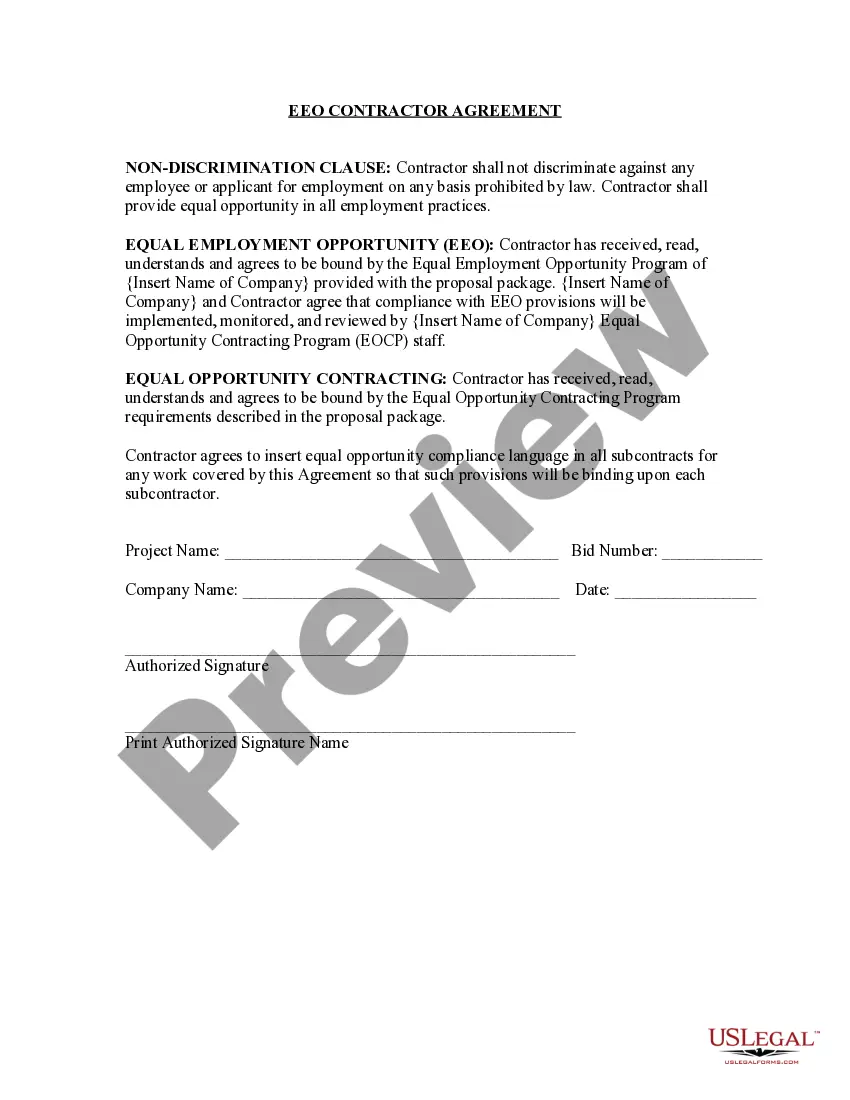
Illinois EEO Contractor Agreement
Description
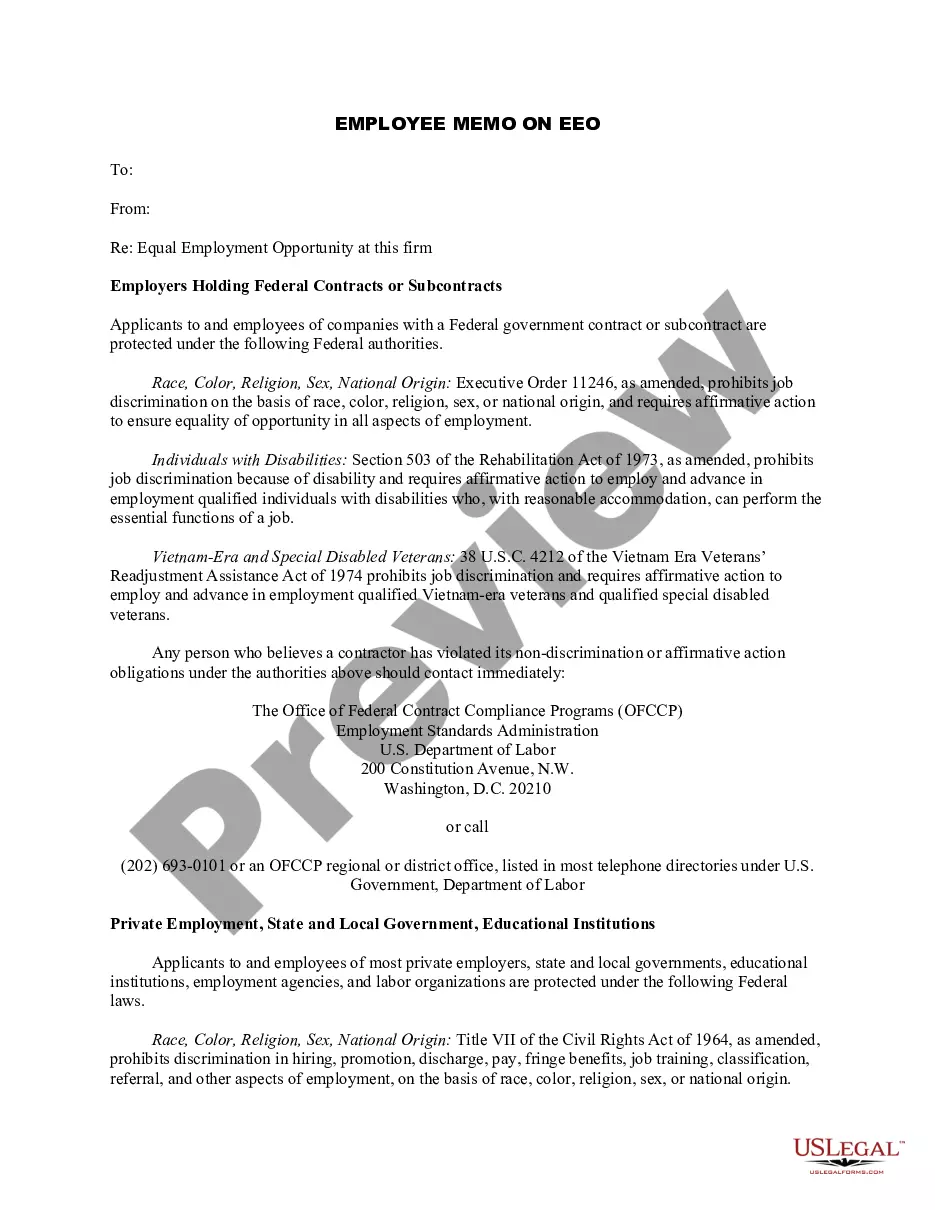
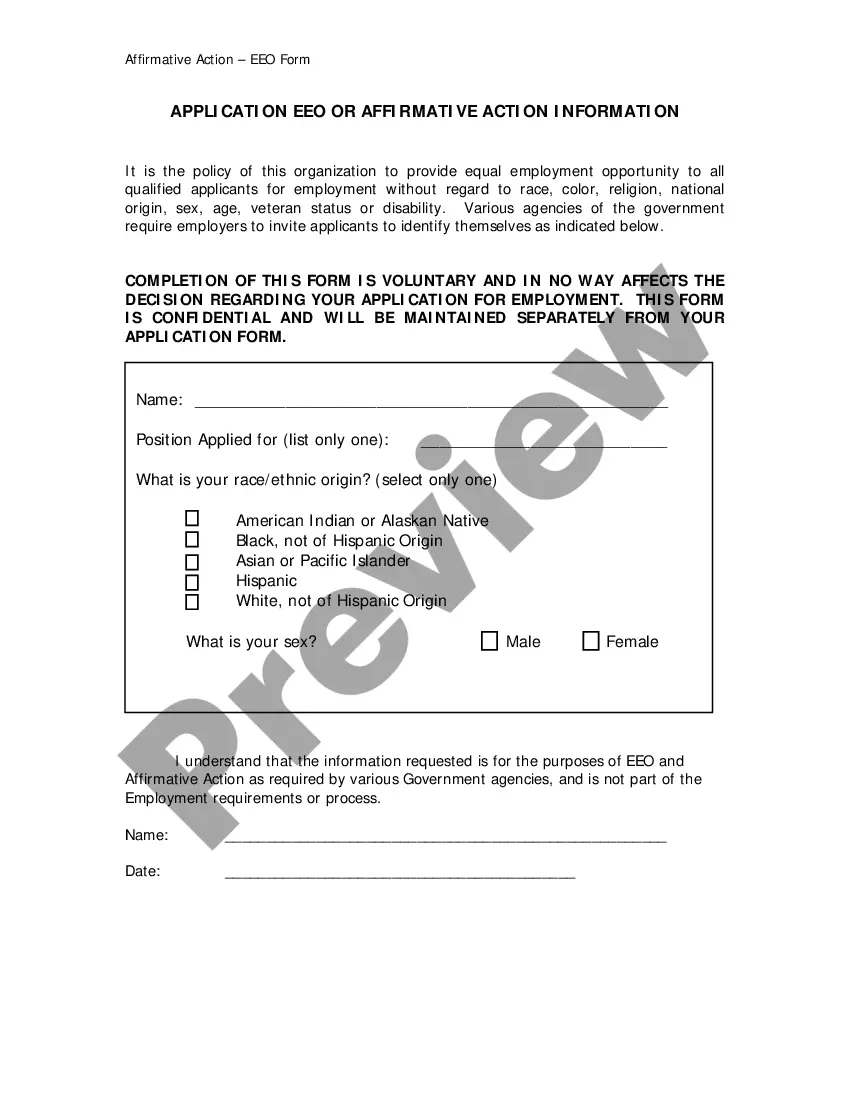
Get your form ready online
Our built-in tools help you complete, sign, share, and store your documents in one place.
Make edits, fill in missing information, and update formatting in US Legal Forms—just like you would in MS Word.
Download a copy, print it, send it by email, or mail it via USPS—whatever works best for your next step.
Sign and collect signatures with our SignNow integration. Send to multiple recipients, set reminders, and more. Go Premium to unlock E-Sign.
If this form requires notarization, complete it online through a secure video call—no need to meet a notary in person or wait for an appointment.
We protect your documents and personal data by following strict security and privacy standards.

Make edits, fill in missing information, and update formatting in US Legal Forms—just like you would in MS Word.

Download a copy, print it, send it by email, or mail it via USPS—whatever works best for your next step.

Sign and collect signatures with our SignNow integration. Send to multiple recipients, set reminders, and more. Go Premium to unlock E-Sign.

If this form requires notarization, complete it online through a secure video call—no need to meet a notary in person or wait for an appointment.

We protect your documents and personal data by following strict security and privacy standards.
Looking for another form?







How to fill out EEO Contractor Agreement?
Selecting the ideal legal document template can be quite a challenge.
Of course, there are numerous templates accessible online, but how do you find the legal form you need.
Utilize the US Legal Forms website. The service offers thousands of templates, including the Illinois EEO Contractor Agreement, which you can utilize for business and personal purposes.
You can browse the form using the Review button and read the form summary to ensure it is indeed the right one for you.
- All of the forms are reviewed by professionals and meet state and federal standards.
- If you are already registered, Log In to your account and click the Download button to get the Illinois EEO Contractor Agreement.
- Use your account to search through the legal forms you have purchased previously.
- Visit the My documents tab in your account to obtain another copy of the document you need.
- If you are a new user of US Legal Forms, here are easy steps for you to follow.
- First, make sure you have selected the correct form for your city/region.
Form popularity
FAQ
What Is an Equal Opportunity Employer Statement? The Equal Employment Opportunity Commission requires that every American employer include an EEO in their job postings. You must include the words (Company X) is an Equal Opportunity Employer followed by a policy statement that details non-discriminatory practices.
30 each employer with more than 100 employees must file an EEO-1 form. It's illegal for the employers to make false statements, and this is a serious crime. Employers can get the information required on the form by visual surveys or by maintaining records.
Employers are required to post notices describing the Federal laws prohibiting job discrimination based on race, color, religion, sex (including pregnancy), national origin, age (40 or older), disability or genetic information.
The purpose of an EEO (Equal Employment Opportunity) statement is to comply with EEOC (Equal Employment Opportunity Commission) law but there's also a marketing aspect to it. The words in your EEO statement (which often appear in all your job postings) are also words that a candidate will measure you by.
Do You Have to Answer EEO Questions? No, job applicants do not have to answer EEO questions on job applications, but they must decline to answer if they are not willing to take the survey. More so, the data from the questions only becomes relevant if the person accepts the job.
State and local governments, public primary and secondary school systems, institutions of higher education, American Indian or Alaska Native tribes, and tax-exempt private membership clubs other than labor organizations are exempt from the EEO-1 component report.
How do you write an equal opportunity employer statement?Be specific.Make sure that your statement emphasizes workplace diversity.Mention which employment practices your EOE statement applies to.State that you make hiring decisions based on merit.Link to your EEO policy.
Writing an EEO statement Besides the EEO-1 report, EEOC makes it mandatory for some companies to include an equal opportunity employer statement in their job ads. This can be as simple as one sentence where you declare that you're an equal opportunity employer and you follow non-discriminatory practices.
An Employment Information Report (EEO1), also known as a Standard Form 100, is filed annually with the EEO-1 Joint Reporting Committee and provides a demographic breakdown of the employer's work force by race and gender.
Under federal law and EEOC regulations, the penalty for making a willfully false statement on an EEO-1 Report is a fine, imprisonment of up to 5 years, or both (29 C.F.R.