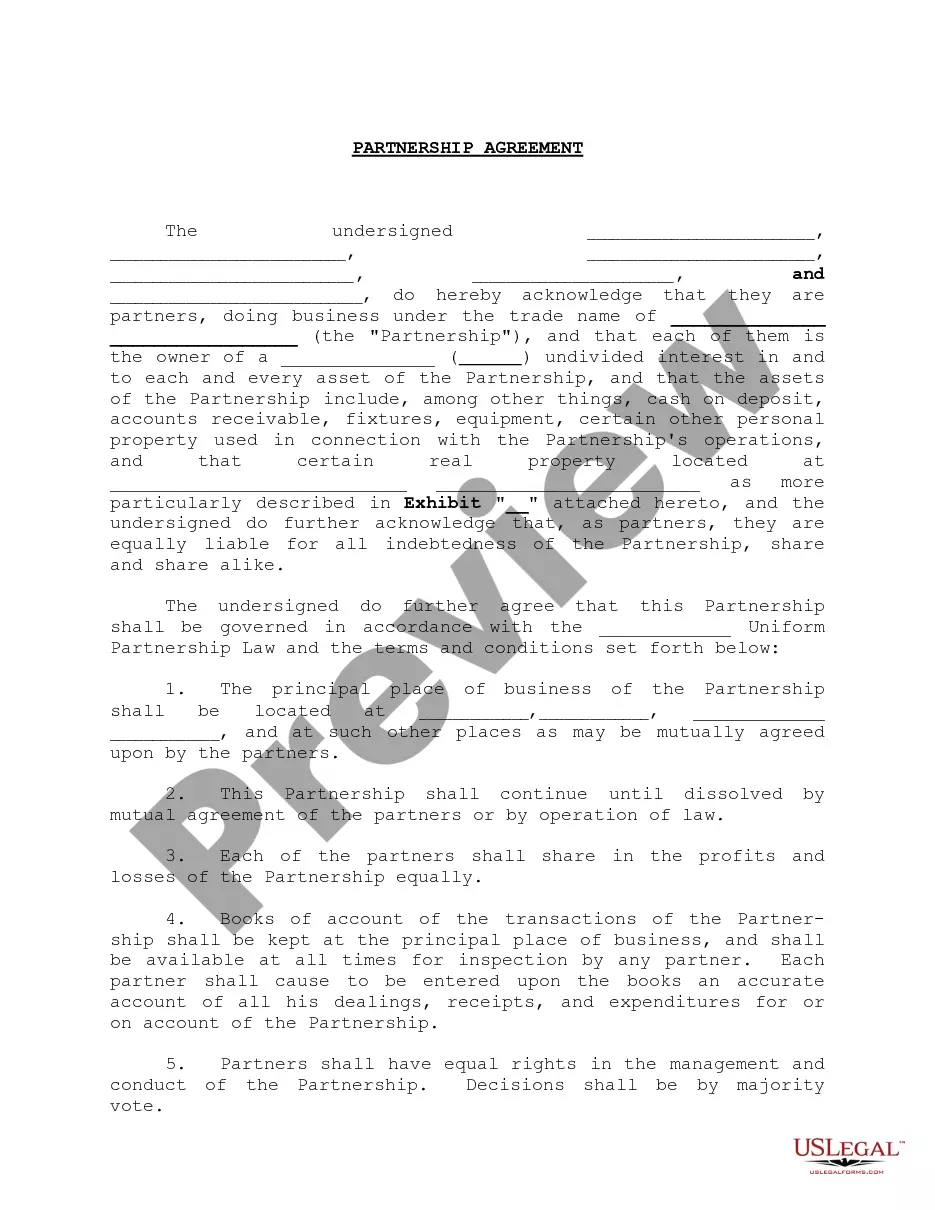
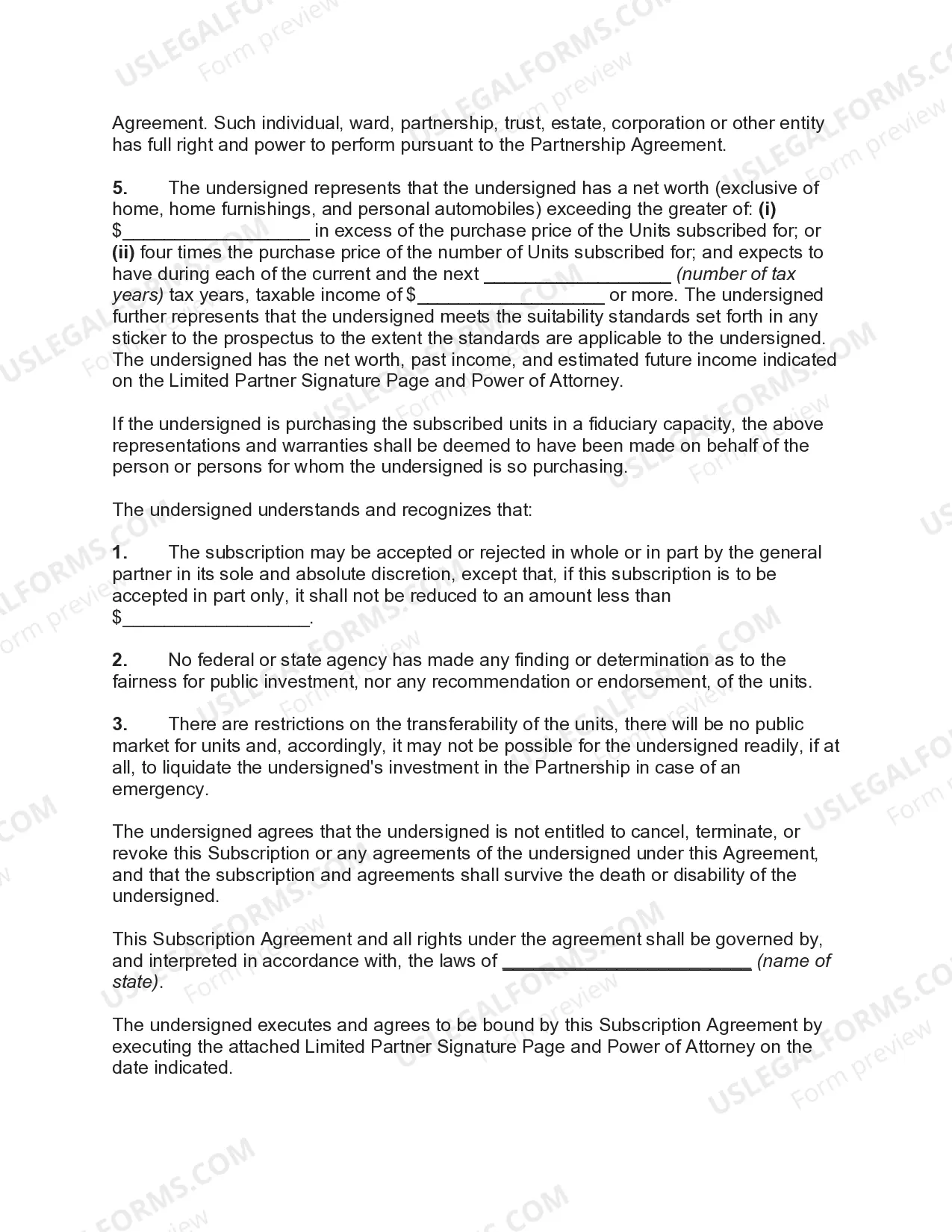
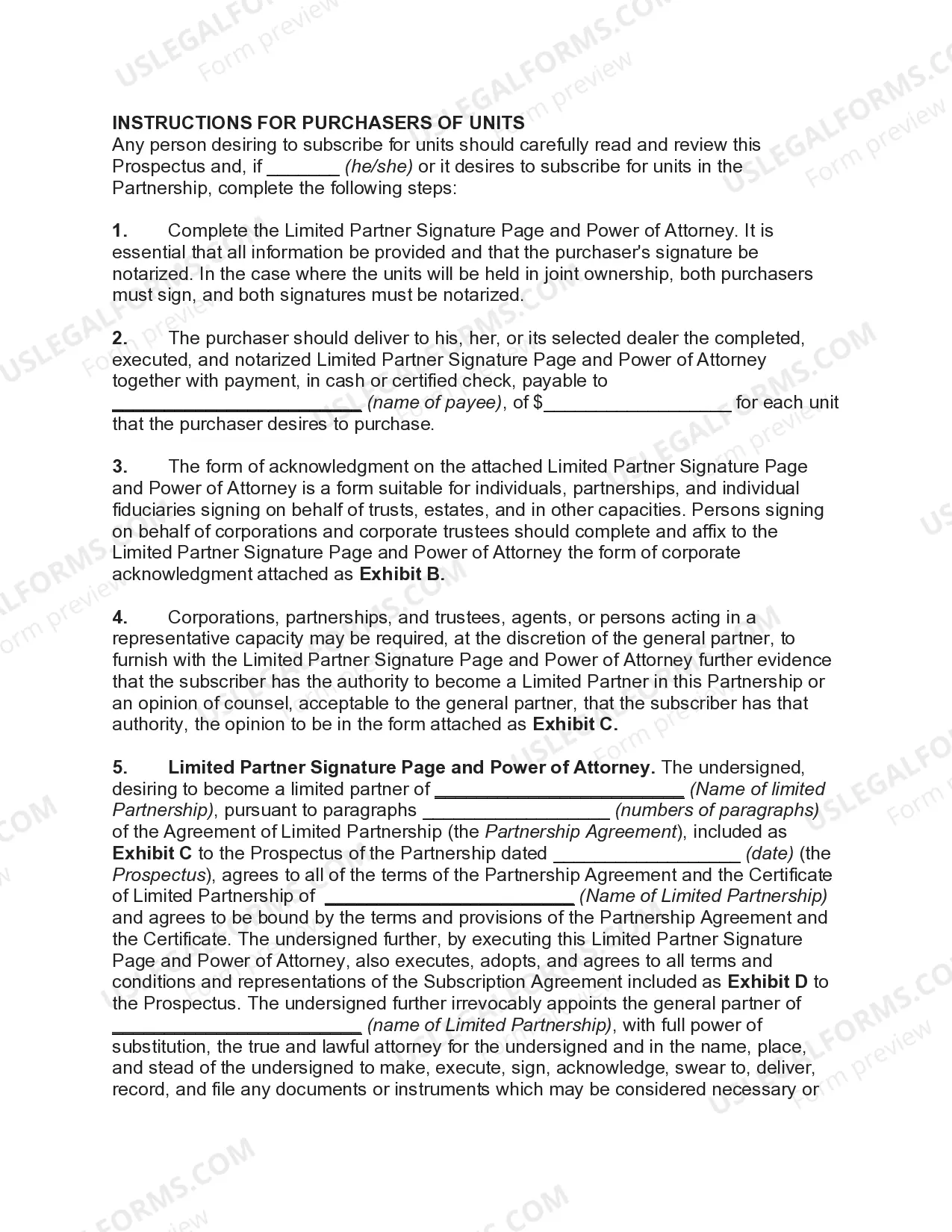
Idaho Subscription Agreement regarding Limited Partnership
Description
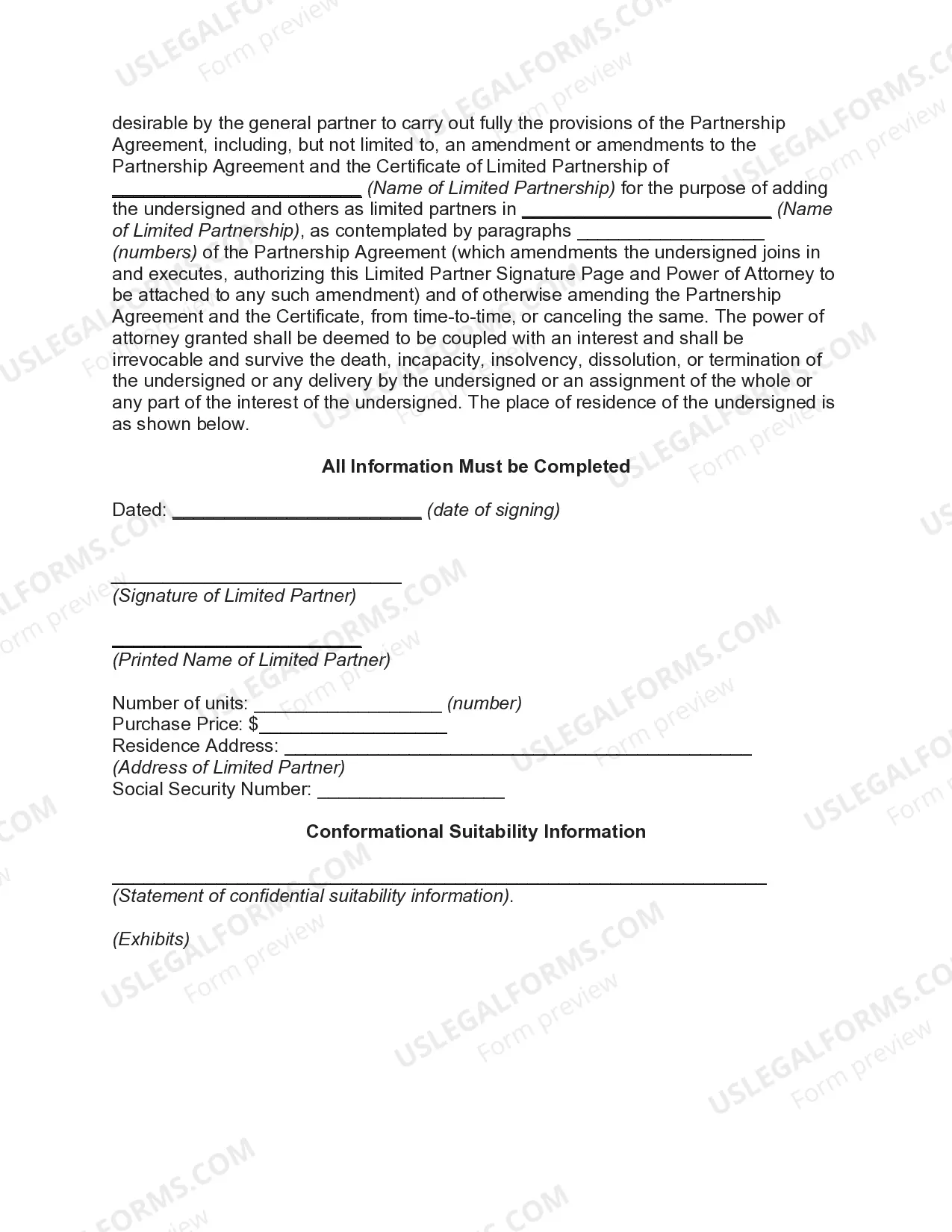
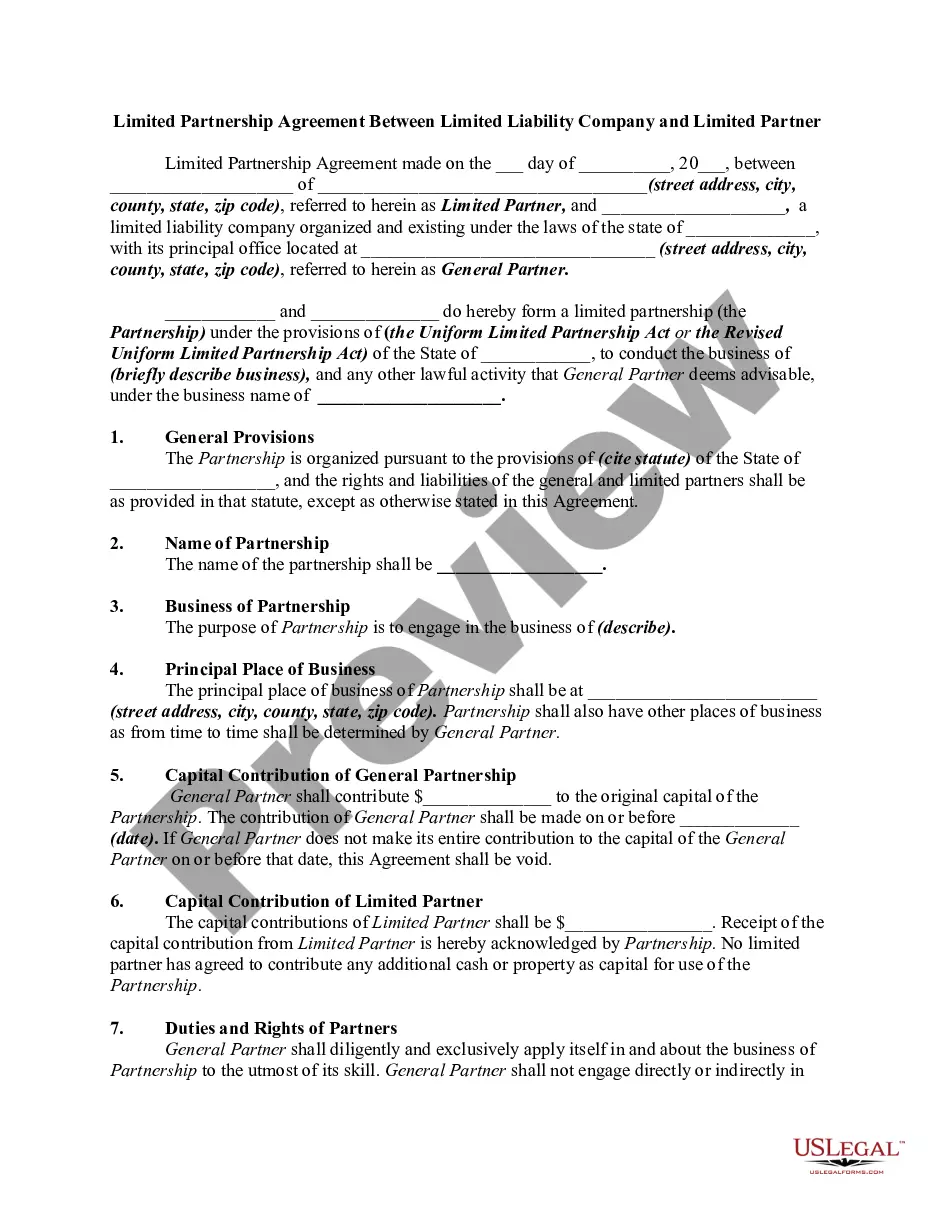
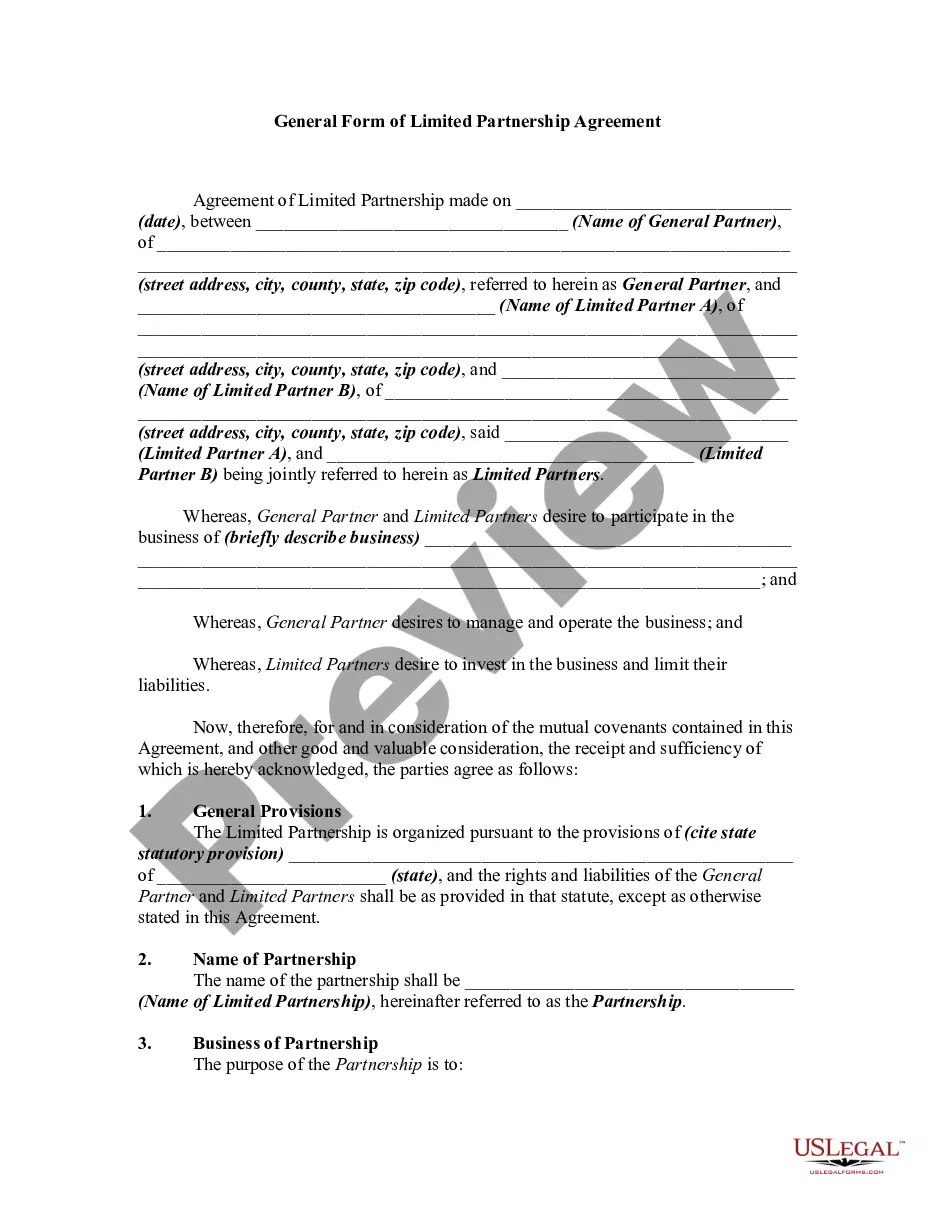
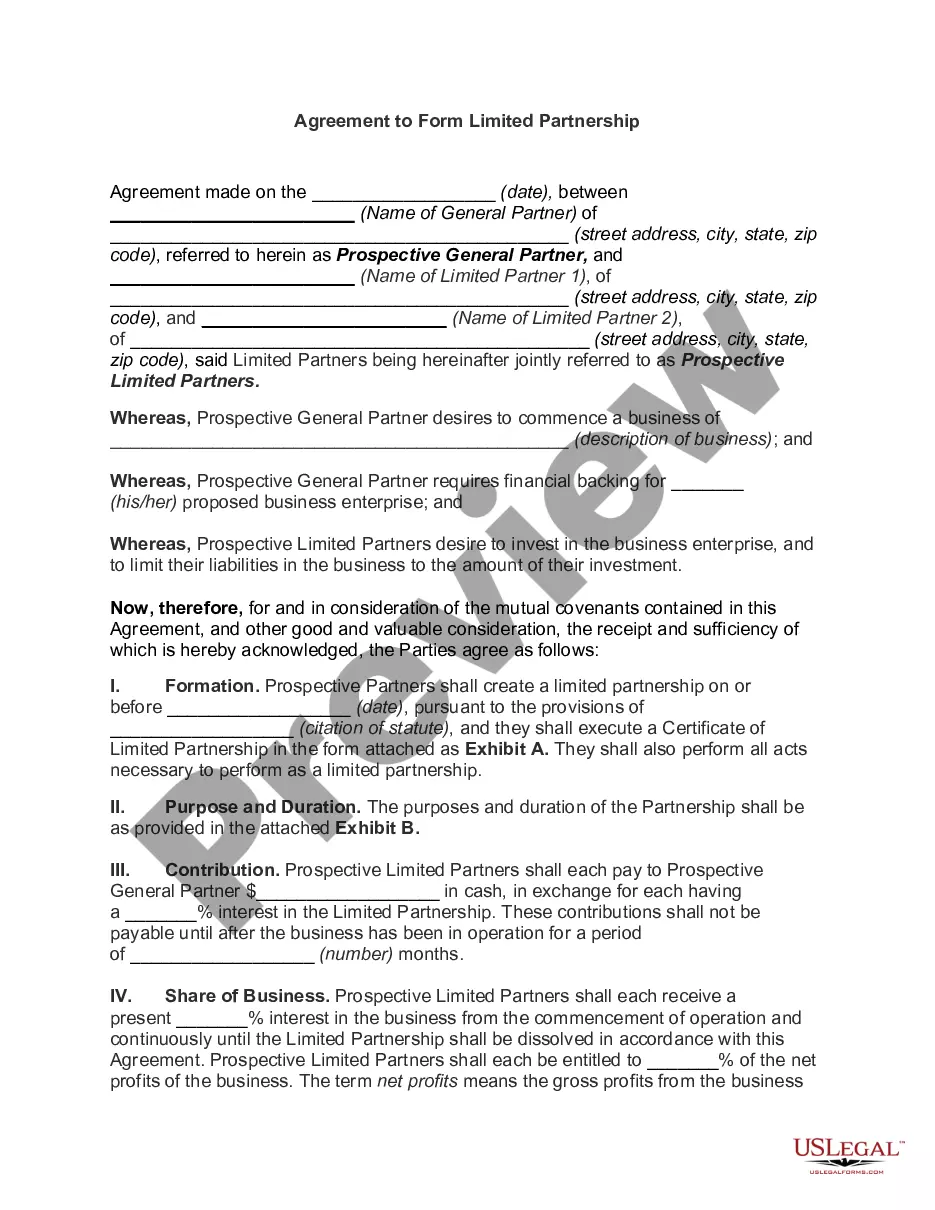
Get your form ready online
Our built-in tools help you complete, sign, share, and store your documents in one place.
Make edits, fill in missing information, and update formatting in US Legal Forms—just like you would in MS Word.
Download a copy, print it, send it by email, or mail it via USPS—whatever works best for your next step.
Sign and collect signatures with our SignNow integration. Send to multiple recipients, set reminders, and more. Go Premium to unlock E-Sign.
If this form requires notarization, complete it online through a secure video call—no need to meet a notary in person or wait for an appointment.
We protect your documents and personal data by following strict security and privacy standards.

Make edits, fill in missing information, and update formatting in US Legal Forms—just like you would in MS Word.

Download a copy, print it, send it by email, or mail it via USPS—whatever works best for your next step.

Sign and collect signatures with our SignNow integration. Send to multiple recipients, set reminders, and more. Go Premium to unlock E-Sign.

If this form requires notarization, complete it online through a secure video call—no need to meet a notary in person or wait for an appointment.

We protect your documents and personal data by following strict security and privacy standards.
Looking for another form?
How to fill out Subscription Agreement Regarding Limited Partnership?
US Legal Forms - one of the largest collections of authentic forms in the USA - provides a wide range of valid document templates that you can download or print.
By using the website, you can access thousands of forms for corporate and personal purposes, categorized by types, states, or keywords. You can find the latest forms like the Idaho Subscription Agreement for Limited Partnership within moments.
If you already possess a subscription, Log In to download the Idaho Subscription Agreement for Limited Partnership from your US Legal Forms library. The Get option will appear on all forms you view. You have access to all previously downloaded forms under the My documents tab in your account.
Complete the purchase. Use your credit card or PayPal account to finalize the transaction.
Choose the format and download the form to your device. Make edits. Fill out, modify, and print, and sign the downloaded Idaho Subscription Agreement for Limited Partnership. Every template you include in your account has no expiration date and is yours permanently. Thus, if you want to download or print another copy, simply visit the My documents section and click on the form you need. Access the Idaho Subscription Agreement for Limited Partnership with US Legal Forms, the most comprehensive library of authentic document templates. Utilize a vast array of professional and state-specific templates that fulfill your business or personal needs and requirements.
- If you wish to use US Legal Forms for the first time, here are simple steps to get started.
- Ensure you have selected the appropriate form for your city/region.
- Click the Preview button to check the form's content.
- Review the description of the form to make sure you have chosen the correct one.
- If the form does not meet your needs, utilize the Search area at the top of the screen to find one that does.
- If you are satisfied with the form, confirm your choice by clicking the Purchase now button.
- Next, choose the pricing plan you desire and provide your details to create an account.
Form popularity
FAQ
Limited partnerships offer unique tax benefits, as income is typically passed through to partners, avoiding double taxation at the entity level. This structure allows for flexible profit sharing among partners. By utilizing an Idaho Subscription Agreement regarding Limited Partnership, you can strategically outline these benefits in your organization’s financial plan.
An LP is defined as having limited partners and a general partner, which has unlimited liability. LPs are pass-through entities that offer little to no reporting requirements. There are three types of partnerships: limited partnership, general partnership, and limited liability partnership.
The limited partnership is a specialized form of partnership. The purpose of the limited partnership is to allow individuals to organize into an entity form that allows the flexibility of a general partnership while allowing for special rights, duties, and protections for limited partners.
An Unincorporated Business Entity means a Limited Partnership (LP), Limited Liability Partnership (LLP), Limited Liability Limited Partnership (LLLP), Limited Liability Company (LLC), Business or other Trust Entity (TE), or other business entity established and maintained under State law that is not incorporated under
Your Limited Partnership Agreement can include details like: the name, address, and purpose of forming the partnership; whether limited partners have any voting rights regarding the day-to-day business decisions; how decisions will be made (by unanimous vote, majority vote, or majority vote based on percent ownership);
A limited partnership agreement establishes the final type of partnership from the above list. A limited partnership is a partnership between a general partner and a limited partner. The general partner oversees and runs the business, and has unlimited liability for any business debts.
Unlike corporations, partnerships don't have incorporation and their rights are based on agreements as well as legal instruments.
If you're wondering, can a partnership be incorporated, the answer is yes. You can incorporate a general partnership and form a business entity with limited liability.
Real estate investors, for example, might use a limited partnership. Another common use of a limited partnership is in a family business, called a family limited partnership. Members of a family may pool their money, designate a general partner, and watch their investments grow.
A limited partnership is a pass-through entity, which means the partnership itself doesn't pay taxes in the way a corporation would. The partnership fills out Form 1065 as an informational return and provides a Schedule K-1 to each partner with details of the partner's share of the company's income and losses.