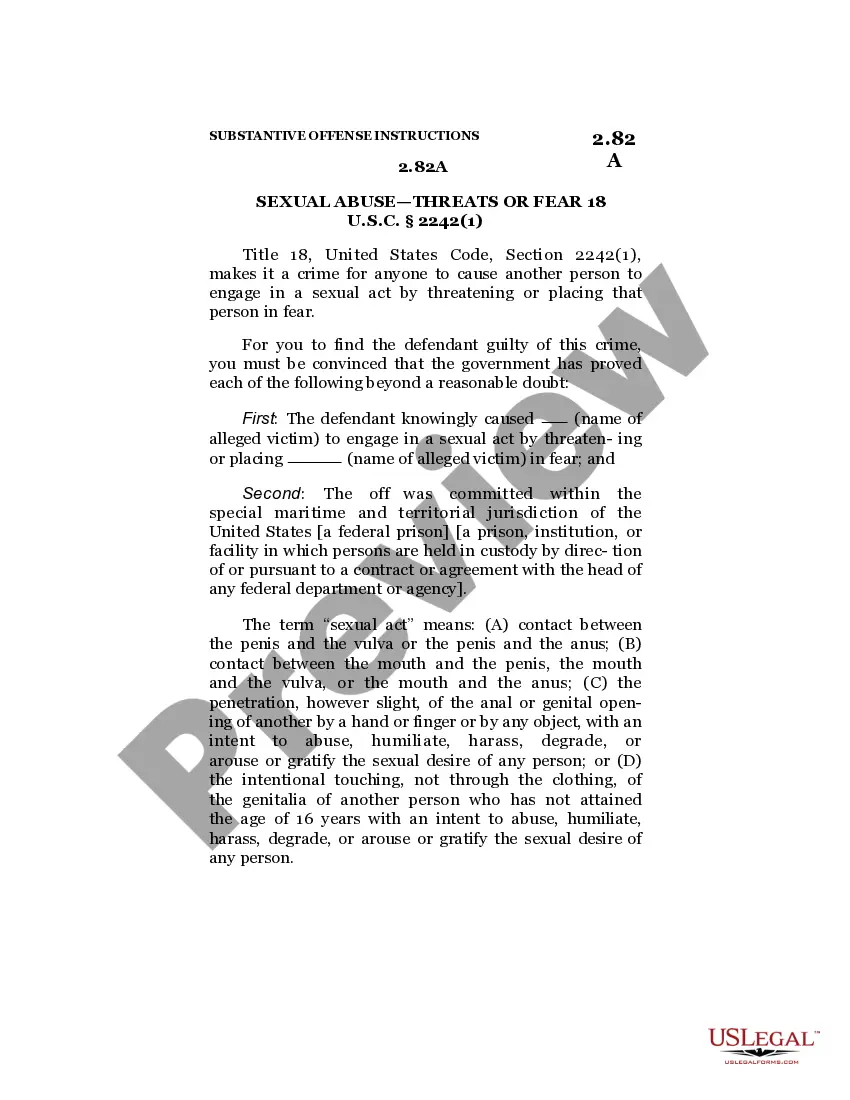
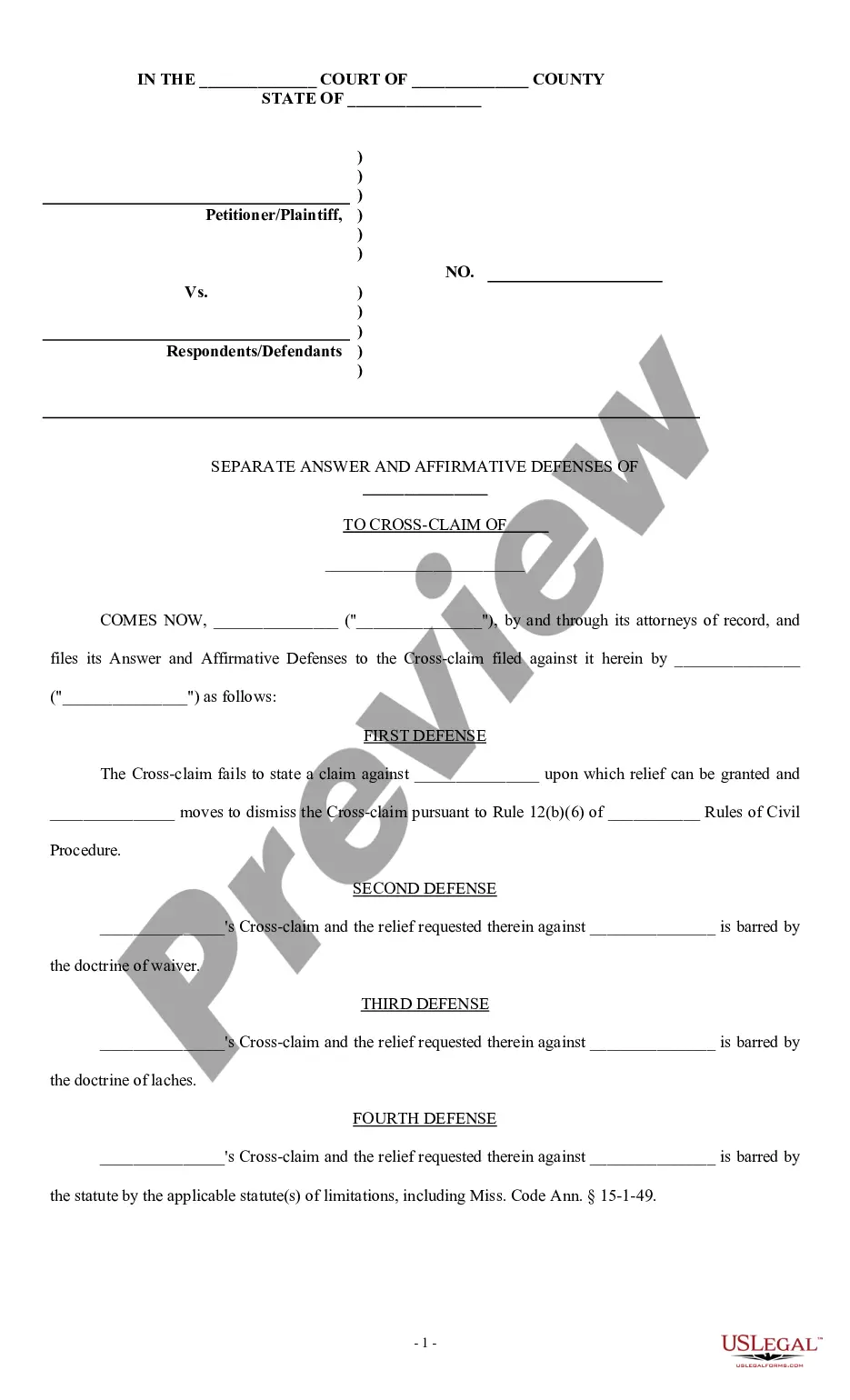
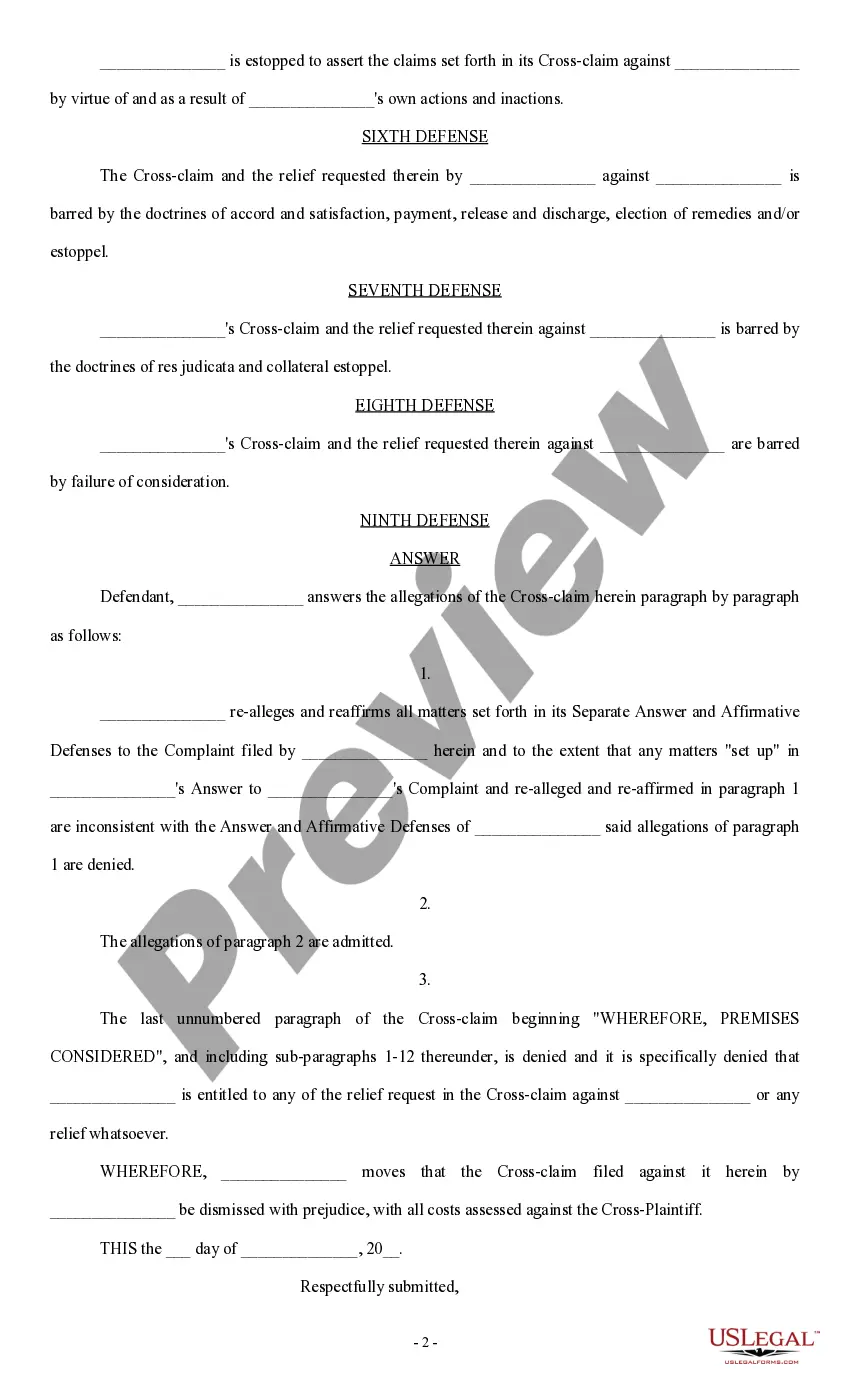
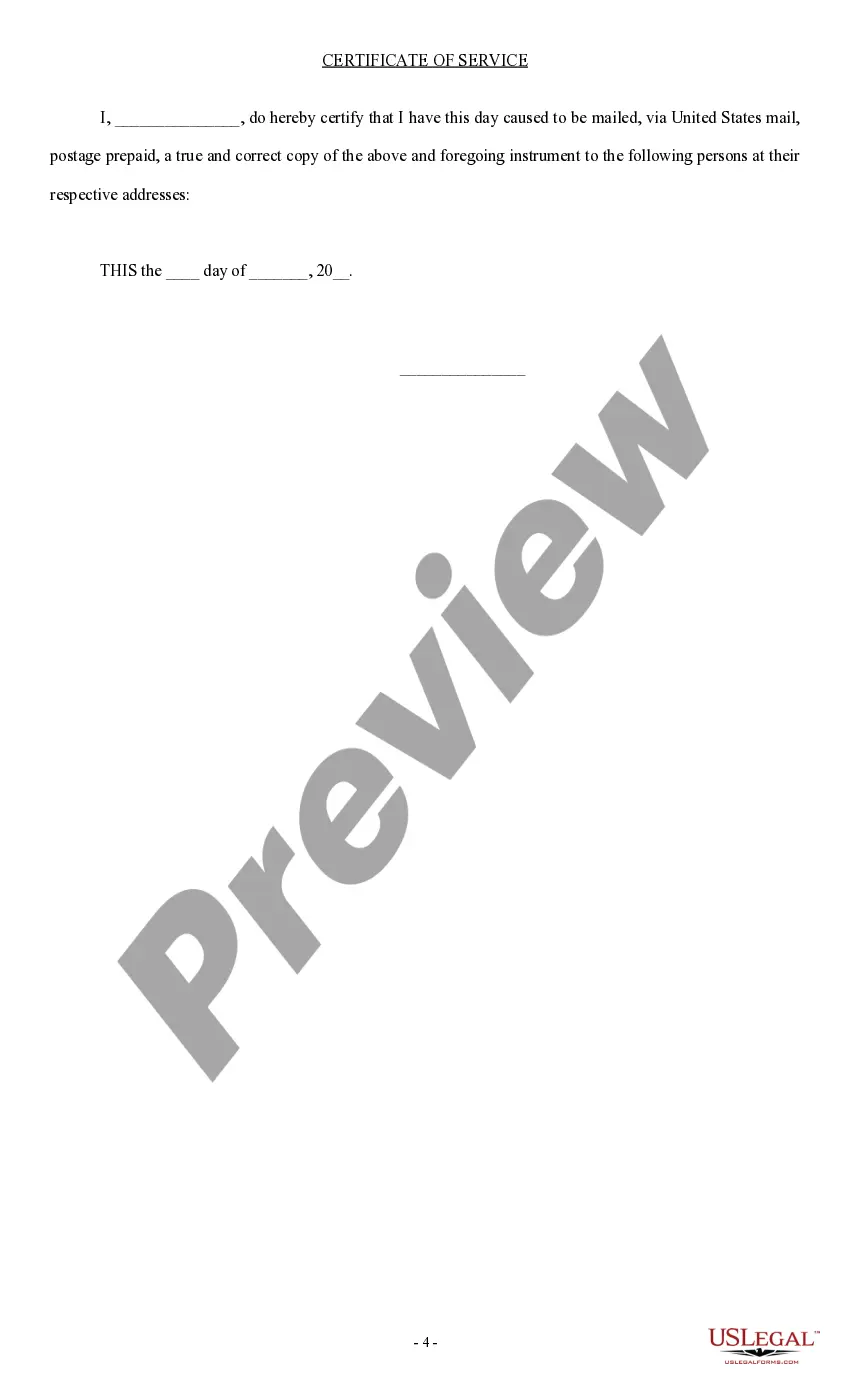
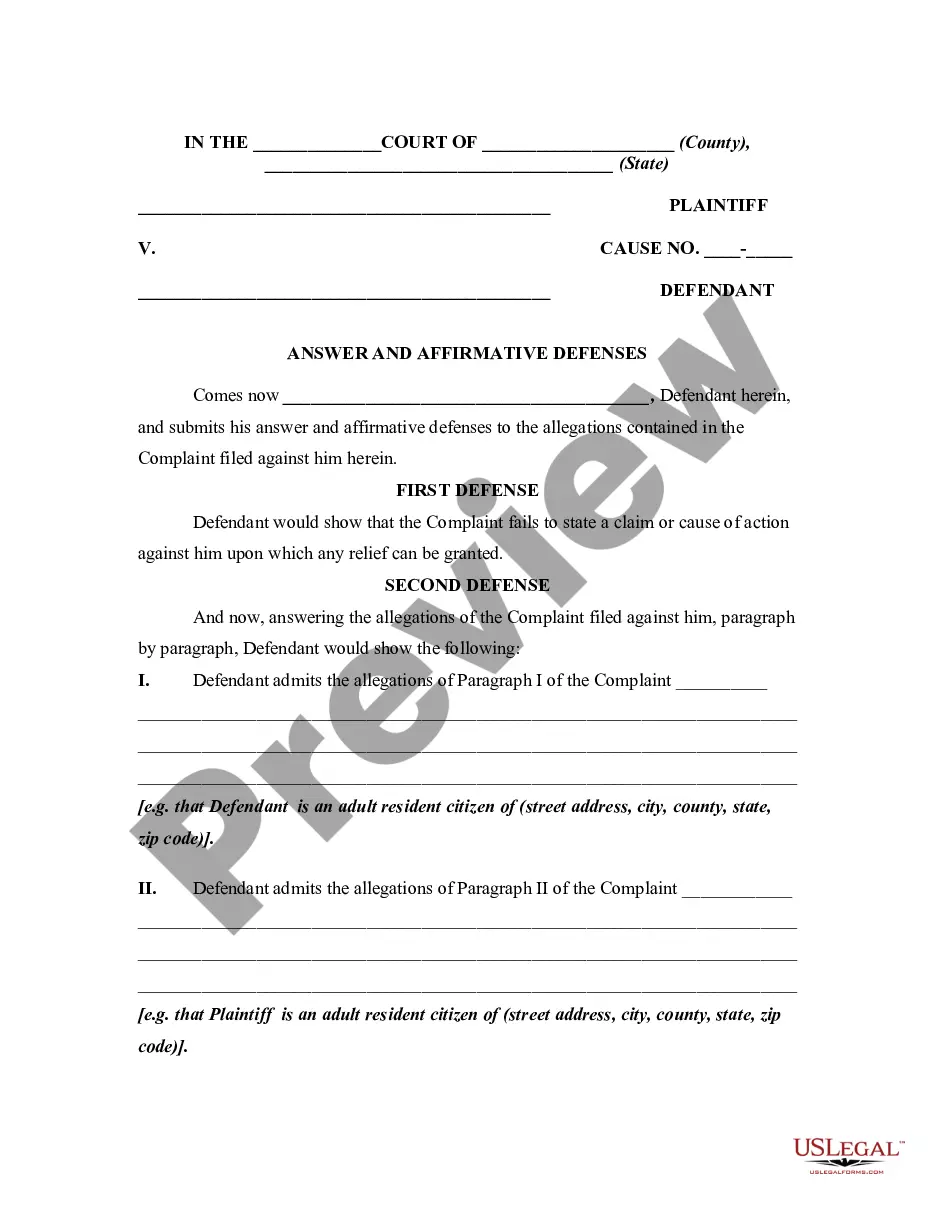
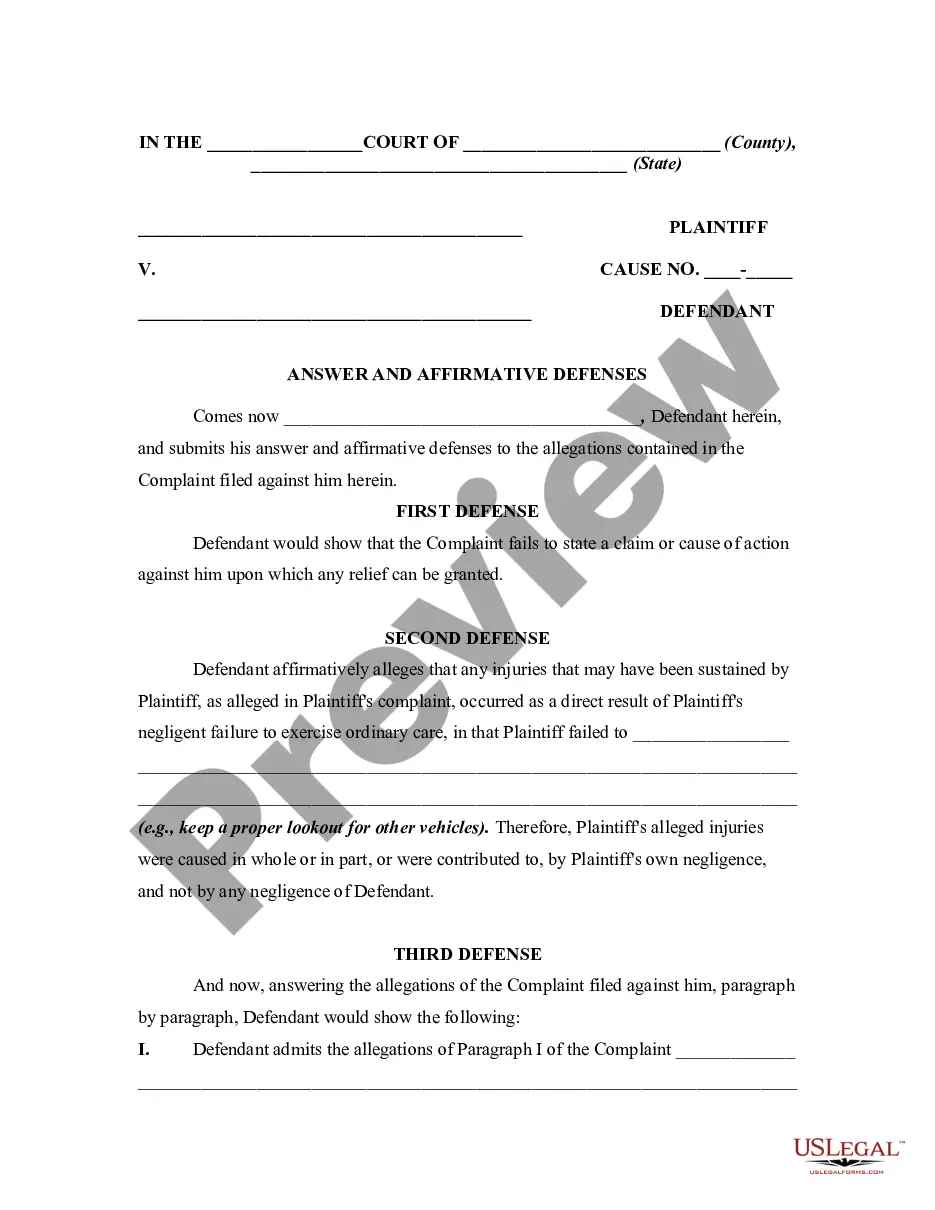
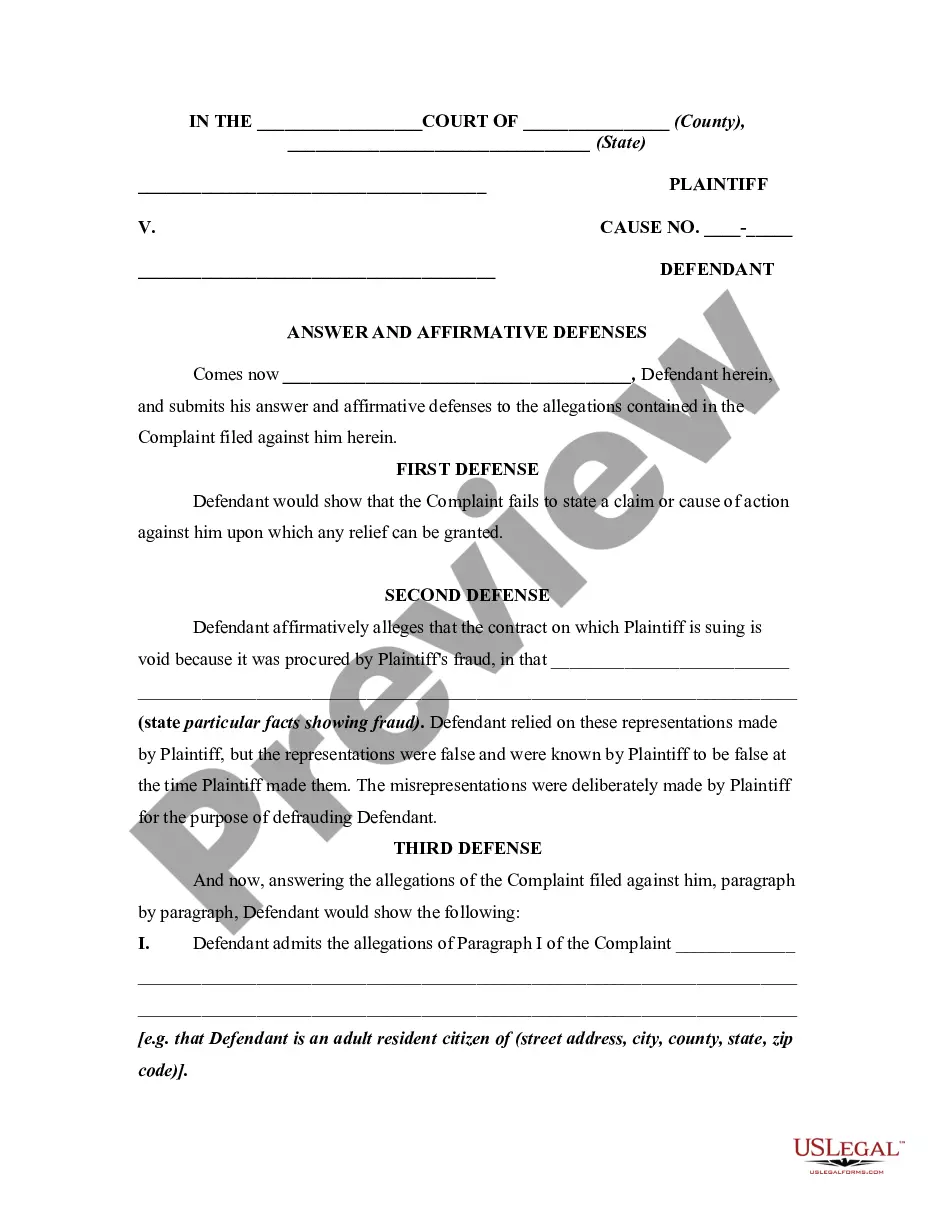
This form is a Separate Answer and Affirmative Defense to a Cross-Claim. The form provides that the cross-claim fails to state a claim upon which relief can be granted. Therefore, it is requested that the cross-claim be dismissed with prejudice, with all costs assessed against the cross-plaintiff.
Idaho Separate Answer and Affirmative Defenses to Crossclaim
Instant download
Description
Free preview
Get your form ready online
Our built-in tools help you complete, sign, share, and store your documents in one place.
Built-in online Word editor
Make edits, fill in missing information, and update formatting in US Legal Forms—just like you would in MS Word.
Export easily
Download a copy, print it, send it by email, or mail it via USPS—whatever works best for your next step.
E-sign your document
Sign and collect signatures with our SignNow integration. Send to multiple recipients, set reminders, and more. Go Premium to unlock E-Sign.
Notarize online 24/7
If this form requires notarization, complete it online through a secure video call—no need to meet a notary in person or wait for an appointment.
Store your document securely
We protect your documents and personal data by following strict security and privacy standards.

Make edits, fill in missing information, and update formatting in US Legal Forms—just like you would in MS Word.

Download a copy, print it, send it by email, or mail it via USPS—whatever works best for your next step.

Sign and collect signatures with our SignNow integration. Send to multiple recipients, set reminders, and more. Go Premium to unlock E-Sign.

If this form requires notarization, complete it online through a secure video call—no need to meet a notary in person or wait for an appointment.

We protect your documents and personal data by following strict security and privacy standards.
Looking for another form?
How to fill out Separate Answer And Affirmative Defenses To Crossclaim?
US Legal Forms - one of the largest collections of legal documents in the United States - offers a variety of legal form templates that you can download or print. By using the website, you can find thousands of forms for business and personal use, organized by categories, states, or keywords. You can access the latest versions of forms such as the Idaho Separate Answer and Affirmative Defenses to Crossclaim within moments.
If you already hold a monthly subscription, Log In and retrieve the Idaho Separate Answer and Affirmative Defenses to Crossclaim from your US Legal Forms library. The Download button will appear on every form you view. You can access all previously downloaded forms within the My documents section of your account.
If you wish to use US Legal Forms for the first time, here are some simple steps to help you get started: Ensure you have selected the correct form for your city/state. Click the Review button to examine the form's content. Check the form summary to confirm you have selected the correct one. If the form doesn’t meet your requirements, utilize the Search area at the top of the screen to find one that does. Once you are satisfied with the form, confirm your choice by clicking the Get now button. Then, choose the pricing plan you prefer and provide your details to register for an account. Process the transaction. Use your credit card or PayPal account to complete the transaction. Select the file format and download the form to your device. Make changes. Fill out, modify, print, and sign the downloaded Idaho Separate Answer and Affirmative Defenses to Crossclaim. Every template you added to your account has no expiration date and is yours permanently. Therefore, if you want to download or print another copy, simply navigate to the My documents section and click on the form you need.
- Access the Idaho Separate Answer and Affirmative Defenses to Crossclaim with US Legal Forms, the most extensive collection of legal document templates.
- Utilize thousands of professional and state-specific templates that cater to your business or personal needs and requirements.
Form popularity
FAQ
Affirmative defense?Examples On [Date], after making the contract and the alleged breach, and before this action was commenced, defendant paid to the plaintiff the sum of [specify amount], which was accepted by the plaintiff in full satisfaction and discharge of the damages claimed in the petition.
Self-defense, entrapment, insanity, necessity, and respondeat superior are some examples of affirmative defenses. Under the Federal Rules of Civil Procedure Rule 56, any party may make a motion for summary judgment on an affirmative defense.
(1) Minutes of any hearing or matter heard by telephone or video teleconference must be prepared and filed in the action. (2) The hearing or matter to be audio recorded electronically with the recording to be made, retained and erased as the court may direct.
A party opposing the giving of testimony by video teleconference must give the court and opposing party written notification of objection or affirmative consent at least 14 days before the proceeding date.
"A court may grant a motion to dismiss for failure to state a claim under Rule 12(b)(6) only when it appears beyond doubt that the plaintiff can prove no set of facts in support of the claim which would entitle the plaintiff to relief." Harper v. Harper, 122 Idaho 535, 536, 835 P.
Lists the following affirmative defenses: and satisfaction, arbitration and award, assumption of risk, contributory or comparative negligence, discharge in bankruptcy, duress, estoppel, failure of consideration, fraud, illegality, injury by fellow servant, laches, license, payment, release, res judicata, statute ...