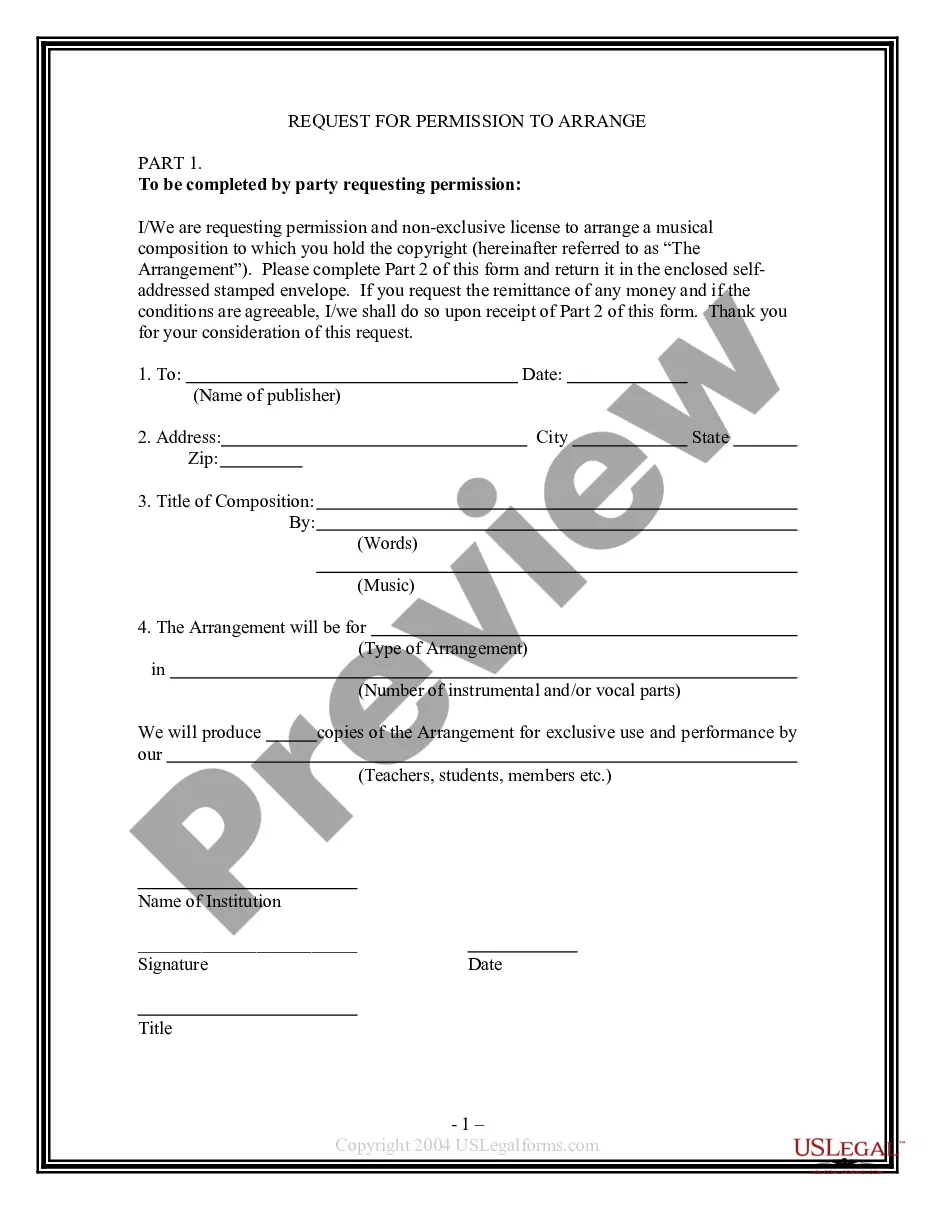
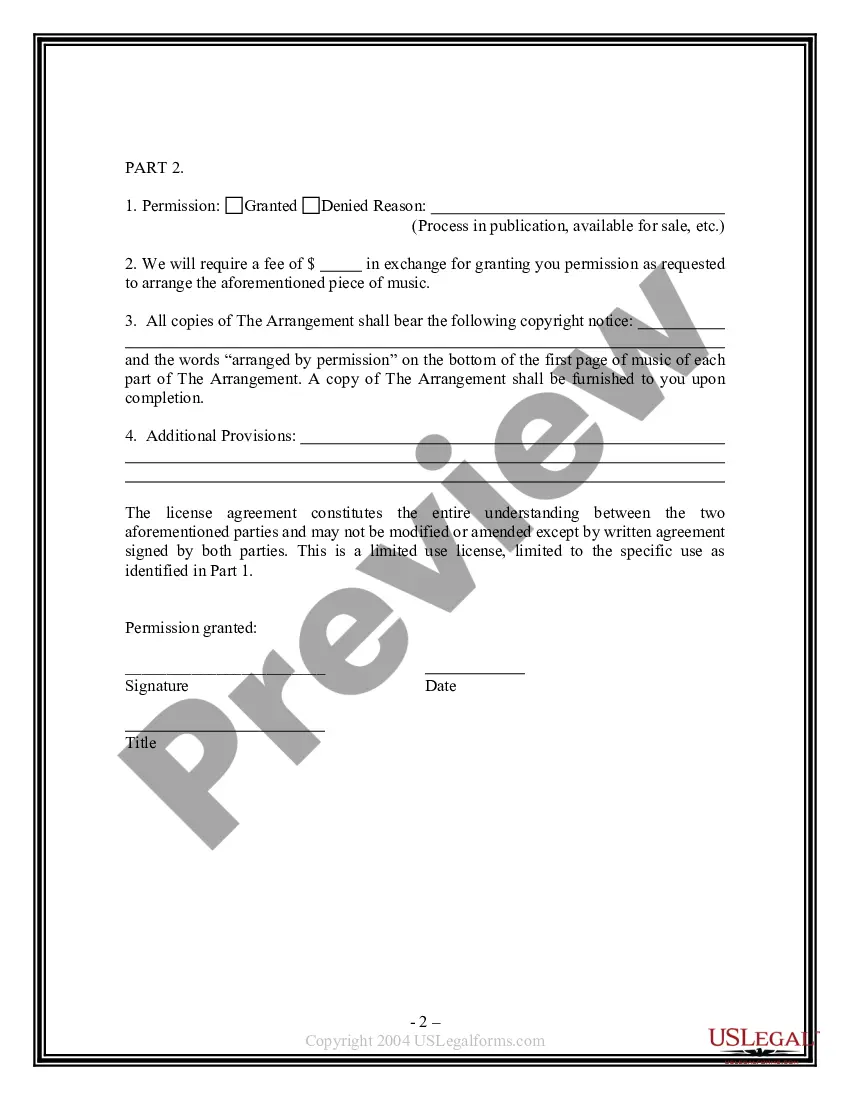
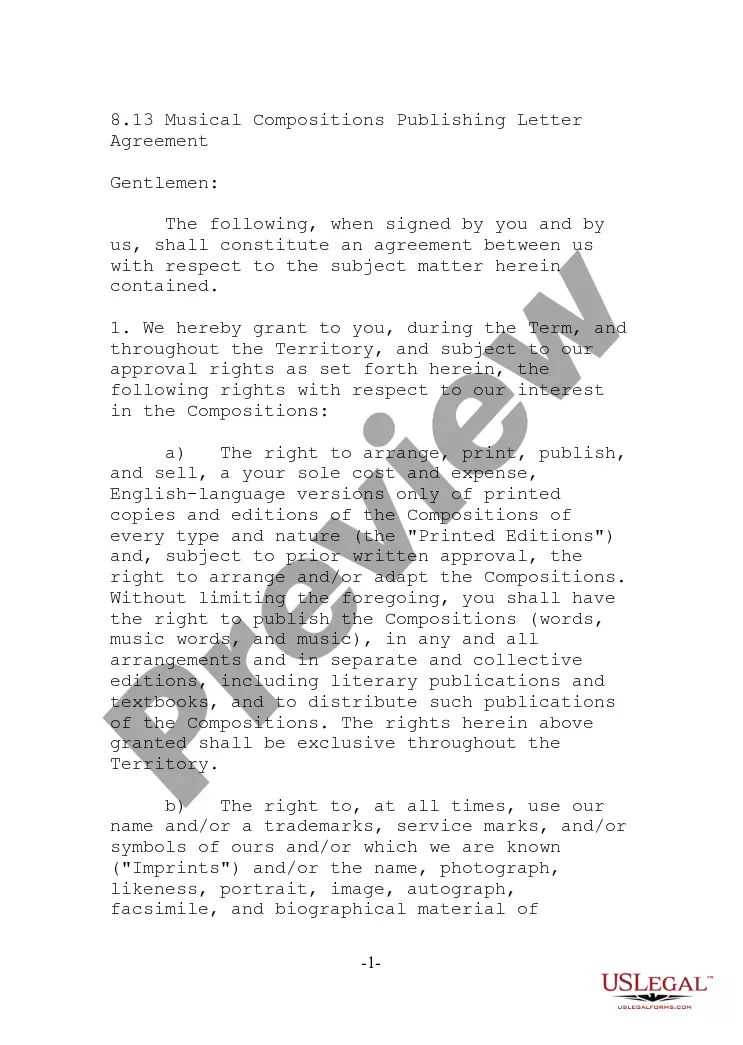
This is a form requesting permission to arrange a piece of music from a publisher. The first part of the form is to be completed by the party requesting permission, and the second part is to be filled out by the publisher or party granting permission.
Iowa Request For Permission To Arrange a Musical Composition
State:
Multi-State
Control #:
US-PRM-11
Format:
Word;
Rich Text
Instant download
Description
Free preview

How to fill out Request For Permission To Arrange A Musical Composition?
If you need to finalize, obtain, or produce sanctioned document templates, utilize US Legal Forms, the primary assortment of legal forms, that are accessible online.
Employ the site’s straightforward and convenient search to find the documents you need.
A collection of templates for business and personal purposes are organized by categories and regions, or keywords. Use US Legal Forms to locate the Iowa Request For Permission To Arrange a Musical Composition in just a few clicks.
Every legal document template you purchase is yours forever. You will have access to every form you saved in your account. Visit the My documents section and select a form to print or download again.
Complete and download, and print the Iowa Request For Permission To Arrange a Musical Composition with US Legal Forms. There are millions of professional and state-specific forms you can utilize for your personal business or individual requirements.
- If you are already a US Legal Forms user, Log In to your account and then click the Download button to access the Iowa Request For Permission To Arrange a Musical Composition.
- You can also retrieve forms you previously stored from the My documents section of your account.
- If you are using US Legal Forms for the first time, follow the instructions below.
- Step 1. Ensure you have selected the form for your correct region/country.
- Step 2. Utilize the Review feature to examine the form’s content. Remember to read the description.
- Step 3. If you are not satisfied with the form, use the Search box at the top of the page to find other variations of the legal form template.
- Step 4. Once you have found the form you need, click the Get now button. Choose the pricing plan you prefer and enter your information to register for the account.
- Step 5. Complete the transaction. You may use your credit card or PayPal account to finalize the payment.
- Step 6. Select the format of your legal form and download it to your device.
- Step 7. Complete, modify and print or sign the Iowa Request For Permission To Arrange a Musical Composition.
Form popularity
FAQ
To obtain copyright permission for arranging music, you need to contact the copyright holder, which is often the original composer or their representative. Clearly articulate your intention to create an arrangement and specify how you will use the composition. This process can be simplified by using the Iowa Request For Permission To Arrange a Musical Composition template available on US Legal Forms, which provides a structured way to secure the necessary rights.
To request permission from an artist to use their music, you should begin by identifying the correct contact method, such as their official website or social media channels. When reaching out, clearly state your intention to use their work, and provide details about how you plan to use it. It is also helpful to mention any specific rights you seek, which can include arranging a musical composition. Utilizing a service like US Legal Forms can streamline the process by offering templates for permission requests.
Arrangements of copyrighted works are only permitted to be sold with ArrangeMe. Selling an arrangement with ArrangeMe does not grant any additional permission to sell your work on other websites, or in physical printed sheet music, unless you have a direct agreement with the work owner or publisher.
General Requirements for CopyrightThe arrangement must be an original work. It must be fixed in a tangible medium of expression, such as on sheet music or a digital recording. It must be a musical work, including any accompanying words. It must not be an idea or concept.
So, here we go.Step 1: Make Sure if The Song Works On Its Own.Step 2: Check What Genre(s) Does the Song Encompass.Step 3: Confirm if The Song Has a Good Length.Step 4: Make Sure You Have a Decent Scratch Lead Vocal.Step 5: Drums and Other Rhythmic Components.Step 5a: Programmed Drums.Step 6: Bass and Bass Elements.More items...
You may have heard of "fair use," a copyright provision that permits you to use 10, 15 or 30 seconds of music without copyright obligation. That is, you understand that you can use a short section of a song without paying a fee.
Getting The Proper License For Your Commissioned Arrangement Permission Fees range from $50 to several hundred dollars, depending on variables such as the nature of intended performance, who the licensee is (educational is cheaper), our arranging fee, and other factors.
Requesting Permission Determine the copyright owner (usually the publisher) using the Harry Fox Agency's Songfile or ASCAP's ACE Title Search. Contact the copyright owner and ask for permission. Get permission in writing. Show a copyright notice on the arrangementon all copies and all parts.More items...
Yes. You need the permission of the copyright owner (usually the music publisher, not the original composer) to create the derivative orchestral arrangement, transcription or adaptation, in addition to the license from the respective PRO to perform the work publicly.
How do I get permission? To arrange or adapt any copyright musical composition, you should contact the copyright owner or his/her representative for permission, before you start to make the arrangement. Unless the work is unpublished, there is normally no need to go directly to the composer for permission.