Iowa Demand to File Suit - Individual
About this form
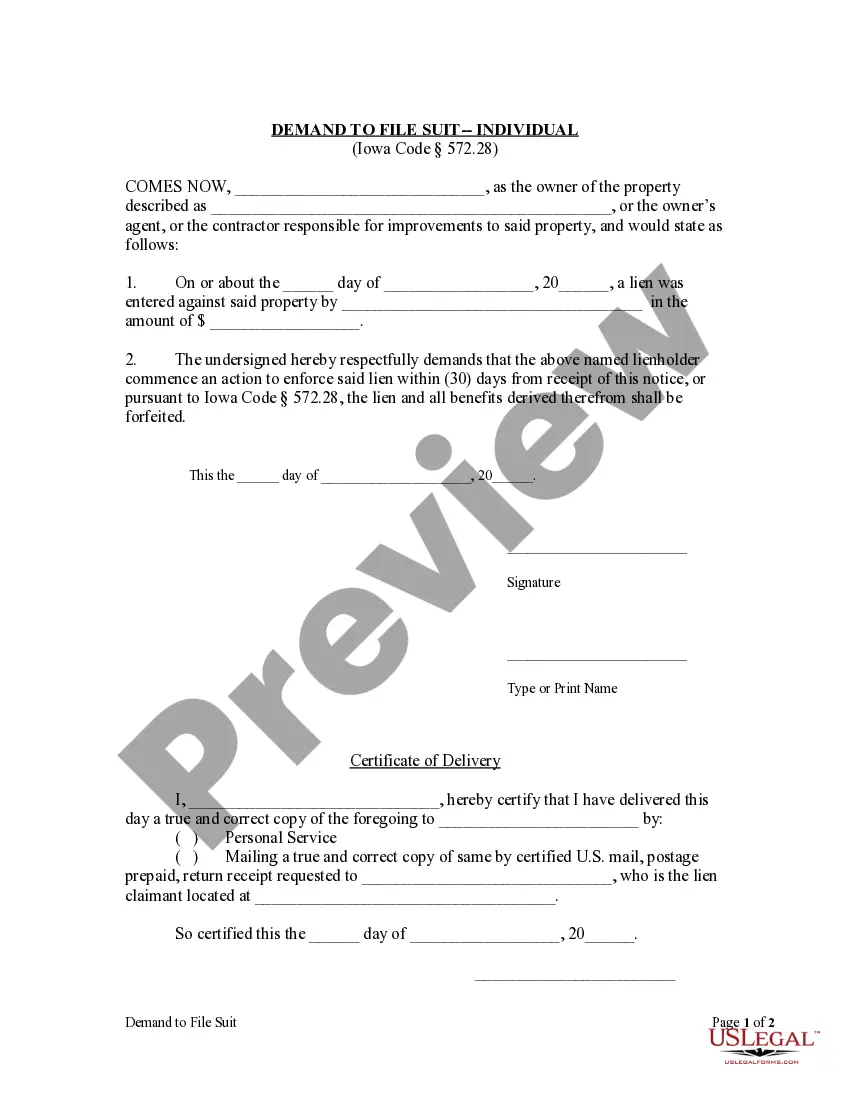
The Demand to File Suit - Individual is a legal document that allows property owners, their agents, or contractors in Iowa to request a lien holder to file a lawsuit to enforce a lien on a property. This form is essential when a lien holder fails to take action within thirty days of receiving the demand, resulting in the forfeiture of the lien and associated benefits. It differs from other legal forms by specifically focusing on the enforcement of property liens under Iowa law.
Form components explained
- Identifying the property owner, agent, or contractor issuing the demand.
- Details of the property and the lien entered against it.
- The specific amount of the lien.
- A clear demand for the lien holder to commence legal action within thirty days.
- Spaces for signatures and delivery certification to ensure proper notification.

Common use cases
This form is typically used when a property owner or their representative needs to prompt a lien holder to take legal action against a property. It is appropriate in situations where a lien has been placed due to non-payment for services rendered or materials supplied for property improvements. If the lien holder fails to act within thirty days, the claimant may subsequently lose their rights to the lien.
Intended users of this form
- Property owners in Iowa seeking to enforce a lien on their property.
- Agents representing property owners who need to address liens.
- Contractors who have not been compensated and have placed a lien against a property.
How to prepare this document
- Identify and enter the name of the property owner, agent, or contractor at the top of the form.
- Specify the property description where the lien is placed.
- Provide the date on which the lien was entered and the name of the lien holder.
- Include the amount of the lien in the designated space.
- Sign and date the form, and complete the certificate of delivery to confirm the demand has been delivered to the lien holder.
Notarization requirements for this form
In most cases, this form does not require notarization. However, some jurisdictions or signing circumstances might. US Legal Forms offers online notarization powered by Notarize, accessible 24/7 for a quick, remote process.
Get your form ready online
Our built-in tools help you complete, sign, share, and store your documents in one place.
Make edits, fill in missing information, and update formatting in US Legal Forms—just like you would in MS Word.
Download a copy, print it, send it by email, or mail it via USPS—whatever works best for your next step.
Sign and collect signatures with our SignNow integration. Send to multiple recipients, set reminders, and more. Go Premium to unlock E-Sign.
If this form requires notarization, complete it online through a secure video call—no need to meet a notary in person or wait for an appointment.
We protect your documents and personal data by following strict security and privacy standards.

Make edits, fill in missing information, and update formatting in US Legal Forms—just like you would in MS Word.

Download a copy, print it, send it by email, or mail it via USPS—whatever works best for your next step.

Sign and collect signatures with our SignNow integration. Send to multiple recipients, set reminders, and more. Go Premium to unlock E-Sign.

If this form requires notarization, complete it online through a secure video call—no need to meet a notary in person or wait for an appointment.

We protect your documents and personal data by following strict security and privacy standards.
Common mistakes to avoid
- Failing to deliver the notice to the correct lien holder.
- Not adhering to the thirty-day deadline for the lien holder's response.
- Incomplete information regarding the lien amount or property details.
- Omitting the signature or date on the demand form.
Benefits of completing this form online
- Convenient access to legal forms that can be downloaded and completed from anywhere.
- Editable templates that allow you to customize the form easily.
- Reliability in using forms drafted by licensed attorneys, ensuring legal compliance.
Looking for another form?
Form popularity
FAQ
In Iowa, contempt of court can result in various penalties, including fines, jail time, or both. The severity of the punishment often depends on the nature of the contempt, whether it is civil or criminal. Understanding these repercussions is significant for individuals involved in legal proceedings, including those related to an Iowa Demand to File Suit - Individual. If you find yourself in such a situation, seeking legal advice will help you navigate the consequences effectively.
In Iowa, the time limit to file a lawsuit varies by the type of claim. Most personal injury claims have a two-year statute of limitations, while written contracts typically have a ten-year limit. Being aware of these deadlines is crucial for anyone considering an Iowa Demand to File Suit - Individual. If you're unsure about the time frame for your specific situation, consulting a legal expert can provide clarity and assurance.
To file a civil suit in Iowa, begin by drafting a complaint that outlines your claims and the relief sought. You must then file this document with the appropriate court, along with any required fees. After filing, you will need to serve the defendant with the complaint. For those looking for a streamlined process, resources like uslegalforms can provide the necessary documentation and support, especially for an Iowa Demand to File Suit - Individual.
Rule 1.701 in Iowa outlines the general provisions for civil procedure, including guidelines for pleadings and motions. This rule plays a fundamental role in ensuring that legal processes are followed correctly, which is essential in any lawsuit. For individuals dealing with an Iowa Demand to File Suit - Individual, aligning your case with these procedural requirements is vital to its success. Legal guidance can clarify your obligations under this rule.
Rule 1.808 in Iowa governs the process of post-trial motions for a new trial. It provides the basis for parties to request a new trial based on various grounds, such as procedural errors or newly discovered evidence. This rule is critical in civil litigation, including those involving an Iowa Demand to File Suit - Individual, as it details how to request judicial reconsideration. Understanding this rule can enhance your chances of a favorable outcome.
Iowa Code 808.7 pertains to the rules regarding the issuance of search warrants. It outlines specific procedures that law enforcement must follow to obtain such warrants, ensuring protections against unlawful searches. Understanding these rules can be pivotal in cases where evidence is obtained, especially if you are involved in an Iowa Demand to File Suit - Individual. Consulting legal resources can clarify how this code might impact your situation.
The home rule law in Iowa empowers local governments to govern themselves in many aspects. It allows municipalities to enact their own laws, as long as they do not conflict with state laws. This autonomy helps communities address their unique needs and fosters local governance. If you need assistance understanding how this applies to your legal situation, particularly in relation to an Iowa Demand to File Suit - Individual, consult legal resources or professionals.
Rule 1.943 in Iowa relates to the discovery process in civil litigation. It outlines how parties exchange information and evidence relevant to the case, promoting transparency. Familiarizing yourself with this rule is crucial as it directly impacts how you prepare your case when making an Iowa demand to file suit - individual. Understanding the discovery process can strengthen your position in legal negotiations.
Yes, you can file a civil lawsuit on your own in Iowa, often referred to as 'pro se' representation. However, navigating the legal system alone can be challenging without proper knowledge of the laws and procedures. Therefore, accessing resources like US Legal Forms is beneficial to guide you through the process of making an Iowa demand to file suit - individual effectively. Consider professional advice if you feel uncertain about proceeding solo.
Rule 1.302 in Iowa addresses the requirements for pleadings and motions in civil cases. This rule mandates that litigants file certain documents in a specified format and within set time frames, ensuring clarity and structure in legal proceedings. Understanding these rules can greatly assist you in managing your case effectively. When considering an Iowa demand to file suit - individual, being aware of Rule 1.302 can enhance your legal strategy.