Iowa Demand to Record Satisfaction - Individual
Understanding this form
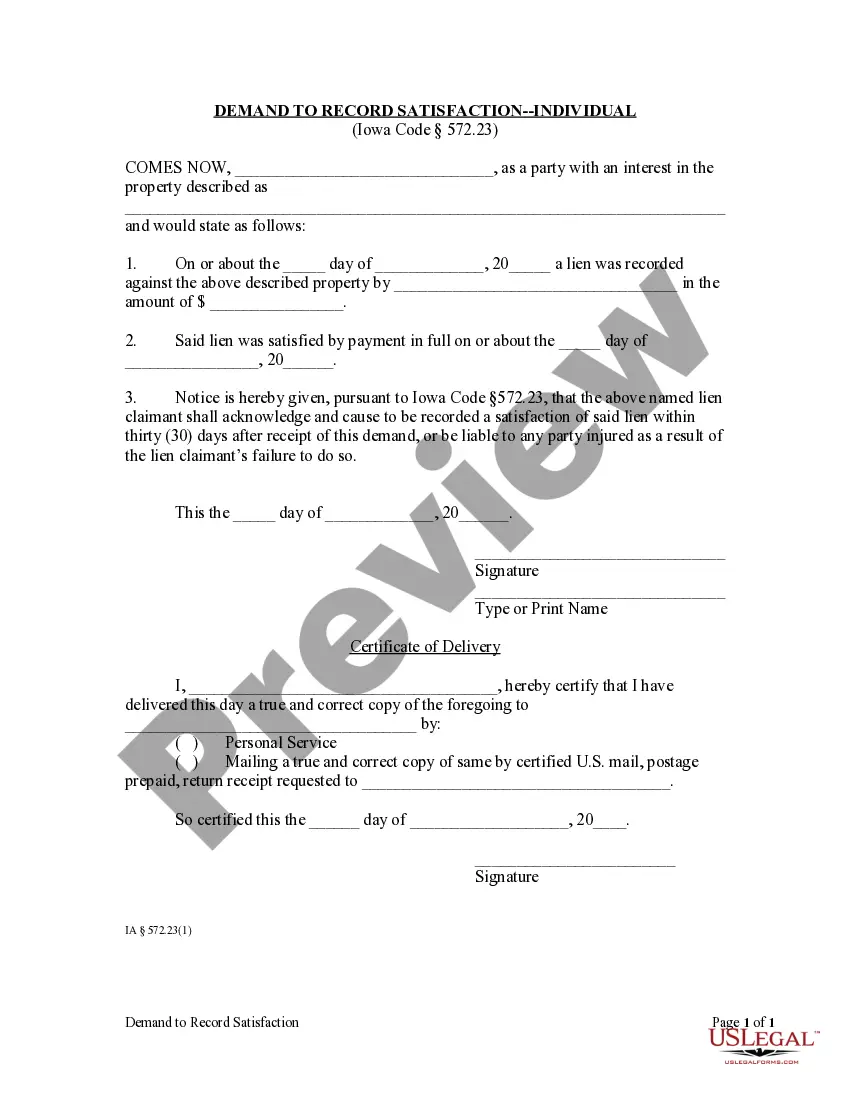
The Demand to Record Satisfaction - Individual is a legal form used primarily in Iowa to formally request that a lienholder acknowledge the satisfaction of a lien. This form ensures that once a lien is paid off, the lienholder must officially record this acknowledgment, protecting the interests of parties involved in the property. It differs from similar forms by emphasizing the obligation of lienholders to respond within thirty days, or they may face liability for damages.
Key parts of this document
- Identification of the party making the demand.
- Description of the property associated with the lien.
- Details of the lien, including date of recording and amount.
- Statement of the lien satisfaction due to payment.
- Notice to the lienholder regarding their obligation to record satisfaction within thirty days.
- Signature and printed name of the individual making the demand.
- Certificate of Delivery ensuring the demand has been sent to the lienholder.
When this form is needed
This form should be used when a lien has been satisfied through payment, and the lienholder has not yet recorded this satisfaction. It is applicable in situations where an individual or party with an interest in a property wishes to ensure that the lienholder formally acknowledges the payment, preventing any future claims on the property arising from an unrecorded lien.
Intended users of this form
- Property owners who have satisfied a lien and need official acknowledgment.
- Parties with a legal interest in the property, such as co-owners or creditors.
- Individuals seeking to protect their property rights after a lien is paid off.
- Anyone involved in a transaction that includes a previously recorded lien on a property.
Instructions for completing this form
- Identify the party making the demand and enter their name.
- Specify the property involved by entering its detailed description.
- Include the date the lien was recorded and name the lienholder.
- Indicate the date when the lien was satisfied and the amount paid.
- Sign and print the name of the individual making the demand.
- Complete the Certificate of Delivery to verify that the demand was sent to the lienholder.
Is notarization required?
In most cases, this form does not require notarization. However, some jurisdictions or signing circumstances might. US Legal Forms offers online notarization powered by Notarize, accessible 24/7 for a quick, remote process.
Get your form ready online
Our built-in tools help you complete, sign, share, and store your documents in one place.
Make edits, fill in missing information, and update formatting in US Legal Forms—just like you would in MS Word.
Download a copy, print it, send it by email, or mail it via USPS—whatever works best for your next step.
Sign and collect signatures with our SignNow integration. Send to multiple recipients, set reminders, and more. Go Premium to unlock E-Sign.
If this form requires notarization, complete it online through a secure video call—no need to meet a notary in person or wait for an appointment.
We protect your documents and personal data by following strict security and privacy standards.

Make edits, fill in missing information, and update formatting in US Legal Forms—just like you would in MS Word.

Download a copy, print it, send it by email, or mail it via USPS—whatever works best for your next step.

Sign and collect signatures with our SignNow integration. Send to multiple recipients, set reminders, and more. Go Premium to unlock E-Sign.

If this form requires notarization, complete it online through a secure video call—no need to meet a notary in person or wait for an appointment.

We protect your documents and personal data by following strict security and privacy standards.
Common mistakes to avoid
- Failing to provide complete and accurate property descriptions.
- Missing the deadline for the lienholder's acknowledgment.
- Not including the correct date and amount for lien satisfaction.
- Forget to sign the form, rendering it invalid.
Why complete this form online
- Convenient access to legal forms at any time.
- Editable format to customize the form to your specific needs.
- Reliable templates drafted by licensed attorneys to ensure legal compliance.
Looking for another form?
Form popularity
FAQ
Yes, you can file a contempt of court yourself in Iowa, as individuals have the right to represent themselves in legal matters. Ensure that you prepare all necessary documents, such as the motion for contempt, accurately and thoroughly. While self-representation is possible, consider the complexities of the legal process and how the Iowa Demand to Record Satisfaction - Individual can provide the necessary support and guidance when navigating these proceedings.
To file a contempt of court in Iowa, start by drafting a motion that outlines the specific order violated and the details of the contempt. You must file this motion with the court that issued the original order. After filing, it is crucial to serve the other party with notice of your motion. Utilizing the Iowa Demand to Record Satisfaction - Individual can help clarify the steps and legal requirements involved in this process.
In Iowa, you generally do not need permission to record a conversation if you are part of that conversation. However, it's essential to understand the nuances of Iowa's recording laws to ensure compliance. If you're seeking to record a private conversation without consent, the legality comes into question. To navigate these regulations effectively, consider using the Iowa Demand to Record Satisfaction - Individual as a guiding tool.
To file a contempt in Iowa, you must gather the relevant documents related to your case and prepare a motion for contempt. This motion must clearly state how the other party violated a court order. Once you submit the motion to the court, you will need to serve it to the other party, ensuring they receive notice of your claims. Using the Iowa Demand to Record Satisfaction - Individual can provide clarity in your legal processes.
The Iowa FOIA includes several exemptions that may restrict access to certain records. Common exemptions involve personal privacy, national security, and ongoing investigations. Understanding these exemptions is essential if you plan to request records; utilizing the Iowa Demand to Record Satisfaction - Individual can provide clarity on how these exemptions may apply to your case.
Iowa Code 22.2 1 outlines the public's right to access government records. It specifies the responsibilities of public officials in providing access to records and maintaining transparency. If you are interested in exercising this right, exploring options through the Iowa Demand to Record Satisfaction - Individual can be beneficial.
Iowa's Sunshine Law governs the transparency of government meetings and records. This law aims to ensure the public can observe how government operates and access pertinent information. Using resources like the Iowa Demand to Record Satisfaction - Individual can help you gain insight into how to obtain records under this law.
The human trafficking code in Iowa includes laws addressing the prevention, prosecution, and punishment of human trafficking offenses. These statutes aim to protect victims and ensure justice for perpetrators. If you require documentation related to this issue, the Iowa Demand to Record Satisfaction - Individual might serve as a resource to assist you.
Yes, Iowa is an open records state, meaning residents have the right to access public records. However, there are exceptions that may limit access to certain documents. Familiarizing yourself with the rules around the Iowa Demand to Record Satisfaction - Individual can empower you to better navigate these public records.
Chapter 22.8 of the Iowa Code discusses the exemption of certain records from public disclosure. This chapter specifies situations where public access may be denied, thus protecting sensitive information. Understanding this chapter is critical if you’re looking to exercise your rights related to the Iowa Demand to Record Satisfaction - Individual.