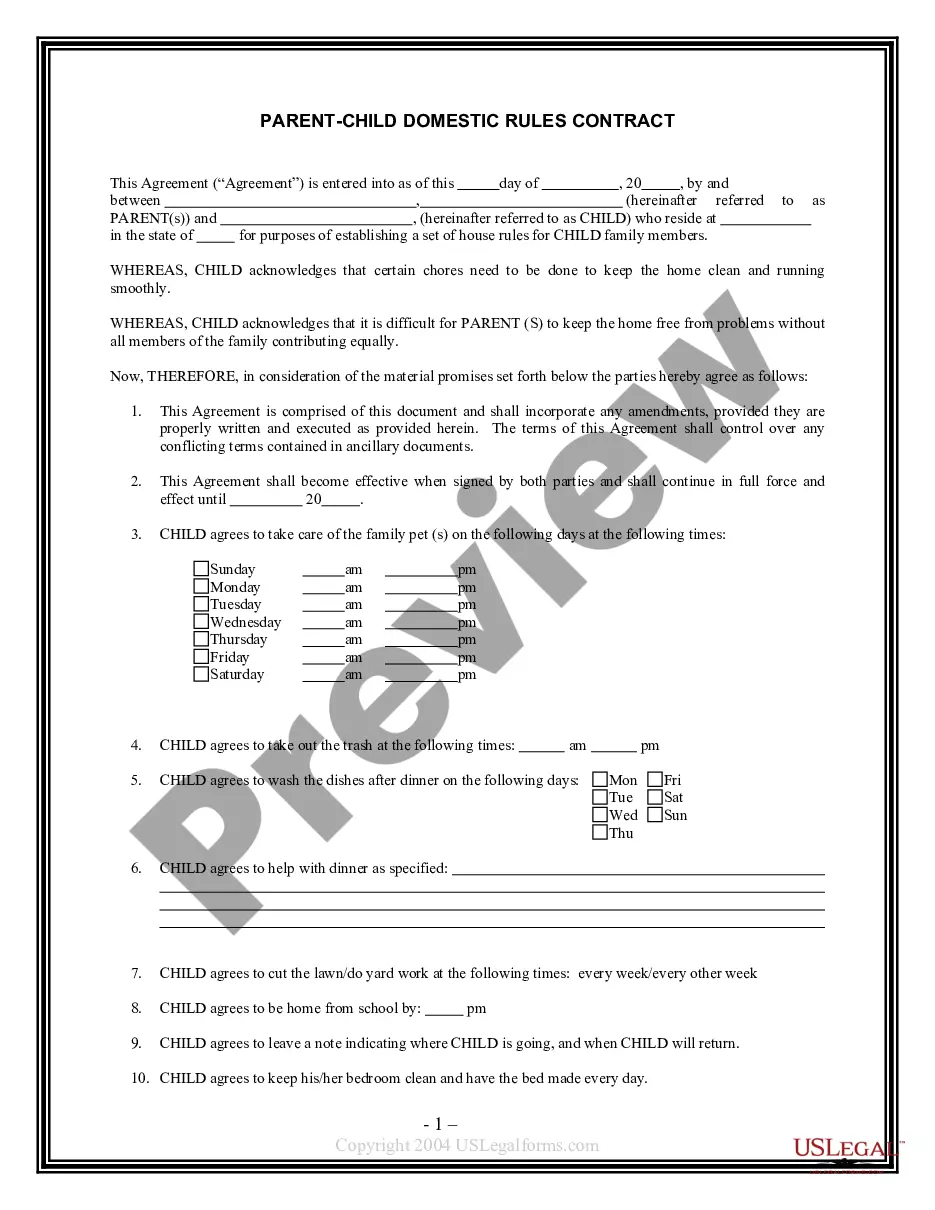
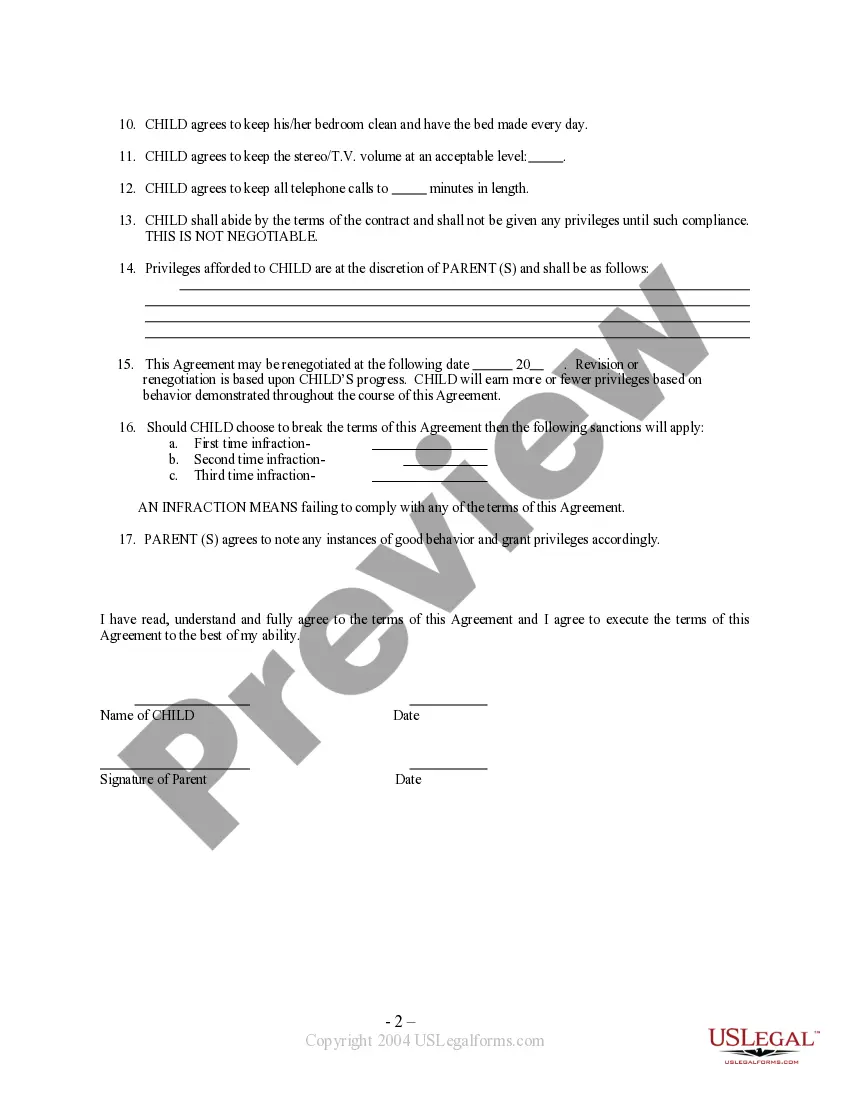
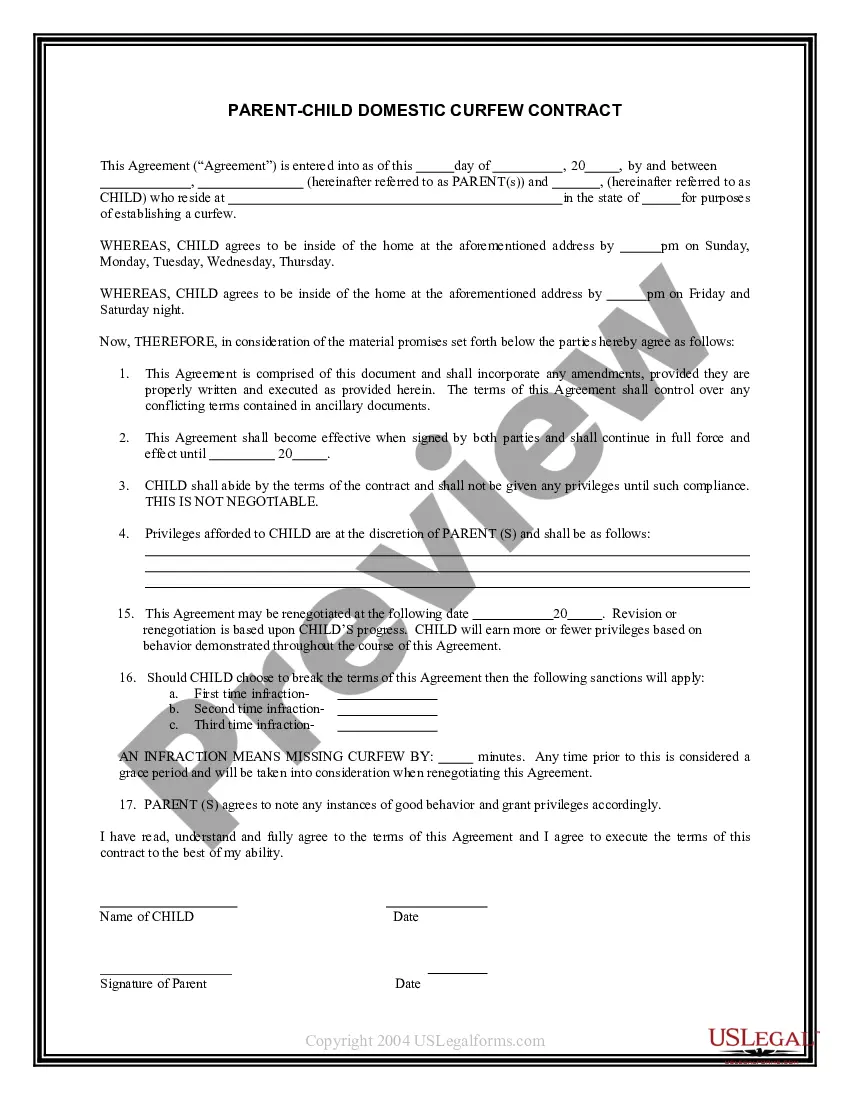
This is a contract between parent(s) and child indicating what chores are expected of child, and on what days and times child is expected to complete the chores. This contract also lists what privileges will be extended for abiding by the contract and what repercussions will follow for breaking the contract.
Hawaii Parent - Child Domestic Rules Contract
Category:
State:
Multi-State
Control #:
US-PC08
Format:
Word;
Rich Text
Instant download
Description
Free preview
Get your form ready online
Our built-in tools help you complete, sign, share, and store your documents in one place.
Built-in online Word editor
Make edits, fill in missing information, and update formatting in US Legal Forms—just like you would in MS Word.
Export easily
Download a copy, print it, send it by email, or mail it via USPS—whatever works best for your next step.
E-sign your document
Sign and collect signatures with our SignNow integration. Send to multiple recipients, set reminders, and more. Go Premium to unlock E-Sign.
Notarize online 24/7
If this form requires notarization, complete it online through a secure video call—no need to meet a notary in person or wait for an appointment.
Store your document securely
We protect your documents and personal data by following strict security and privacy standards.

Make edits, fill in missing information, and update formatting in US Legal Forms—just like you would in MS Word.

Download a copy, print it, send it by email, or mail it via USPS—whatever works best for your next step.

Sign and collect signatures with our SignNow integration. Send to multiple recipients, set reminders, and more. Go Premium to unlock E-Sign.

If this form requires notarization, complete it online through a secure video call—no need to meet a notary in person or wait for an appointment.

We protect your documents and personal data by following strict security and privacy standards.
Looking for another form?

How to fill out Parent - Child Domestic Rules Contract?
Are you presently in a scenario where you require documents for either business or personal purposes almost all the time.
There are numerous legal document templates accessible online, but finding trustworthy ones is not easy.
US Legal Forms provides a wide array of form templates, including the Hawaii Parent - Child Domestic Rules Contract, which can be printed to comply with federal and state regulations.
Utilize US Legal Forms, the most extensive selection of legal documents, to save time and prevent errors.
The service offers well-crafted legal document templates that can be used for various purposes. Create an account on US Legal Forms and start making your life a bit easier.
- If you are currently familiar with the US Legal Forms website and have an account, simply Log In.
- Then, you can download the Hawaii Parent - Child Domestic Rules Contract template.
- If you do not have an account and wish to start using US Legal Forms, follow these steps.
- Find the form you need and ensure it is for your correct city/state.
- Use the Review button to check the form.
- Look at the description to confirm that you have chosen the right form.
- If the form is not what you are looking for, utilize the Search field to locate the form that fulfills your requirements.
- Once you find the appropriate form, click on Buy now.
- Select the pricing plan you prefer, fill in the necessary information to create your account, and pay for your order using your PayPal or Visa or Mastercard.
- Choose a convenient document format and download your copy.
- Access all the document templates you have purchased in the My documents section. You can obtain an additional copy of the Hawaii Parent - Child Domestic Rules Contract whenever needed. Just click the relevant form to download or print the document template.
Form popularity
FAQ
The legal definition of an unfit parent is when the parent through their conduct fails to provide proper guidance, care, or support. Also, if there is abuse, neglect, or substance abuse issues, that parent will be deemed unfit.
In California, an unfit parent is a parent who, through their conduct, fails to provide proper guidance, care, or support to their children. This can include not only a parent's actions but also a home environment where abuse, neglect, or substance abuse is present.
At What Age Can a Child Decide Which Parent To Live With in Hawaii? Although it is not the only factor in determining custody, the Hawaii court may consider a child's wishes if he or she is aged 14 or older.
So the answer to the question or a query that can child in India ever choose that which parent to live with is YES! But only after attaining a particular age i.e. 9 years as per the Guardians and Wards Act 1890 (GAWA). Once a child achieves the age of 9 years in India, his/her preference for custody is considered.
Child custody and visitation in Hawai'i is based upon the best interests of the child. If you are involved in a custody dispute, you will hear this term many, many times. It simply means that custody is not given to reward a parent, or to punish the other parent. Rather, the Court focuses on what is best for the child.
What exactly is an unfit parent? The legal definition of an unfit parent is when the parent through their conduct fails to provide proper guidance, care, or support. Also, if there is abuse, neglect, or substance abuse issues, that parent will be deemed unfit.
Circumstances in California that Make a Parent Unfit for having Child CustodyHistory and evidence of abuse or violence.Lack of involvement in the child's life.Incapacity to provide financial support.Having an existing mental illness.History of an extremely hostile relationship with the child.
In a sole physical custody arrangement, the child lives with one parent full-time, even if the non-custodial parent has visitation rights or shares in the legal custody arrangement. Hawaii child custody laws generally involve a judge overseeing custody decisions, with the court able to overrule any decision.
If a child is of sufficient age and capacity to reason (age 14), the court may take into consideration the child's wishes. A child will not testify in a custody proceeding or be asked to choose between parents.