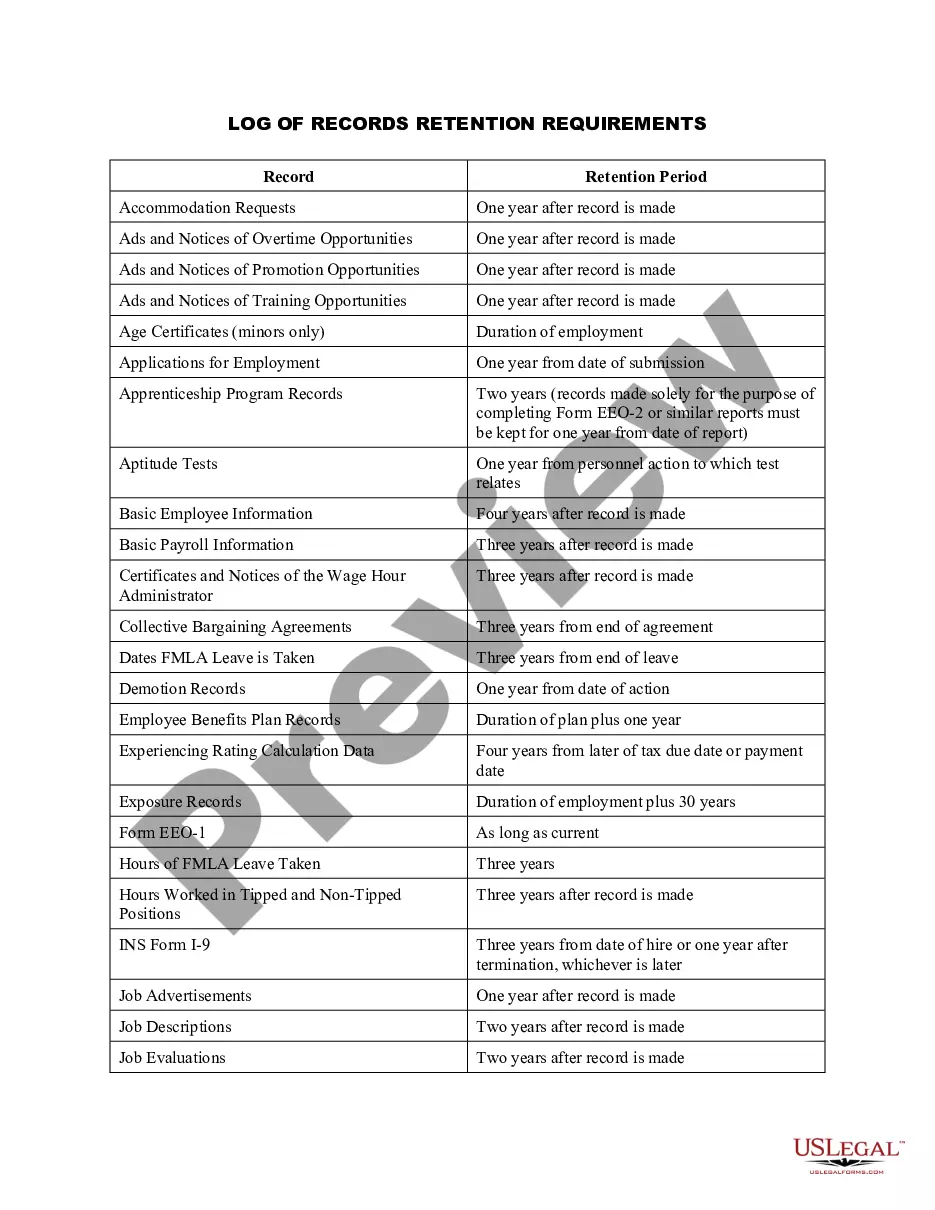
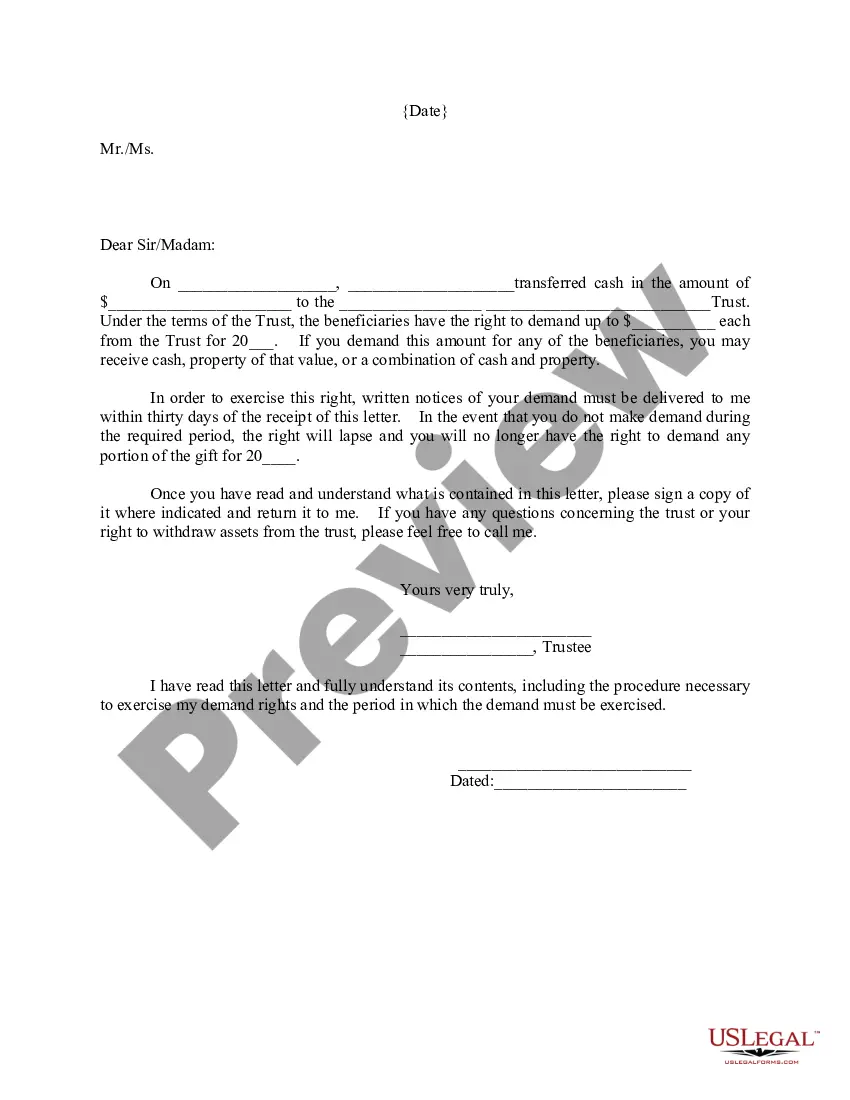
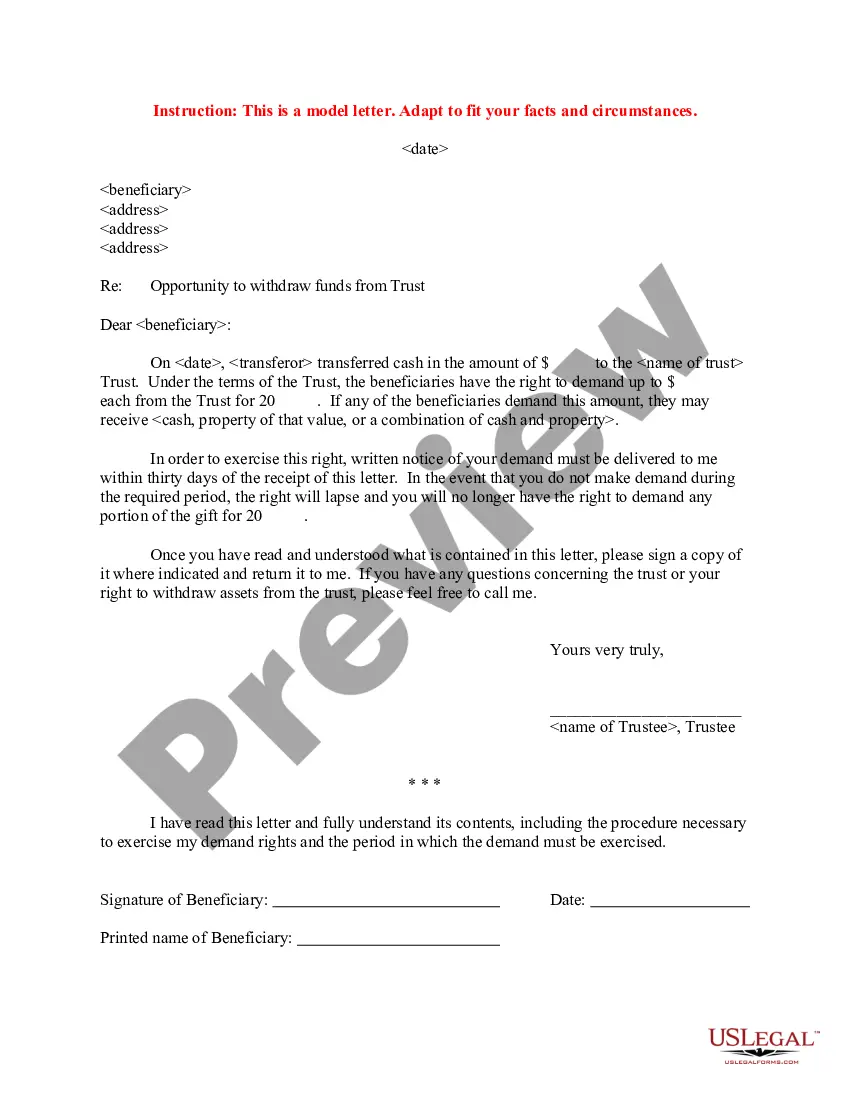
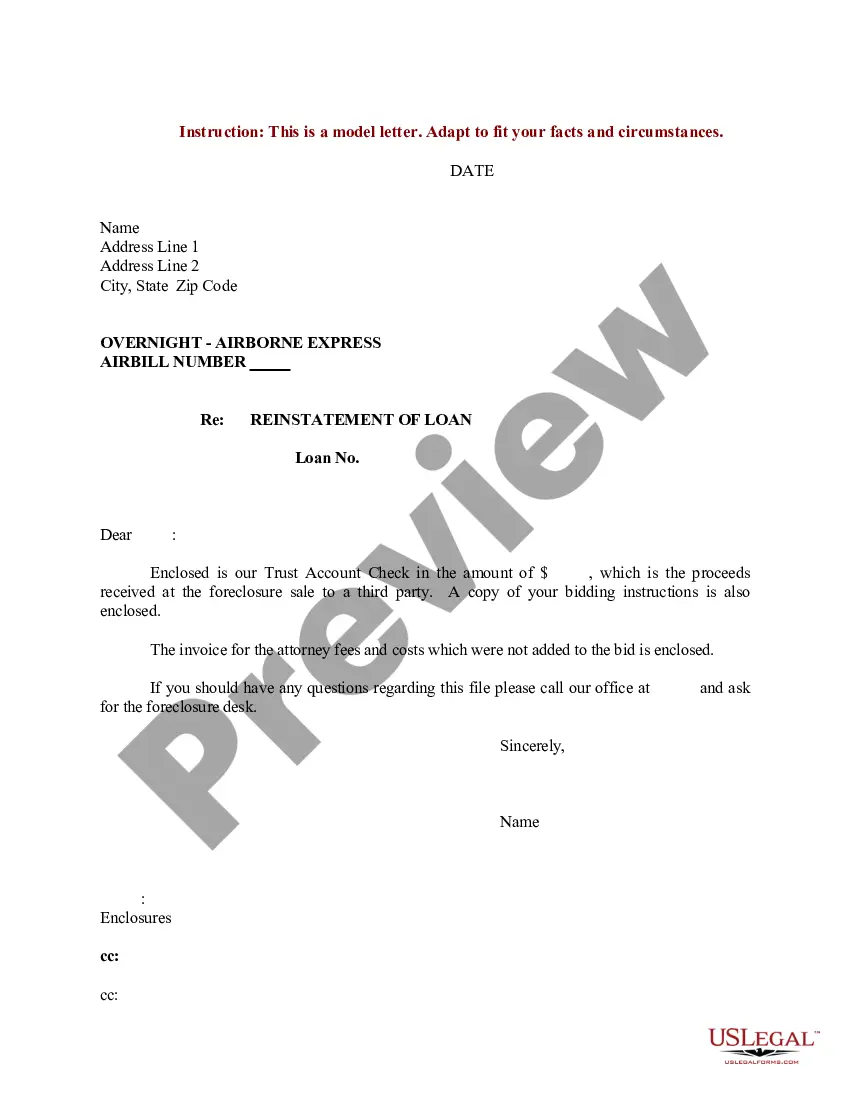
Trustee informs the trustor that he/she has the right to demand a certain amount of funds from the trust during the year. If the trustor demands a withdrawal for any of the beneficiaries, he/she may receive cash, property of that value, or a combination of cash and property.
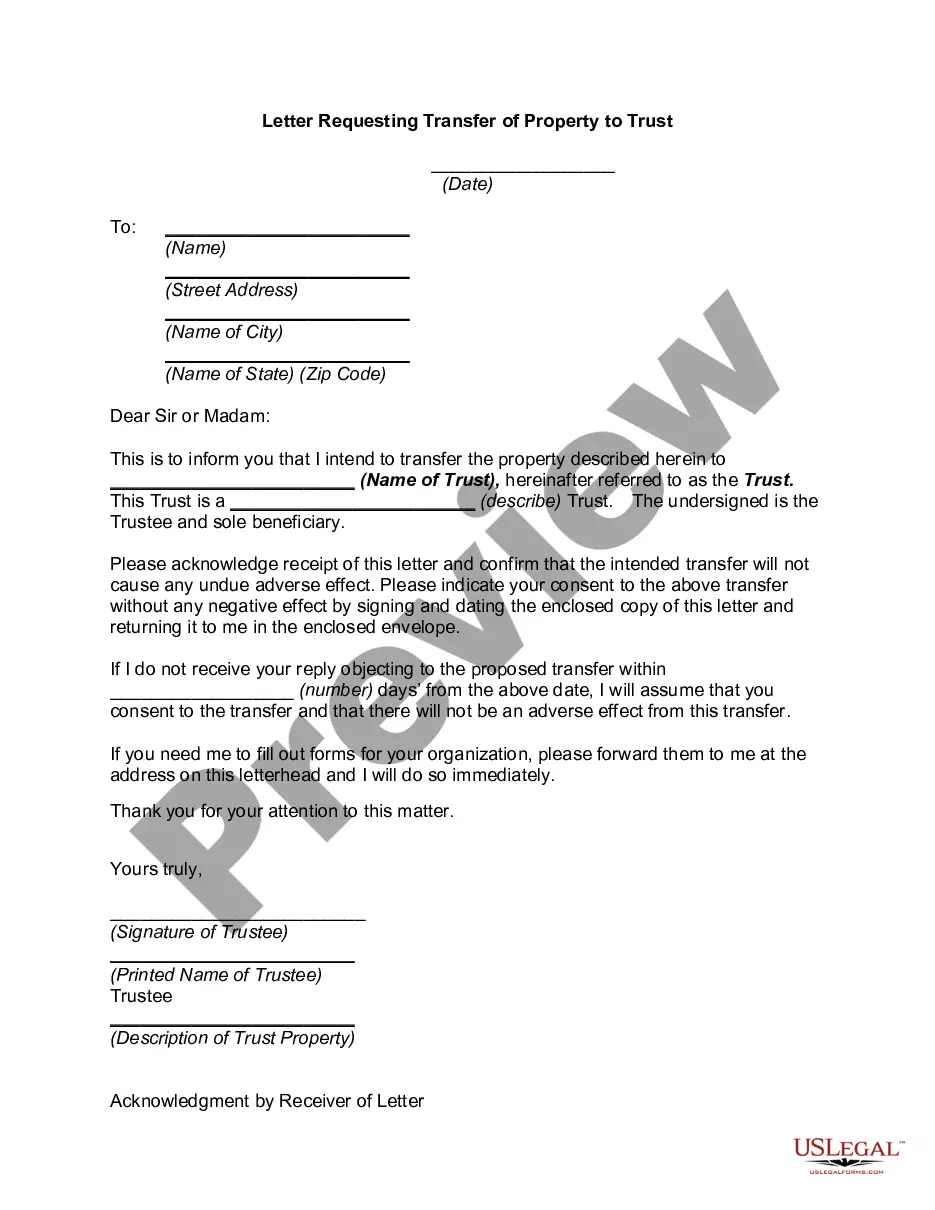
Guam Letter regarding trust money
Instant download
Description
Get your form ready online
Our built-in tools help you complete, sign, share, and store your documents in one place.
Built-in online Word editor
Make edits, fill in missing information, and update formatting in US Legal Forms—just like you would in MS Word.
Export easily
Download a copy, print it, send it by email, or mail it via USPS—whatever works best for your next step.
E-sign your document
Sign and collect signatures with our SignNow integration. Send to multiple recipients, set reminders, and more. Go Premium to unlock E-Sign.
Notarize online 24/7
If this form requires notarization, complete it online through a secure video call—no need to meet a notary in person or wait for an appointment.
Store your document securely
We protect your documents and personal data by following strict security and privacy standards.

Make edits, fill in missing information, and update formatting in US Legal Forms—just like you would in MS Word.

Download a copy, print it, send it by email, or mail it via USPS—whatever works best for your next step.

Sign and collect signatures with our SignNow integration. Send to multiple recipients, set reminders, and more. Go Premium to unlock E-Sign.

If this form requires notarization, complete it online through a secure video call—no need to meet a notary in person or wait for an appointment.

We protect your documents and personal data by following strict security and privacy standards.
Looking for another form?


How to fill out Letter Regarding Trust Money?
Are you in a situation where you occasionally require documents for business or personal reasons almost every day.
There are numerous legal document templates available online, but finding ones that you can rely on is challenging.
US Legal Forms provides a wide array of templates, including the Guam Letter regarding trust money, which can be tailored to comply with federal and state regulations.
Select the pricing plan you prefer, complete the necessary information to create your account, and process the payment using your PayPal or credit card.
Choose a convenient file format and download your copy. You can access all the document templates you have purchased in the My documents section. You can obtain an additional version of the Guam Letter regarding trust money at any time. Just click on the desired form to download or print the document template.
- If you are already familiar with the US Legal Forms website and have an account, simply Log In.
- After that, you can download the Guam Letter regarding trust money template.
- If you do not possess an account and wish to start using US Legal Forms, follow these steps.
- Find the form you require and ensure it is for the correct city/state.
- Utilize the Preview option to review the document.
- Read the description to verify that you have selected the correct form.
- If the form is not what you seek, use the Lookup field to find the document that suits your needs and criteria.
- Once you find the appropriate form, click Acquire now.
Form popularity
FAQ
Yes, you can file your Guam tax online through the Department of Revenue and Taxation’s e-filing service. This method allows you to submit your tax returns easily and securely. If you need guidance, consider using platforms like uslegalforms for help in preparing your tax documents correctly. Ensure you have all required information ready to make the filing process smooth and efficient.
If you have a revocable trust, you can get money out by making a request via the trustee. Should you yourself be listed as the trustee, you'll be able to transfer funds and assets out of the trust as you see fit.
In Trust For, Definition In trust for (ITF) or account in trust refers to an account that has a named trustee. This trustee manages the assets in the account on behalf of one or more beneficiaries. The person who creates an in trust for account can set the rules or guidelines for how those assets should be managed.
In a revocable trust, the grantor still owns all their assets. When they die, the assets are considered part of their estate (although the trust itself is now irrevocable) and may be subject to estate taxes. Since the person is deceased, the trustee acts as their stand-in and pays the taxes using money from the trust.
Among the chief advantages of trusts, they let you: Put conditions on how and when your assets are distributed after you die; Reduce estate and gift taxes; Distribute assets to heirs efficiently without the cost, delay and publicity of probate court.
Putting money in a trust lets you pass property to someone in a structured way, where you can impose rules. For example, you might say that your beneficiary can't use these funds to pay off debt. Or, you might impose rules on how old the beneficiary needs to be before she gains control over the money.
In Trust For (or ITF) accounts are non-registered plans that allow investors to save on behalf of a child.
A trust can remain open for up to 21 years after the death of anyone living at the time the trust is created, but most trusts end when the trustor dies and the assets are distributed immediately.
How Do I Figure Out Where All of the Money In My Trust Went?Perform an Asset Search.Issue Subpoenas to Financial Institutions.Take Depositions.Hire a Forensic Accounting Expert.Some Things You'll Never Know.
Essentially, they are a legal arrangement that lets a person place assets in a trust fund to benefit specific individuals or organizations. Trust funds also provide tax benefits and avoid the hassles of waiting for a probate court to distribute your assets.