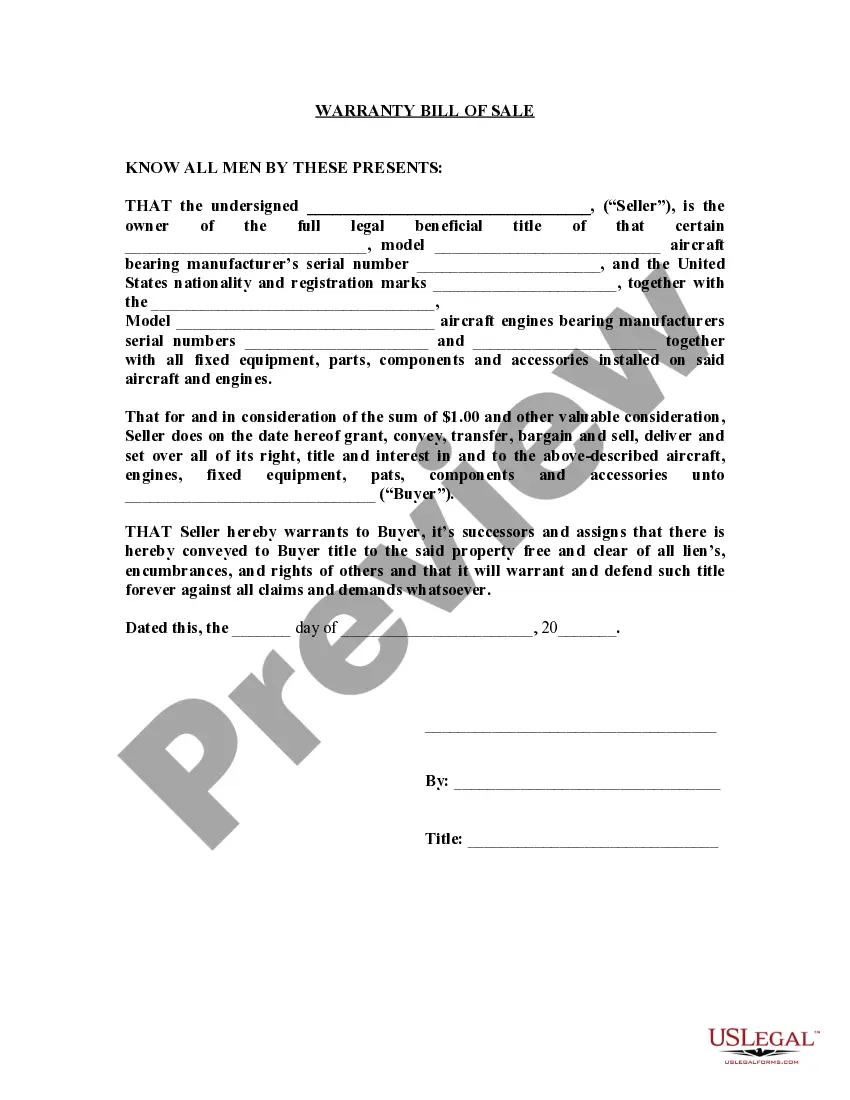
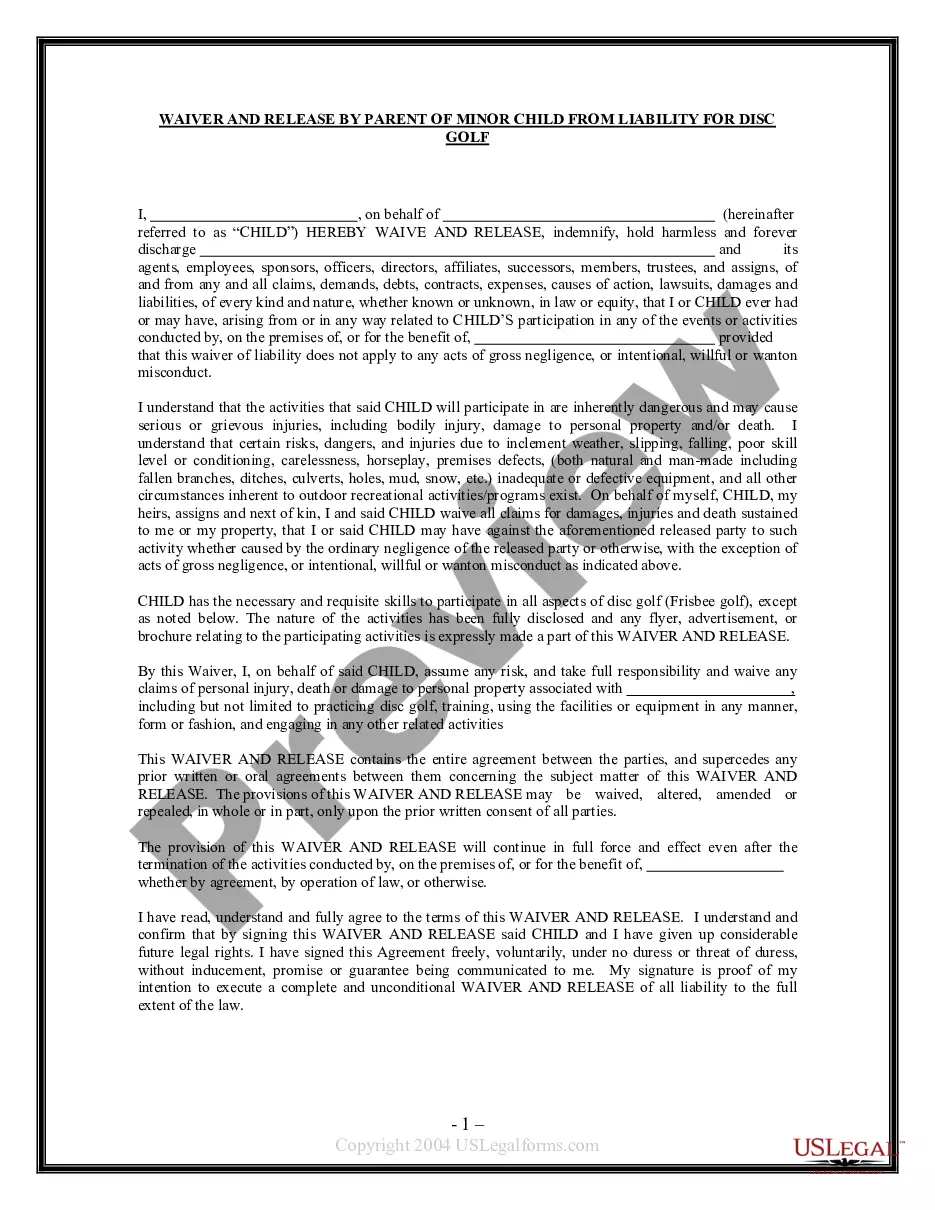
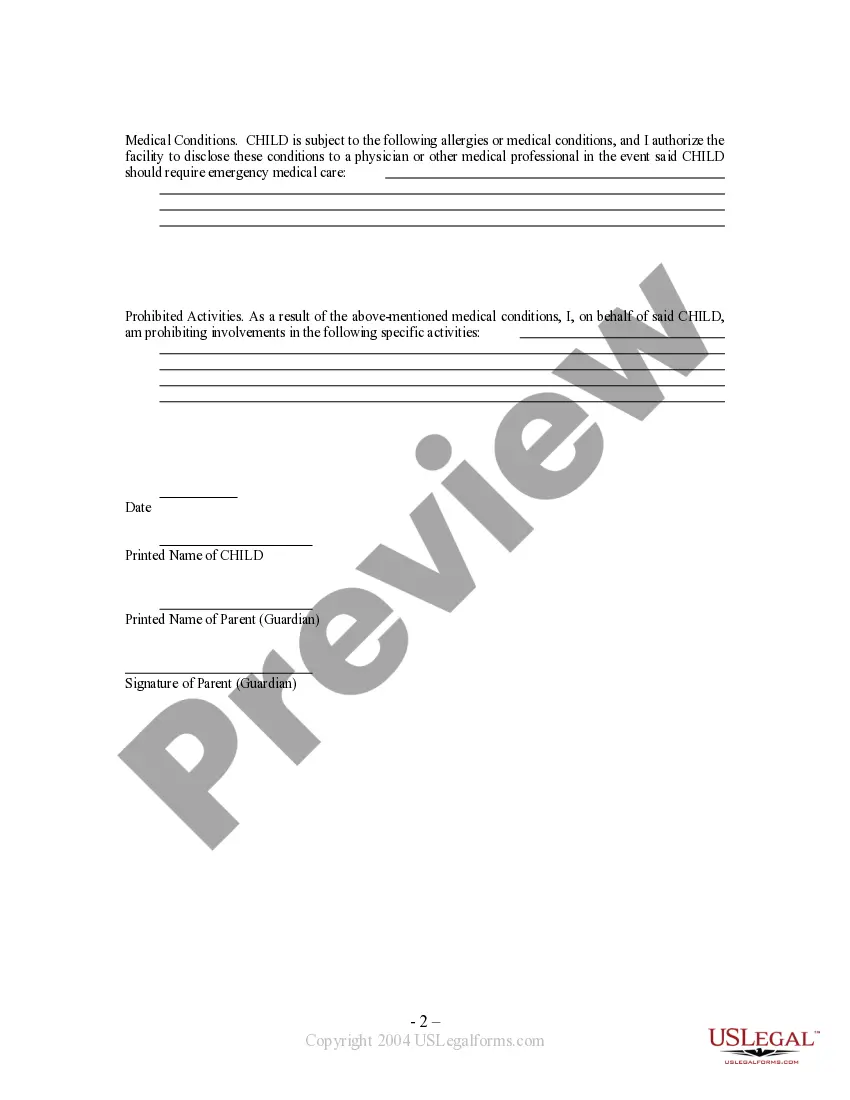
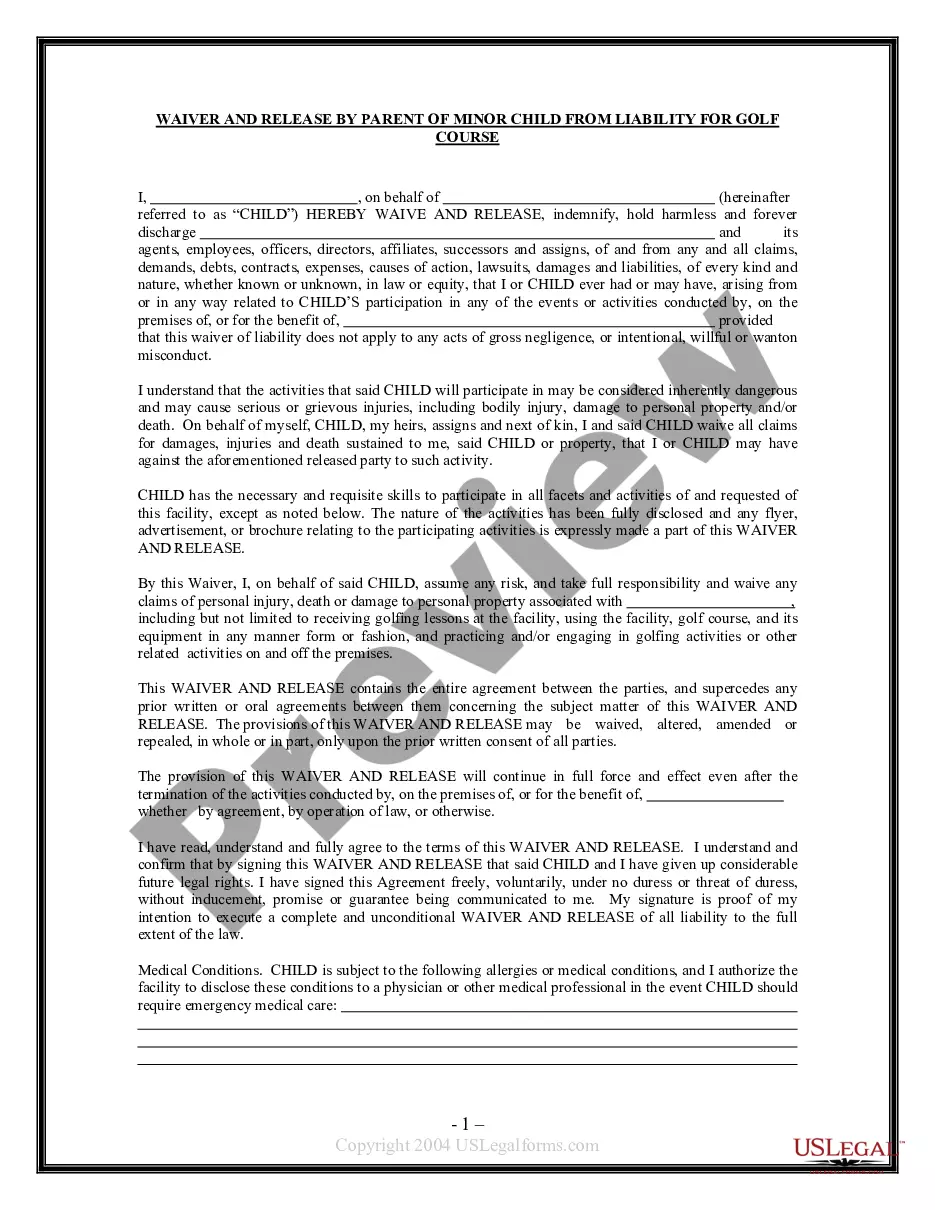
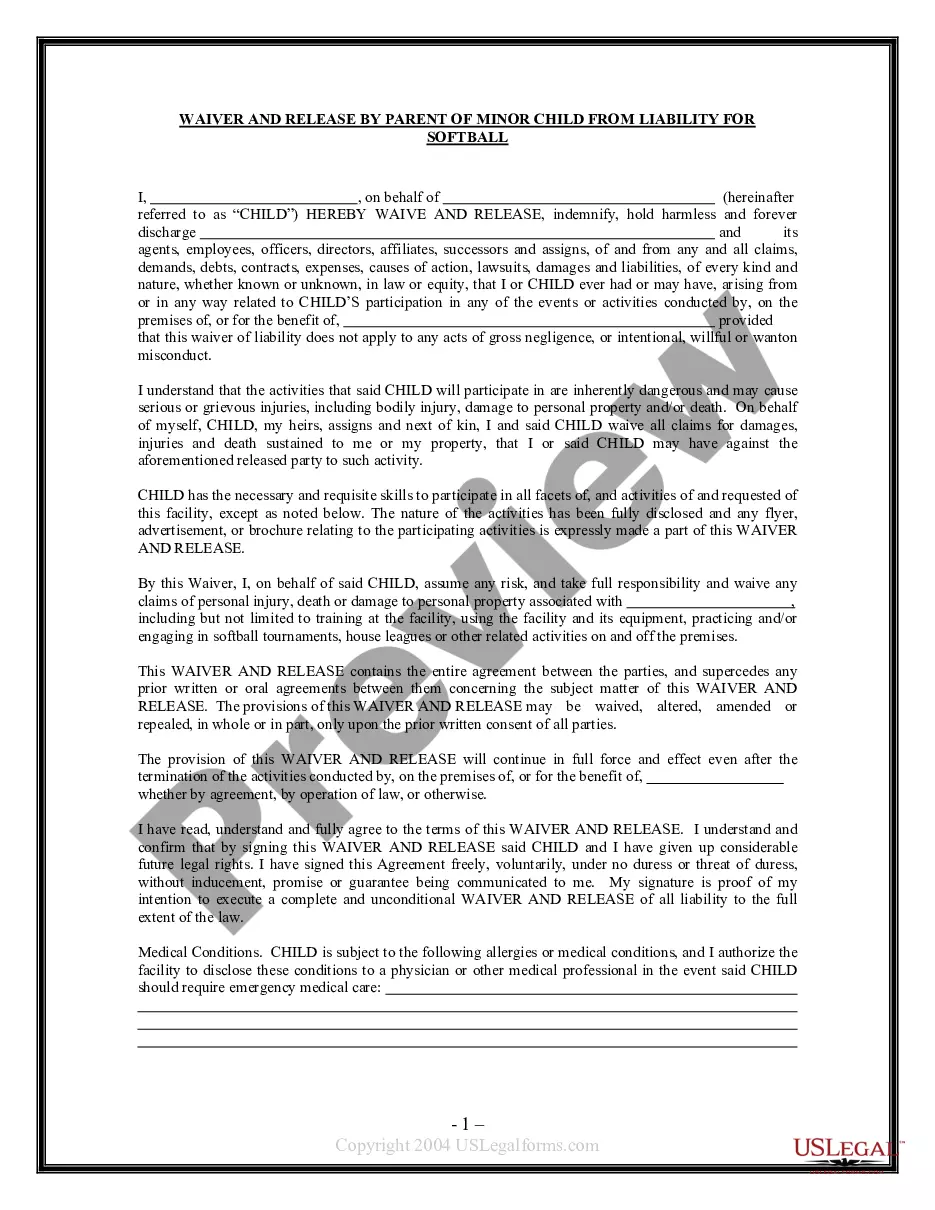
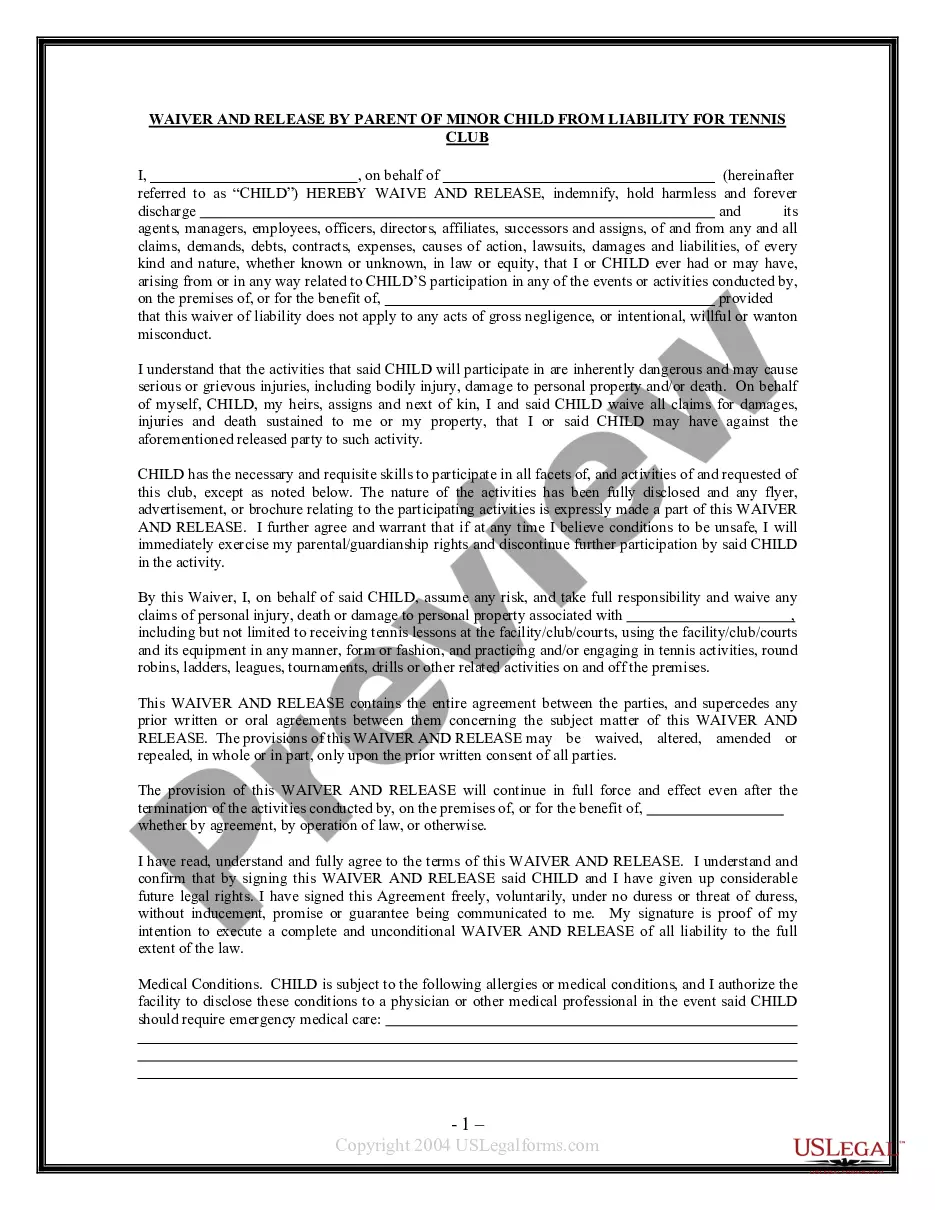
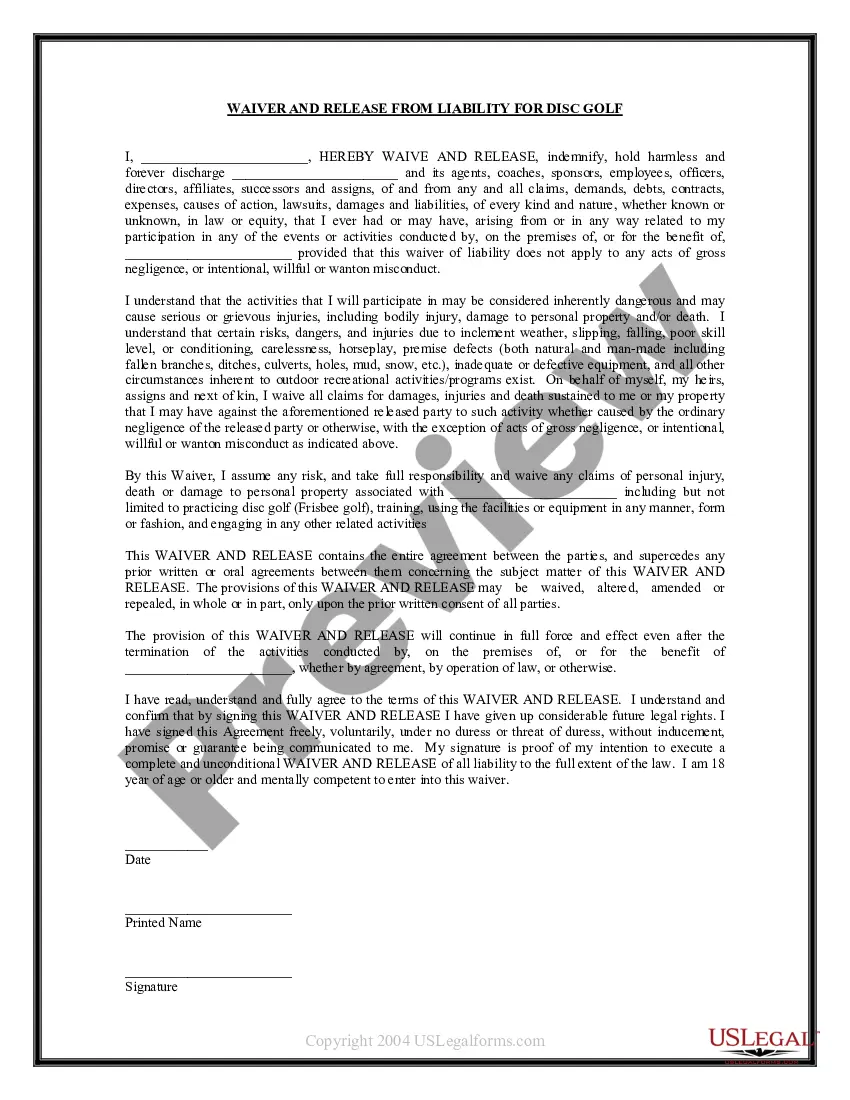
This form allows a parent or guardian to release a minor for disc golf from liability for injuries which may be incurred by a minor child while on the premises, taking part in activities, etc.
Georgia Waiver and Release From Liability For Minor Child for Disc Golf
Category:
State:
Multi-State
Control #:
US-WAV-84M
Format:
Word;
Rich Text
Instant download
Description
Free preview
How to fill out Waiver And Release From Liability For Minor Child For Disc Golf?
If you need to complete, download, or generate valid document templates, utilize US Legal Forms, the largest collection of legal forms available online.
Employ the site’s straightforward and user-friendly search to locate the documents you need.
Various templates for business and personal purposes are organized by categories and states, or keywords.
Step 4. Once you have found the form you need, click the Purchase now button. Choose the pricing plan you prefer and provide your information to register for an account.
Step 5. Complete the purchase. You can use your credit card or PayPal account to finalize the transaction.
- Utilize US Legal Forms to find the Georgia Waiver and Release From Liability For Minor Child for Disc Golf in just a few clicks.
- If you are already a US Legal Forms user, Log In to your account and then click the Download button to obtain the Georgia Waiver and Release From Liability For Minor Child for Disc Golf.
- You can also access forms you previously downloaded from the My documents section of your account.
- If you are using US Legal Forms for the first time, follow the instructions below.
- Step 1. Ensure you have selected the form for the correct city/state.
- Step 2. Use the Review option to inspect the form’s content. Be sure to read the summary.
- Step 3. If you are not satisfied with the form, utilize the Search field at the top of the screen to find other versions of the legal form template.
Form popularity
FAQ
To sum it up, customers can still sue business owners even when they've signed a waiver to use the business.
A waiver is a formal statement giving up a right. If you go on a school trip, your mom might sign a waiver saying that the school is not responsible if you get hurt on the trip. When you sign a waiver, you're voluntarily giving up a privilege or legal right.
The definition of a waiver is the act of voluntarily giving up rights or privileges, usually through a written statement. An example of waiver is a person signing a form releasing the owners of an event location from liability if the person signing the waiver was injured while at the event. noun.
A waiver is a legal agreement the primary purpose of which is to let you or another party modify or relinquish a right, privilege, or claim. The agreement can be a separate document on its own, such as if you sign a waiver form, or added to a contract as a waiver clause.
If the risks are specifically outlined in the waiver, chances are you will experience them. If nothing else, reading the waiver will prepare you for the activity, which may help you avoid injuries. The document will also state that signing the waiver releases the company of any injury liability.
A release of liability, also known as a liability waiver or a hold harmless agreement, is a contract in which one party agrees not to hold another party liable for damages or injury. These contracts are common in fields that involve some risk to property, finances, or health.
Liability waivers are enforceable in California solely to the extent they shift to the customer the risk of ordinary negligence. Under California law, a liability waiver cannot excuse an injury caused by a defendant's gross negligence, recklessness or intentionally wrongful act.
Waiver and release refers to the waiving of rights or privileges and the release of a party from their obligations or rights.
In California, waivers of liability are generally enforceable so long as they have been drafted correctly, are explicit as to the scope of coverage, are legible and use high-visibility text, and do not illegally waive unknown or unrelated claims.
The main difference between releases and waivers is the transferring of ownership. When rights are released, they are transferred to another party. When rights are waived, they are gone altogether.