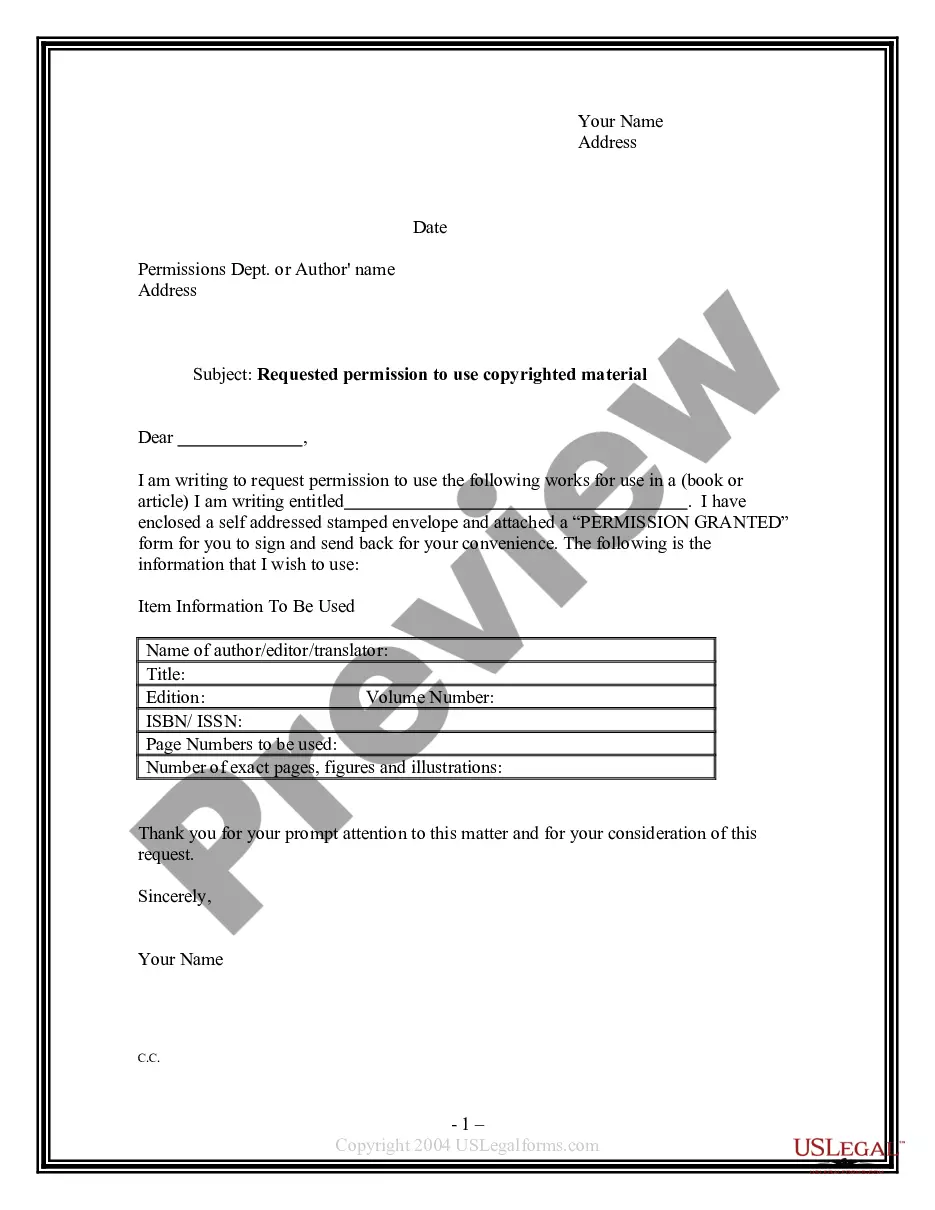
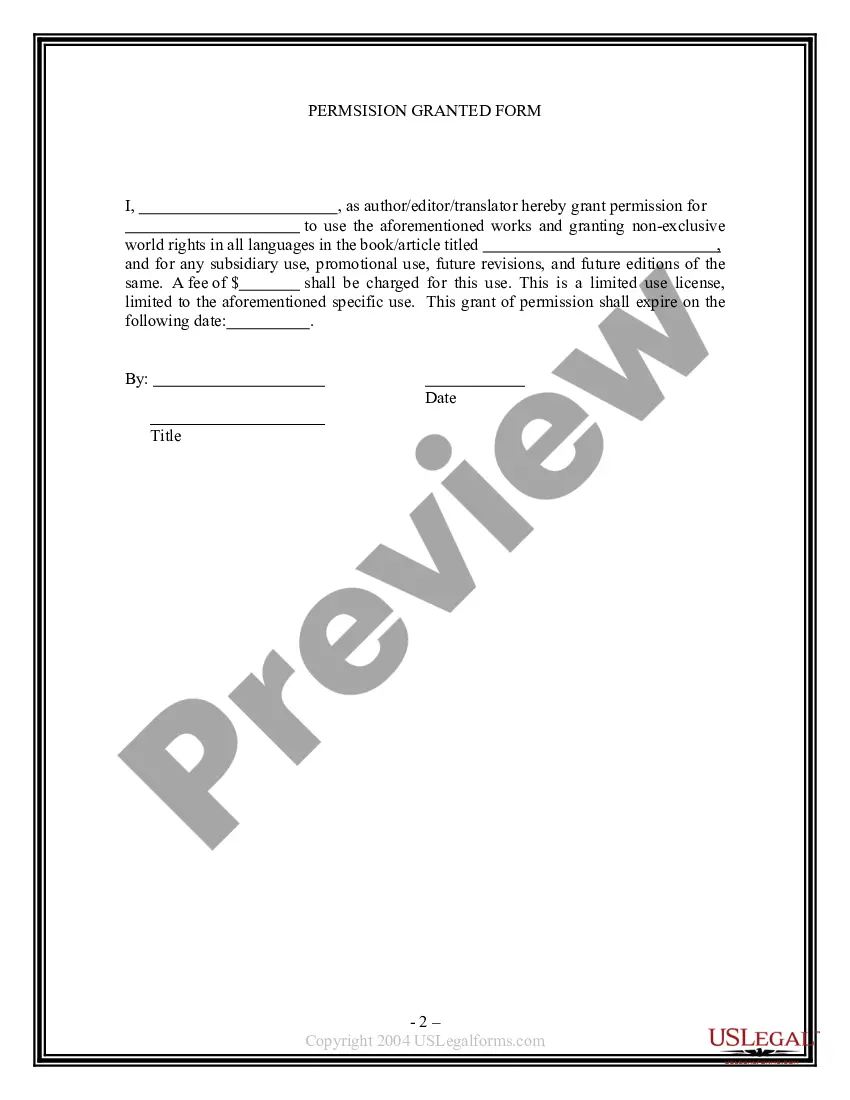
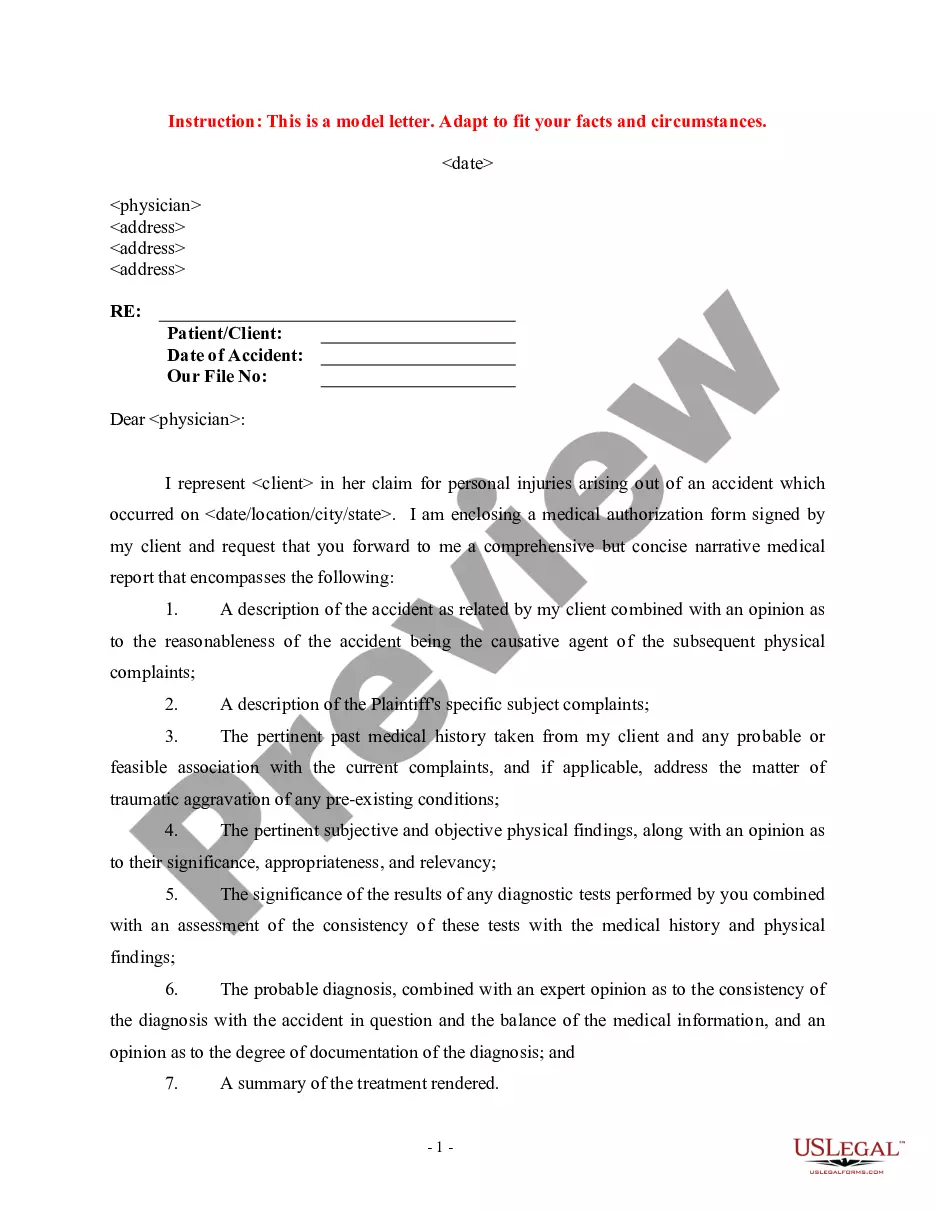
This is a request to the holder of a copyright asking permission to use the copyrighted material in a book or article. There is an attached addendum for the copyright holder to sign granting permission. The request can be granted for only a fixed period of time if the copyright holder does not want to grant the request to be used indefinitely.
Georgia Requested Permission to Use Copyrighted Material
State:
Multi-State
Control #:
US-PRM-07
Format:
Word;
Rich Text
Instant download
Description
Free preview
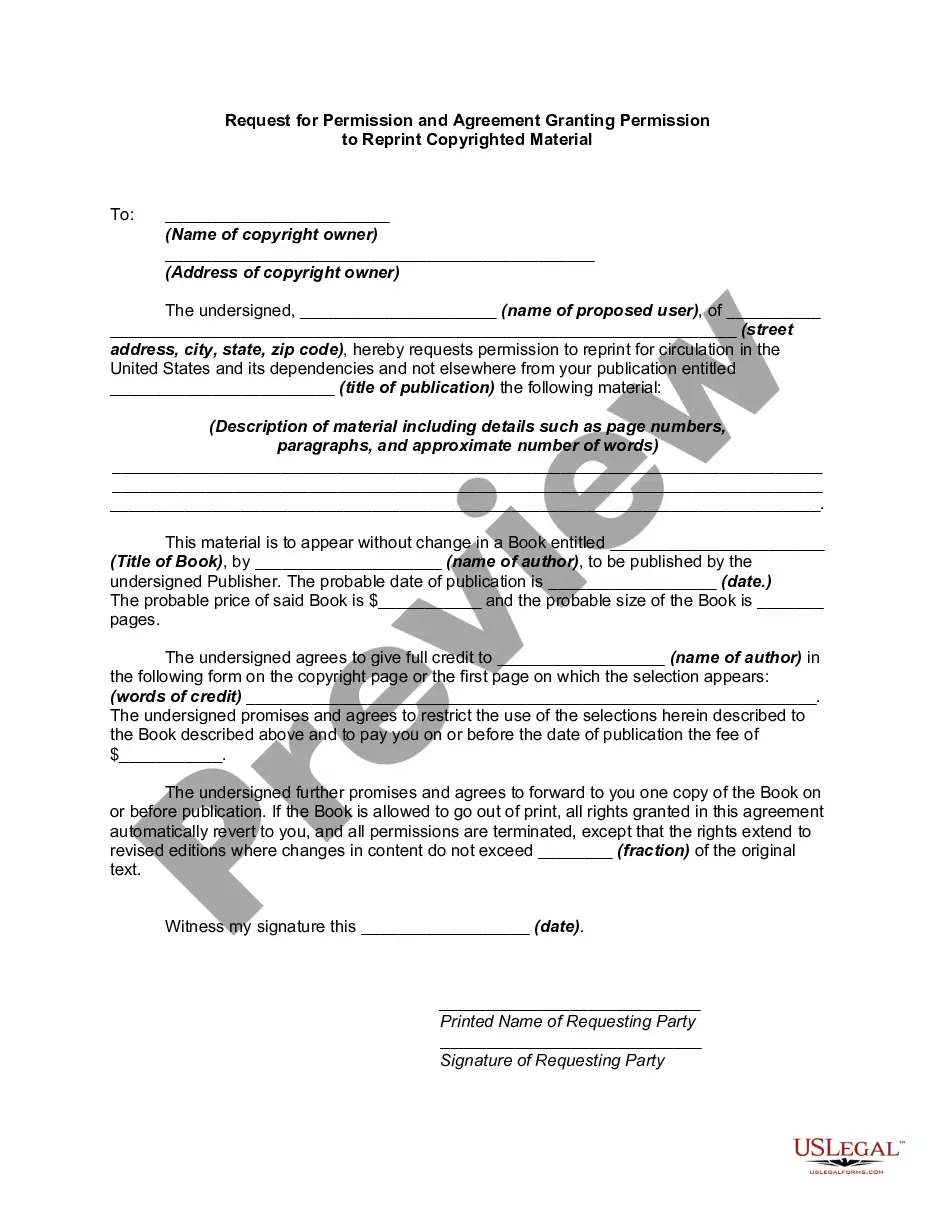
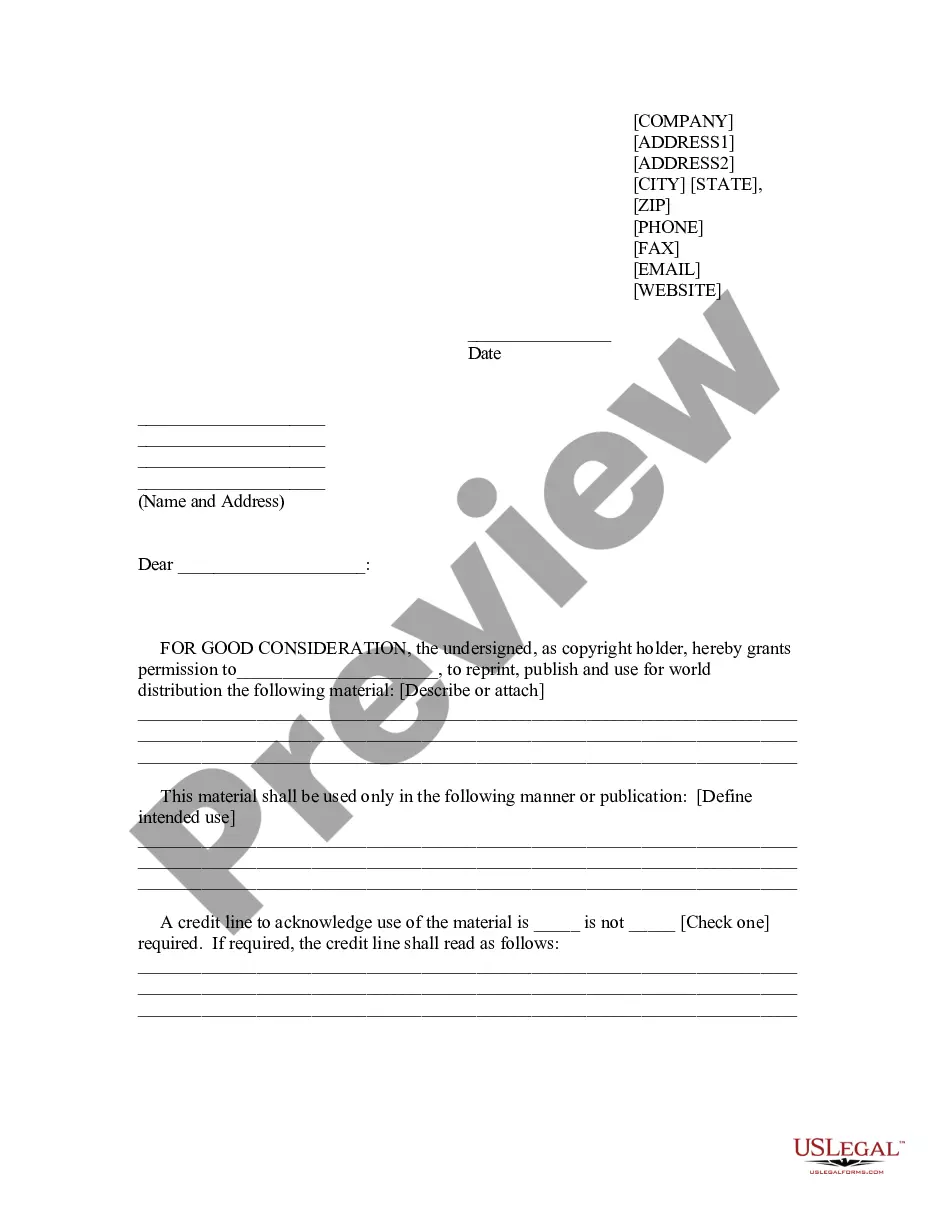

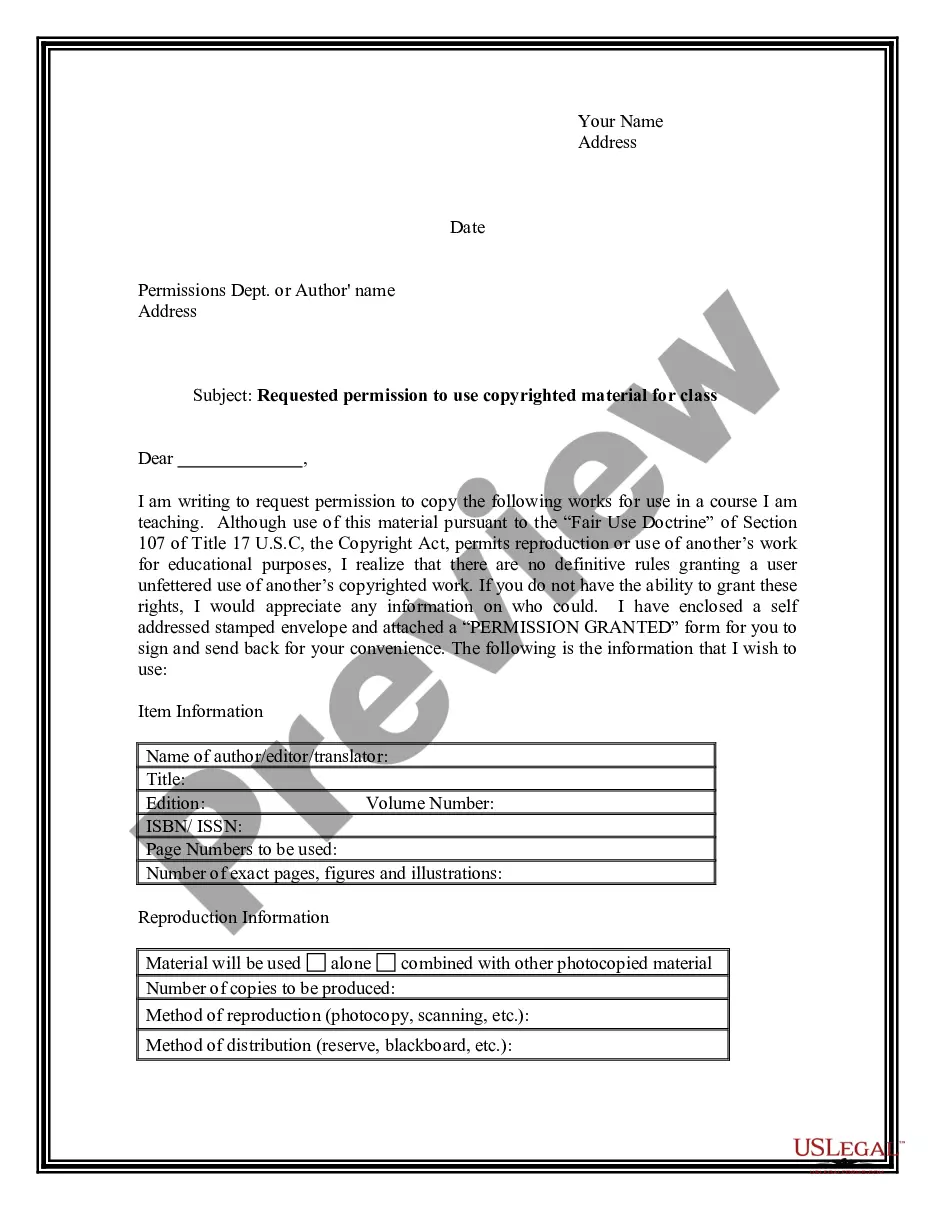
Get your form ready online
Our built-in tools help you complete, sign, share, and store your documents in one place.
Built-in online Word editor
Make edits, fill in missing information, and update formatting in US Legal Forms—just like you would in MS Word.
Export easily
Download a copy, print it, send it by email, or mail it via USPS—whatever works best for your next step.
E-sign your document
Sign and collect signatures with our SignNow integration. Send to multiple recipients, set reminders, and more. Go Premium to unlock E-Sign.
Notarize online 24/7
If this form requires notarization, complete it online through a secure video call—no need to meet a notary in person or wait for an appointment.
Store your document securely
We protect your documents and personal data by following strict security and privacy standards.

Make edits, fill in missing information, and update formatting in US Legal Forms—just like you would in MS Word.

Download a copy, print it, send it by email, or mail it via USPS—whatever works best for your next step.

Sign and collect signatures with our SignNow integration. Send to multiple recipients, set reminders, and more. Go Premium to unlock E-Sign.

If this form requires notarization, complete it online through a secure video call—no need to meet a notary in person or wait for an appointment.

We protect your documents and personal data by following strict security and privacy standards.
Looking for another form?


How to fill out Requested Permission To Use Copyrighted Material?
Are you currently in a role that requires documents for potential organization or specific purposes almost every day.
There are numerous legal document templates available online, but finding ones you can trust isn't easy.
US Legal Forms offers thousands of form templates, including the Georgia Requested Permission to Use Copyrighted Material, which are designed to meet federal and state requirements.
Once you find the correct form, click Get now.
Choose the pricing plan you want, fill out the necessary information to create your account, and complete your purchase using your PayPal or credit card. Select a convenient file format and download your copy. Access all the document templates you have purchased in the My documents menu. You can download another copy of Georgia Requested Permission to Use Copyrighted Material at any time, if needed. Click on the required form to download or print the document template. Use US Legal Forms, one of the largest collections of legal forms, to save time and avoid mistakes. The service provides professionally crafted legal document templates that you can utilize for various purposes. Create your account on US Legal Forms and start making your life a bit easier.
- If you are already familiar with the US Legal Forms website and have an account, simply Log In.
- Then, you can download the Georgia Requested Permission to Use Copyrighted Material template.
- If you do not have an account and wish to start using US Legal Forms, follow these steps.
- Locate the form you need and ensure it is for the correct city/state.
- Utilize the Review feature to inspect the form.
- Read the description to confirm that you have selected the appropriate form.
- If the form isn’t what you’re searching for, use the Search field to find the form that suits your needs and requirements.
Form popularity
FAQ
How much of someone else's work can I use without getting permission? Under the fair use doctrine of the U.S. copyright statute, it is permissible to use limited portions of a work including quotes, for purposes such as commentary, criticism, news reporting, and scholarly reports.
Although many uses of works may be free, you should usually expect to pay somethingeven a minimal feefor copyright permission, said Stanford University Libraries. For instance, using a stock image can cost as little as $5; but, a song license may be a few thousand dollars.
Copyright law allows "fair use" of small parts of copyrighted works without the permission of the author. If the reproduction is for the purpose of criticism, news reporting, teaching, or research it is more likely to be fair use than if it is copied for commercial purposes.
What is fair use? Fair use allows limited use of copyrighted material without permission from the copyright holder for purposes such as criticism, parody, news reporting, research and scholarship, and teaching.
The Copyright Office cannot grant permission to use copyrighted works. In many situations, securing permission is the most certain way to ensure an intended use is not an infringement of the copyright owner's rights. For more information about limitations to copyright law, see fl 102, Fair Use.
Fair use allows limited use of copyrighted material without permission from the copyright holder for purposes such as criticism, parody, news reporting, research and scholarship, and teaching. There are four factors to consider when determining whether your use is a fair one.
Although many uses of works may be free, you should usually expect to pay somethingeven a minimal feefor copyright permission, said Stanford University Libraries. For instance, using a stock image can cost as little as $5; but, a song license may be a few thousand dollars.
Step-by-Step Guide to Get Copyright PermissionsStep 1: Determine if you require permission to use or adapt the original work.Step 2: Identify the copyright holder.Step 3: Send a request to the owner for permission to use the work.Step 4: Cite the original work appropriately.
In general, the permissions process involves a simple five-step procedure:Determine if permission is needed.Identify the owner.Identify the rights needed.Contact the owner and negotiate whether payment is required.Get your permission agreement in writing.
How To Get Copyright Permission?Step One: Identify the Type of Permission Needed. Copyright law vests each creator with certain exclusive rights.Step Two: Identifying and Locating the Copyright Owner(s)Step Three: Negotiating Permission.