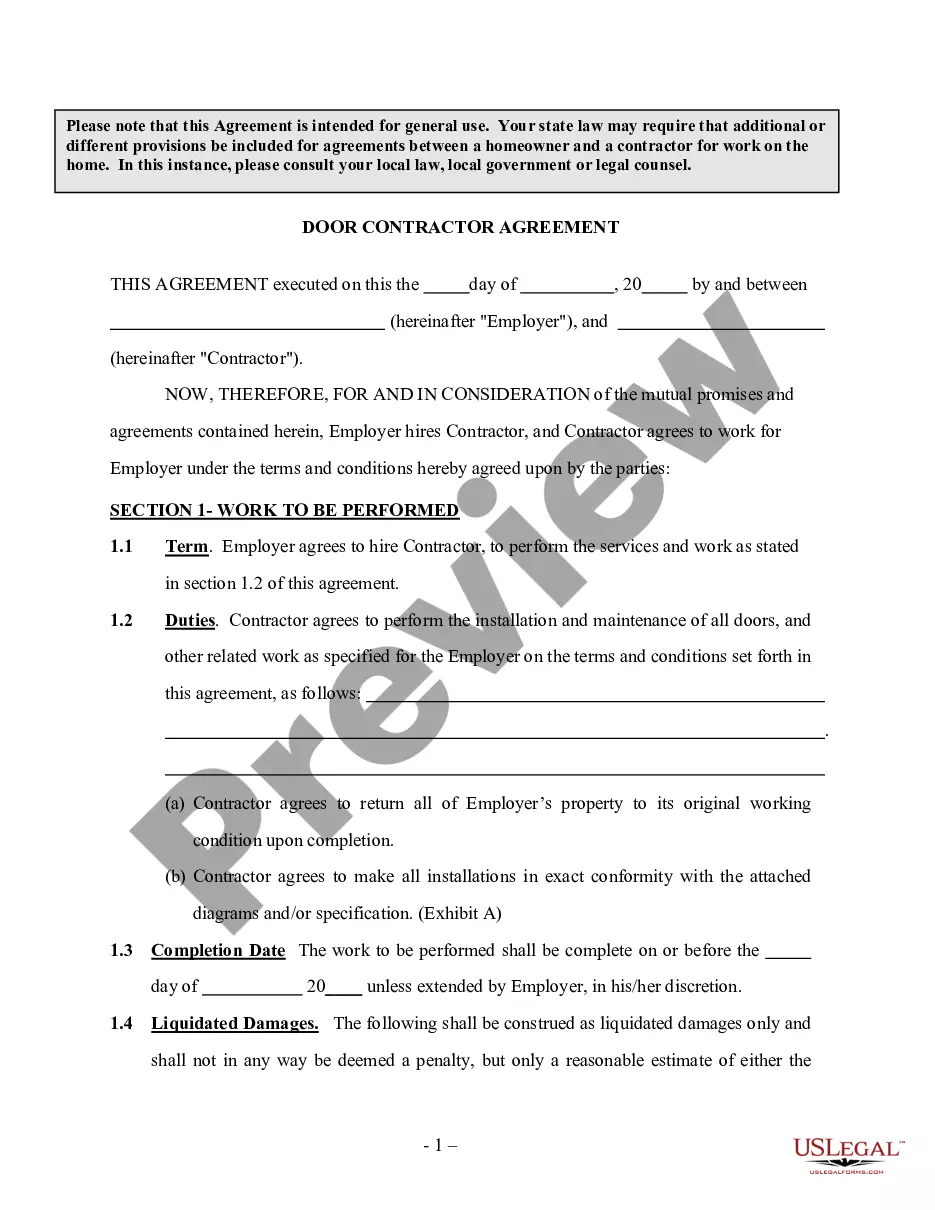
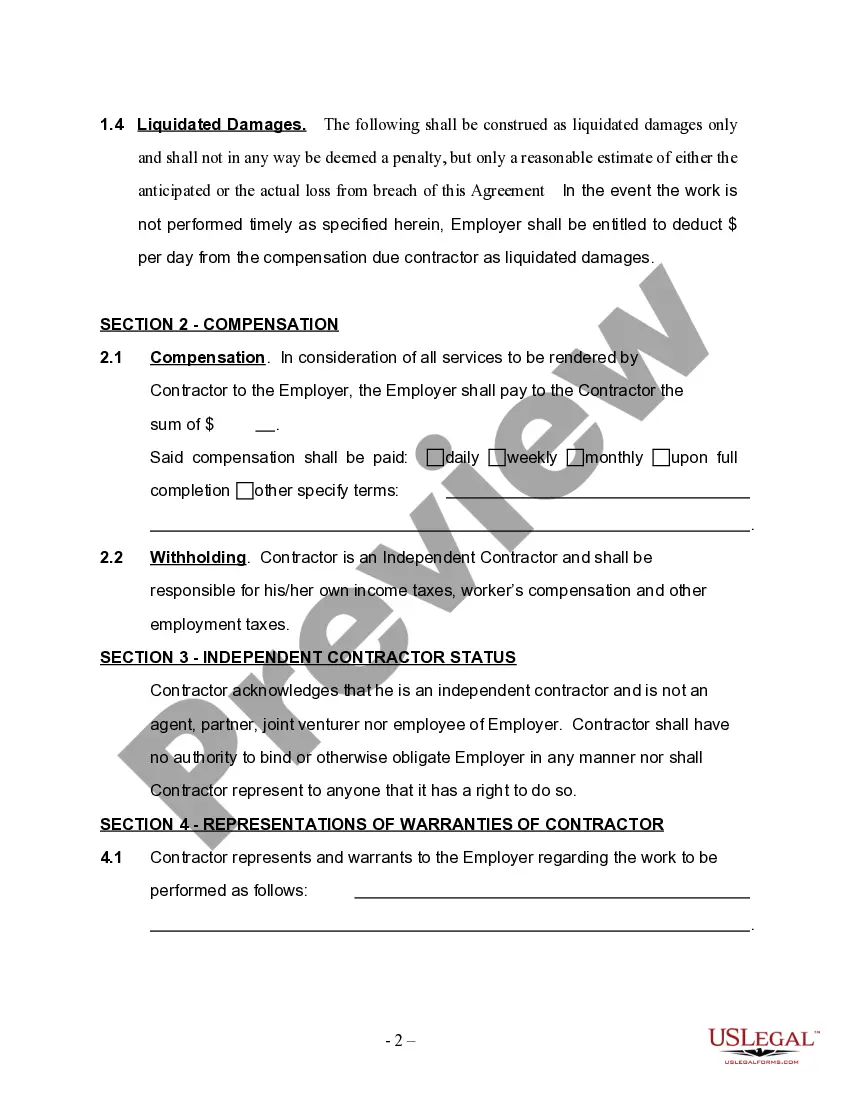
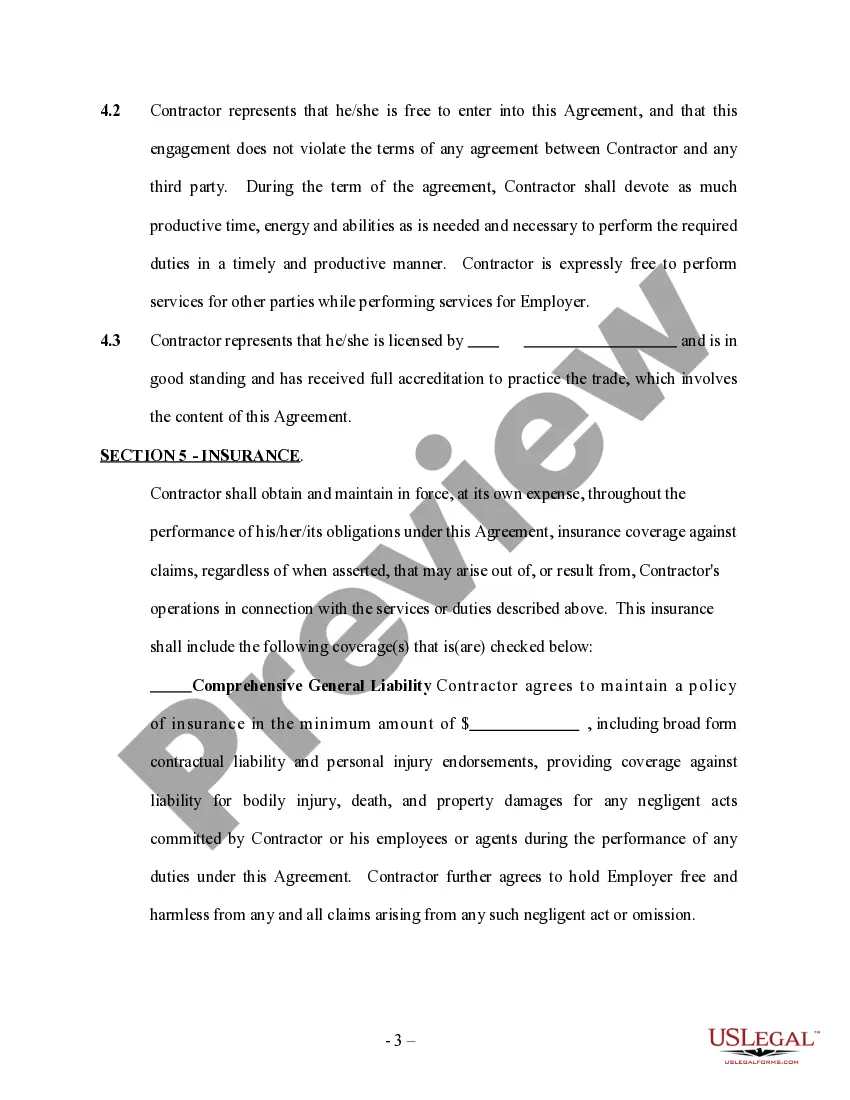
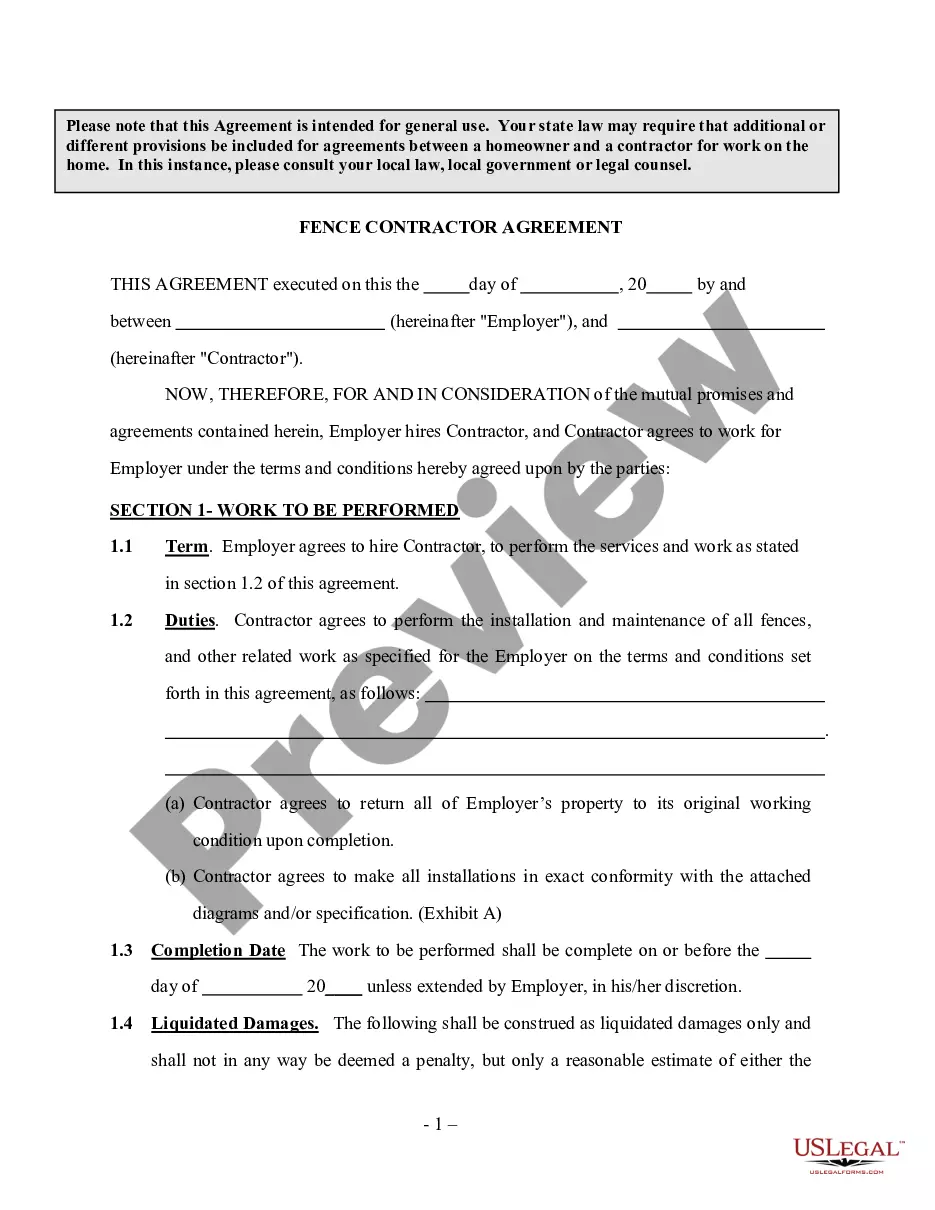
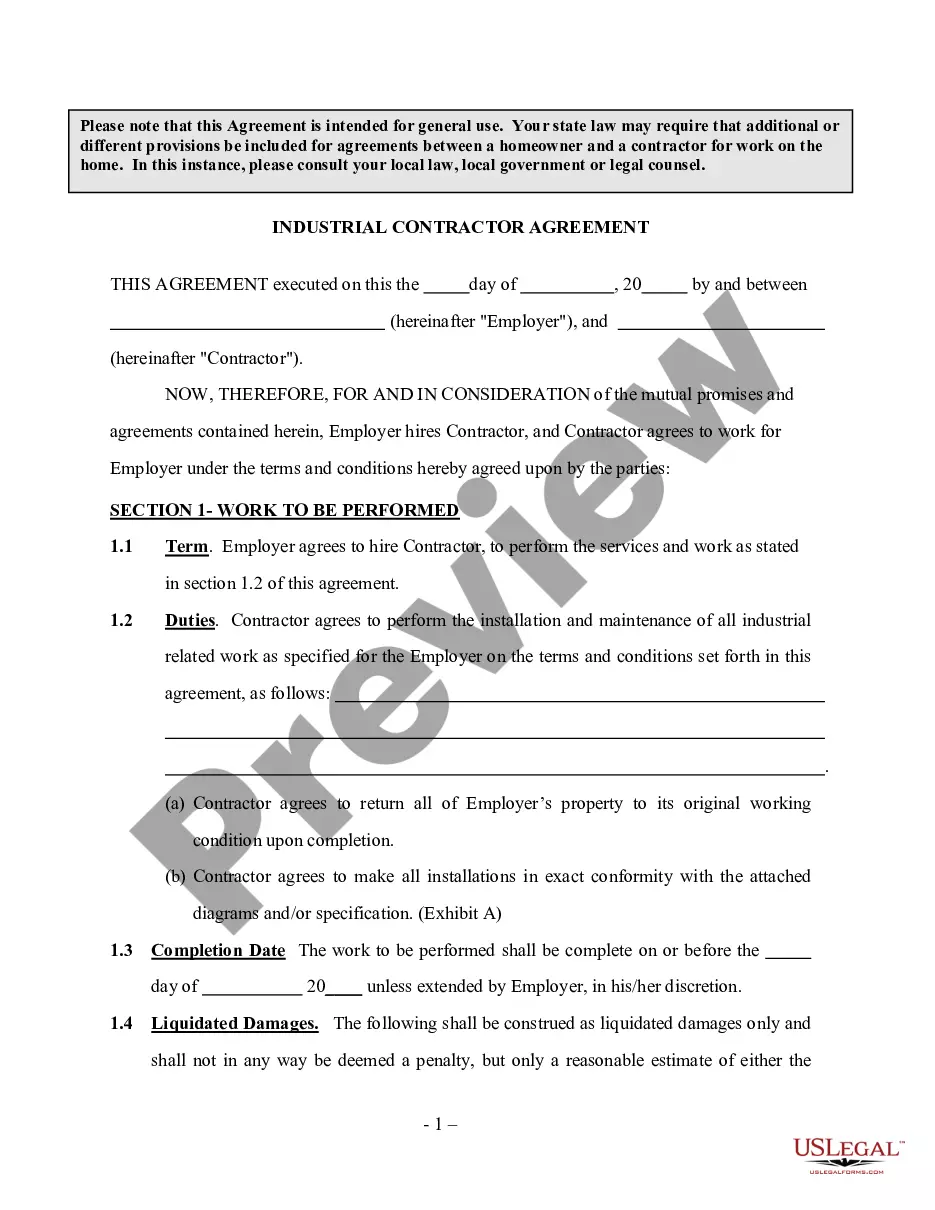
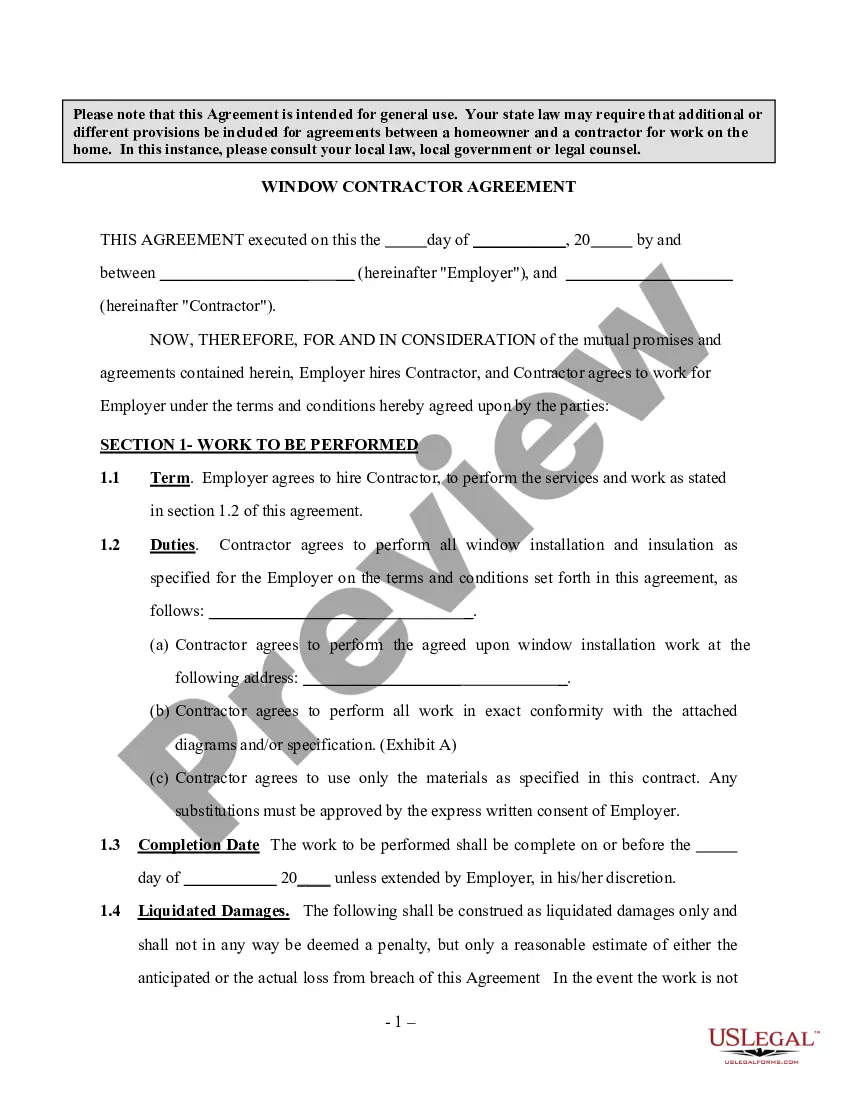
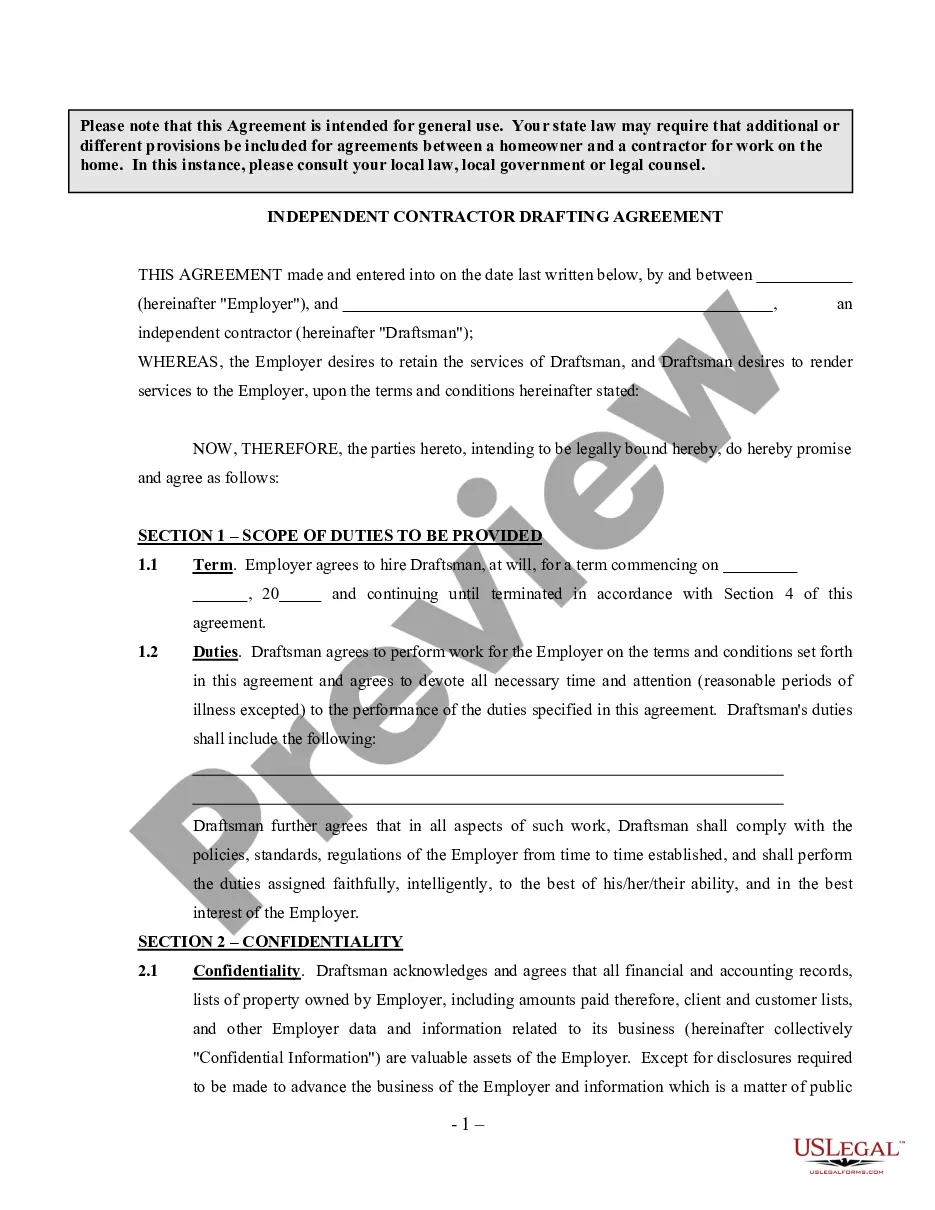
Employer contracts with an independent contractor to provide, install and service doors as specified and agreed upon in the contract. Please note that this Agreement is intended for general use. Your state law may require that additional or different provisions be included for agreements between a homeowner and a contractor for work on the home. In this instance, please consult your local law, local government or legal counsel.
Georgia Door Contractor Agreement - Self-Employed
State:
Multi-State
Control #:
US-INDC-108
Format:
Word;
Rich Text
Instant download
Description
Free preview
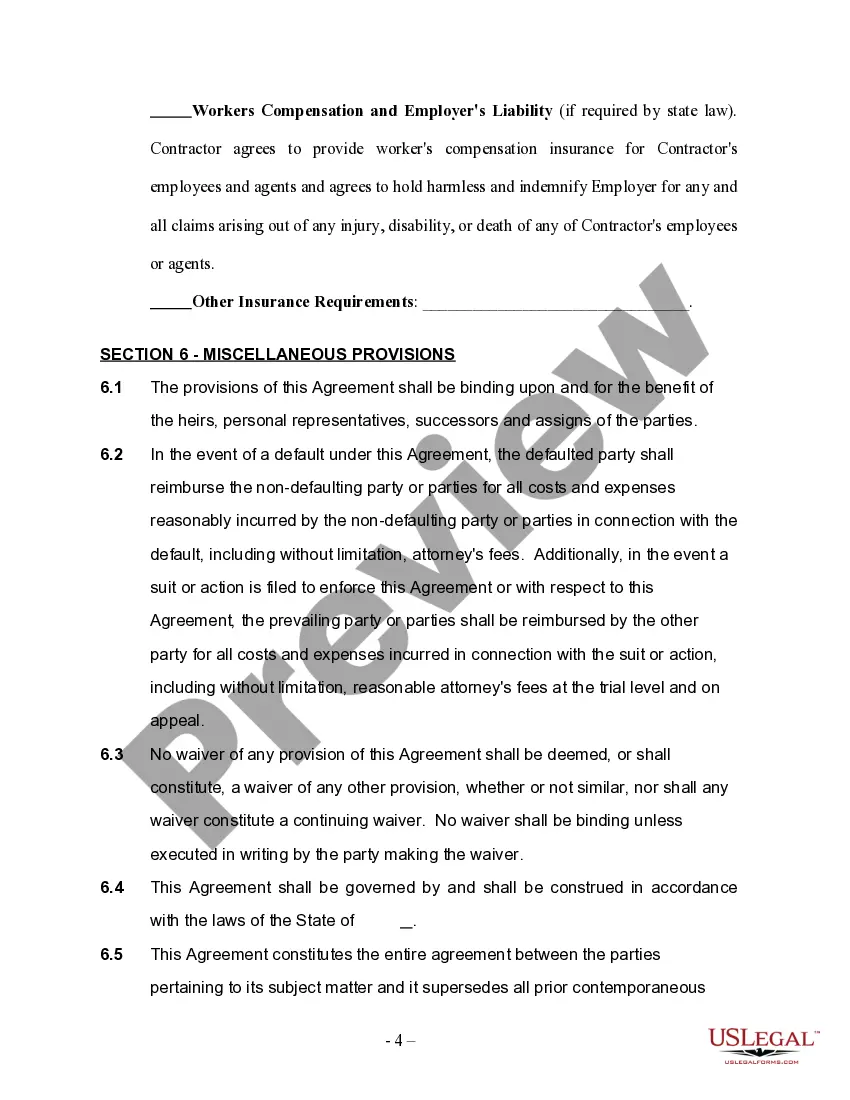
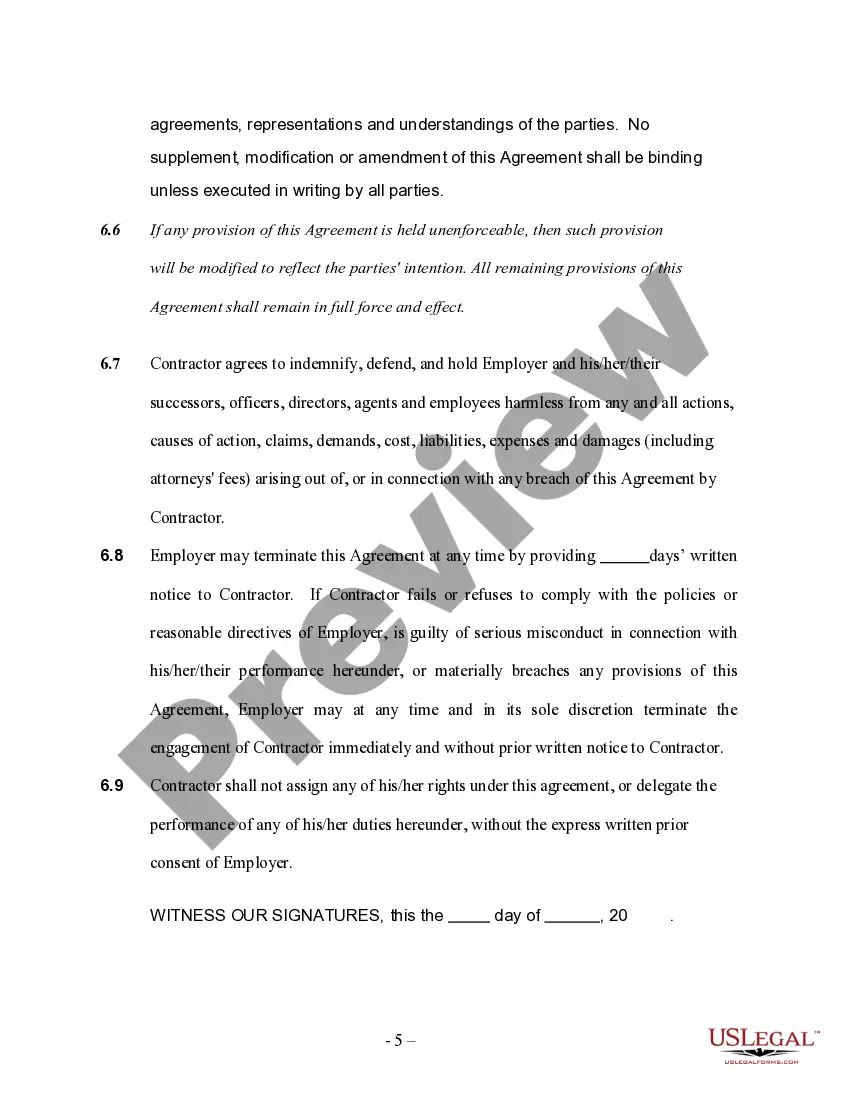
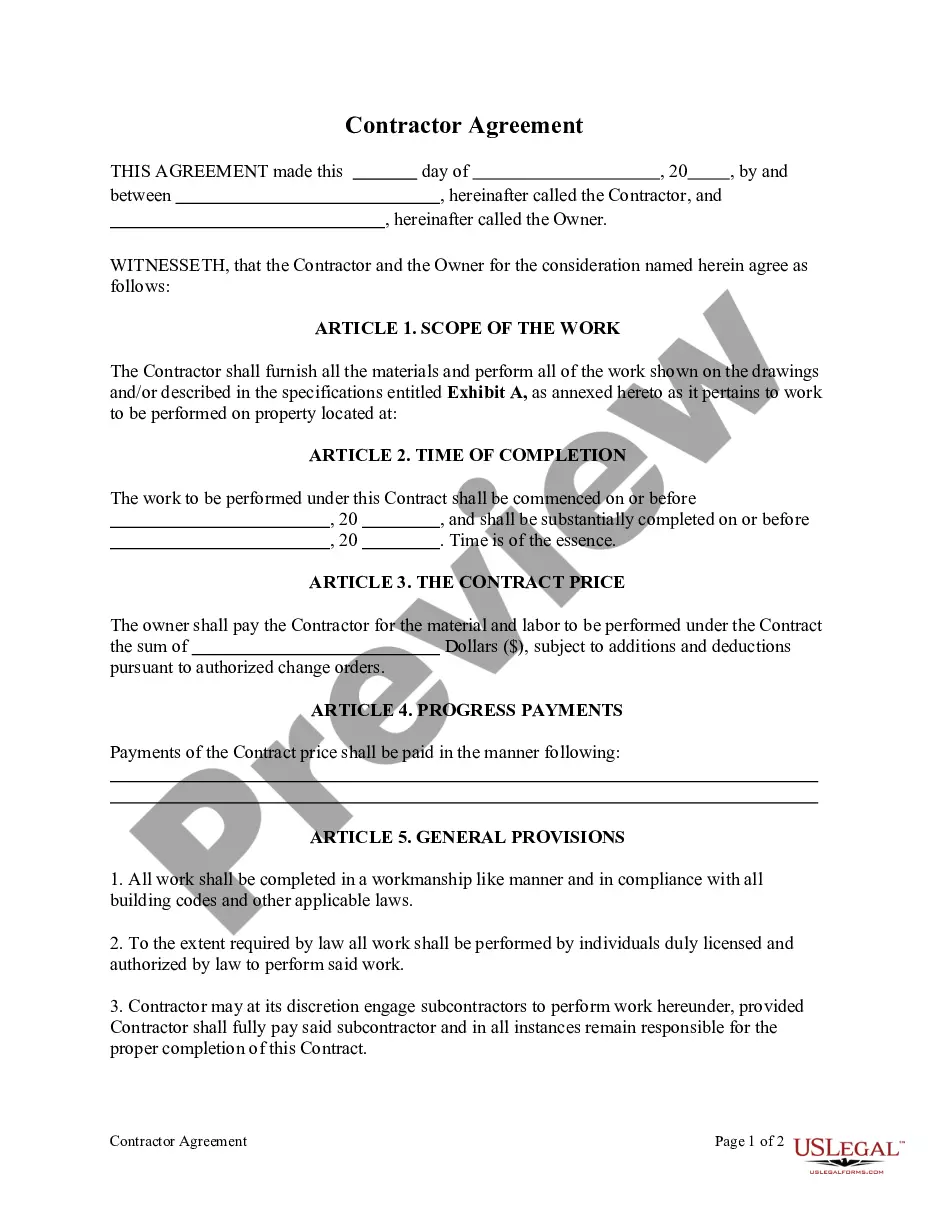
Get your form ready online
Our built-in tools help you complete, sign, share, and store your documents in one place.
Built-in online Word editor
Make edits, fill in missing information, and update formatting in US Legal Forms—just like you would in MS Word.
Export easily
Download a copy, print it, send it by email, or mail it via USPS—whatever works best for your next step.
E-sign your document
Sign and collect signatures with our SignNow integration. Send to multiple recipients, set reminders, and more. Go Premium to unlock E-Sign.
Notarize online 24/7
If this form requires notarization, complete it online through a secure video call—no need to meet a notary in person or wait for an appointment.
Store your document securely
We protect your documents and personal data by following strict security and privacy standards.

Make edits, fill in missing information, and update formatting in US Legal Forms—just like you would in MS Word.

Download a copy, print it, send it by email, or mail it via USPS—whatever works best for your next step.

Sign and collect signatures with our SignNow integration. Send to multiple recipients, set reminders, and more. Go Premium to unlock E-Sign.

If this form requires notarization, complete it online through a secure video call—no need to meet a notary in person or wait for an appointment.

We protect your documents and personal data by following strict security and privacy standards.
Looking for another form?



How to fill out Door Contractor Agreement - Self-Employed?
US Legal Forms - one of the largest collections of legal documents in the United States - offers a broad selection of legal document templates that you can download or print.
By utilizing the website, you can discover thousands of forms for business and personal purposes, organized by categories, states, or keywords. You can find the latest versions of documents like the Georgia Door Contractor Agreement - Self-Employed in moments.
If you have an existing subscription, Log In to acquire the Georgia Door Contractor Agreement - Self-Employed from the US Legal Forms library. The Download button will appear on each form you view. You can access all previously downloaded forms in the My documents section of your account.
Complete the transaction. Use your credit card or PayPal account to process the payment.
Select the format and download the form to your device. Edit it as needed. Fill out, revise, and print, then sign the downloaded Georgia Door Contractor Agreement - Self-Employed.
Every template you save in your account does not expire and remains yours forever. Thus, if you wish to download or print another copy, simply visit the My documents section and click on the required form.
Access the Georgia Door Contractor Agreement - Self-Employed with US Legal Forms, the most comprehensive collection of legal document templates. Utilize thousands of professional and state-specific templates that meet your business or personal requirements and standards.
- Ensure you have selected the correct form for your area/region.
- Click on the Preview button to review the content of the form.
- Check the form details to confirm that you have chosen the right document.
- If the form doesn't match your needs, use the Search field at the top of the screen to find the one that does.
- Once you are satisfied with the form, confirm your choice by clicking on the Get now button.
- Then, choose your preferred pricing plan and provide your credentials to sign up for an account.
Form popularity
FAQ
In Georgia, you can perform minor repair and maintenance work without a contractor's license, but there are limits. For example, if your work costs less than $2,500, you may not need a license. However, larger projects require a Georgia Door Contractor Agreement - Self-Employed to formalize the relationship and ensure compliance with state regulations. Using a legal platform like uslegalforms can help you draft appropriate agreements to protect your interests.
Writing a Georgia Door Contractor Agreement - Self-Employed involves drafting a document that captures all necessary details clearly. You need to start with the parties' names, followed by a comprehensive scope of work, compensation terms, and important deadlines. Including clauses for confidentiality, termination, and liability can strengthen the contract. To make this task easier, reference uslegalforms for professional templates and instructions.
Filling out a Georgia Door Contractor Agreement - Self-Employed form requires you to provide detailed information about the job and the contractor. Begin by listing the parties involved, followed by a clear description of services offered. Don't forget to specify payment details and timelines. Consider utilizing uslegalforms for easy access to organized templates and guidance.
To complete a Georgia Door Contractor Agreement - Self-Employed, start by entering the contractor's information, including names and addresses. Next, outline the scope of work, payment terms, and deadlines. Ensure you include relevant clauses for liability and dispute resolution. Using a template from uslegalforms can simplify this process and ensure the agreement meets legal standards.
An independent contractor agreement in Georgia outlines the terms of the working relationship between the contractor and the client. This document is crucial for establishing expectations, responsibilities, and payment terms, especially for those in a Georgia Door Contractor Agreement - Self-Employed. It protects both parties by clearly defining each person’s obligations and can be customized to fit specific project needs. Using a reliable platform like US Legal Forms can simplify the process of creating this agreement.
Yes, an independent contractor is typically considered self-employed. This classification means that they operate their own business and have the freedom to choose how to complete their work. In the context of a Georgia Door Contractor Agreement - Self-Employed, this independence allows contractors to manage their projects and clients directly. Understanding this distinction can help you navigate contracts and expectations more effectively.
What the service is and how much the contractor will be paid. If the client/customer will cover expenses or provide resources. When the contract will end. If either party will be penalized for things such as late payments or unfinished work.
Who Needs a Contractor's License in Georgia? General contractors performing work over $2,500 and all residential contractors need to obtain a license at the state level.
Here are some steps you may use to guide you when you write an employment contract:Title the employment contract.Identify the parties.List the term and conditions.Outline the job responsibilities.Include compensation details.Use specific contract terms.Consult with an employment lawyer.Employment.More items...?