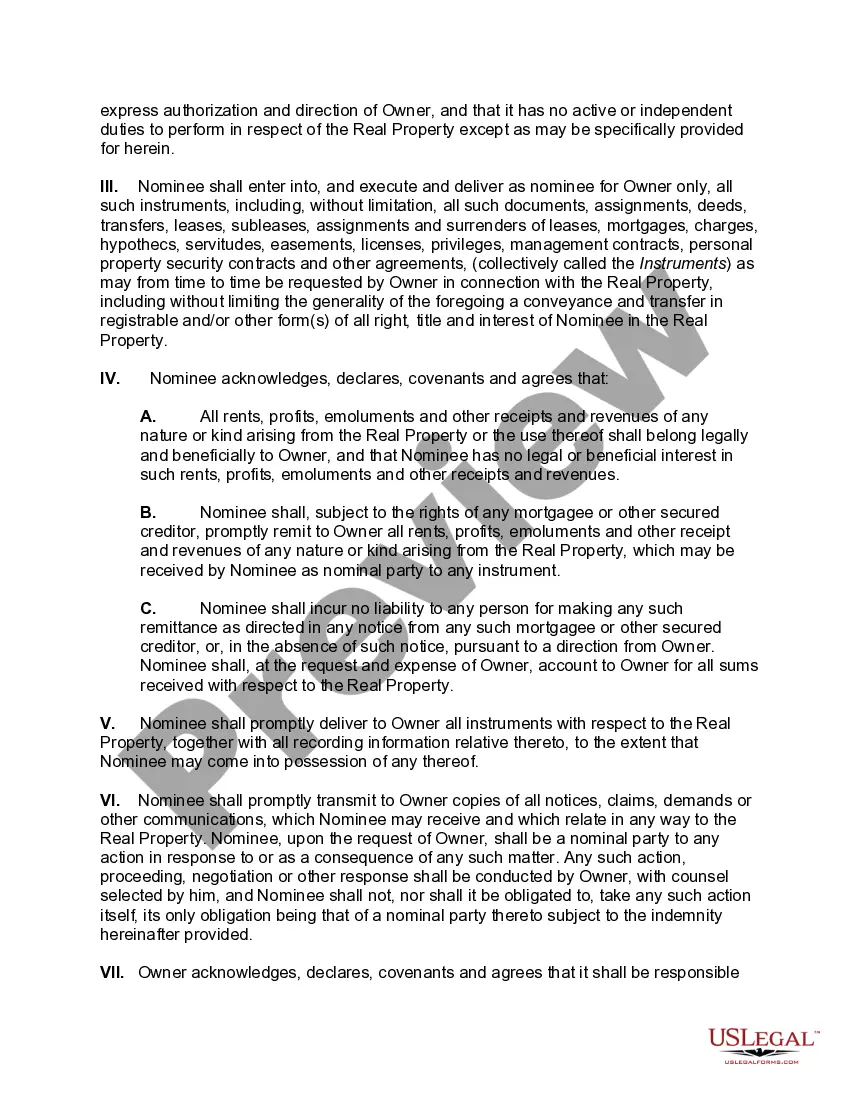
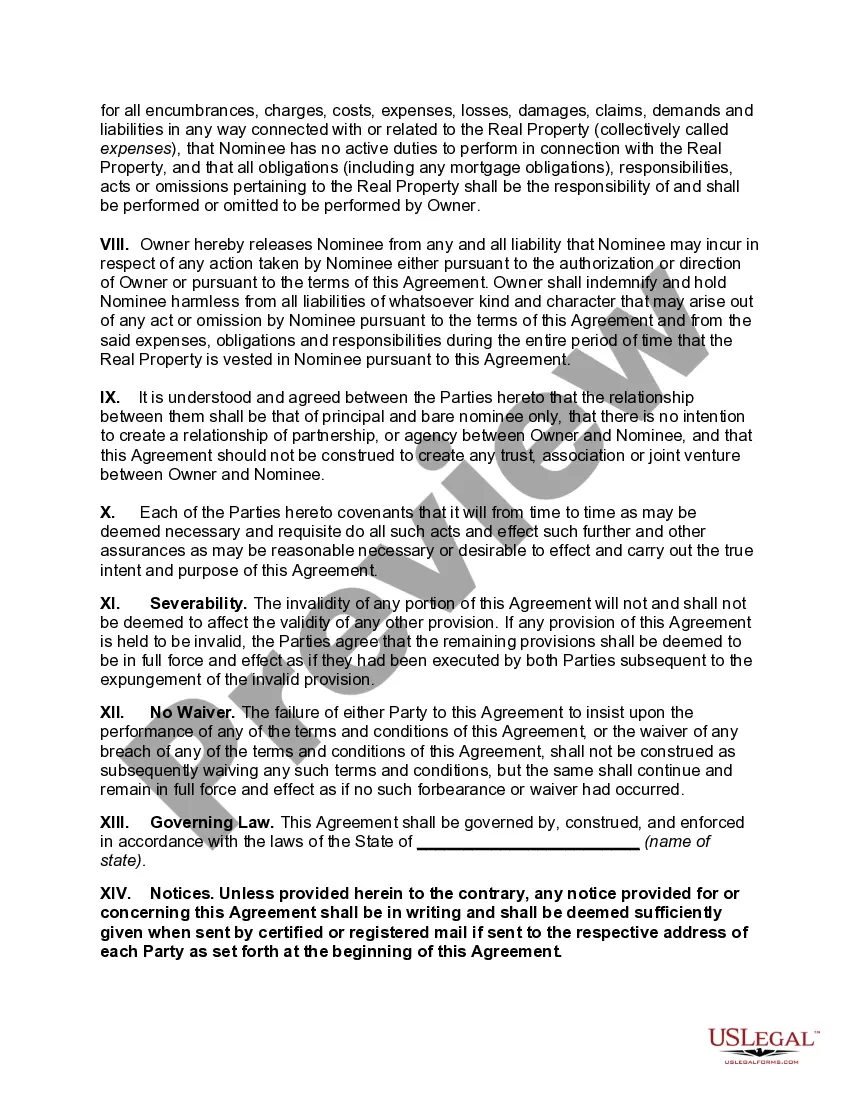
Georgia Nominee Agreement
Description
Get your form ready online
Our built-in tools help you complete, sign, share, and store your documents in one place.
Make edits, fill in missing information, and update formatting in US Legal Forms—just like you would in MS Word.
Download a copy, print it, send it by email, or mail it via USPS—whatever works best for your next step.
Sign and collect signatures with our SignNow integration. Send to multiple recipients, set reminders, and more. Go Premium to unlock E-Sign.
If this form requires notarization, complete it online through a secure video call—no need to meet a notary in person or wait for an appointment.
We protect your documents and personal data by following strict security and privacy standards.

Make edits, fill in missing information, and update formatting in US Legal Forms—just like you would in MS Word.

Download a copy, print it, send it by email, or mail it via USPS—whatever works best for your next step.

Sign and collect signatures with our SignNow integration. Send to multiple recipients, set reminders, and more. Go Premium to unlock E-Sign.

If this form requires notarization, complete it online through a secure video call—no need to meet a notary in person or wait for an appointment.

We protect your documents and personal data by following strict security and privacy standards.
Looking for another form?




How to fill out Nominee Agreement?
US Legal Forms - one of the most extensive collections of authentic documents in the United States - offers a range of legal document templates that you can download or print.
By utilizing the website, you can access thousands of forms for business and personal purposes, organized by categories, states, or keywords. You can find the latest documents such as the Georgia Nominee Agreement within moments.
If you have a subscription, Log In and download the Georgia Nominee Agreement from your US Legal Forms collection. The Acquire button will appear on each form you view. You can access all previously downloaded forms in the My documents section of your account.
Choose the format and download the document onto your device.
Make edits. Complete, modify, and print, then sign the downloaded Georgia Nominee Agreement.
- Ensure you have selected the correct form for your area/state. Click the Review button to check the document's content.
- Examine the form details to make sure you have chosen the appropriate document.
- If the form does not meet your requirements, use the Search area at the top of the screen to find one that does.
- If you are satisfied with the document, confirm your choice by clicking the Purchase now button.
- Then, select the payment plan you want and provide your information to register for your account.
- Process the payment. Use your credit card or PayPal account to complete the transaction.
Form popularity
FAQ
The primary reason for a nominee arrangement is to maintain confidentiality while fulfilling legal and regulatory requirements. By engaging a nominee, business owners can shield their identities from public records, which can be particularly beneficial in competitive markets. A Georgia Nominee Agreement clearly defines how the nominee will operate on behalf of the owner, ensuring transparency and compliance. This arrangement serves as a strategic tool for various business objectives.
A nomination clause is to be distinguished from a novation of the agreement as it is restricted in being a right for the benefiting party to direct a transfer to the nominee. A nomination clause does not result in the nominee becoming a party to the contract. Consequently, the nominee can reject the nomination.
Purchasers often nominate a third party to perform the obligations under an agreement for sale and purchase. They flag their intention to do so by using the words and/or nominee on the front of the agreement.
A nominee is a person or firm whose name is titled on securities or other property to facilitate certain transactions or transfers while leaving the original customer as the actual or legal owner. In this way, a nominee can serve as a custodian.
A "nominee" is someone who is given limited authority to act on behalf of an entity, usually for a limited period of time, and usually during the formation of the entity. The "principal officer, general partner," etc., as defined by the IRS, is the true "responsible party" for the entity, instead of a nominee.
A Nominee Trust is an estate planning tool that is unique to Massachusetts. It is essentially a realty trust in which the trust holds the property for the beneficiaries, but the beneficiaries are able to exercise control over the real property.
Example: In a real estate purchase agreement, Bob Buyer agrees to purchase the property, but provides that title (legal ownership) will be granted to "Bob Buyer or nominee," so that Buyer can sell his rights to another person before the deal closes, or because Buyer is really acting for someone else.
According to the Indian law, the nominee will receive and hold the property of the deceased until the nominee is legally bound to transfer or distribute it to the legal heirs of the deceased. For instance, if a husband has nominated his wife in his life insurance policy.
A nominee is ordinarily a related entity to the buyer named in the purchase and sale agreement. An assignment occurs when the buyer assigns their interest in the purchase and sale agreement to someone else. An assignee is an entirely different person or entity.
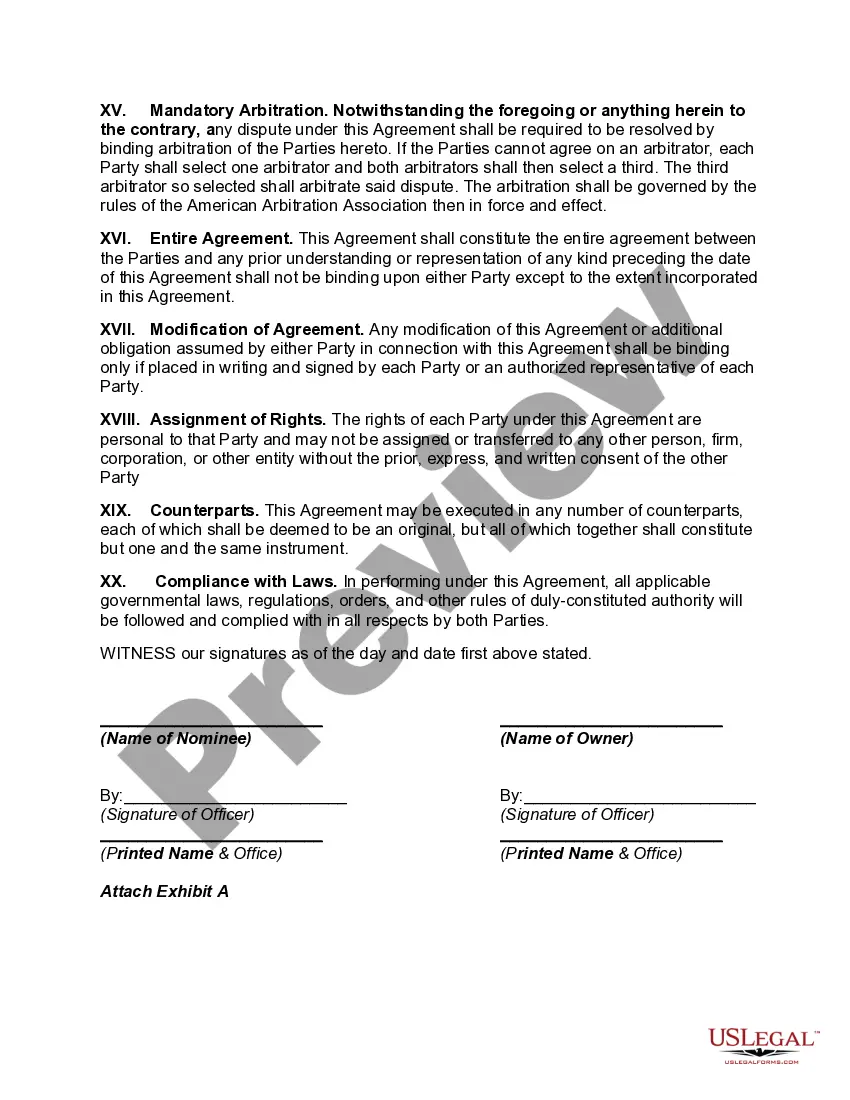
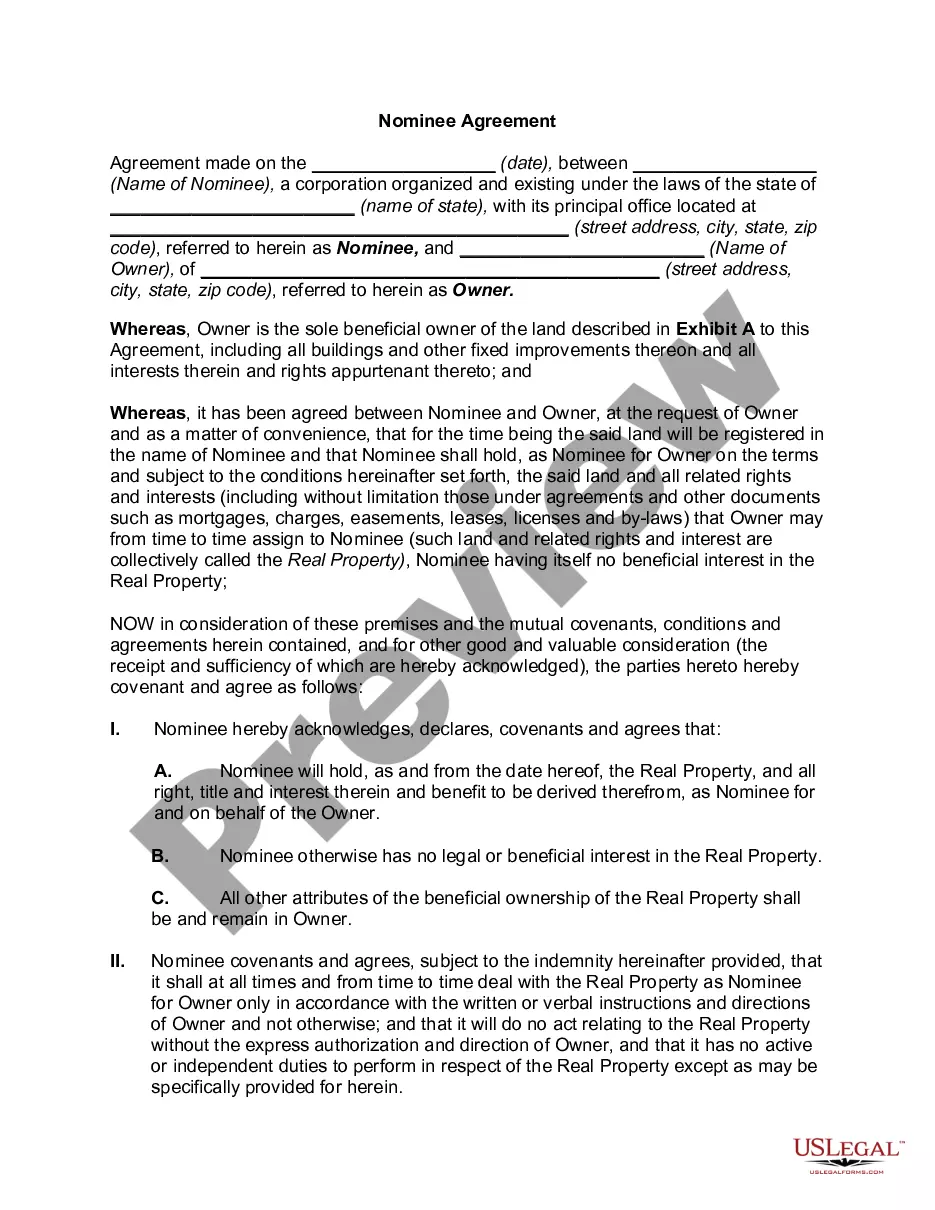
A nominee agreement is an agreement where one person agrees to act on behalf of another person in certain legal matters. A nominee agreement is like a power of attorney but may be broader in scope. A nominee may receive a payment for services or may agree to conduct the affairs of without charge.