Georgia Acknowledgment for Affidavit of Transaction
Understanding this form
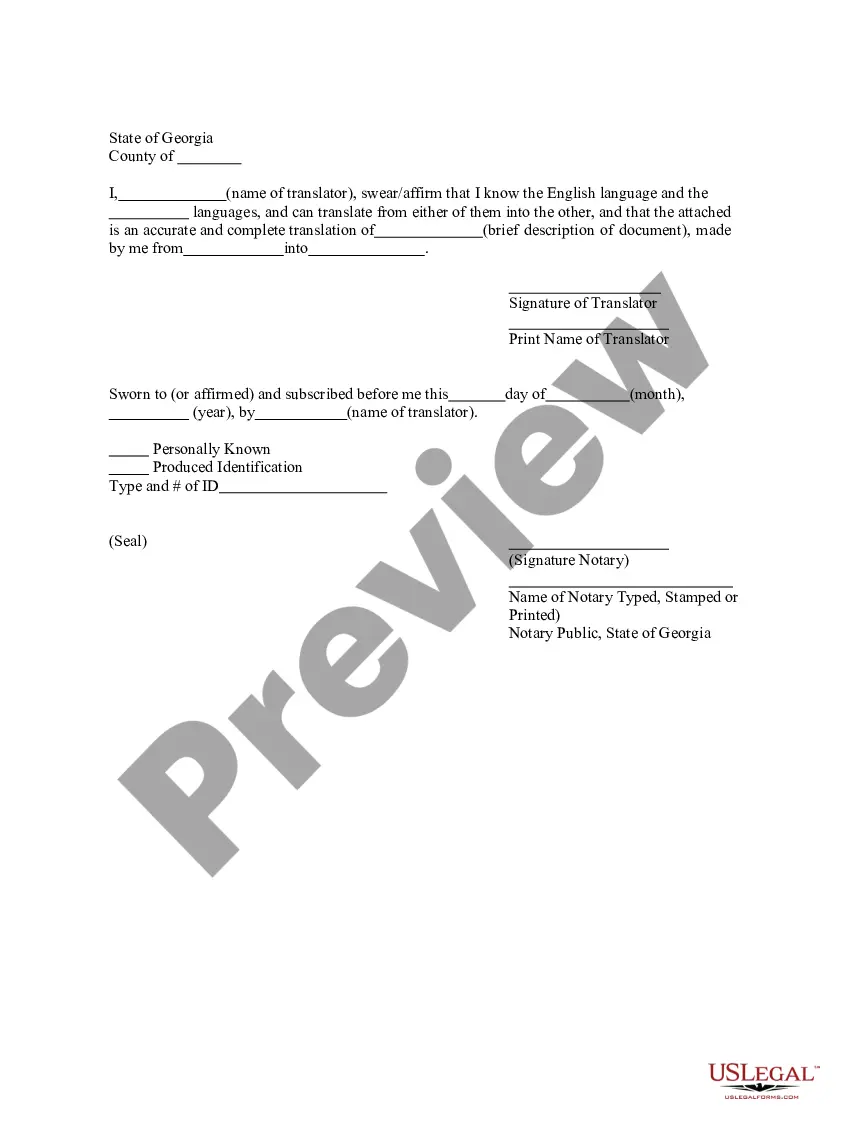
The acknowledgment for affidavit of transaction is a legal document that serves as proof of a transaction that has been sworn to or affirmed before a notary public. This form confirms the accuracy and completeness of translations for documents related to the transaction, differentiating it from other forms that may not require notarized verification or do not involve translation declarations.
What’s included in this form
- Name of the translator who completes the affidavit.
- A sworn statement affirming the translator's language proficiency and accuracy of the translation.
- A description of the document that is translated.
- The date and location where the acknowledgment is executed.
- Notary public information including signature and seal.

Common use cases
This form is typically used when a document needs to be translated from one language to another, and the translated document must be submitted for legal proceedings or official purposes. Examples include immigration applications, court filings, or any situation where official translations are required and must be verified by a notary.
Intended users of this form
- Individuals needing an official translation of documents for legal or administrative purposes.
- Translators who have performed a translation and need to assert its accuracy.
- Notaries public who are responsible for overseeing the signing of the acknowledgment.
How to prepare this document
- Begin by entering the full name of the translator.
- Provide a brief description of the document that was translated.
- Enter the date and location where the acknowledgment is being sworn.
- Have the translator sign their name, affirming the accuracy of the translation.
- Include the notaryâs details, including signature and seal.
Is notarization required?
Yes, this form must be notarized to be legally valid. It requires the signature of a notary public to verify the authenticity of the affidavit and the translator's statement. US Legal Forms offers integrated online notarization services that are available 24/7 through secure video calls, making it easy to obtain notarization without needing to travel.
Get your form ready online
Our built-in tools help you complete, sign, share, and store your documents in one place.
Make edits, fill in missing information, and update formatting in US Legal Forms—just like you would in MS Word.
Download a copy, print it, send it by email, or mail it via USPS—whatever works best for your next step.
Sign and collect signatures with our SignNow integration. Send to multiple recipients, set reminders, and more. Go Premium to unlock E-Sign.
If this form requires notarization, complete it online through a secure video call—no need to meet a notary in person or wait for an appointment.
We protect your documents and personal data by following strict security and privacy standards.

Make edits, fill in missing information, and update formatting in US Legal Forms—just like you would in MS Word.

Download a copy, print it, send it by email, or mail it via USPS—whatever works best for your next step.

Sign and collect signatures with our SignNow integration. Send to multiple recipients, set reminders, and more. Go Premium to unlock E-Sign.

If this form requires notarization, complete it online through a secure video call—no need to meet a notary in person or wait for an appointment.

We protect your documents and personal data by following strict security and privacy standards.
Avoid these common issues
- Failing to accurately describe the document being translated.
- Leaving out the notary signature or seal, which is essential for validity.
- Not providing the full name of the translator or using abbreviations.
Advantages of online completion
- Convenience of downloading and completing the form at your own pace.
- Easy to edit and customize according to your specific needs.
- Access to forms drafted by licensed attorneys to ensure legal compliance.
What to keep in mind
- The acknowledgment for affidavit of transaction is essential for validating translated documents in legal scenarios.
- Using this form requires clear identification of the translator and confirmation of language proficiency.
- Notarization is crucial for the legal standing of this form in Georgia.
Looking for another form?
Form popularity
FAQ
Yes, an affidavit must be notarized in Georgia to meet legal standards. Notarization validates the affidavit, ensuring it can be presented in court if needed. Utilizing the Georgia Acknowledgment for Affidavit of Transaction ensures that your affidavit is not only notarized but also compliant with state regulations.
The new notary law in Georgia, effective as of January 1, 2023, introduces provisions for remote notarizations, allowing notaries to perform services via electronic means. This change aims to improve accessibility and efficiency in handling legal documents, including affidavits. To navigate this new law effectively, consider the Georgia Acknowledgment for Affidavit of Transaction as part of your document preparation.
An affidavit generally requires notarization to be considered valid, as notarization serves to verify the identity of the signer and the authenticity of the information stated. Without notarization, the affidavit might not hold up in legal proceedings. To ensure your affidavit adheres to legal standards, utilize the Georgia Acknowledgment for Affidavit of Transaction, which simplifies the notarization process.
When acknowledgment appears in a notarial certificate, it indicates that the signer has confirmed their identity and willingly signed the document in front of the notary. This process adds a layer of authenticity to your affidavit. Incorporating the Georgia Acknowledgment for Affidavit of Transaction can enhance the legal standing of your document, providing peace of mind.
For an affidavit to be valid, it must include a clear statement of facts, be sworn or affirmed by the affiant, and be signed in the presence of a notary public. Additionally, the notary must properly execute the acknowledgment, ensuring that the document meets legal requirements. Using the Georgia Acknowledgment for Affidavit of Transaction can help ensure that your affidavit is properly validated and accepted in court.
When a notary fills out an affidavit, they must first ensure that they verify the identity of the signer and witness the signature. Then, they will complete the notarial certificate, which includes their signature, seal, and the date of the notarization. This process is crucial, especially in the context of a Georgia Acknowledgment for Affidavit of Transaction, as it adds authenticity to the document.
Notarial wording typically includes phrases such as, 'Subscribed and sworn before me,' or 'In witness whereof, I have hereunto set my hand.' These phrases serve to formalize the acknowledgment, particularly in documents like the Georgia Acknowledgment for Affidavit of Transaction. By using established notarial language, you ensure that the document meets legal standards.
A signature acknowledgement is a formal statement made by a notary that confirms the identity of the person signing a document. For example, in a Georgia Acknowledgment for Affidavit of Transaction, the notary might say, 'I hereby acknowledge that the person whose name appears above has signed this document in my presence.' This statement adds significant legal weight to the transaction.
When notarizing a document, the notary typically begins by introducing themselves and explaining the purpose of the transaction. They may say something like, 'I need to verify your identity and confirm that you are signing this document voluntarily.' This approach ensures clarity and sets a professional tone for the process, especially in the case of a Georgia Acknowledgment for Affidavit of Transaction.
An acknowledgement of signature verifies that the person who signed a document did so willingly and was in their right mind at the time of signing. For instance, in the context of a Georgia Acknowledgment for Affidavit of Transaction, a notary public will confirm the identity of the signer before witnessing the signing. This process creates a layer of trust and legality for the document.