Florida Jury Duty Policy
Description

Get your form ready online
Our built-in tools help you complete, sign, share, and store your documents in one place.
Make edits, fill in missing information, and update formatting in US Legal Forms—just like you would in MS Word.
Download a copy, print it, send it by email, or mail it via USPS—whatever works best for your next step.
Sign and collect signatures with our SignNow integration. Send to multiple recipients, set reminders, and more. Go Premium to unlock E-Sign.
If this form requires notarization, complete it online through a secure video call—no need to meet a notary in person or wait for an appointment.
We protect your documents and personal data by following strict security and privacy standards.

Make edits, fill in missing information, and update formatting in US Legal Forms—just like you would in MS Word.

Download a copy, print it, send it by email, or mail it via USPS—whatever works best for your next step.

Sign and collect signatures with our SignNow integration. Send to multiple recipients, set reminders, and more. Go Premium to unlock E-Sign.

If this form requires notarization, complete it online through a secure video call—no need to meet a notary in person or wait for an appointment.

We protect your documents and personal data by following strict security and privacy standards.
Looking for another form?




How to fill out Jury Duty Policy?
You can spend time online searching for the legal document template that meets the federal and state regulations you need.
US Legal Forms offers a vast array of legal forms that have been reviewed by experts.
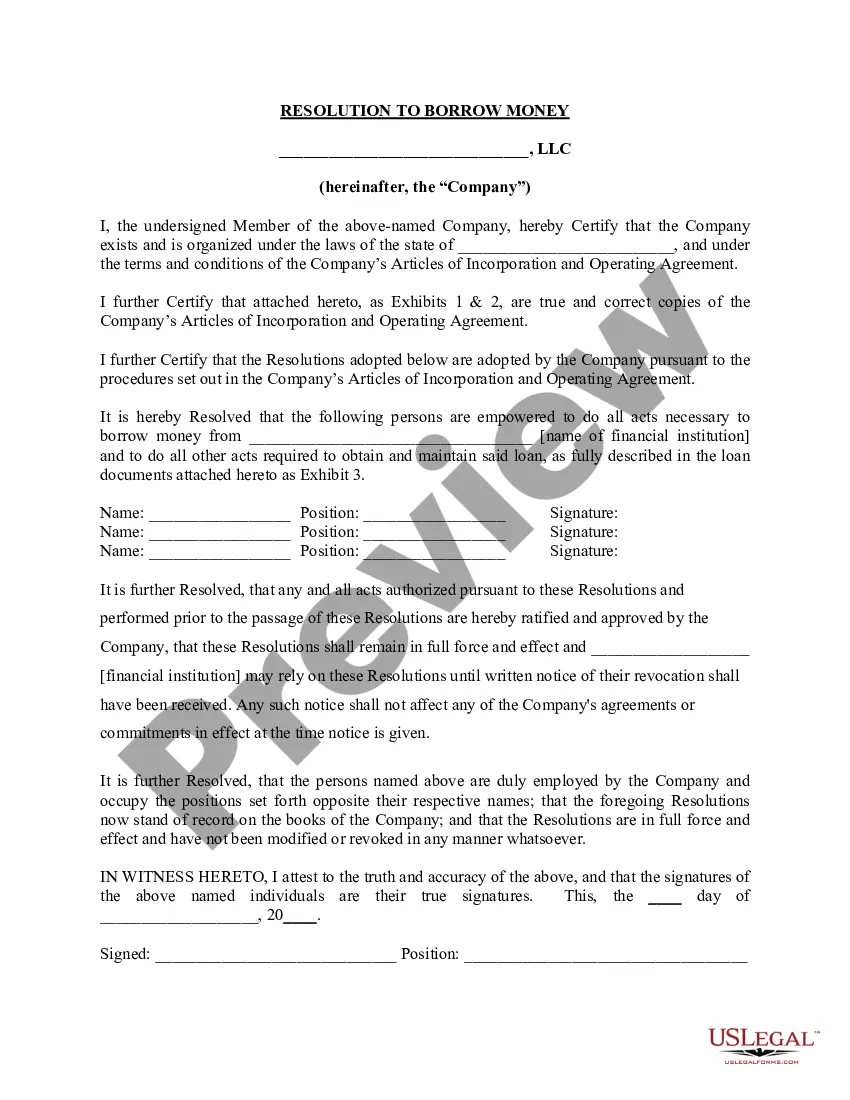
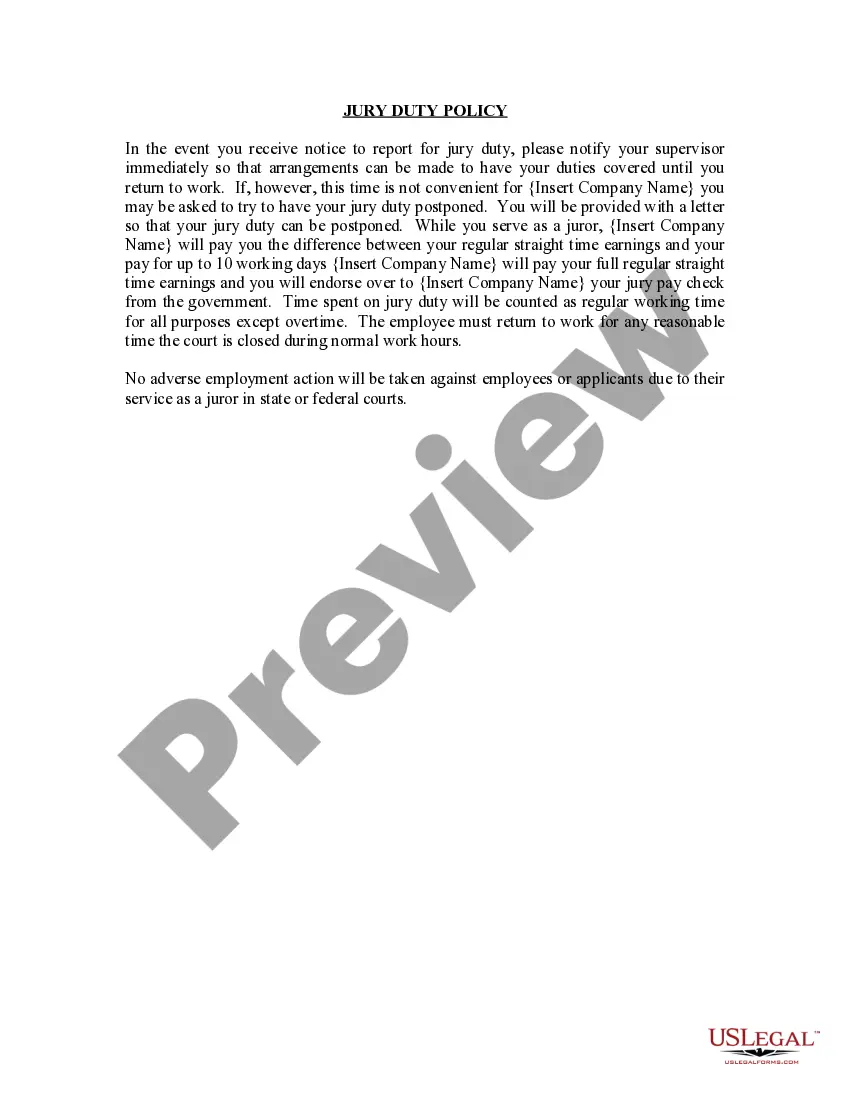
You can conveniently download or print the Florida Jury Duty Policy from the website.
To find another version of the form, use the Search field to locate the template that meets your needs and requirements.
- If you already have a US Legal Forms account, you can Log In and click the Download button.
- Then, you can complete, modify, print, or sign the Florida Jury Duty Policy.
- Every legal document template you acquire is yours permanently.
- To obtain another copy of any purchased form, go to the My documents section and click the appropriate button.
- If this is your first time using the US Legal Forms website, follow the simple instructions below.
- First, ensure that you have selected the correct document template for your state/city of interest.
- Review the form description to verify that you have chosen the right form.
Form popularity
FAQ
If you're aged 65 or over, permanently disabled or have a chronic illness, you can request to be permanently excused when you respond to your jury summons. The court will send you a letter of permanent excusal.
Common Effective Jury Duty ExcusesExtreme Financial Hardship.Full-Time Student Status.Surgery/Medical Reasons.Being Elderly.Being Too Opinionated.Mental/Emotional Instability.Relation to the Case/Conflict of Interest.Line of Work.More items...?
A person cannot qualify for jury service who is under prosecution for any crime, or has been convicted in Florida, any federal court or any other state, territory or country of bribery, forgery, perjury, larceny or any other offense that is a felony in this state or that, if it had been committed in this state, would
Section 40.23 of the Florida Statutes states that failure to attend as a juror upon being duly summoned may result in a fine not to exceed $100. In addition to the fine, you may also face contempt proceedings which could result in the imposition of community service or other sanctions, including jail time.
Prospective jurors are randomly selected from the Florida Department of Highway Safety and Motor Vehicles records. These records include all Orange and Osceola County residents eighteen years of age and older who are licensed drivers, and those who have a Florida Identification Card.
Full-time federal, state or local law enforcement or investigative personnel. An expectant mother or a parent who is not employed full time and who has custody of a child under six years of age. A person 70 years of age or older shall be excused from jury service upon request.
The Florida State Supreme Court has issued a series of Administrative Orders outlining guidelines within the state courts system as it confronts the novel coronavirus (COVID-19), which currently suspend all jury trials in Florida's Court System through .
Florida has a list of specific excuses that can be used to be exempt from reporting for jury duty, including excuses for military, student, breastfeeding, age, medical worker, firefighter and disability. You can also be excused if you don't meet the basic eligibility requirements for jury duty in FL.
Section 40.23 of the Florida Statutes states that failure to attend as a juror upon being duly summoned may result in a fine not to exceed $100. In addition to the fine, you may also face contempt proceedings which could result in the imposition of community service or other sanctions, including jail time.
There is no State law in Florida that requires employers to pay jurors while they are serving on jury duty.