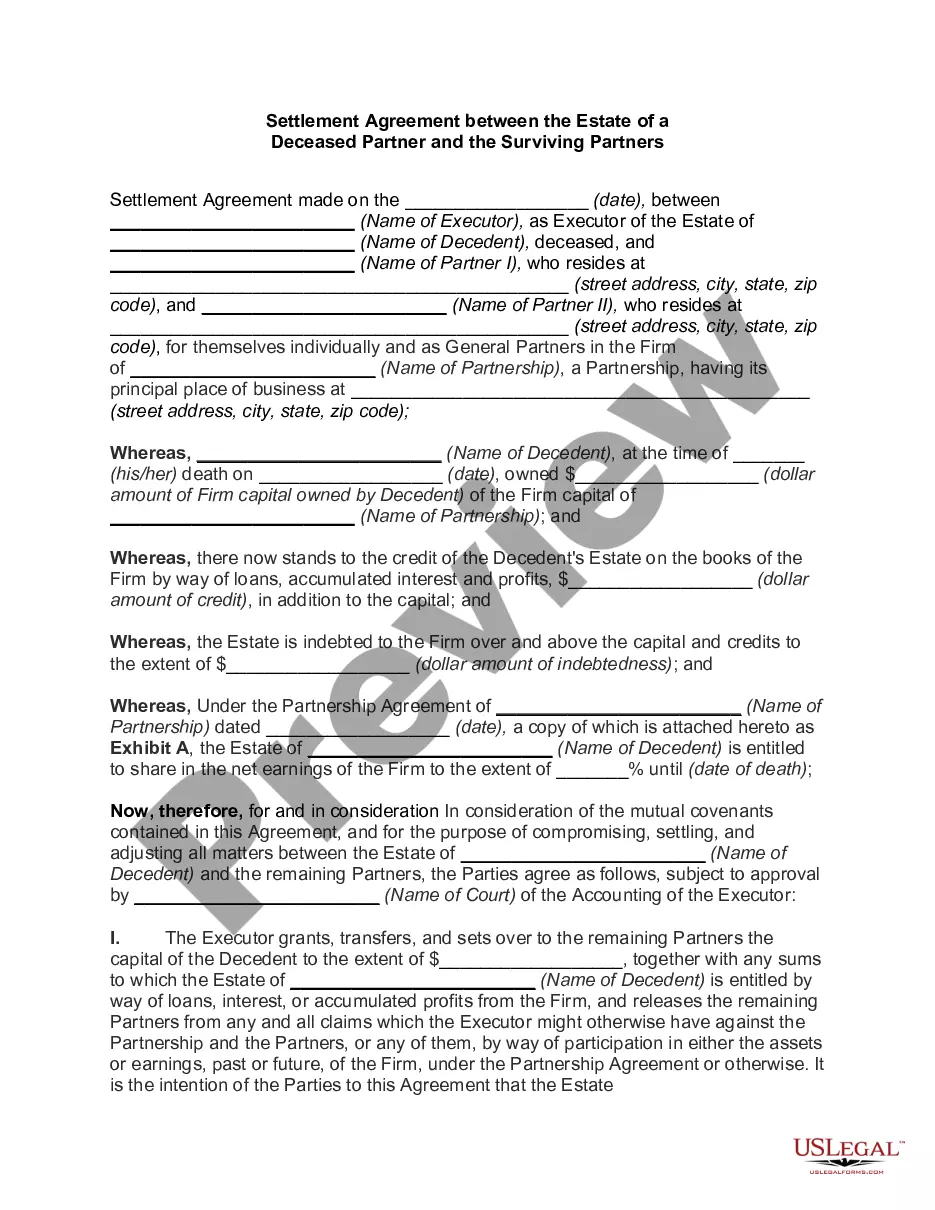
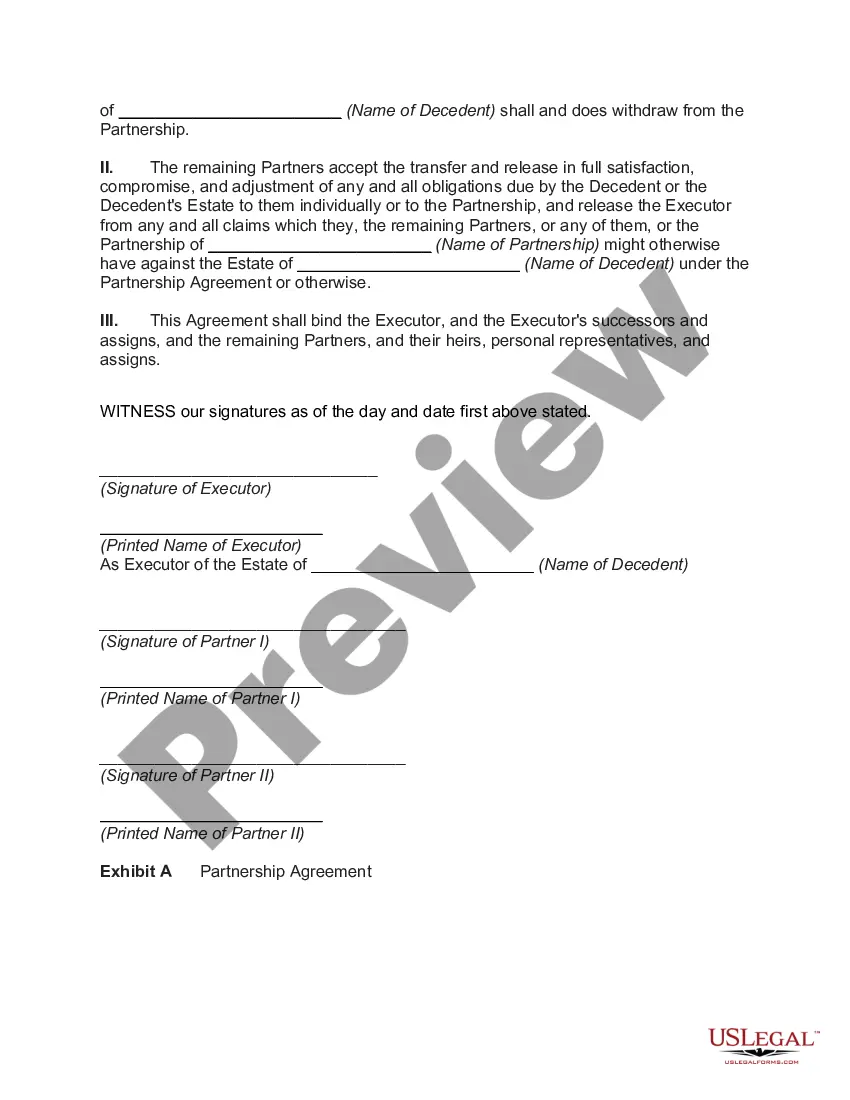
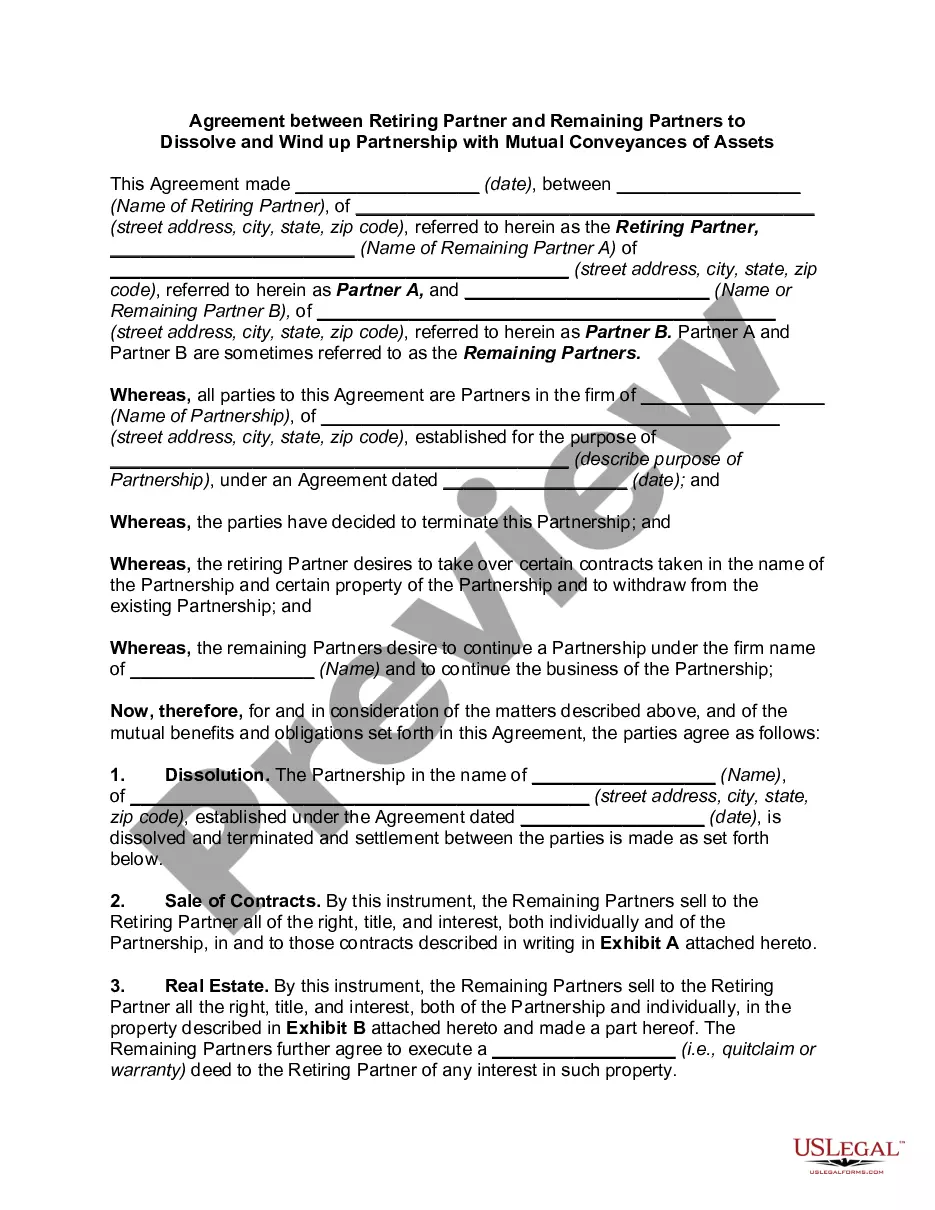
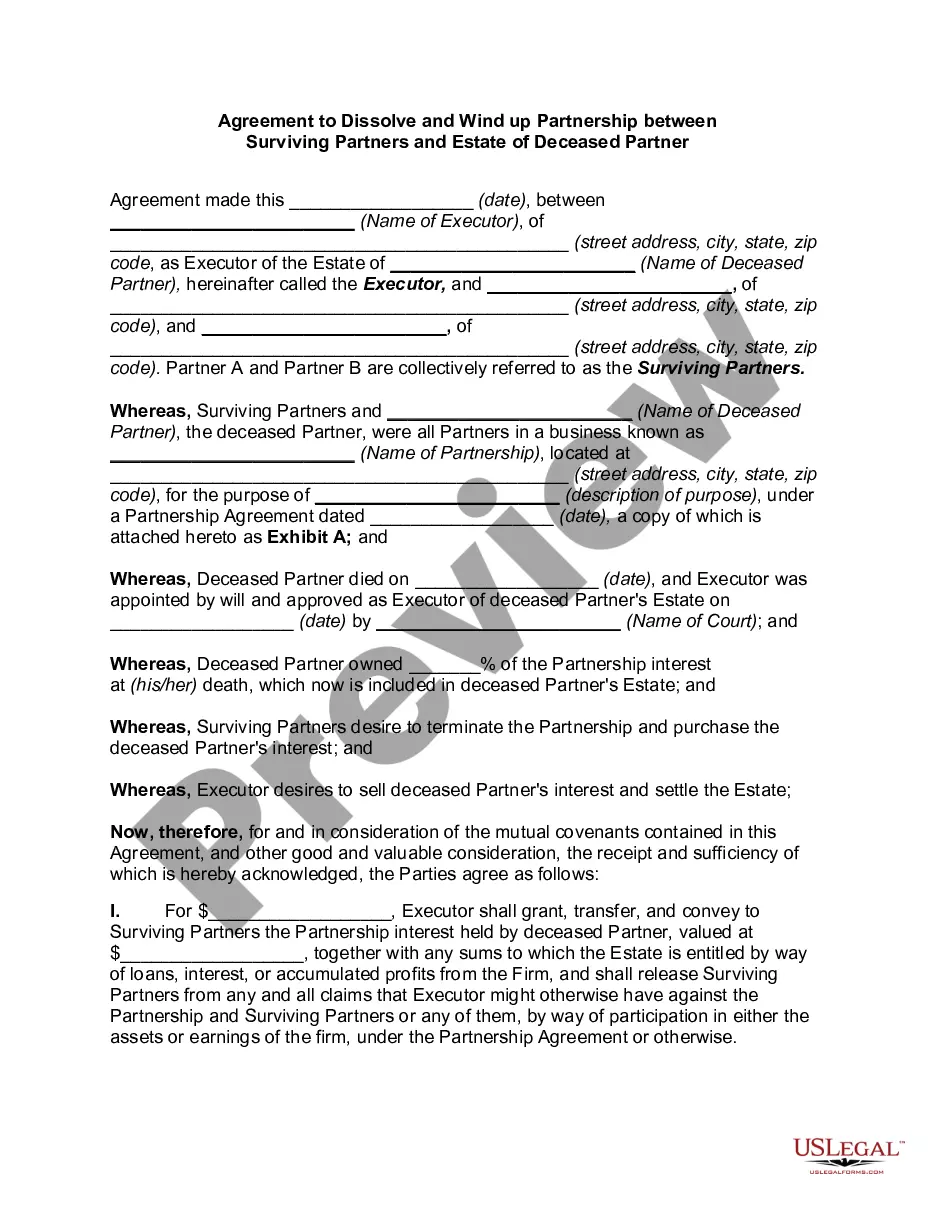
This is a form of a settlement agreement between the estate of a deceased partner and
the remaining partners of a business partnership.
Florida Settlement Agreement between the Estate of a Deceased Partner and the Surviving Partners
State:
Multi-State
Category:
Control #:
US-13266BG
Format:
Word;
Rich Text
53 downloads
Description
Free preview
Get your form ready online
Our built-in tools help you complete, sign, share, and store your documents in one place.
Built-in online Word editor
Make edits, fill in missing information, and update formatting in US Legal Forms—just like you would in MS Word.
Export easily
Download a copy, print it, send it by email, or mail it via USPS—whatever works best for your next step.
E-sign your document
Sign and collect signatures with our SignNow integration. Send to multiple recipients, set reminders, and more. Go Premium to unlock E-Sign.
Notarize online 24/7
If this form requires notarization, complete it online through a secure video call—no need to meet a notary in person or wait for an appointment.
Store your document securely
We protect your documents and personal data by following strict security and privacy standards.

Make edits, fill in missing information, and update formatting in US Legal Forms—just like you would in MS Word.

Download a copy, print it, send it by email, or mail it via USPS—whatever works best for your next step.

Sign and collect signatures with our SignNow integration. Send to multiple recipients, set reminders, and more. Go Premium to unlock E-Sign.

If this form requires notarization, complete it online through a secure video call—no need to meet a notary in person or wait for an appointment.

We protect your documents and personal data by following strict security and privacy standards.
Looking for another form?
How to fill out Settlement Agreement Between The Estate Of A Deceased Partner And The Surviving Partners?
If you need to compile, download, or create legal document templates, utilize US Legal Forms, the most extensive collection of legal forms available online.
Take advantage of the site's user-friendly and convenient search feature to find the documents you need.
A selection of templates for business and personal use is categorized by types and states, or keywords.
Step 5. Complete the transaction. You can use your Visa or MasterCard or PayPal account to finalize the payment.
Step 6. Select the format of the legal form and download it to your device. Step 7. Complete, edit, print, or sign the Florida Settlement Agreement between the Estate of a Deceased Partner and the Surviving Partners.
- Use US Legal Forms to acquire the Florida Settlement Agreement between the Estate of a Deceased Partner and the Surviving Partners in just a few clicks.
- If you are already a US Legal Forms customer, Log In to your account and click on the Purchase button to access the Florida Settlement Agreement between the Estate of a Deceased Partner and the Surviving Partners.
- You can also find forms you previously downloaded in the My documents section of your account.
- If you are using US Legal Forms for the first time, follow the outlined instructions below.
- Step 1. Ensure that you have selected the form for the correct city/state.
- Step 2. Use the Preview option to review the form's content. Don't forget to check the description.
- Step 3. If you are not satisfied with the form, utilize the Search field at the top of the screen to discover other variations of the legal form template.
- Step 4. Once you have located the form you need, click the Order now button. Choose the pricing plan you prefer and enter your details to register for an account.
Form popularity
FAQ
The agreement between heirs regarding the division of an estate is a mutual understanding that outlines how assets will be distributed among the beneficiaries. This agreement can be formalized as part of the Florida Settlement Agreement between the Estate of a Deceased Partner and the Surviving Partners, providing clarity and reducing the potential for disputes. This process ensures that all parties are on the same page and can help streamline the settlement process. Seeking guidance from a legal platform can help in creating a fair agreement.
Yes, a wife has rights to her husband's property after his death in Florida, depending on whether there is a will in place. If the husband did not leave a will, the wife typically inherits a portion of the estate under state law. The Florida Settlement Agreement between the Estate of a Deceased Partner and the Surviving Partners facilitates the distribution of these assets, ensuring that the wife's rights are honored. It's advisable to consult with a legal expert to navigate these rights effectively.
Your surviving spouse inherits everything. If you die with children or other descendants from you and the surviving spouse, and your surviving spouse has descendants from previous relationships. Your surviving spouse inherits half of your intestate property and your descendants inherit the other half.
Unmarried couples don't generally have rights to their partner's property. This means if a couple splits up or if one of them dies, they won't be entitled to any of their partner's property.
Being in a so called common law partnership will not give couples any legal protection whatsoever, and so under the law, if someone dies and they have a partner that they are not married to, then that partner has no right to inherit anything unless the partner that has passed away has stated in their will that they
If one of the children has already died, their share is divided equally between their own children (the grandchildren of the person who died). If there is no surviving spouse or civil partner and no living children or grandchildren, everything is split between the living parents.
Unmarried couples still have very limited legal rights in Florida. The exception concerns unmarried couples and their children; the law provides many protections in that area. The property rights of married spouses are codified in law, and they may also be specified in other documents such as prenuptial agreements.
Unfortunately, Florida's intestate succession law does not protect unmarried individuals. Florida also does not recognize common law marriage. Unless you have an estate plan in Florida, your partner will be unable to inherit your property and will be excluded from the decision-making process after your death.
Many married couples own most of their assets jointly with the right of survivorship. When one spouse dies, the surviving spouse automatically receives complete ownership of the property. This distribution cannot be changed by Will.
The family house It would become part of the probate estate. One option is to make sure both of you are named as joint owners on the deed, with rights of survivorship. In that case, generally speaking, you each equally own the house and are entitled to assume full ownership upon the death of the other.