Florida Motion for final judgment for possession
Overview of this form
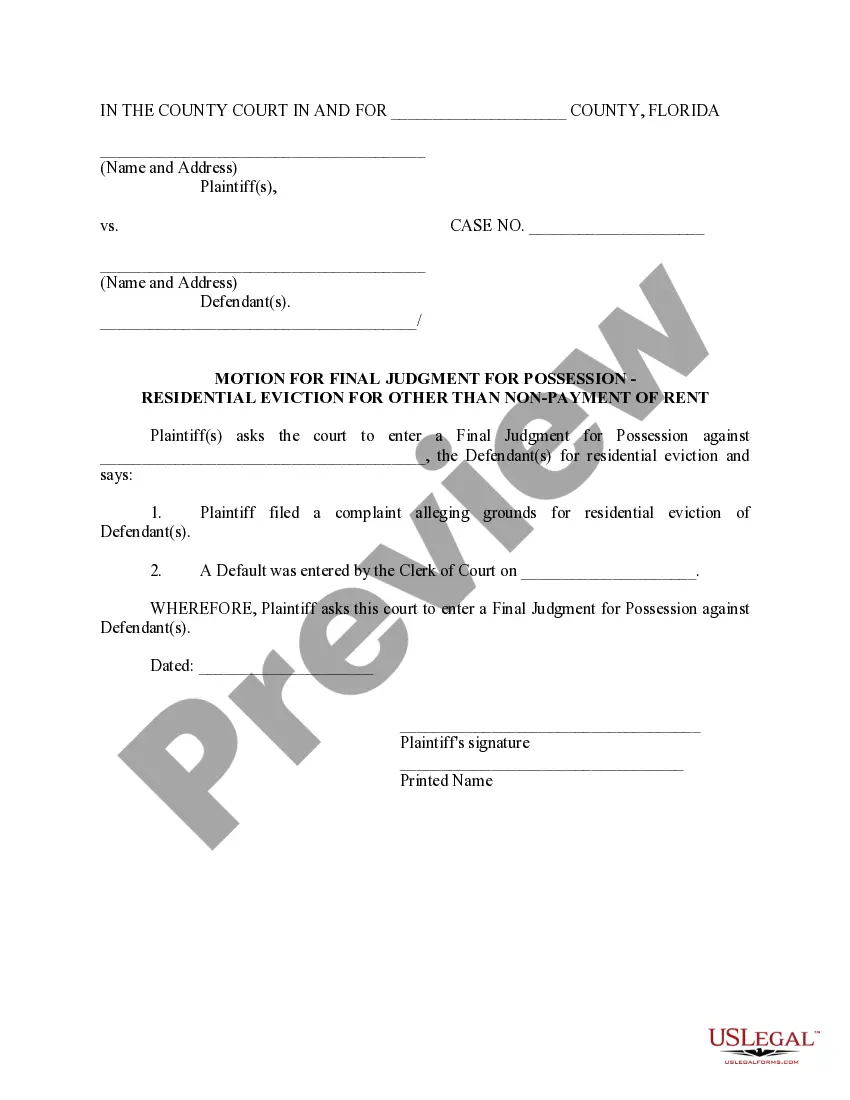
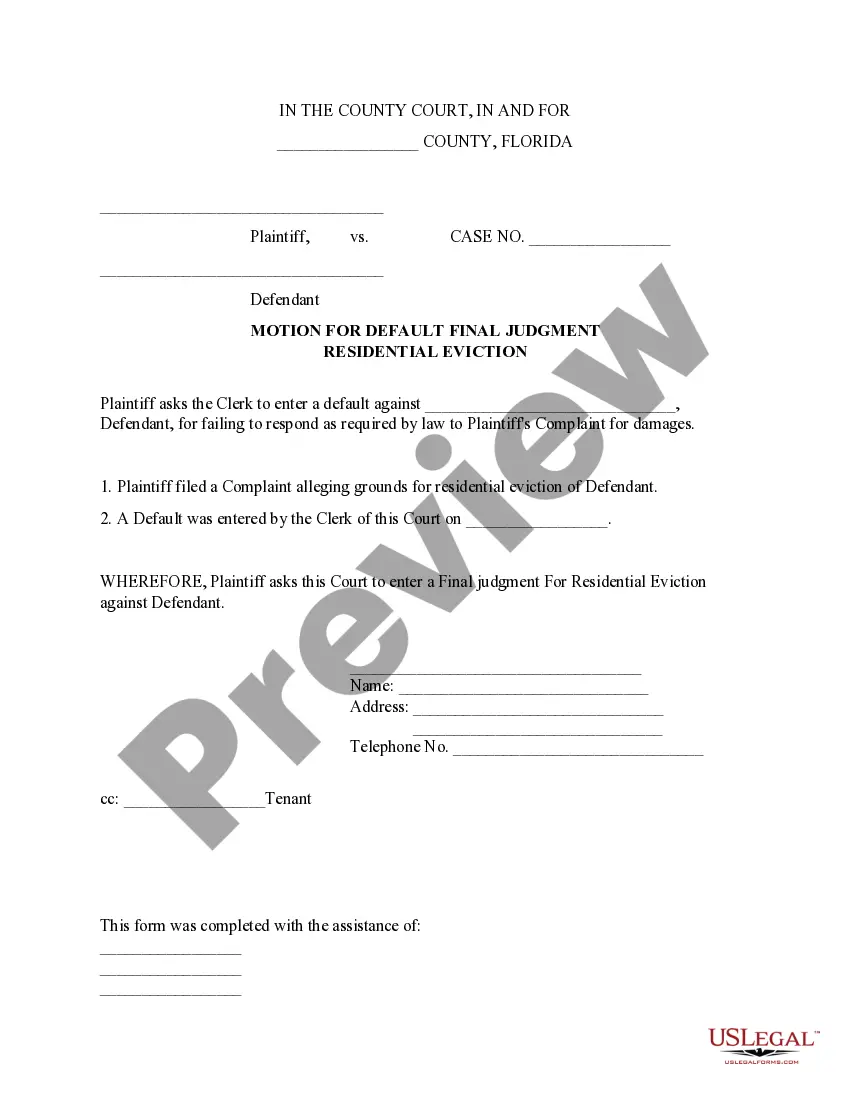
The Motion for Final Judgment for Possession is a legal document that allows a landlord or plaintiff in Florida to request a final judgment of possession against a tenant who has failed to respond to an eviction complaint. This form is specifically used in cases of residential eviction for reasons other than non-payment of rent, distinguishing it from other eviction forms. By filing this motion, the landlord seeks to finalize the eviction process legally.
Main sections of this form
- Caption section for listing the court, case number, and parties involved.
- A statement affirming that the plaintiff filed a complaint alleging grounds for eviction.
- Details about any default entered against the defendant.
- A request for the court to issue a final judgment for possession.
- Signature line for the plaintiff, including printed name and date.

When this form is needed
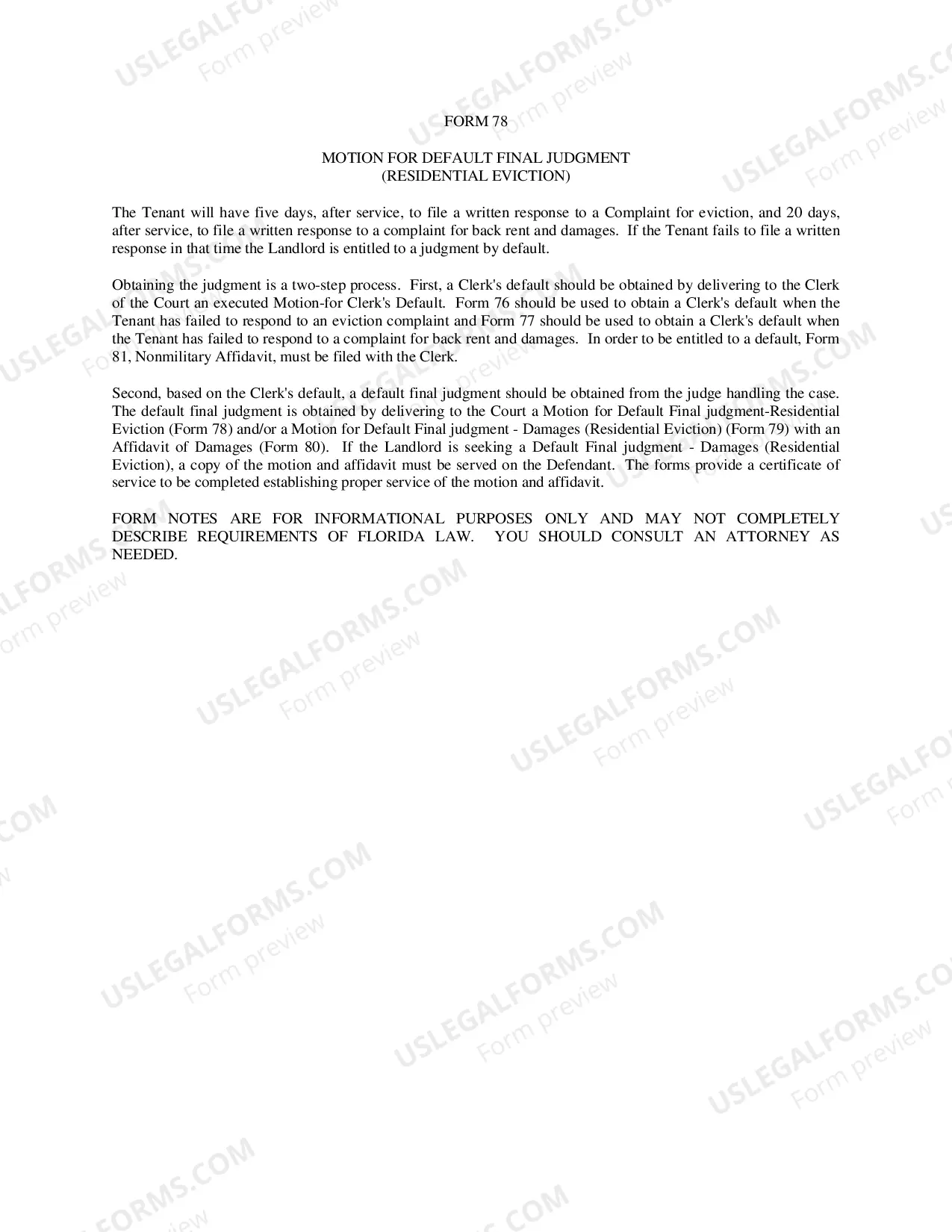
This form is used when a landlord seeks to reclaim possession of a residential property from a tenant who has not responded to the eviction complaint. It is suitable for situations where the landlord has already filed a complaint and received a default judgment due to the tenant's failure to respond. Common scenarios include cases of lease violations or other breaches of agreement by the tenant.
Who this form is for
This form is intended for:
- Landlords or property owners pursuing eviction for reasons other than non-payment of rent.
- Legal representatives acting on behalf of landlords in Florida eviction proceedings.
How to complete this form
- Identify the appropriate county where the court is located and fill it in the caption.
- Enter the names and addresses of the plaintiff and defendant in the respective sections.
- Insert the case number into the designated field.
- Specify the date when the default was entered by the Clerk of Court.
- Sign and date the form as the plaintiff, including your printed name beneath your signature.
Is notarization required?
This form does not typically require notarization unless specified by local law. To ensure compliance with specific requirements, always check state or local guidelines.
Get your form ready online
Our built-in tools help you complete, sign, share, and store your documents in one place.
Make edits, fill in missing information, and update formatting in US Legal Forms—just like you would in MS Word.
Download a copy, print it, send it by email, or mail it via USPS—whatever works best for your next step.
Sign and collect signatures with our SignNow integration. Send to multiple recipients, set reminders, and more. Go Premium to unlock E-Sign.
If this form requires notarization, complete it online through a secure video call—no need to meet a notary in person or wait for an appointment.
We protect your documents and personal data by following strict security and privacy standards.

Make edits, fill in missing information, and update formatting in US Legal Forms—just like you would in MS Word.

Download a copy, print it, send it by email, or mail it via USPS—whatever works best for your next step.

Sign and collect signatures with our SignNow integration. Send to multiple recipients, set reminders, and more. Go Premium to unlock E-Sign.

If this form requires notarization, complete it online through a secure video call—no need to meet a notary in person or wait for an appointment.

We protect your documents and personal data by following strict security and privacy standards.
Avoid these common issues
- Failing to provide accurate names and addresses of all parties involved.
- Omitting the case number, which can delay processing.
- Not specifying the date of default entered by the court.
- Not signing the form or providing an unreadable signature.
Why use this form online
- Convenience of downloading and filling the form at your own pace.
- Editable electronic format allows for easy adjustments as needed.
- Access to forms drafted by licensed attorneys, ensuring legal accuracy and reliability.
Main things to remember
- The Motion for Final Judgment for Possession is crucial for landlords seeking possession of their property in Florida after tenant non-response.
- Accurate completion of the form ensures that the eviction process moves forward without delays.
- Use this form appropriately, and ensure compliance with Florida eviction laws to avoid unnecessary complications.
Looking for another form?




Form popularity
FAQ
A motion to enforce judgment is filed when a party seeks to compel compliance with a court's judgment. This motion aims to ensure that the terms of the judgment are fulfilled, whether it's payment, eviction, or another obligation. If you face challenges in executing your Florida Motion for final judgment for possession, employing a motion to enforce may provide the necessary remedy. Platforms like uslegalforms can assist you in formulating this motion accurately.
A motion to vacate final judgment in Florida is a request made to the court to nullify a previous judgment. This may occur if there is new evidence, if the judgment was entered improperly, or if there were procedural issues. If you believe that a Florida Motion for final judgment for possession should be reconsidered, seeking to vacate that judgment might be a viable route. You can consult with legal experts to navigate this process effectively.
After the court issues a final judgment, the winning party can take steps to enforce it. This often includes collecting any owed amounts or potentially evicting a tenant, if applicable. The process following a Florida Motion for final judgment for possession is designed to facilitate a smooth transition to possession or collection. Therefore, it is important to understand your rights and obligations to ensure everything proceeds according to the law.
In Florida, a judgment can typically be enforced for 20 years. This means that once you have a final judgment, you have two decades to take action if the judgment is not satisfied. Understanding this timeframe is crucial when dealing with a Florida Motion for final judgment for possession. The long enforcement period ensures that you have ample time to pursue the recovery of any amounts owed.
To collect a final judgment in Florida, begin by obtaining a writ of execution, which allows you to seize the debtor's assets or property. Once the writ is issued, you can enlist the help of local law enforcement to facilitate the collection. Additionally, using platforms like USLegalForms can guide you through the necessary legal documentation and procedures, streamlining the collection process.
The final judgment rule in Florida stipulates that a court's decision must be conclusive and finalize the matter before an appeal can be made. This judgment indicates that all claims or issues have been resolved, providing clarity and certainty to all parties involved. Understanding this rule is crucial, especially when pursuing a Florida Motion for final judgment for possession.
To initiate the process of obtaining a writ of possession in Florida, you must file a Florida Motion for final judgment for possession at the court. Ensure that you have followed all legal procedures, such as providing proper notice to the defendant. After your motion is granted, the court will issue the writ, which you can then use to request enforcement from law enforcement.
The service of a writ of possession in Florida typically occurs within a few days to a week after the writ is issued. Timing can vary based on the local sheriff's office and their current caseload. Once served, it enables you to take physical possession of your property promptly, ensuring compliance with the court's final judgment.
In Florida, obtaining a writ of execution requires first having a final judgment that orders monetary damages. After securing your Florida Motion for final judgment for possession, you can file for a writ of execution with the court. This document allows you to enforce the judgment and collect what is owed, providing a necessary legal pathway for collection.
To obtain a writ of possession in Florida, you must first secure a final judgment for possession. Once the court grants this judgment, you can file a motion for a writ of possession with the court clerk. This will initiate the process, allowing the local sheriff to take action to enforce the judgment, ensuring you reclaim your property.