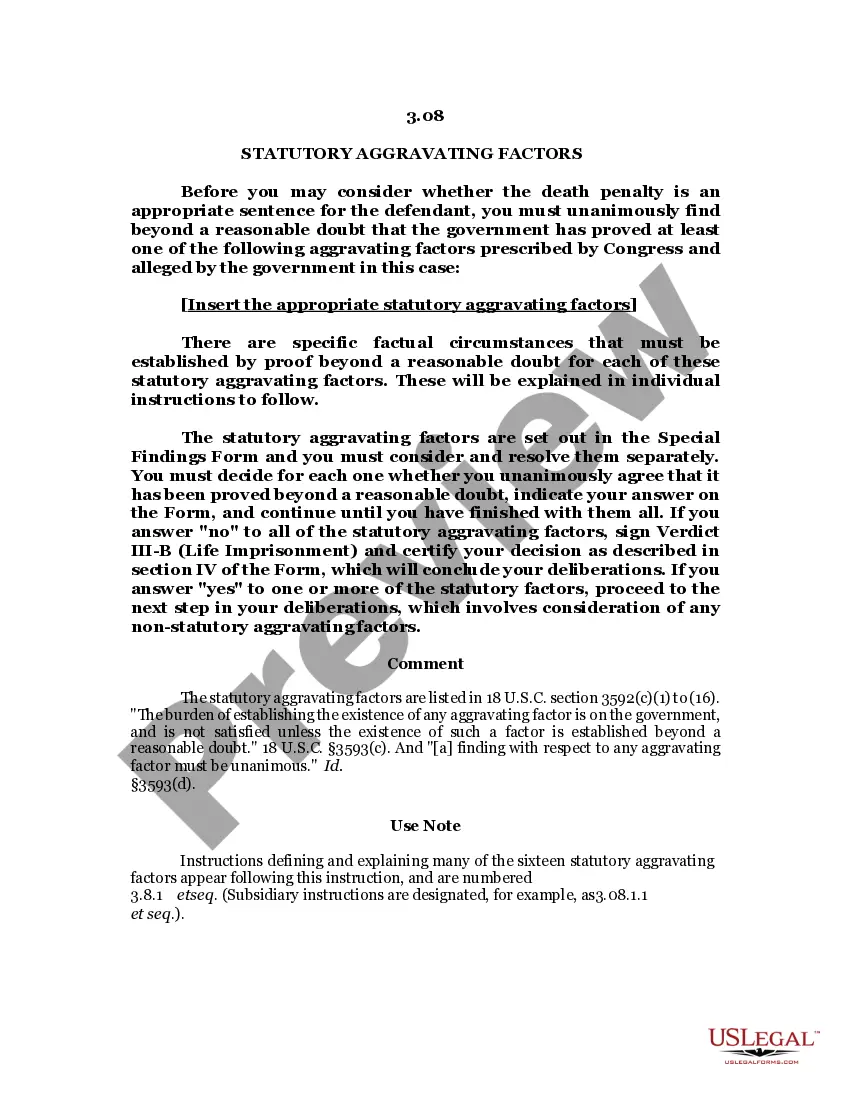
STATUTORY AGGRAVATING FACTORS
About this form
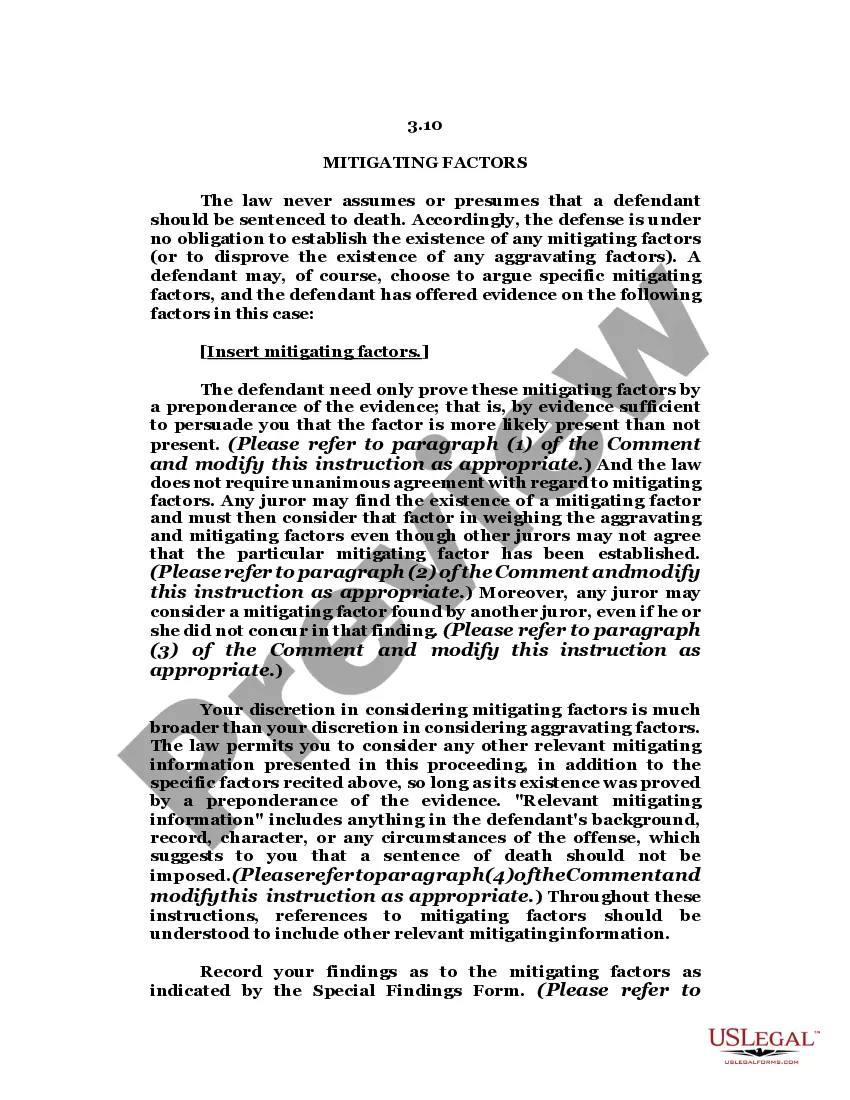
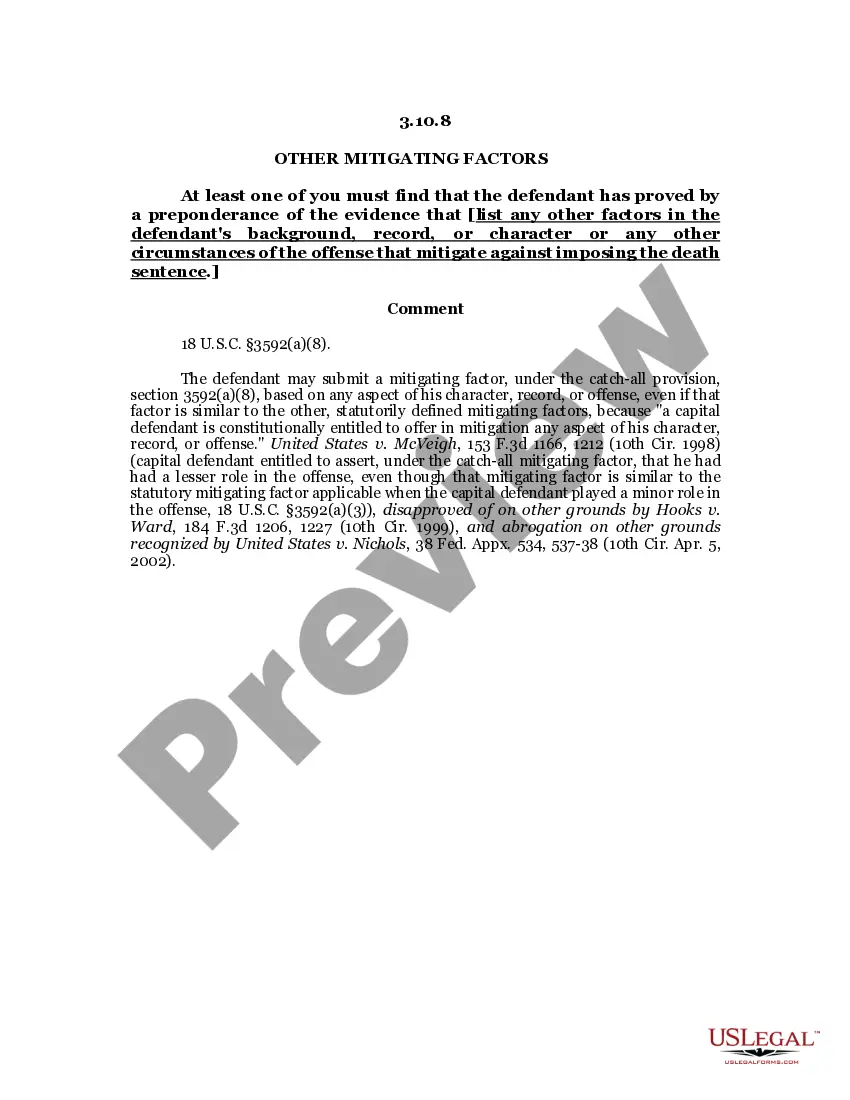
The Statutory Aggravating Factors form is a legal document used in capital punishment cases to determine if the death penalty is appropriate for a defendant. It requires the jury to unanimously identify and confirm the presence of specific aggravating factors presented by the government. This form is crucial in ensuring a fair assessment of whether the statutory conditions warrant such a severe sentence, distinguishing it from other legal forms that may deal with less severe penalties.
Form components explained
- List of statutory aggravating factors: Specific factors that must be proven beyond a reasonable doubt.
- Unanimous agreement requirement: The necessity for all jurors to agree on the presence of any aggravating factor.
- Special Findings Form: A designated area where jurors indicate their conclusions regarding each aggravating factor.
- Instructions for deliberation: Guidelines on next steps based on the jury's findings.
- Signatures certifying the decision: Areas for jurors to sign and confirm their conclusions.
When to use this form
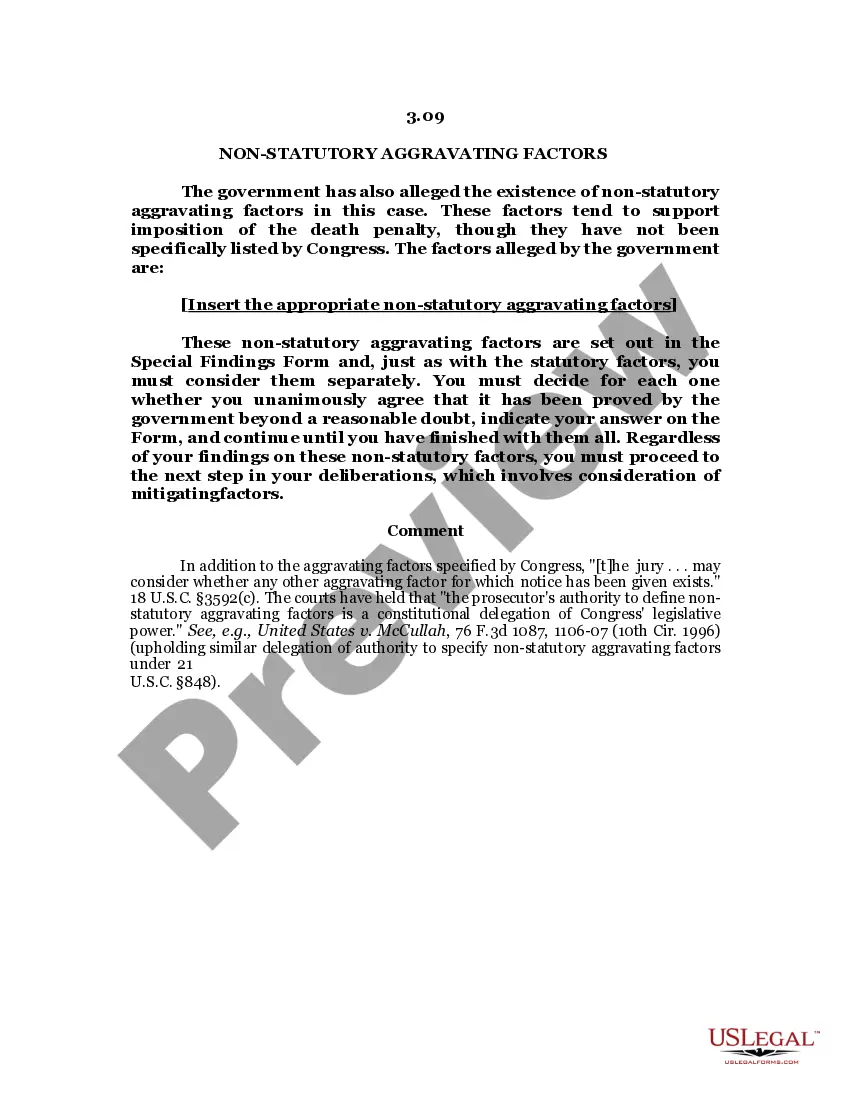
This form is used in federal capital cases when the prosecution seeks the death penalty. It is necessary during jury deliberations to assess whether any of the statutory aggravating factors exist. If the jury finds that at least one factor is proven beyond a reasonable doubt, the case can then proceed to consider any non-statutory aggravating factors.
Who can use this document
The following individuals should use this form:
- Federal juries involved in capital punishment cases.
- Legal professionals guiding juries through the deliberation process in such cases.
- Attorneys representing defendants in capital cases, to understand the implications of aggravating factors.
How to complete this form
- Identify the statutory aggravating factors as presented by the government.
- Deliberate as a jury to determine if each factor is proven beyond a reasonable doubt.
- Indicate your unanimous agreement or disagreement for each factor on the Special Findings Form.
- Proceed to the next step only if you agree that one or more aggravating factors are present.
- Sign and date the form to certify the jury's findings and conclusion.
Does this document require notarization?
Notarization is generally not required for this form. However, certain states or situations might demand it. You can complete notarization online through US Legal Forms, powered by Notarize, using a verified video call available anytime.
Get your form ready online
Our built-in tools help you complete, sign, share, and store your documents in one place.
Make edits, fill in missing information, and update formatting in US Legal Forms—just like you would in MS Word.
Download a copy, print it, send it by email, or mail it via USPS—whatever works best for your next step.
Sign and collect signatures with our SignNow integration. Send to multiple recipients, set reminders, and more. Go Premium to unlock E-Sign.
If this form requires notarization, complete it online through a secure video call—no need to meet a notary in person or wait for an appointment.
We protect your documents and personal data by following strict security and privacy standards.

Make edits, fill in missing information, and update formatting in US Legal Forms—just like you would in MS Word.

Download a copy, print it, send it by email, or mail it via USPS—whatever works best for your next step.

Sign and collect signatures with our SignNow integration. Send to multiple recipients, set reminders, and more. Go Premium to unlock E-Sign.

If this form requires notarization, complete it online through a secure video call—no need to meet a notary in person or wait for an appointment.

We protect your documents and personal data by following strict security and privacy standards.
Common mistakes
- Failing to discuss each statutory aggravating factor individually.
- Assuming that a simple majority is sufficient; all jurors must agree unanimously.
- Not clearly marking responses on the Special Findings Form.
- Neglecting to follow the sequence of deliberation as mandated in the instructions.
Legal use & context
- The form is rooted in federal law, specifically 18 U.S.C. sections regarding capital punishment.
- Adhering to its requirements ensures the jury's findings are legally robust and defensible.
- Failure to properly utilize this form can affect the outcome of death penalty considerations.
Quick recap
- The Statutory Aggravating Factors form is vital for determining the appropriateness of a death penalty sentence.
- Unanimous agreement among jurors is required for any aggravating factor to be considered valid.
- Carefully assess and document each aggravating circumstance as it is presented.
- This form is used exclusively in federal cases involving capital punishment.
Looking for another form?
Form popularity
FAQ
Before sentencing, prosecutors can submit statements to judges, in which they outline factors in aggravation, hoping to persuade the judge to impose a stiff sentence.
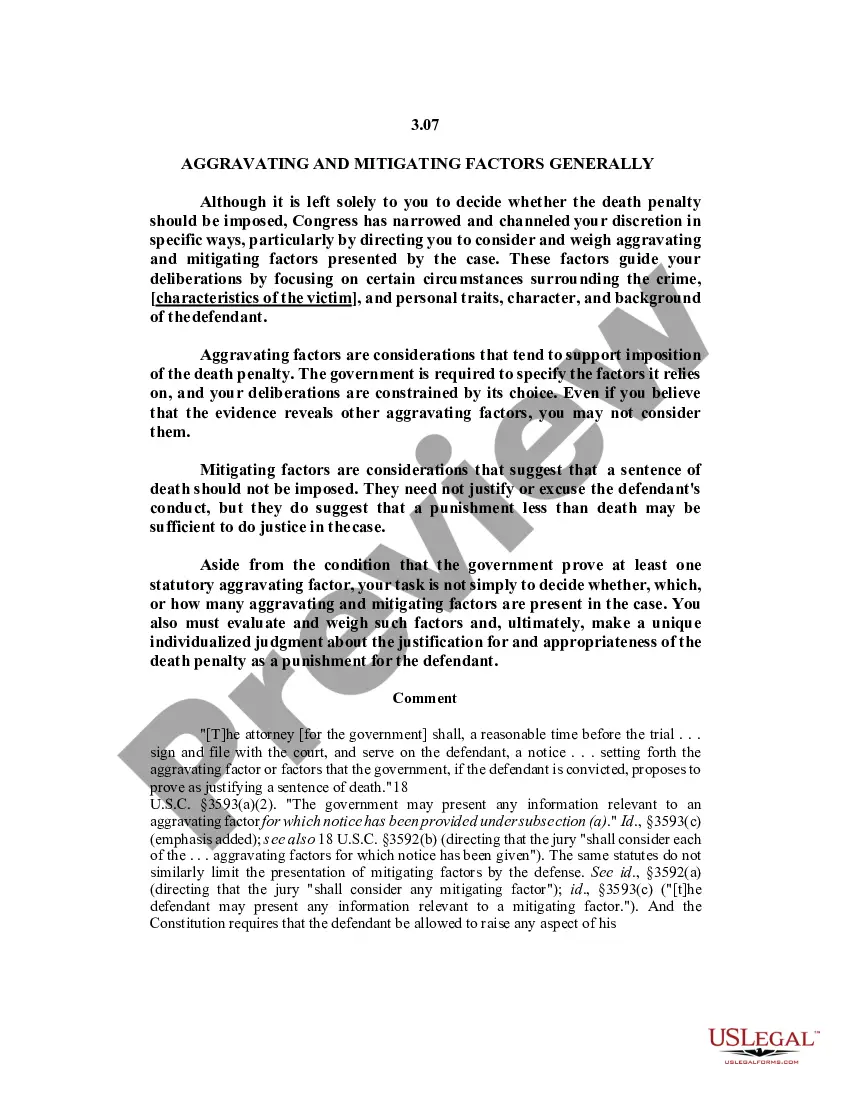
States vary in the specific circumstances they define as aggravating factors, but generally include murders committed during the commission of another crime, murders committed for monetary gain, murders of police officers, multiple murders, or other murders considered to be particularly aggravated.
What are the 5 mitigating circumstances? Five mitigating circumstances include age, mental state, history of abuse, level of involvement in the crime and lack of criminal record of the defendant. Each of these categories of circumstances can contain many specific factors that result in different levels of mitigation.
The judge may consider a variety of aggravating or mitigating factors. These include whether the defendant has committed the same crime before, whether the defendant has expressed regret for the crime, and the nature of the crime itself.
Aggravating factors might include, for example, wilfulness (i.e. doing something intentionally), lack of remorse, effect of the misconduct on the employer, loss of trust, previous warnings etc. Mitigating factors could include remorse, confession, absence of damage or loss, provocation and a clean disciplinary record.