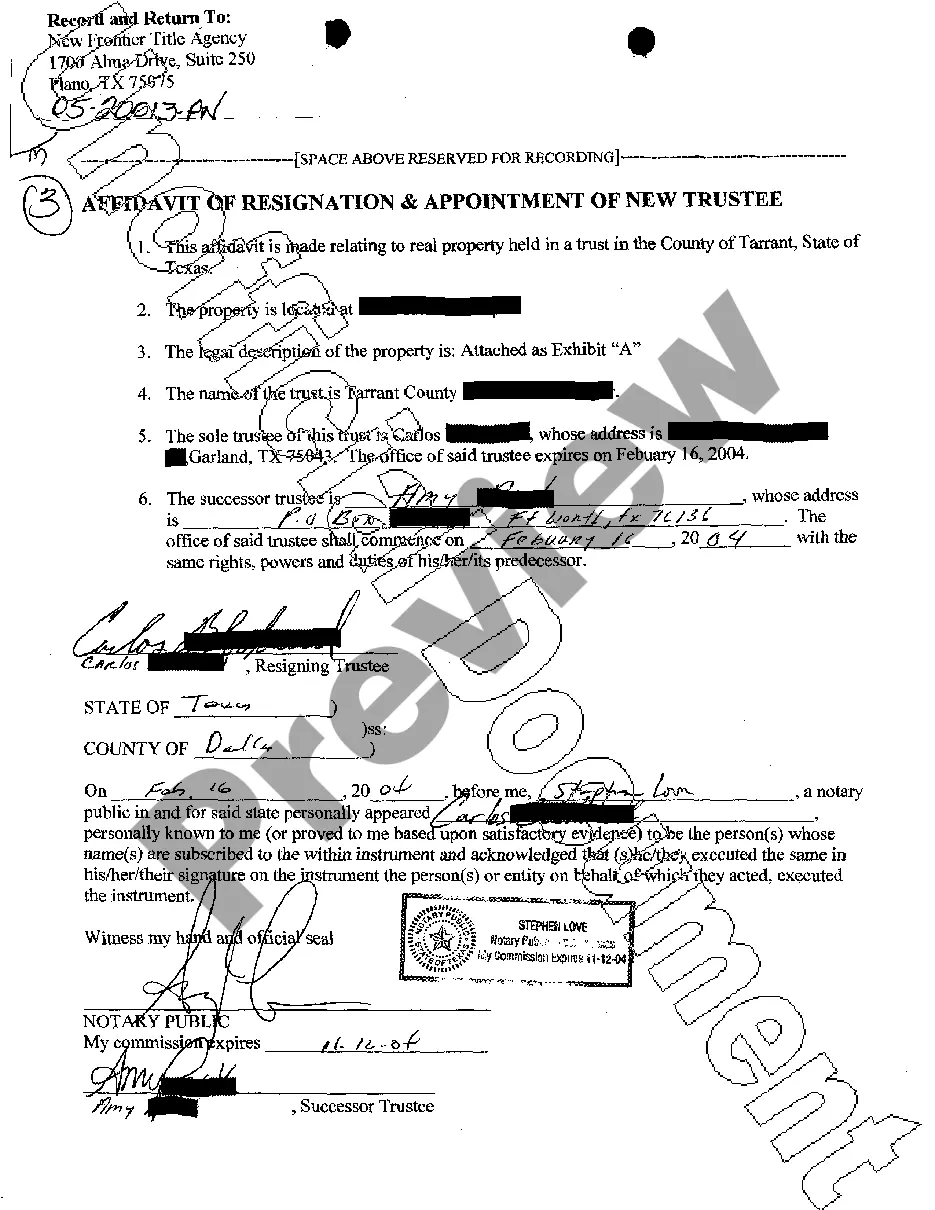
Florida Quitclaim Deed from a Trust to an Individual
Understanding this form
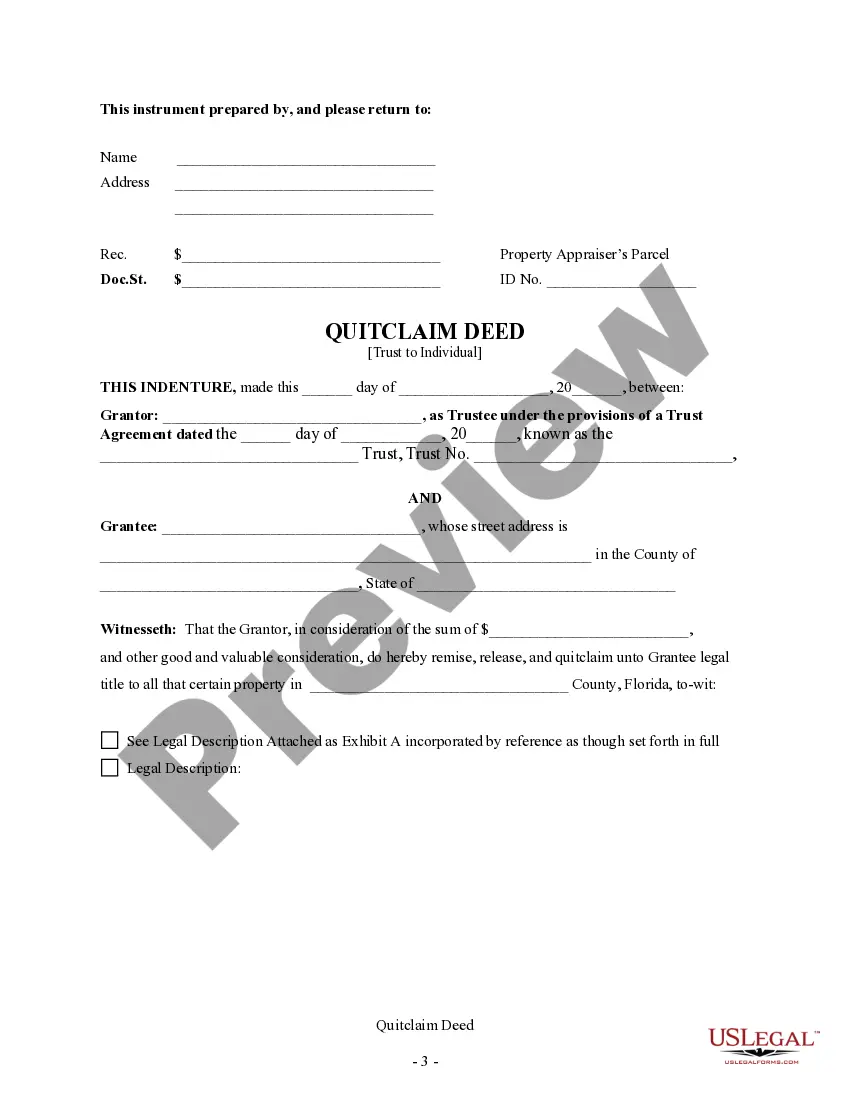
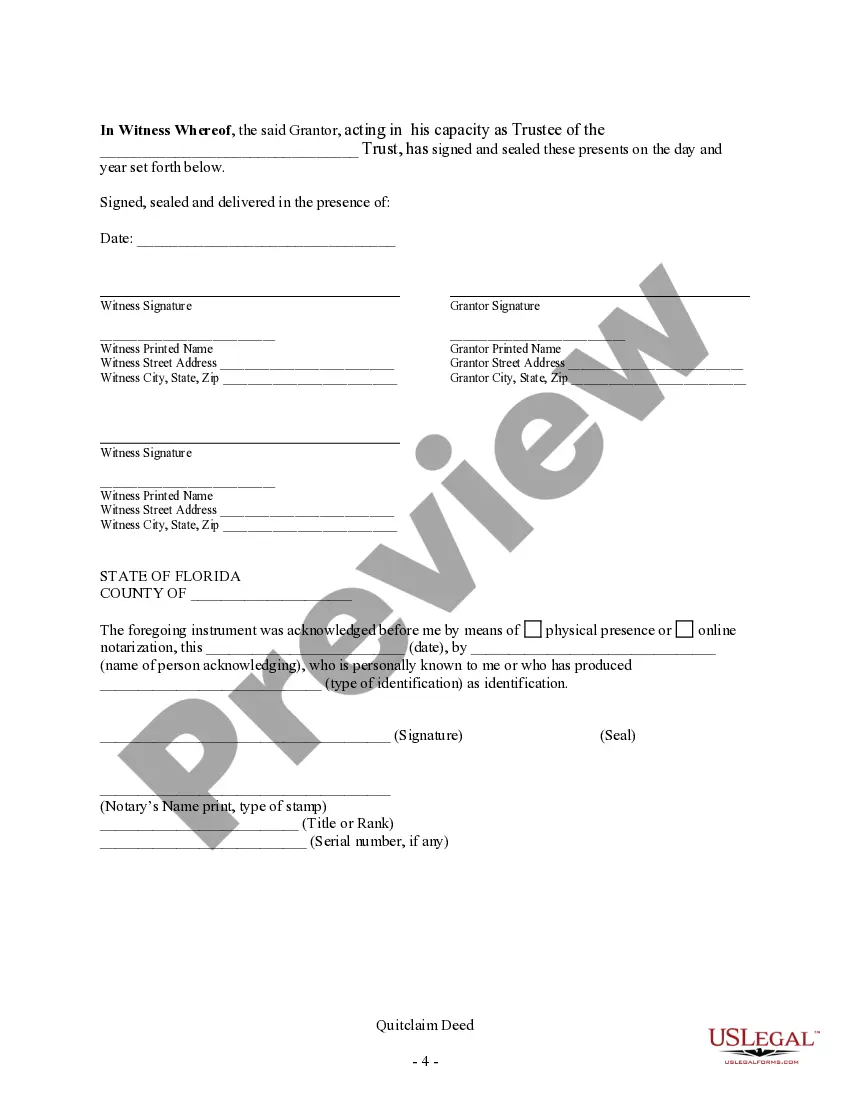
The Quitclaim Deed from a Trust to an Individual is a legal document that transfers property ownership from a trust (the Grantor) to an individual (the Grantee). Unlike a warranty deed, a quitclaim deed conveys only the Grantor's interest in the property, without guarantees regarding its title. This form is essential when a trust is involved in real estate transactions, allowing for a straightforward transfer of property rights with minimal legal hurdles.
Main sections of this form
- Grantor: The trust transferring the property ownership.
- Grantee: The individual receiving the property.
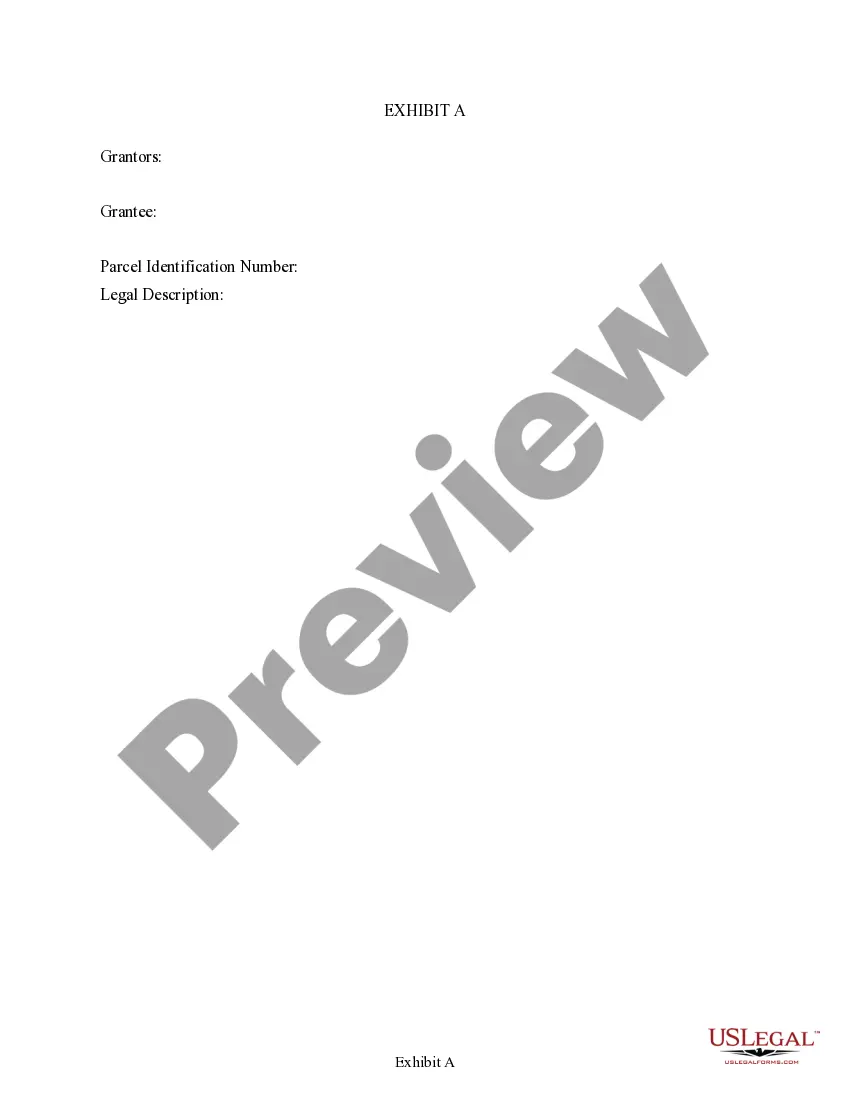
- Description of the property: Contains details about the property being transferred.
- Effective date: The date the deed becomes active.
- Signatures: Required signatures from the authorized representative of the trust.





Common use cases
This form is used when a trust needs to transfer property ownership to an individual. Common scenarios include the dissolution of a trust, the distribution of trust assets to beneficiaries, or when a trustee decides to transfer property for estate planning purposes. Using this deed simplifies the process of transferring property without involving the complexities of a warranty deed.
Who needs this form
This quitclaim deed is intended for:
- Trustees of a trust managing property that needs to be transferred.
- Beneficiaries of a trust who are receiving property.
- Individuals involved in estate planning or property distribution through a trust.
How to complete this form
- Identify the parties involved: Fill in the names of the trust (Grantor) and the individual (Grantee).
- Specify the property: Include the legal description of the property to be transferred.
- Enter the effective date: Indicate when the transfer should take effect.
- Gather required signatures: Have the authorized representative of the trust sign the document.
- Record the deed: If required, file the completed deed with the appropriate local authority to formalize the transfer.
Is notarization required?
This form must be notarized to be legally valid. US Legal Forms provides secure online notarization powered by Notarize, allowing you to complete the process through a verified video call.
Get your form ready online
Our built-in tools help you complete, sign, share, and store your documents in one place.
Make edits, fill in missing information, and update formatting in US Legal Forms—just like you would in MS Word.
Download a copy, print it, send it by email, or mail it via USPS—whatever works best for your next step.
Sign and collect signatures with our SignNow integration. Send to multiple recipients, set reminders, and more. Go Premium to unlock E-Sign.
If this form requires notarization, complete it online through a secure video call—no need to meet a notary in person or wait for an appointment.
We protect your documents and personal data by following strict security and privacy standards.

Make edits, fill in missing information, and update formatting in US Legal Forms—just like you would in MS Word.

Download a copy, print it, send it by email, or mail it via USPS—whatever works best for your next step.

Sign and collect signatures with our SignNow integration. Send to multiple recipients, set reminders, and more. Go Premium to unlock E-Sign.

If this form requires notarization, complete it online through a secure video call—no need to meet a notary in person or wait for an appointment.

We protect your documents and personal data by following strict security and privacy standards.
Common mistakes
- Not including a complete legal description of the property.
- Failing to have the correct parties sign the deed.
- Not recording the deed with local authorities, if required.
- Assuming that a quitclaim deed provides guarantees about the property's title.
Benefits of using this form online
- Convenience: Easily access and download the form from anywhere.
- Editability: Fill out the form digitally, ensuring clear and legible information.
- Time-saving: Quickly complete the form without the need for physical paperwork.
- Reliability: Access legally vetted documents created by licensed attorneys.
Looking for another form?


Form popularity
FAQ
Filling out a quitclaim deed in Florida requires accurate and thorough attention to detail. Begin with the current owner's name and address, then add the recipient's information. Be specific about the property being transferred, and remember to follow any necessary notarization rules to ensure the Florida Quitclaim Deed from a Trust to an Individual is legally binding. Use platforms like USLegalForms to make this process easier.
To fill out a Florida quitclaim deed, start with the grantor's information, which is the individual transferring the property. Follow this with the grantee's details, who is the person receiving the property from the trust. Lastly, accurately describe the property, and remember to sign the deed in front of a notary public to validate the Florida Quitclaim Deed from a Trust to an Individual.
Yes, you can prepare your own quitclaim deed in Florida. However, it's crucial to ensure that you understand the legal requirements and ensure that the deed includes all necessary information. Utilizing a user-friendly platform like USLegalForms can simplify this process and help you generate a valid Florida Quitclaim Deed from a Trust to an Individual.
Filling out a quitclaim deed form involves several key steps. First, enter the names of the parties involved, along with the property description and its location. Then, include the details of the trust and the specific individual receiving the property. Finally, ensure you have all necessary signatures and dates to complete the Florida Quitclaim Deed from a Trust to an Individual.
Quitting claim deed to yourself can clarify property ownership, correct title issues, or simplify estate planning. This action often helps in establishing a clear and direct ownership record, particularly in cases of inheritance or property held in a trust. Using a Florida Quitclaim Deed from a Trust to an Individual can facilitate this process while ensuring that your property records are up to date.
Absolutely, you can perform a quitclaim deed yourself. This process is straightforward and can often save on legal fees, especially if you are transferring property using a Florida Quitclaim Deed from a Trust to an Individual. Just ensure that you follow the proper steps and requirements, or utilize resources like US Legal Forms to assist you in preparing the deed.
A quitclaim deed from a trust to an individual is a legal document that transfers ownership rights of property held in a trust directly to an individual. This type of deed provides a swift way to change ownership without extensive legal proceedings. It is particularly useful for estate planning and asset distribution, allowing for a clear transfer of property through a Florida Quitclaim Deed from a Trust to an Individual.
Yes, you can create a quitclaim deed yourself if you understand the required information and format. This is particularly relevant when transferring property through a Florida Quitclaim Deed from a Trust to an Individual. To simplify this task, consider using US Legal Forms, which provides easy-to-use templates and guidance tailored to your needs.
You can transfer a deed without an attorney by using a quitclaim deed form. This process allows you to handle the transfer of property, particularly when dealing with a Florida Quitclaim Deed from a Trust to an Individual, on your own. However, seeking legal advice is beneficial to ensure compliance with local laws and to prevent any potential issues down the line.
Yes, a quitclaim deed can be handwritten, as long as it meets the legal requirements in Florida. To ensure validity, include all essential elements such as the names of the parties, a clear description of the property, and the notarization of signatures. However, using a professional template or service, like US Legal Forms, can help you avoid errors and streamline the process, especially when preparing a Florida Quitclaim Deed from a Trust to an Individual.