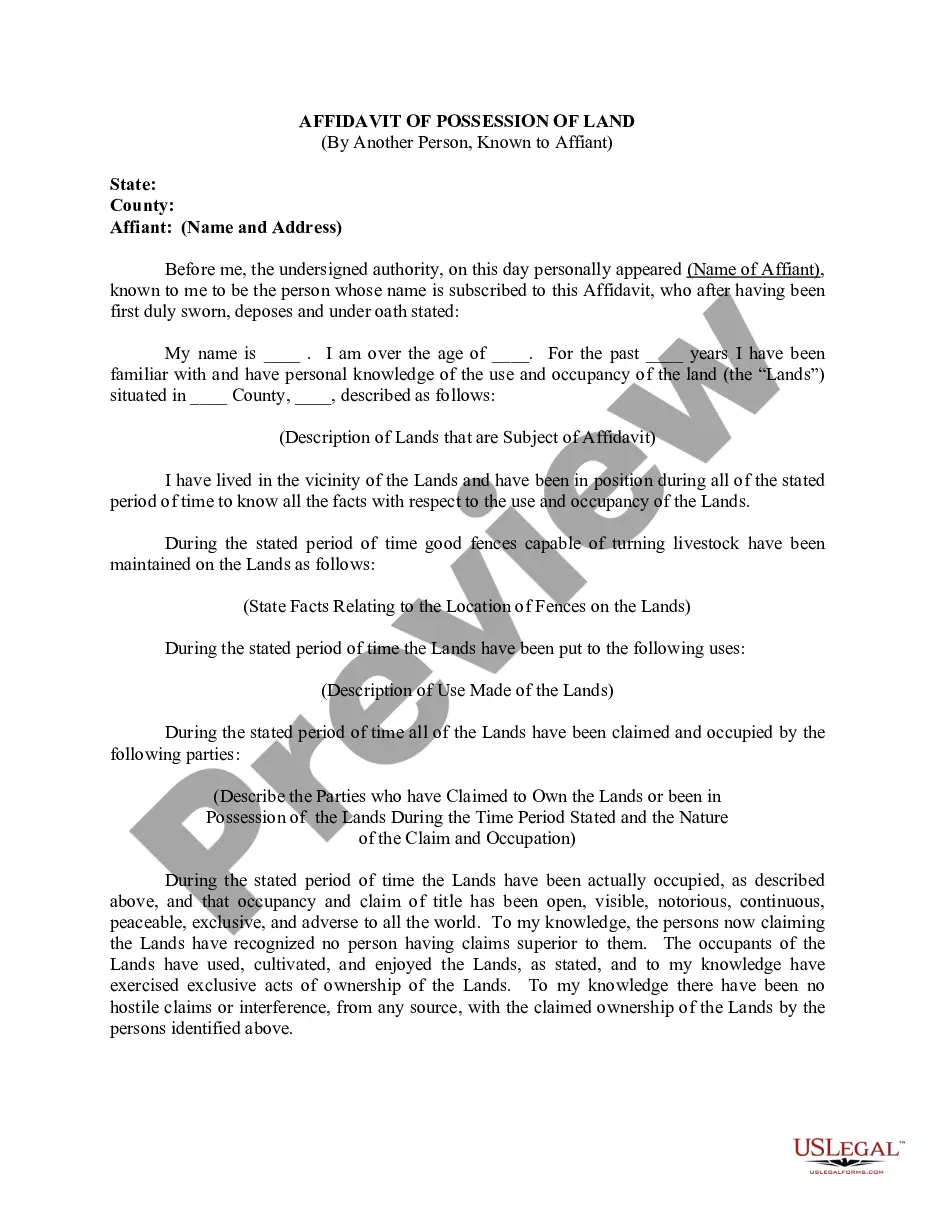
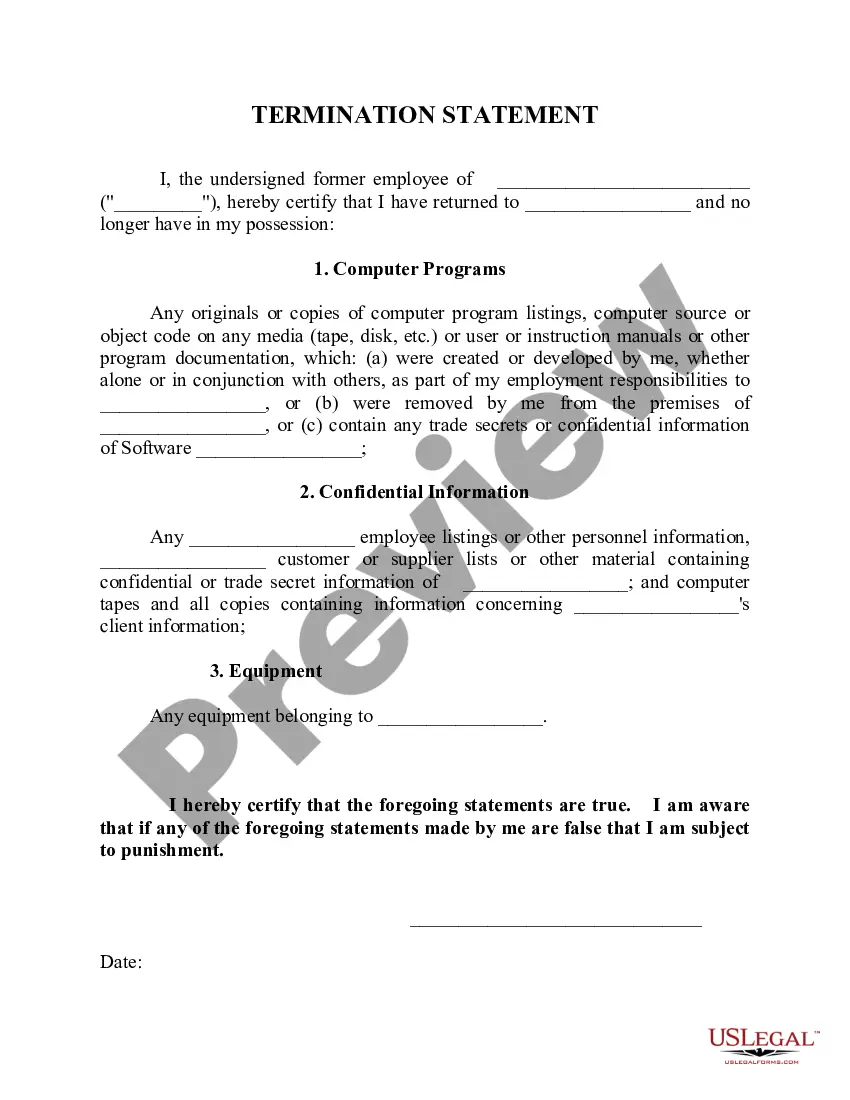
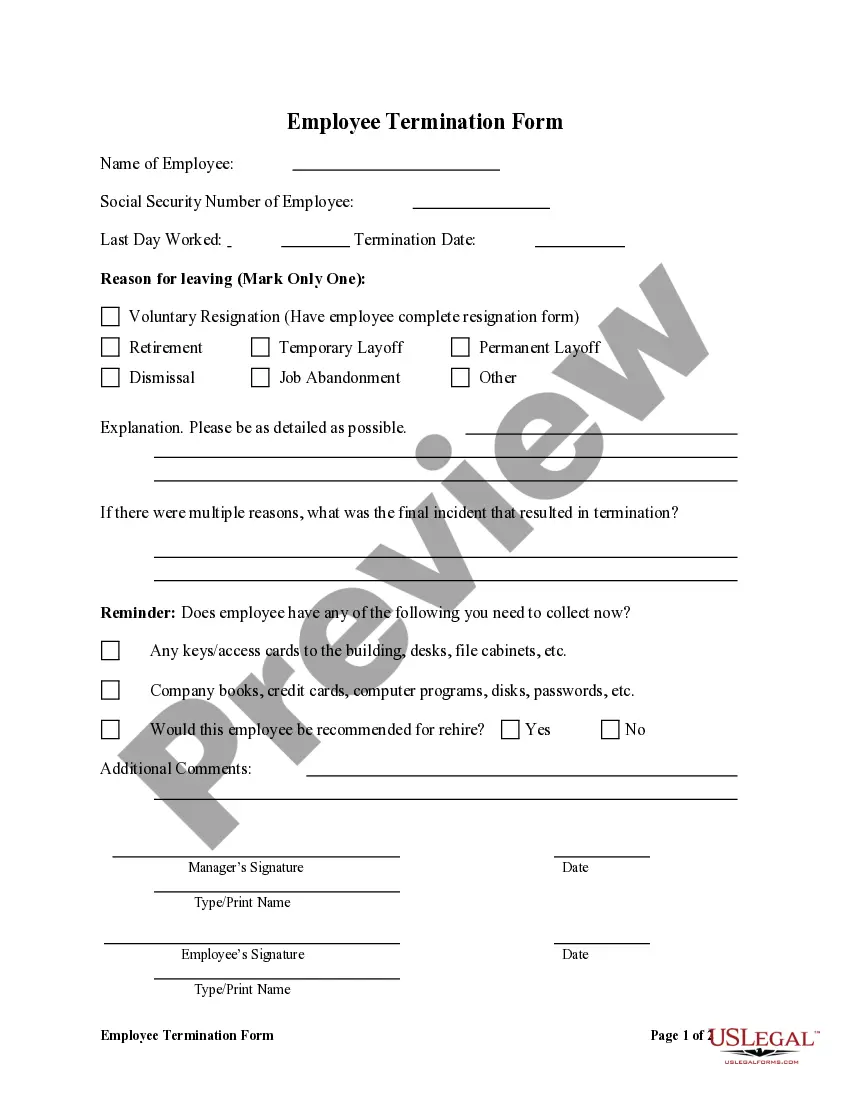
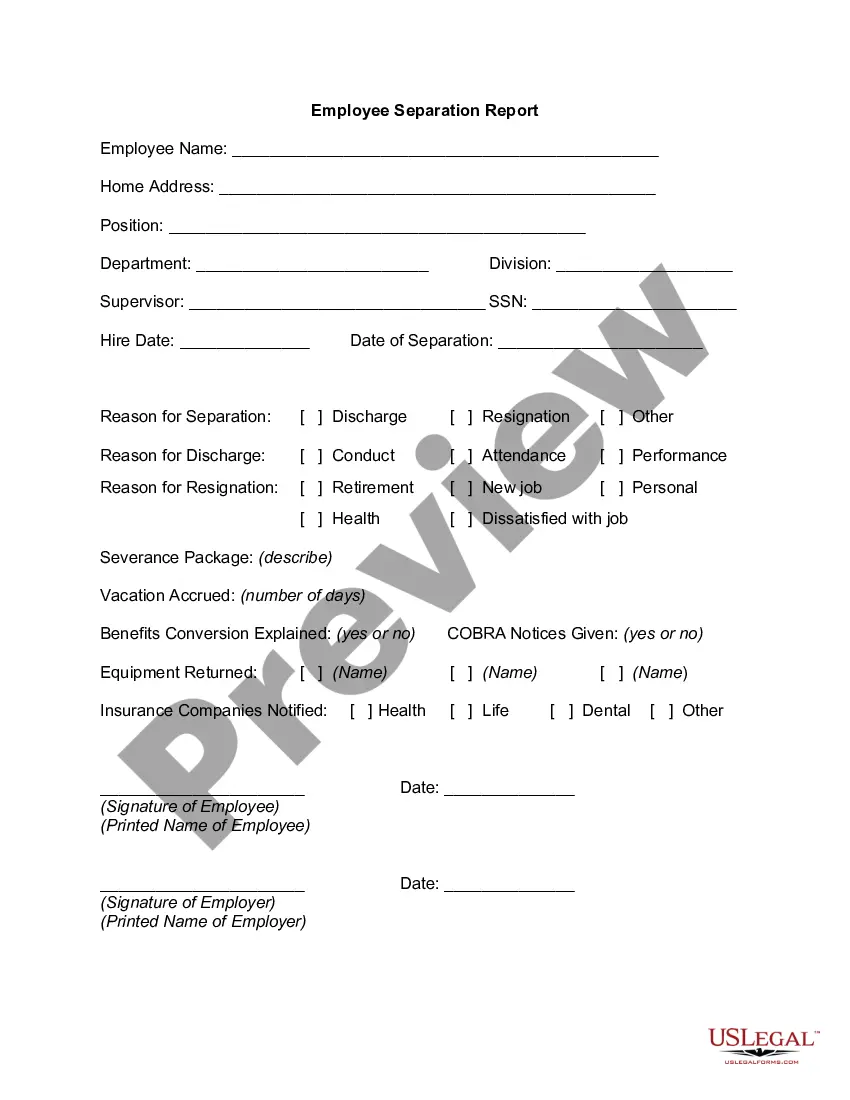
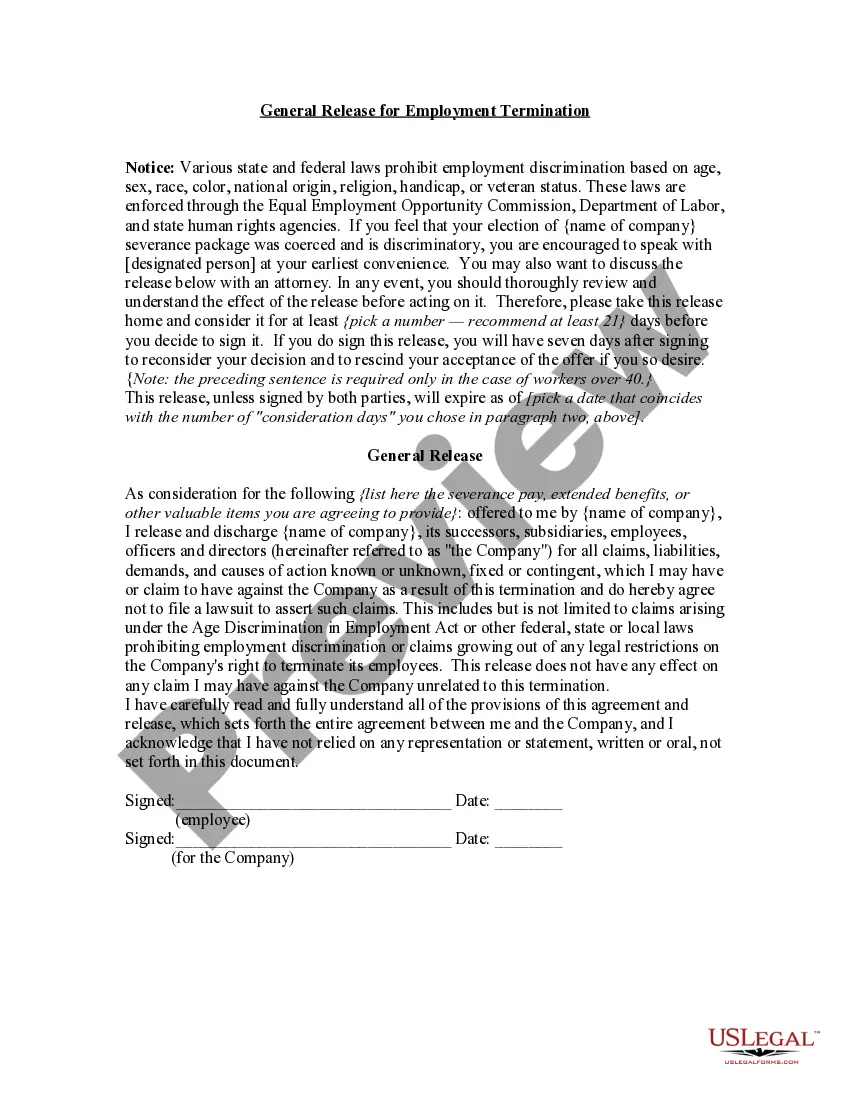
This form is a Termination Statement. The former employee certifies that he/she has returned to his/her former employer all originals and copies of computer programs, confidential information, and equipment upon termination of employment.
Delaware Employee Termination Statement
Category:
State:
Multi-State
Control #:
US-KWP-0035
Format:
Word;
Rich Text
Instant download
Description
Get your form ready online
Our built-in tools help you complete, sign, share, and store your documents in one place.
Built-in online Word editor
Make edits, fill in missing information, and update formatting in US Legal Forms—just like you would in MS Word.
Export easily
Download a copy, print it, send it by email, or mail it via USPS—whatever works best for your next step.
E-sign your document
Sign and collect signatures with our SignNow integration. Send to multiple recipients, set reminders, and more. Go Premium to unlock E-Sign.
Notarize online 24/7
If this form requires notarization, complete it online through a secure video call—no need to meet a notary in person or wait for an appointment.
Store your document securely
We protect your documents and personal data by following strict security and privacy standards.

Make edits, fill in missing information, and update formatting in US Legal Forms—just like you would in MS Word.

Download a copy, print it, send it by email, or mail it via USPS—whatever works best for your next step.

Sign and collect signatures with our SignNow integration. Send to multiple recipients, set reminders, and more. Go Premium to unlock E-Sign.

If this form requires notarization, complete it online through a secure video call—no need to meet a notary in person or wait for an appointment.

We protect your documents and personal data by following strict security and privacy standards.
Looking for another form?

How to fill out Employee Termination Statement?
Have you ever found yourself in a situation where you require documents for various business or personal reasons almost every day.
There are numerous legal document templates available online, but finding reliable versions can be challenging. US Legal Forms offers a wide selection of form templates, such as the Delaware Employee Termination Statement, that are designed to meet federal and state regulations.
If you are already familiar with the US Legal Forms website and have an account, simply Log In. After that, you can download the Delaware Employee Termination Statement template.
Select a convenient file format and download your version.
Access all the document templates you have purchased in the My documents menu. You can obtain another copy of the Delaware Employee Termination Statement at any time if needed. Just click the necessary form to download or print the document template. Utilize US Legal Forms, one of the most extensive collections of legal forms, to save time and prevent errors. The service provides properly crafted legal document templates that you can use for various purposes. Create an account on US Legal Forms and start making your life a bit easier.
- If you do not have an account and wish to use US Legal Forms, follow these steps.
- Find the form you need and ensure it is for the correct city/state.
- Use the Review button to examine the form.
- Read the description to ensure you have selected the correct form.
- If the form is not what you are looking for, use the Search field to locate the form that meets your needs and requirements.
- Once you find the appropriate form, click Get now.
- Choose the pricing plan you prefer, fill in the required information to create your account, and pay for the order using your PayPal or Visa or Mastercard.
Form popularity
FAQ
While Delaware law does not mandate a termination letter, providing one is a best practice that can protect both the employer and the employee. A termination letter, often accompanied by a Delaware Employee Termination Statement, outlines the reasons for termination and any relevant details. This documentation can be valuable in case of disputes or further legal inquiries.
Delaware is an at-will employment state, meaning that either the employer or the employee can terminate employment at any time, for any lawful reason. However, it is essential to document the termination process properly using a Delaware Employee Termination Statement. This statement serves as a formal record and helps both parties understand the reasons and terms of the termination.
Yes, there is termination paperwork required in Delaware. The Delaware Employee Termination Statement serves as an essential document to formalize the process. It helps both employers and employees understand the reasons for termination and outlines any final obligations. Utilizing a service like uslegalforms can simplify the creation of this paperwork, ensuring compliance with state regulations.
An example of a termination statement would include specific details, such as the employee's name, position, termination date, and the reason for termination. For instance, 'This letter confirms that Employee's Name, employed as Position, will be terminated effective Date due to reason.' Incorporating the Delaware Employee Termination Statement ensures that the document meets legal standards. This formality supports a smooth transition for all involved.
An example statement of termination might read, 'As of Date, Employee's Name is no longer employed by Company Name due to specific reason.' This statement should be straightforward and factual, avoiding emotional language. Referencing the Delaware Employee Termination Statement can also be beneficial to demonstrate adherence to local guidelines. This example serves as a clear communication tool for both parties.
Writing a termination statement involves clearly outlining the reasons for the employee's termination and citing any relevant company policies. Begin by stating the employee's name, position, and termination date. Make sure to include any actions that led to this decision, referencing the Delaware Employee Termination Statement to confirm the process aligns with state laws. This statement serves as a formal record, ensuring transparency and compliance.
To write an employee termination letter, start by clearly stating the employee's name and the position they held. Include the effective date of termination and a concise reason for the decision, while ensuring you maintain a professional tone. For added clarity, you may also reference the Delaware Employee Termination Statement to ensure compliance with state regulations. This formal document helps protect both the employer and employee during the termination process.