Delaware Independent Contractor Agreement Between Licensed Counselor and Therapist and Licensed Counselor and Therapist Practicing as a Solo Practitioner

State:
Multi-State
Control #:
US-02565BG
Format:
Word; 
Rich Text
Instant download

Description

An independent contractor is a person or business who performs services for another person pursuant to an agreement and who is not subject to the other's control, or right to control, the manner and means of performing the services. The exact nature of the independent contractor's relationship with the hiring party is important since an independent contractor pays his/her own Social Security, income taxes without payroll deduction, has no retirement or health plan rights, and often is not entitled to worker's compensation coverage. The traditional tests to determine whether a worker is an employee or independent contractor involve the concept of control. The Internal Revenue Service (IRS) developed 20 factors used to determine whether a worker is an independent contractor under the common law. A "yes" answer to any of these questions would be evidence of an employer-employee relationship.

" Does the principal provide instructions to the worker about when, where, and how he or she is to perform the work?


" Does the principal provide training to the worker?

" Are the services provided by the worker integrated into the principal's business operations?

" Must the services be rendered personally by the worker?

" Does the principal hire, supervise and pay assistants to the worker?

" Is there a continuing relationship between the principal and the worker?

" Does the principal set the work hours and schedule?

" Does the worker devote substantially full time to the business of the principal?

" Is the work performed on the principal's premises?

" Is the worker required to perform the services in an order or sequence set by the principal?

" Is the worker required to submit oral or written reports to the principal?

" Is the worker paid by the hour, week, or month?

" Does the principal have the right to discharge the worker at will?

" Can the worker terminate his or her relationship with the principal any time he or she wishes without incurring liability to the principal?

" Does the principal pay the business or traveling expenses of the worker?

A "yes" answer to any of these questions would be evidence of an independent contractor relationship.


" Does the worker furnish significant tools, materials and equipment?

" Does the worker have a significant investment in facilities?

" Can the worker realize a profit or loss as a result of his or her services?

" Does the worker provide services for more than one firm at a time?

" Does the worker make his or her services available to the general public?
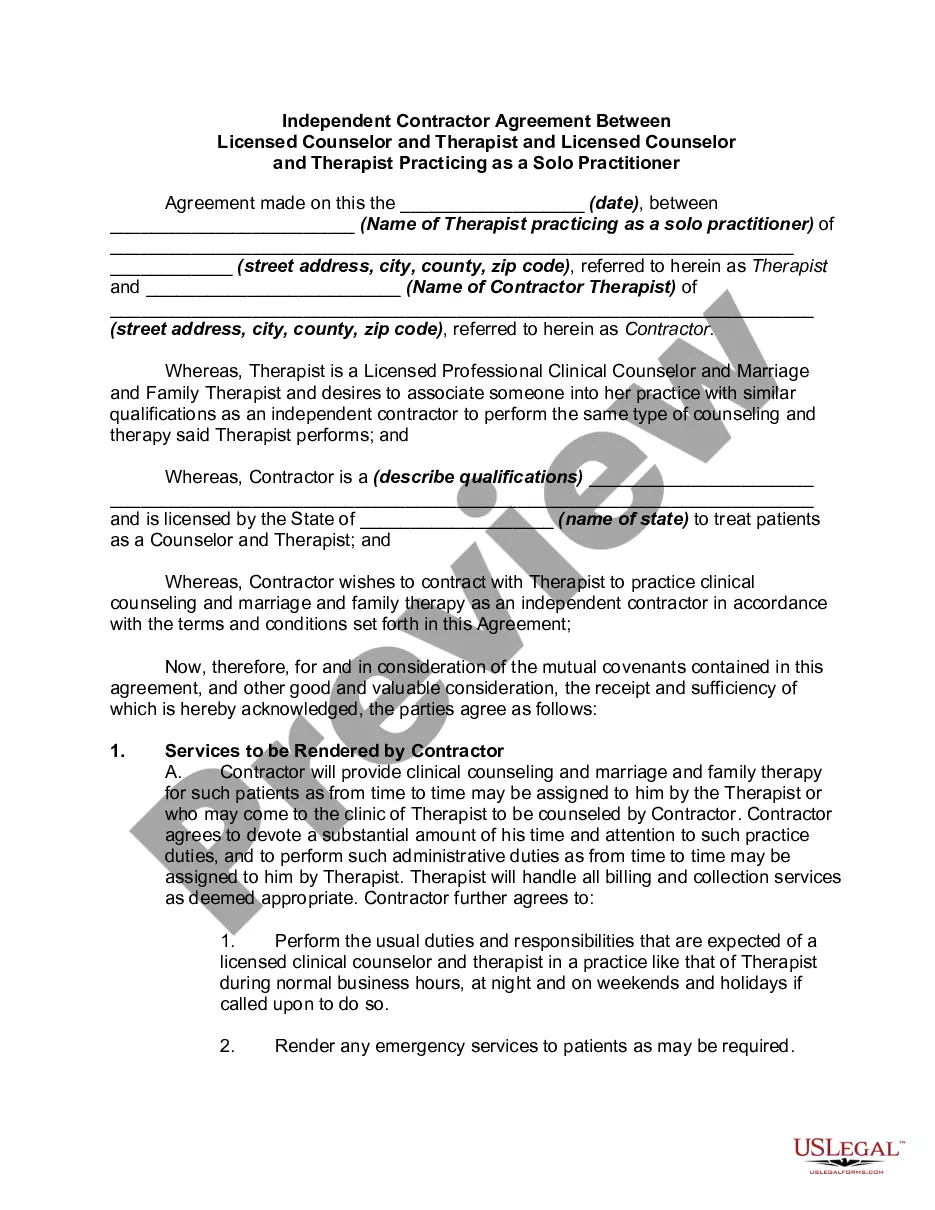
Free preview
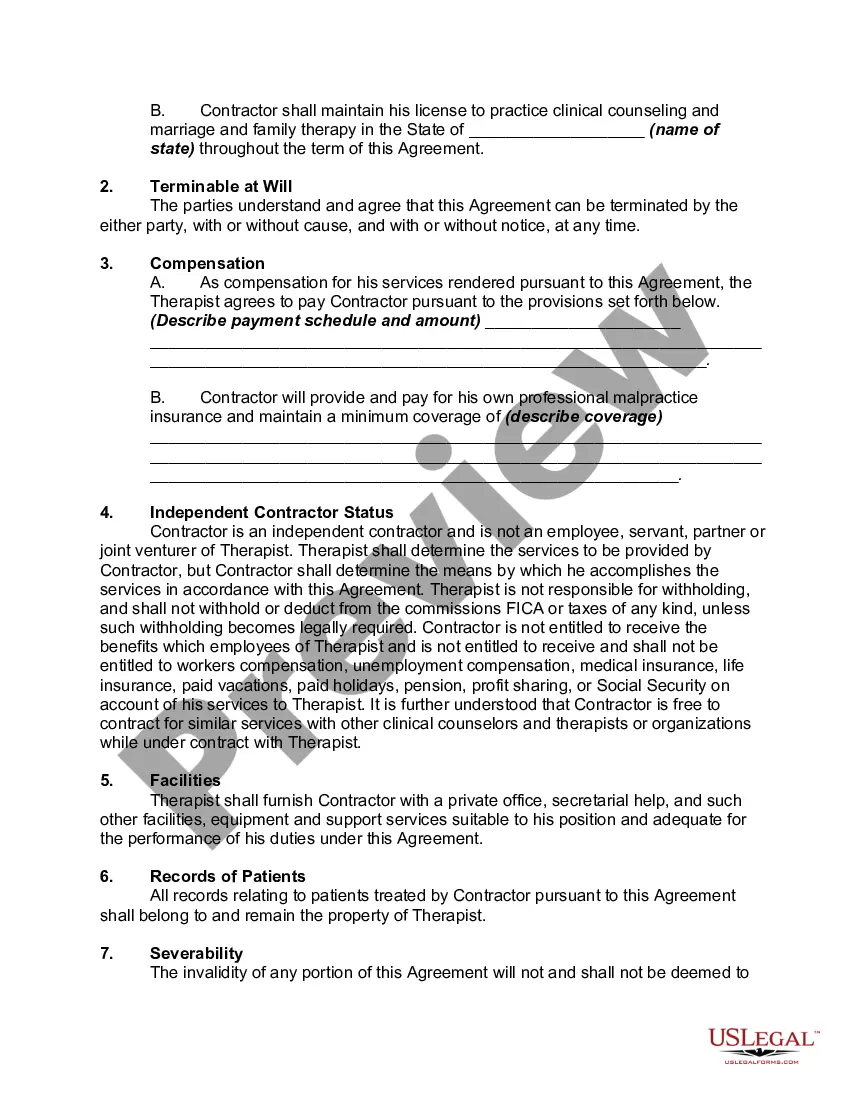
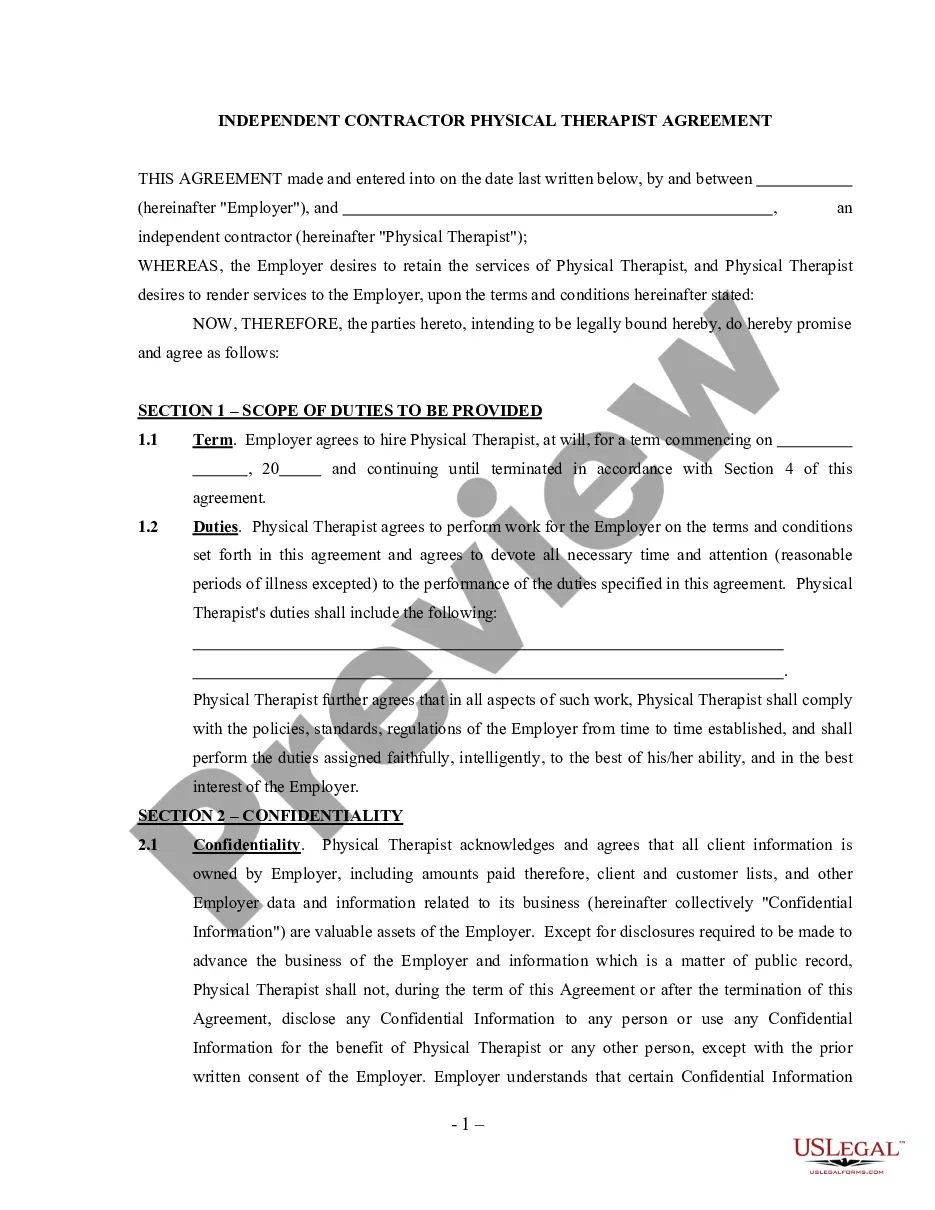
  • Preview Independent Contractor Agreement Between Licensed Counselor and Therapist and Licensed Counselor and Therapist Practicing as a Solo Practitioner
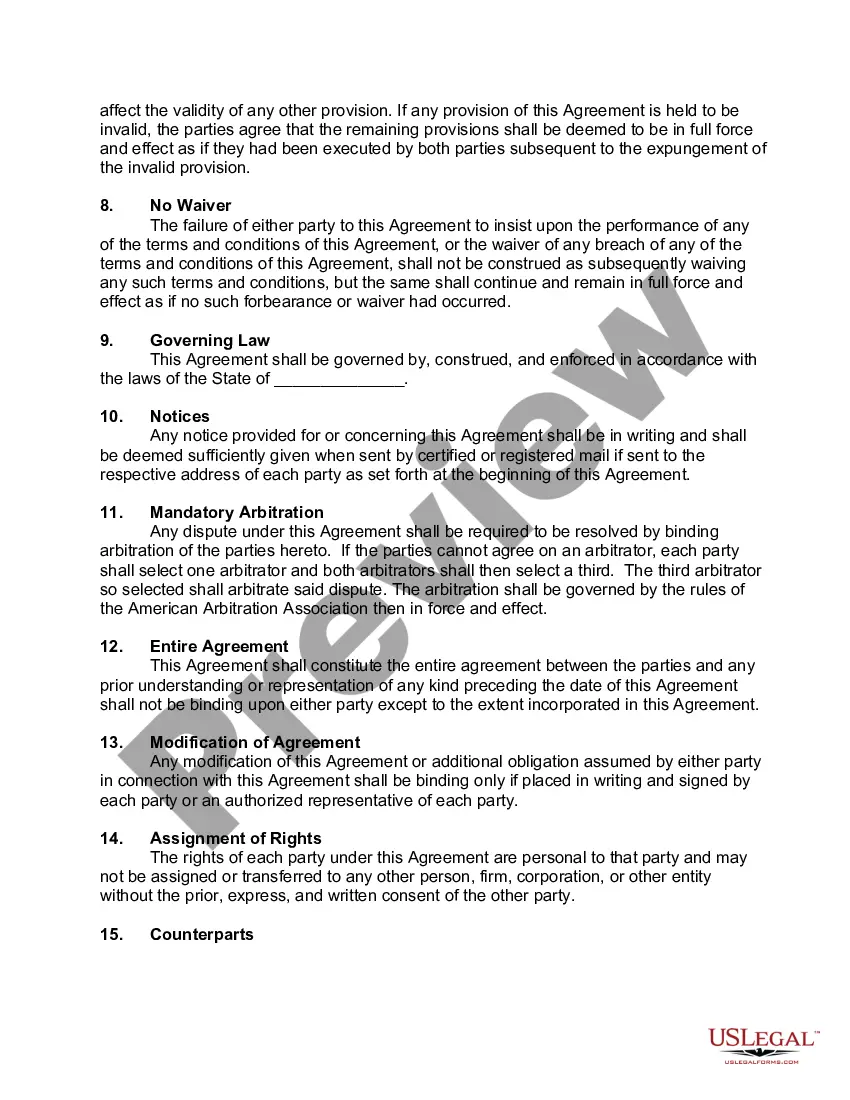
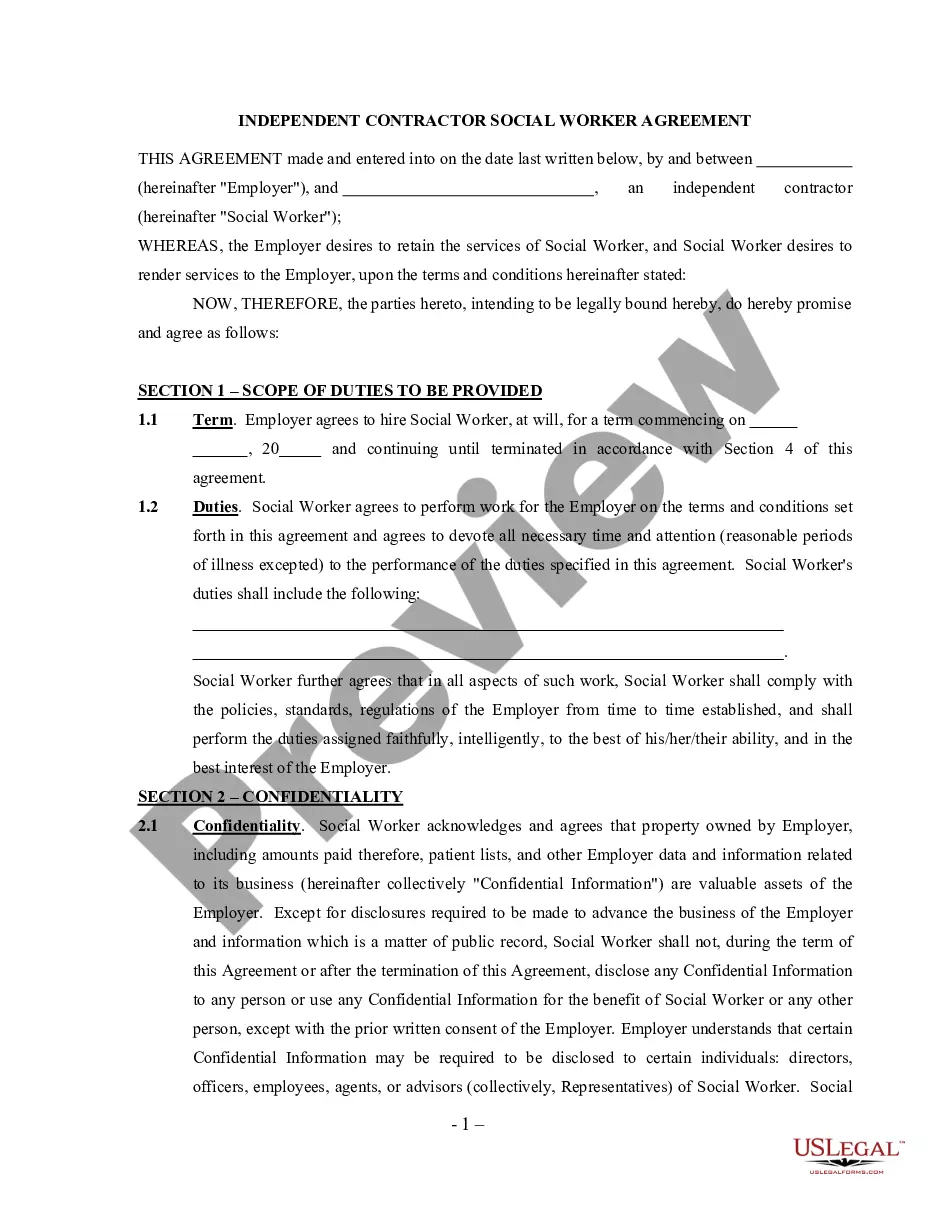
  • Preview Independent Contractor Agreement Between Licensed Counselor and Therapist and Licensed Counselor and Therapist Practicing as a Solo Practitioner
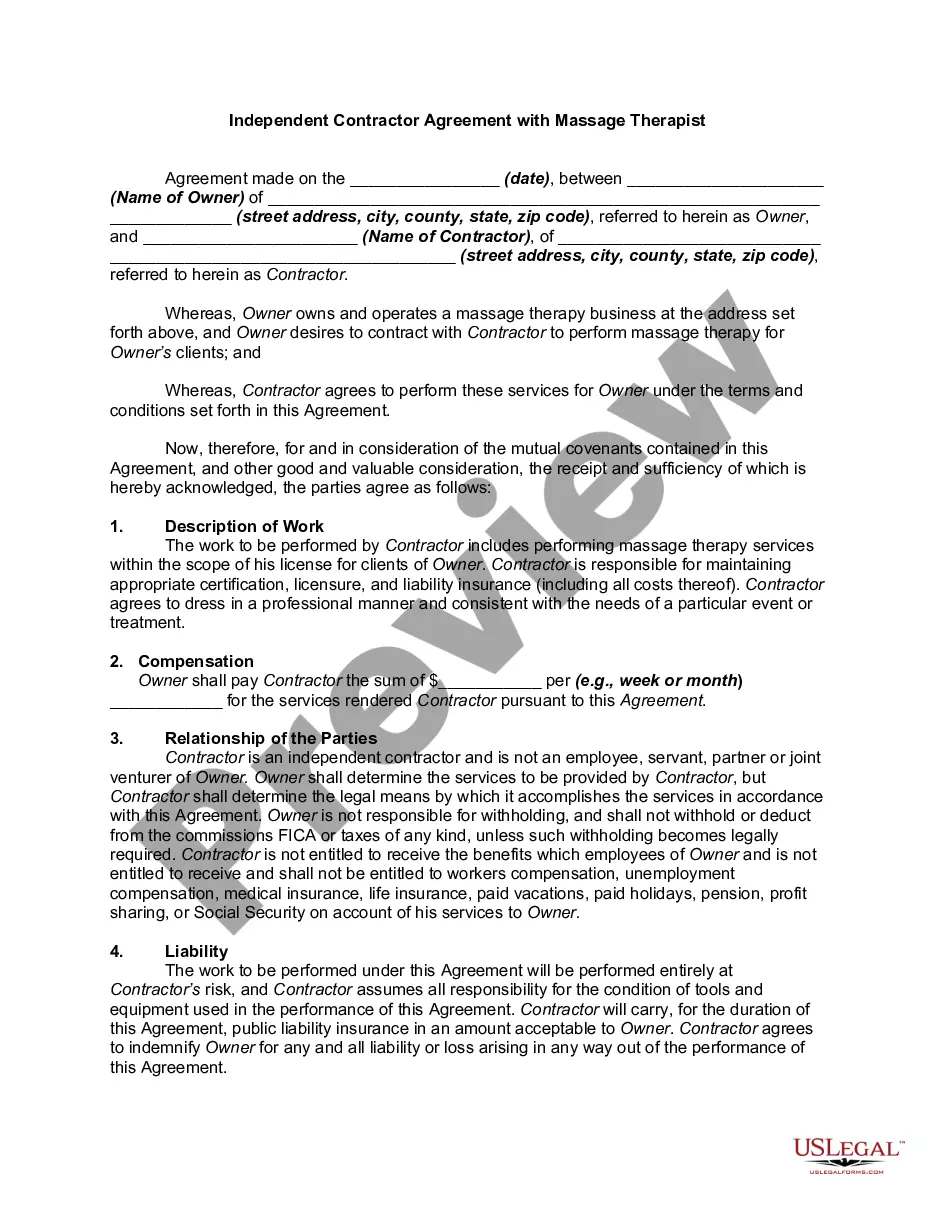
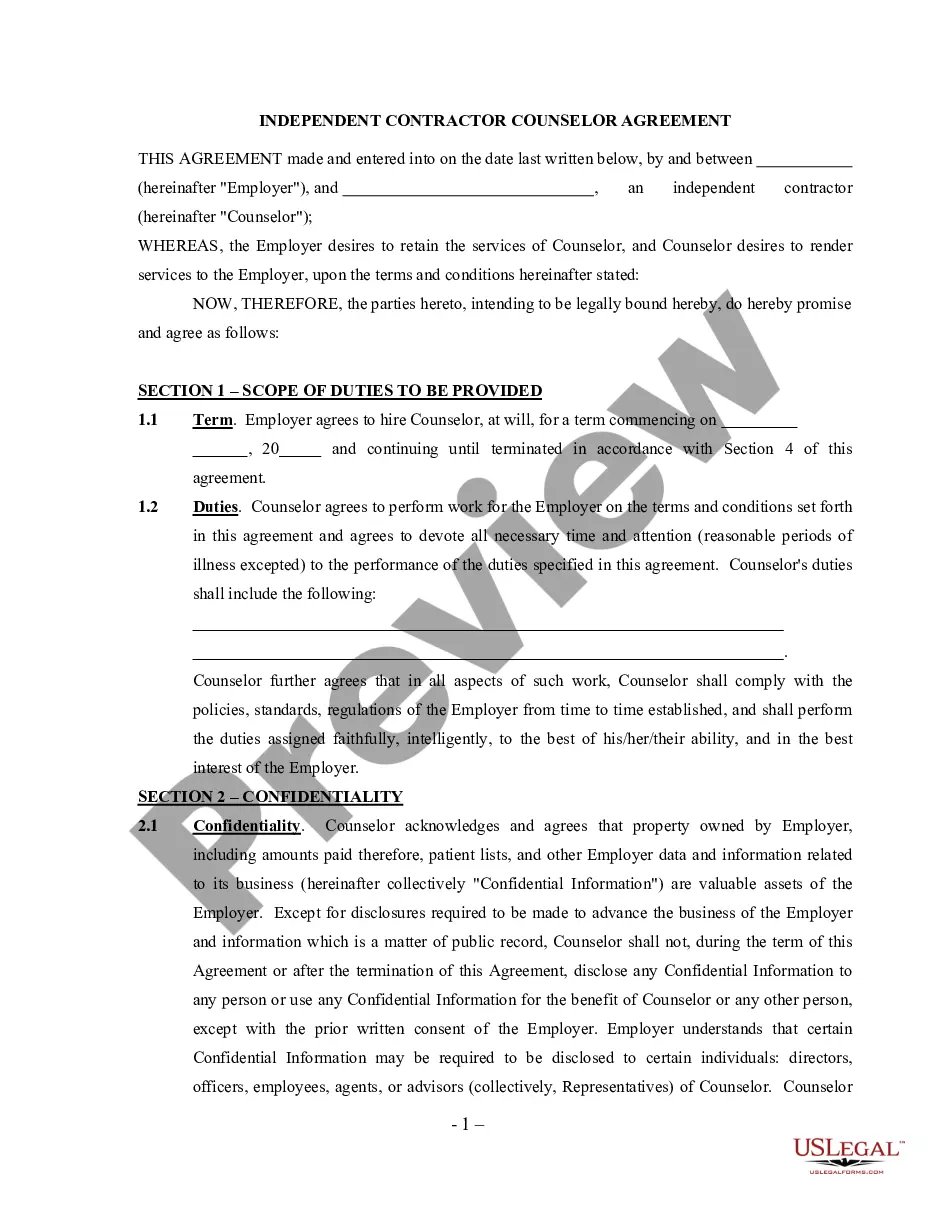
  • Preview Independent Contractor Agreement Between Licensed Counselor and Therapist and Licensed Counselor and Therapist Practicing as a Solo Practitioner
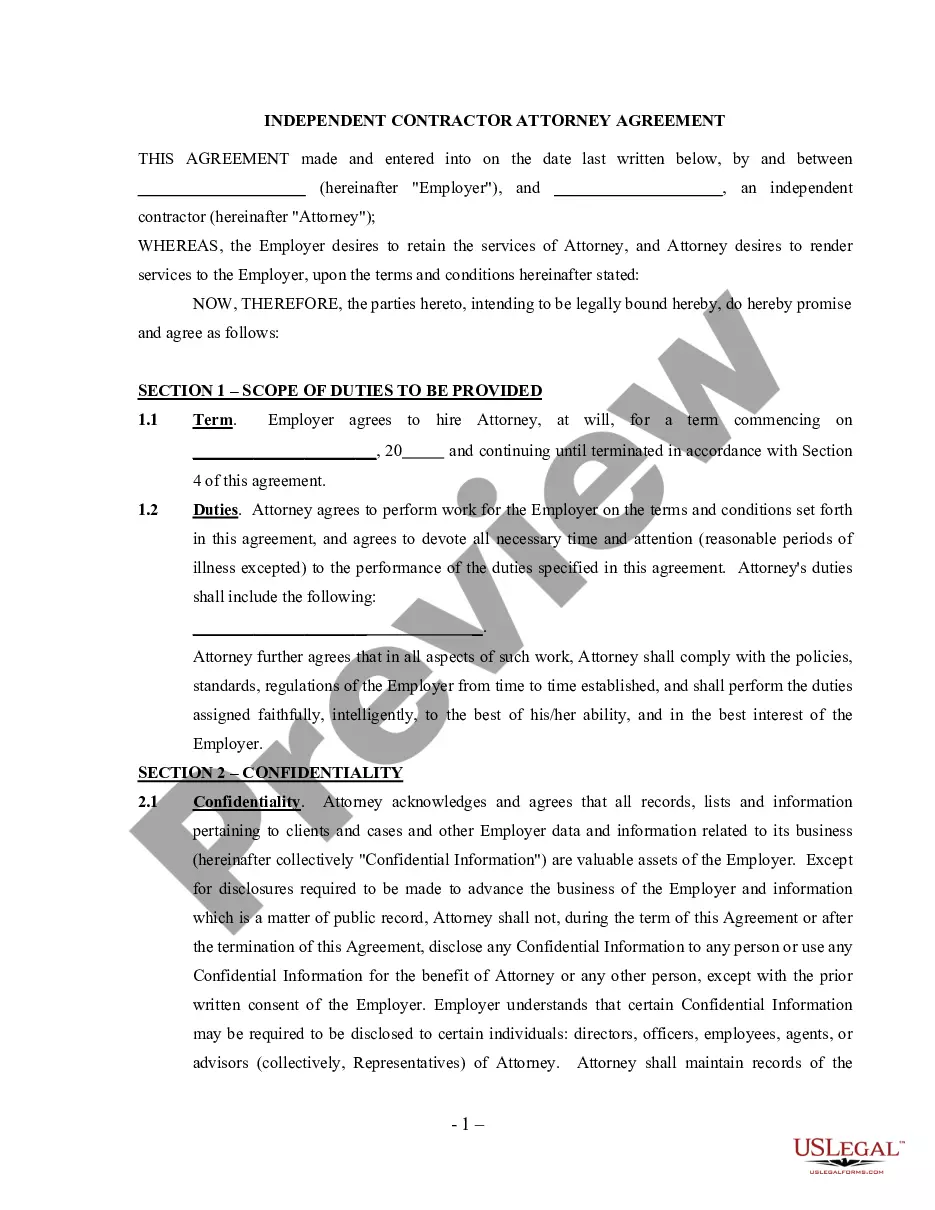
  • Preview Independent Contractor Agreement Between Licensed Counselor and Therapist and Licensed Counselor and Therapist Practicing as a Solo Practitioner

How to fill out Independent Contractor Agreement Between Licensed Counselor And Therapist And Licensed Counselor And Therapist Practicing As A Solo Practitioner?

You can spend hours online searching for the valid document format that satisfies the federal and state requirements you need.

US Legal Forms offers a vast array of legal forms that can be reviewed by experts.

It is easy to download or print the Delaware Independent Contractor Agreement Between Licensed Counselor and Therapist and Licensed Counselor and Therapist Practicing as a Solo Practitioner from our service.

If available, make use of the Review option to verify the document format as well.

  1. If you already have a US Legal Forms account, you can Log In and then click the Obtain button.
  2. After that, you can complete, edit, print, or sign the Delaware Independent Contractor Agreement Between Licensed Counselor and Therapist and Licensed Counselor and Therapist Practicing as a Solo Practitioner.
  3. Every legal document format you obtain is yours forever.
  4. To get another copy of any purchased form, go to the My documents tab and click the relevant option.
  5. If you are using the US Legal Forms website for the first time, follow the simple steps below.
  6. First, make sure you have selected the correct document format for your county/town of choice.
  7. Review the form description to confirm you have chosen the right form.

Form popularity

FAQ

In most cases, non-therapists cannot own a therapy practice that provides therapeutic services without appropriate licensure. Ownership typically requires someone with the necessary mental health credentials to ensure ethical and legal compliance. However, non-therapists can oversee business operations if the services are delivered by licensed professionals. This situation highlights the importance of a solid legal structure, such as a Delaware Independent Contractor Agreement Between Licensed Counselor and Therapist and Licensed Counselor and Therapist Practicing as a Solo Practitioner, to define the roles and responsibilities clearly.

Yes, therapists can and often do seek their own therapy. This practice allows them to manage their mental health while gaining insights into their clients' experiences. Having a therapist provides a safe space for therapists to process their emotions, ensuring they offer the best care to their clients. This aligns well with the principles behind a Delaware Independent Contractor Agreement Between Licensed Counselor and Therapist and Licensed Counselor and Therapist Practicing as a Solo Practitioner, emphasizing the importance of professional self-care.

Licensed professional counselors and therapists both provide essential mental health services but differ in their credentials and focus areas. Licensed professional counselors hold specific state licenses and often specialize in diagnosing and treating mental health disorders. Therapists, on the other hand, can refer to a broader range of mental health professionals, including social workers and psychologists. Understanding these distinctions is crucial when drafting a Delaware Independent Contractor Agreement Between Licensed Counselor and Therapist and Licensed Counselor and Therapist Practicing as a Solo Practitioner.

The term 'licensed independently' signifies that a therapist has the qualifications to practice without requiring supervision from another professional. This status allows them to decide how to conduct their practice, manage their case load, and set their fees. It is essential to clarify this distinction in your Delaware Independent Contractor Agreement Between Licensed Counselor and Therapist and Licensed Counselor and Therapist Practicing as a Solo Practitioner to ensure compliance and clarity.

Licensed counselors and licensed therapists often work in similar fields, yet they may have different educational paths and focus areas. Licensed counselors typically address mental and emotional issues, while licensed therapists might focus on a broader range of therapeutic techniques and approaches. In both cases, understanding these roles is important when developing a Delaware Independent Contractor Agreement Between Licensed Counselor and Therapist and Licensed Counselor and Therapist Practicing as a Solo Practitioner.

An independently licensed therapist is a professional who has received full licensure from their state’s credentialing board. This means they can operate their practice independently, offering therapy services and accepting patients directly. When creating a Delaware Independent Contractor Agreement Between Licensed Counselor and Therapist and Licensed Counselor and Therapist Practicing as a Solo Practitioner, it is important to know this status.

An independently licensed therapist has obtained the necessary credentials to practice without supervision. This designation allows them to make clinical decisions and operate their practice. Such independence is vital when you're drafting a Delaware Independent Contractor Agreement Between Licensed Counselor and Therapist and Licensed Counselor and Therapist Practicing as a Solo Practitioner.

An independent contractor therapist functions independently, providing therapy services without being an employee of a practice or facility. They often handle their billing, scheduling, and business operations. This setup allows for more flexibility and autonomy and is particularly relevant when drafting a Delaware Independent Contractor Agreement Between Licensed Counselor and Therapist and Licensed Counselor and Therapist Practicing as a Solo Practitioner.

Licensed therapists have met specific educational and training requirements and hold a state-issued license to practice. Non-licensed therapists may have training in therapy but do not have the credentials to provide treatment legally. Understanding this distinction is crucial, especially when forming a Delaware Independent Contractor Agreement Between Licensed Counselor and Therapist and Licensed Counselor and Therapist Practicing as a Solo Practitioner.

As a 1099 therapist, forming an LLC can offer you legal and financial protections. Maintaining an LLC separates your personal assets from your business liabilities. Although it's not legally required, having an LLC can streamline your practices, especially when dealing with the Delaware Independent Contractor Agreement Between Licensed Counselor and Therapist and Licensed Counselor and Therapist Practicing as a Solo Practitioner.

Trusted and secure by over 3 million people of the world’s leading companies

Delaware Independent Contractor Agreement Between Licensed Counselor and Therapist and Licensed Counselor and Therapist Practicing as a Solo Practitioner