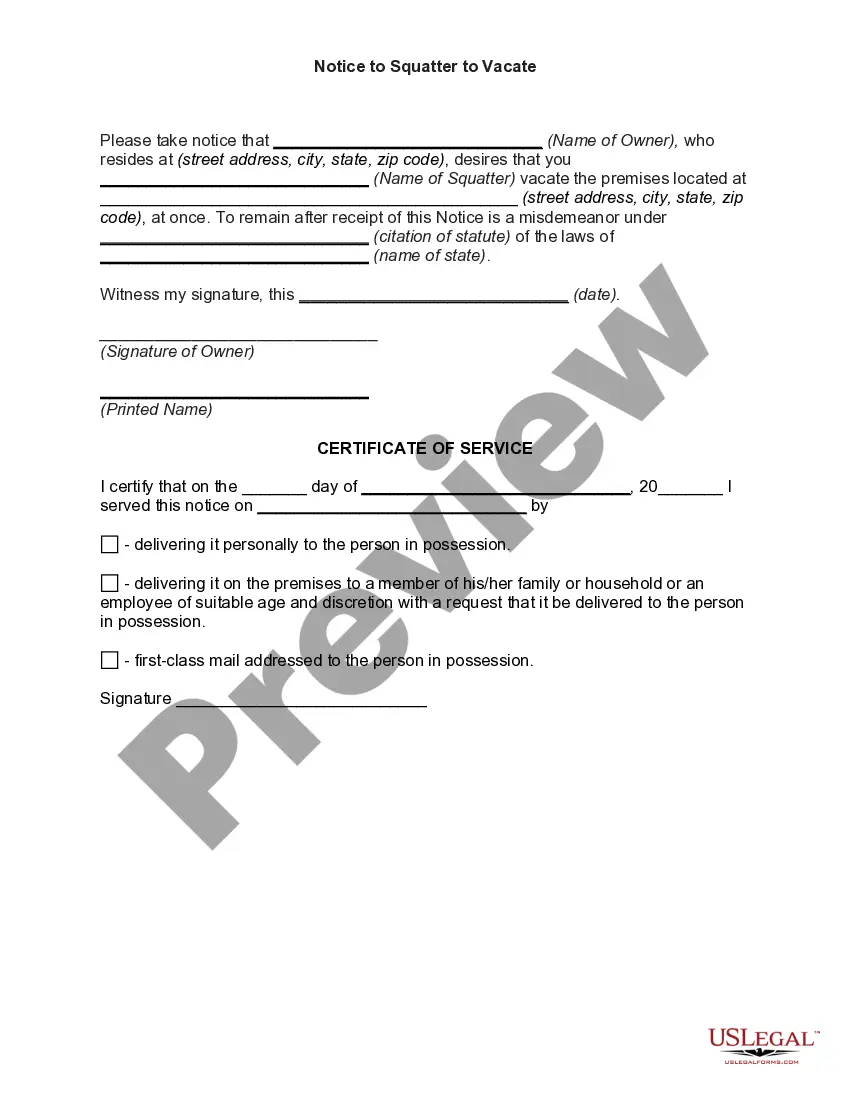
Delaware Notice to Vacate for Squatters
Description
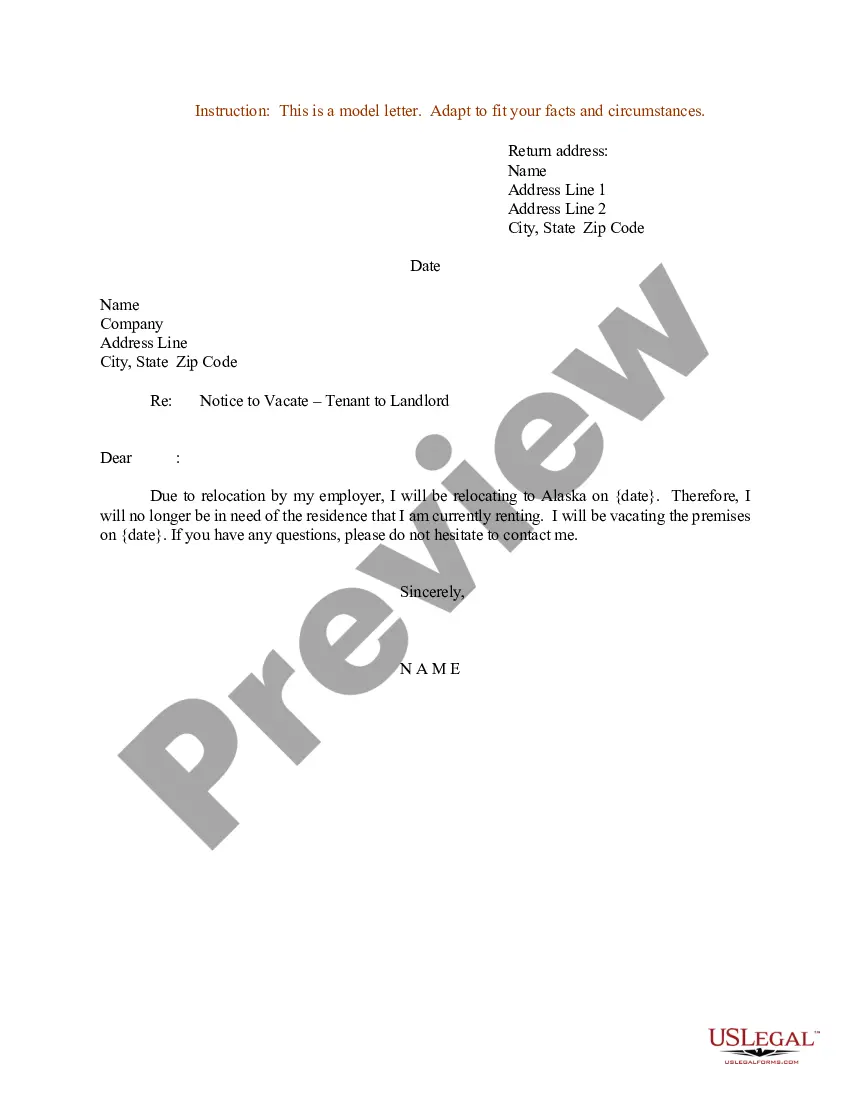
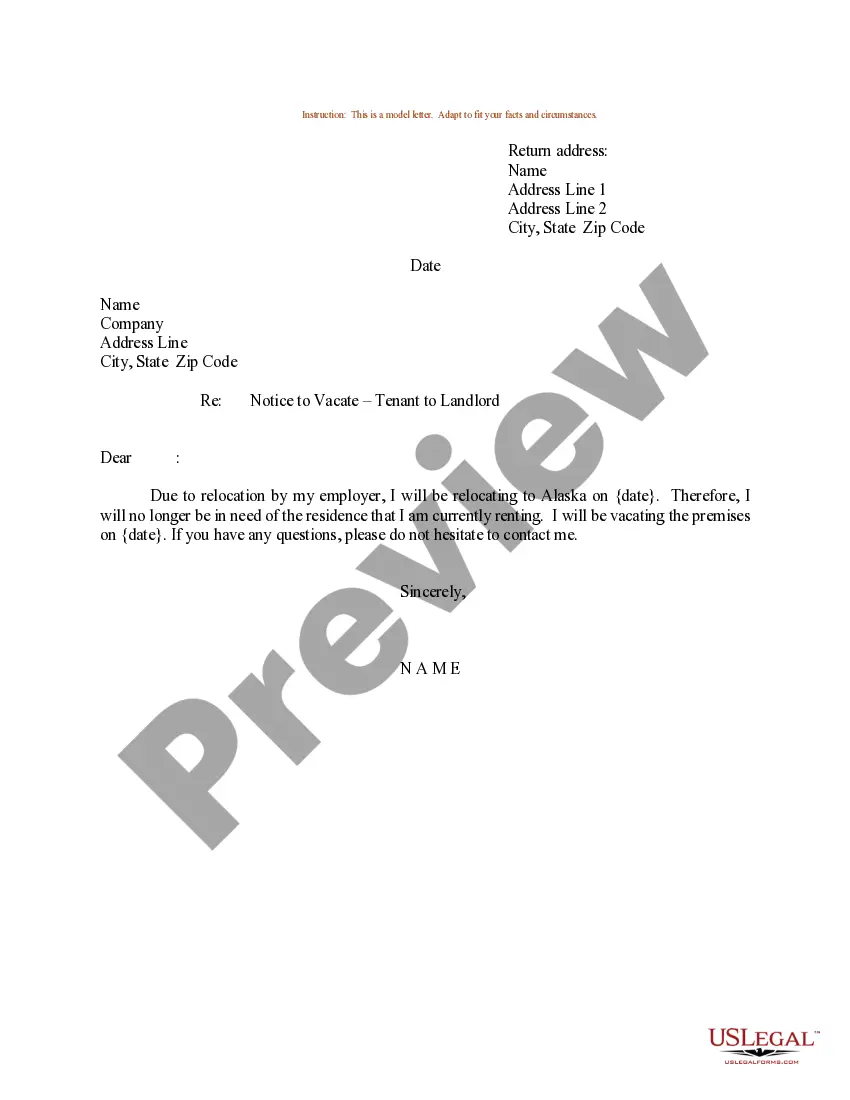
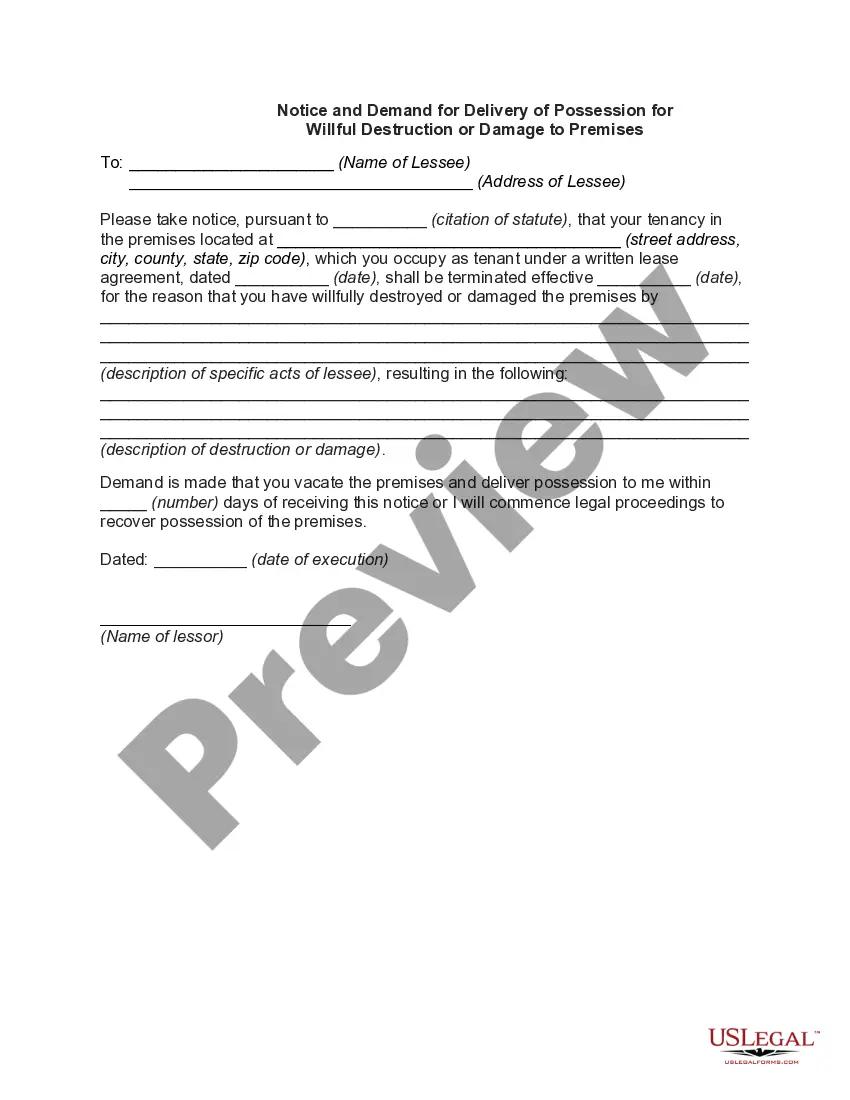
Get your form ready online
Our built-in tools help you complete, sign, share, and store your documents in one place.
Make edits, fill in missing information, and update formatting in US Legal Forms—just like you would in MS Word.
Download a copy, print it, send it by email, or mail it via USPS—whatever works best for your next step.
Sign and collect signatures with our SignNow integration. Send to multiple recipients, set reminders, and more. Go Premium to unlock E-Sign.
If this form requires notarization, complete it online through a secure video call—no need to meet a notary in person or wait for an appointment.
We protect your documents and personal data by following strict security and privacy standards.

Make edits, fill in missing information, and update formatting in US Legal Forms—just like you would in MS Word.

Download a copy, print it, send it by email, or mail it via USPS—whatever works best for your next step.

Sign and collect signatures with our SignNow integration. Send to multiple recipients, set reminders, and more. Go Premium to unlock E-Sign.

If this form requires notarization, complete it online through a secure video call—no need to meet a notary in person or wait for an appointment.

We protect your documents and personal data by following strict security and privacy standards.
Looking for another form?
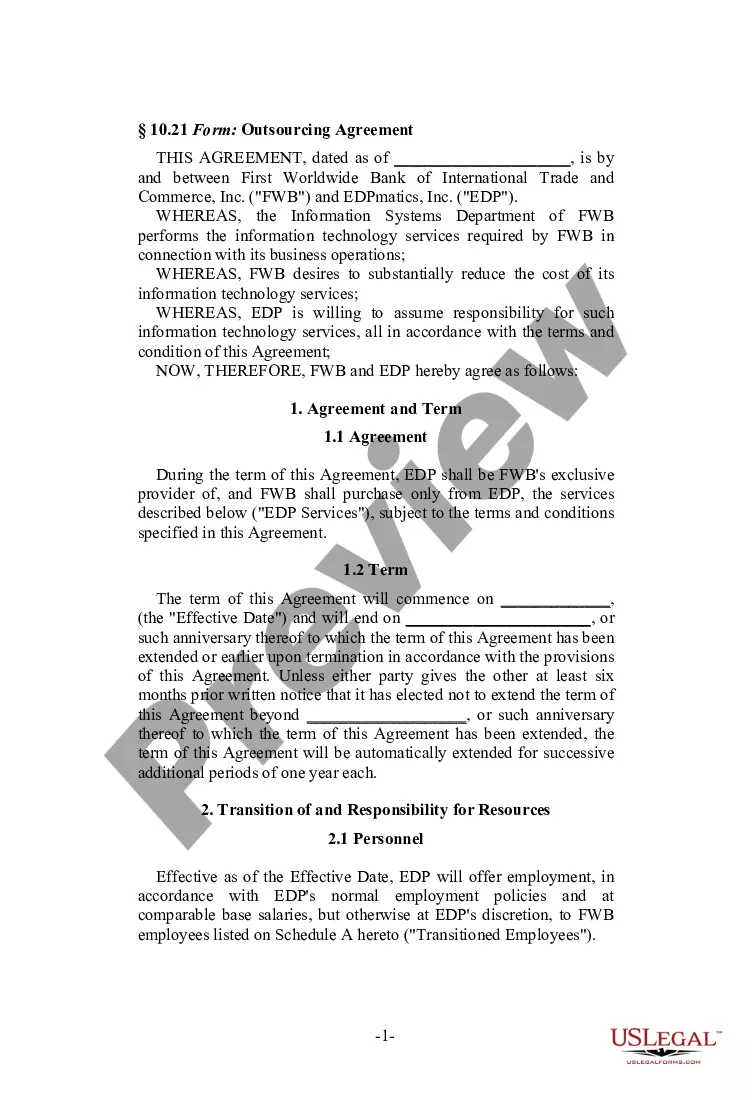


How to fill out Notice To Vacate For Squatters?
You can spend hours online searching for the legal document template that fulfills the federal and state requirements you need.
US Legal Forms provides a vast array of legal forms reviewed by experts.
You can download or print the Delaware Notice to Vacate for Squatters from the service.
- If you have a US Legal Forms account, you may Log In and click the Obtain button.
- After that, you can complete, edit, print, or sign the Delaware Notice to Vacate for Squatters.
- Every legal document template you purchase is yours indefinitely.
- To get an additional copy of a purchased form, visit the My documents tab and click the respective button.
- If you are using the US Legal Forms website for the first time, follow the simple instructions below.
- First, ensure you have selected the correct document template for the county/area of your choice.
Form popularity
FAQ
In most cases, a guest can stay for a limited time without being added to the lease; typically, this duration ranges from 30 to 90 days, depending on your lease agreement and local laws. If the guest becomes a regular resident, you may need to consider a Delaware Notice to Vacate for Squatters. This notice can be essential if you wish to remove someone who has overstayed their welcome. To ensure compliance with all regulations, it's beneficial to consult legal resources or platforms like US Legal Forms.
In Delaware, a landlord typically must provide a 5-day notice to move out for non-payment of rent or a 10-day notice for other breaches of the rental agreement. However, when addressing squatters, a Delaware Notice to Vacate for Squatters usually suffices. Ensure that you deliver this notice according to legal standards to expedite the process.
To remove someone from your house, start with a Delaware Notice to Vacate for Squatters, ensuring you clearly state the timeline for their departure. If they don’t leave, gather evidence of your ownership and file for eviction in your local court. This process may vary, so understanding local laws can help you navigate your case effectively.
Evicting someone with no lease in Delaware follows a similar process. Start by issuing a Delaware Notice to Vacate for Squatters to formally notify the occupant of your demands. If they refuse to comply, you will need to file an unlawful detainer action in court. Be prepared with evidence of your ownership to support your case.
To evict someone in Delaware without a lease, you can begin by serving a Delaware Notice to Vacate for Squatters. This notice informs the occupant that they must vacate the property. If they do not leave voluntarily, you must file for eviction in your local court. Having documentation that proves your ownership is crucial during this process.
If someone refuses to leave your house, the first step is to issue a Delaware Notice to Vacate for Squatters. This notice creates a legal basis for your request. If they still do not leave, you may proceed with filing for eviction. It’s important to document all communications and follow legal protocols to ensure a smooth process.
To get someone out of your house in Delaware, you should begin by issuing a Delaware Notice to Vacate for Squatters. This formal notice communicates your intent and specifies a deadline for them to leave. If they do not comply, you will need to file an eviction action in court. Ensure that you follow all legal procedures to avoid any complications.
In Delaware, a person can claim residency after staying in your home for a certain period, typically around 15 days without your permission. If they establish residency, removing them can become more complex. It is essential to act quickly if you suspect someone may be squatting. Use a Delaware Notice to Vacate for Squatters to initiate the eviction process as soon as possible.
To evict a squatter in Delaware, you must first serve a Delaware Notice to Vacate for Squatters. This notice informs the occupant that they must leave the property. If they refuse to vacate, you will need to file for eviction in your local court. Be prepared with evidence of your ownership and any relevant documentation.
Michigan does recognize squatter rights through a legal concept known as adverse possession. Squatters may gain legal ownership of property if they occupy it without permission for a statutory period, usually 15 years. To protect against this, property owners should act swiftly with notices, such as the Delaware Notice to Vacate for Squatters, to reclaim their properties efficiently.