Delaware Boarding Stable Agreement - Horse Equine Forms
About this form
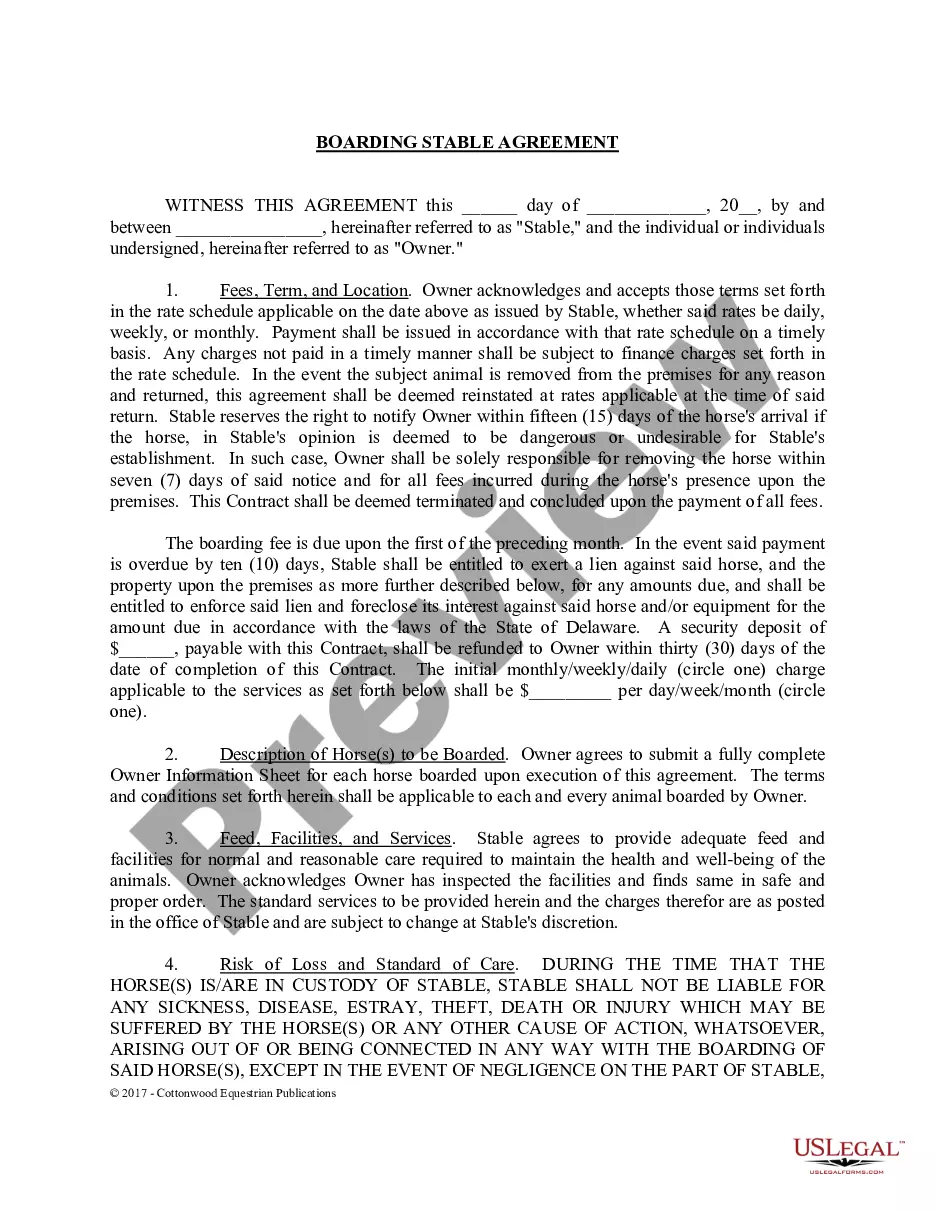
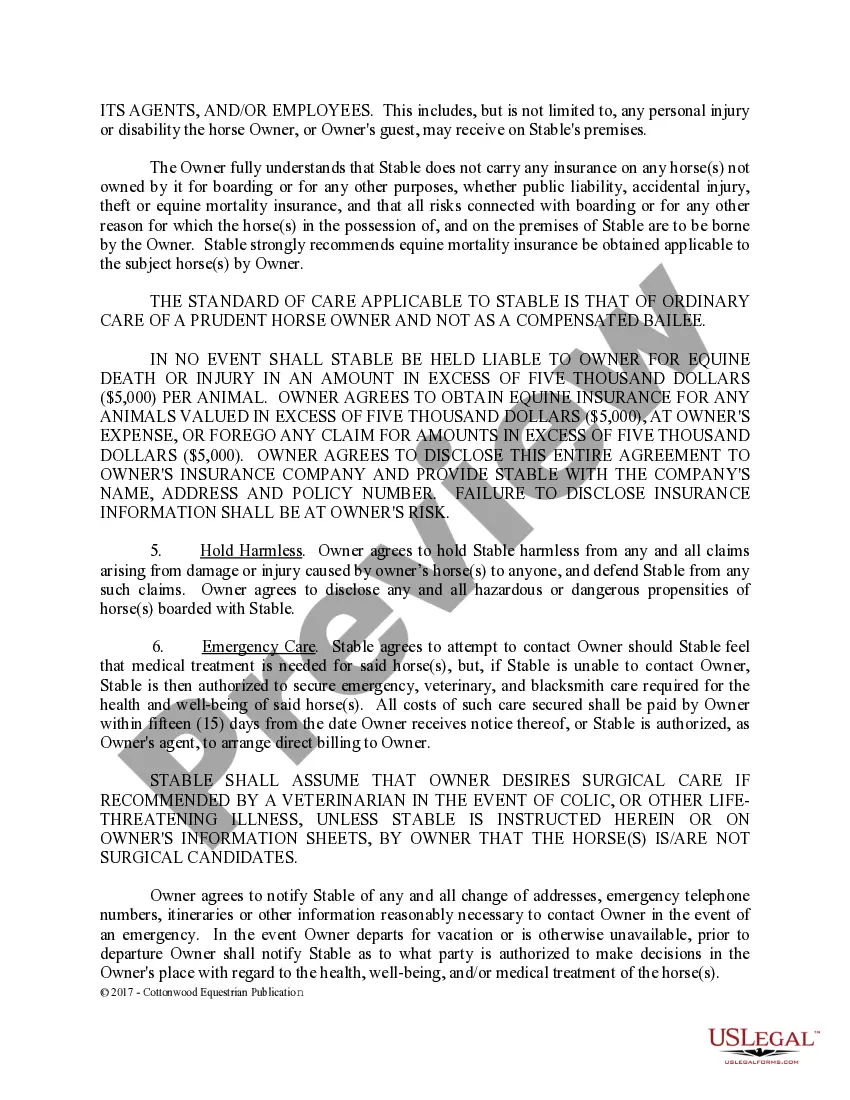
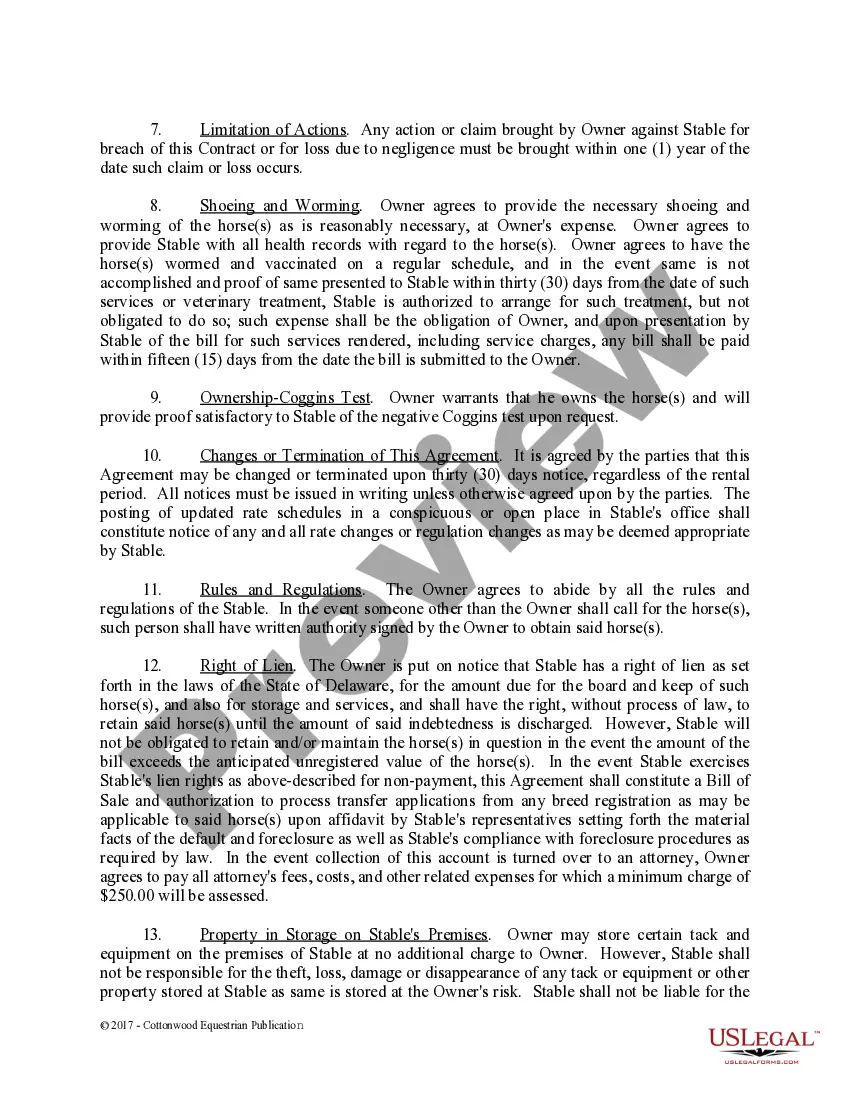
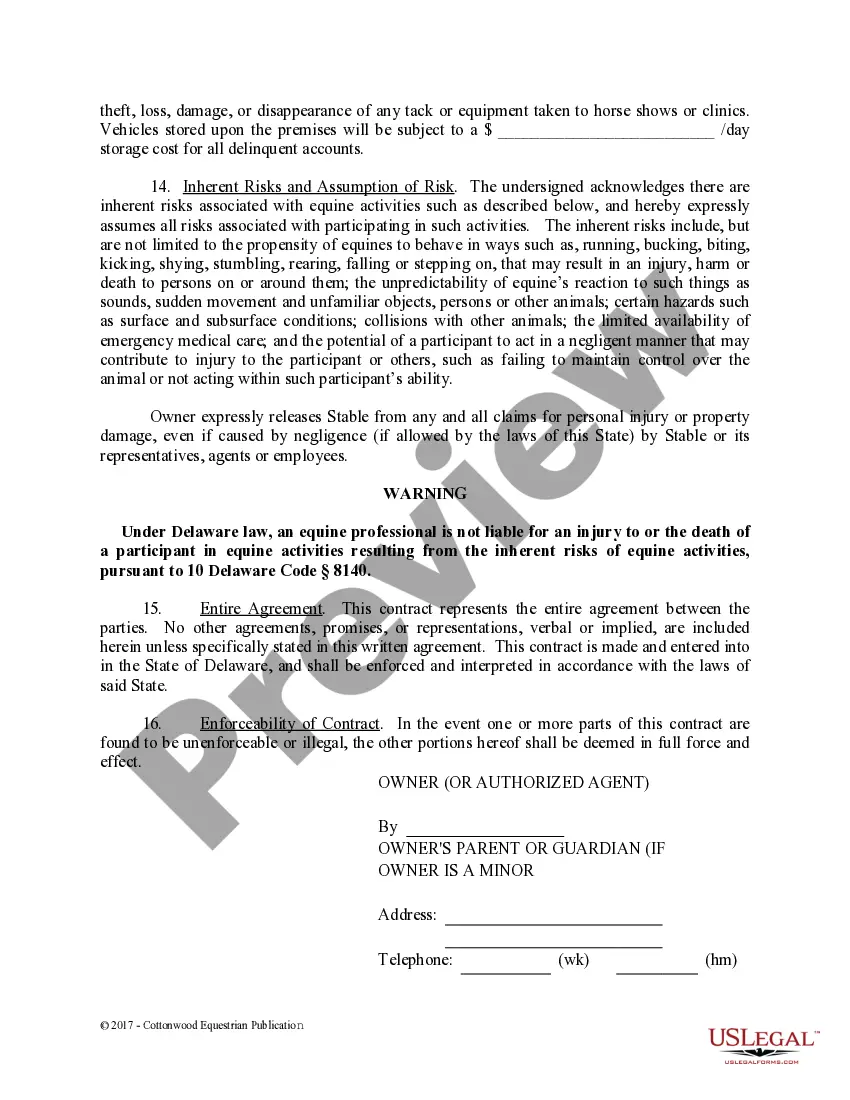
The Boarding Stable Agreement is a legal document that outlines the terms between a stable owner and a horse owner regarding the boarding of horses. This form is comprehensive, detailing fees, liability, standard of care, and responsibilities for both parties. It ensures clear communication and understanding, differentiating it from other equine agreements by focusing specifically on the boarding process and care of horses while in custody of the stable.
Main sections of this form
- Fees, Term, and Location: Establishes pricing structure and payment timelines.
- Description of Horse(s): Requires the owner to submit detailed information for each horse boarded.
- Standard of Care and Liability: Outlines the care level provided and limits the stable's liability in specific situations.
- Risk of Loss: Addresses circumstances under which the stable is not liable for horse loss or injury.
- Emergency Care: Sets procedures for medical decisions in case of emergencies.
- Right of Lien: Grants the stable rights related to unpaid boarding fees.
When to use this document
This form should be used when a horse owner needs to establish a formal agreement with a boarding stable. It is essential when entering a new boarding arrangement, ensuring both parties understand their obligations and rights regarding care, payment, and the management of the horse.
Who needs this form
- Horse owners seeking to board their horses at a stable.
- Stable operators offering boarding services to ensure compliance with legal standards.
- Individuals new to horse boarding who require clear terms regarding payment and care.
Steps to complete this form
- Identify the parties: Clearly state the names and contact information of both the stable and the horse owner.
- Specify the fees: Fill in the agreed terms for boarding fees based on the stable's rate schedule.
- Detail horse information: Complete the Owner Information Sheet for each horse being boarded.
- Select additional services: Indicate any extra services required, such as grooming or feeding.
- Sign and date the agreement: Ensure both parties sign and date the form, acknowledging their acceptance of the terms.
Notarization guidance
Notarization is not commonly needed for this form. However, certain documents or local rules may make it necessary. Our notarization service, powered by Notarize, allows you to finalize it securely online anytime, day or night.
Get your form ready online
Our built-in tools help you complete, sign, share, and store your documents in one place.
Make edits, fill in missing information, and update formatting in US Legal Forms—just like you would in MS Word.
Download a copy, print it, send it by email, or mail it via USPS—whatever works best for your next step.
Sign and collect signatures with our SignNow integration. Send to multiple recipients, set reminders, and more. Go Premium to unlock E-Sign.
If this form requires notarization, complete it online through a secure video call—no need to meet a notary in person or wait for an appointment.
We protect your documents and personal data by following strict security and privacy standards.

Make edits, fill in missing information, and update formatting in US Legal Forms—just like you would in MS Word.

Download a copy, print it, send it by email, or mail it via USPS—whatever works best for your next step.

Sign and collect signatures with our SignNow integration. Send to multiple recipients, set reminders, and more. Go Premium to unlock E-Sign.

If this form requires notarization, complete it online through a secure video call—no need to meet a notary in person or wait for an appointment.

We protect your documents and personal data by following strict security and privacy standards.
Typical mistakes to avoid
- Failing to complete the Owner Information Sheet for each horse.
- Not specifying all desired services, leading to unexpected costs.
- Neglecting to read and understand the liability and risk of loss clauses.
- Overlooking to provide notification of a horse's removal from the premises.
Benefits of using this form online
- Convenience of immediate download and use without needing to visit a law office.
- Editability allows users to customize the agreement to fit their specific needs.
- Access to legal forms drafted by licensed attorneys, ensuring completeness and compliance.
Legal use & context
- This agreement serves as a binding contract that protects both the horse owner and the stable.
- Understanding the liability terms can help prevent disputes and set expectations for care standards.
- The right of lien outlined in the agreement provides legal recourse for stable operators regarding unpaid fees.
Quick recap
- The Boarding Stable Agreement outlines the responsibilities of both the stable and the horse owner.
- Clear understanding of fees, care standards, and liabilities is crucial for both parties.
- This form helps prevent misunderstandings and legal disputes in horse boarding arrangements.
Looking for another form?
Form popularity
FAQ
A hold harmless agreement for horses is a specific contract that releases a stable or facility from liability related to the care of your horse. By signing this document, you're acknowledging the potential risks involved and agreeing not to hold the facility accountable for any accidents or injuries. This agreement is crucial for maintaining peace of mind while using the Delaware Boarding Stable Agreement - Horse Equine Forms. It ensures that both horse owners and stables have a clear understanding of their responsibilities.
A hold harmless agreement works by establishing a mutual understanding between parties regarding liability. When you enter into this agreement, you agree not to hold the stable responsible for any injuries or damages that may occur while your horse is boarded. By using a Delaware Boarding Stable Agreement - Horse Equine Forms, you clearly outline your acceptance of risk, effectively protecting both yourself and the stable. This clarity fosters trust and increases the overall safety of your horse's boarding experience.
A hold harmless agreement for horse boarding is a legal document designed to protect both the horse owner and the stable facility from liabilities. This agreement stipulates that the owner assumes all risks associated with boarding their horse, such as injuries or accidents. Utilizing a Delaware Boarding Stable Agreement - Horse Equine Forms can simplify this process, ensuring all responsibilities are clearly defined. It serves as a necessary safeguard for everyone involved.
When you board a horse, several key elements are necessary to ensure a smooth experience. First, you typically need a signed Delaware Boarding Stable Agreement - Horse Equine Forms, which outlines the responsibilities of both the owner and the stable. Additionally, proof of vaccinations and health records for the horse may be required. Lastly, understanding the terms regarding feeding, grooming, and exercise is essential.
The profit margin on horse boarding can vary widely depending on location, services offered, and market demand. However, many stables report profit margins ranging from 15% to 40%. Using a well-structured Delaware Boarding Stable Agreement - Horse Equine Forms helps ensure clarity with clients, which can impact your overall profitability positively. Properly managing costs and understanding market rates can help you optimize your profit margins.
Yes, horse boarding can qualify as farm income. This type of income arises when you provide stabling and related services to horse owners. If you establish a Delaware Boarding Stable Agreement - Horse Equine Forms, it not only clarifies the terms of the boarding arrangement, but it also helps in accounting and tax purposes. This documentation serves as proof of your business activities and may assist in correctly reporting your income.
Full horse boarding typically covers essential care services such as feeding, stall cleaning, and daily health checks. With a well-crafted Delaware Boarding Stable Agreement - Horse Equine Forms, you can clearly articulate all services, including turnout time, exercise, and access to facilities. Offering comprehensive care ensures peace of mind for horse owners and helps you stand out in the market. Clients appreciate transparency in service offerings, making the agreement an important part of your business.
Horse boarding can be a lucrative business, especially in areas where demand for equine care is high. By utilizing a well-structured Delaware Boarding Stable Agreement - Horse Equine Forms, you can clearly outline services and fees, making it easier to attract clients. Factors such as location, facilities, and additional services offered play a crucial role in profitability. With the right management and a solid agreement, you can effectively maximize your revenue potential.