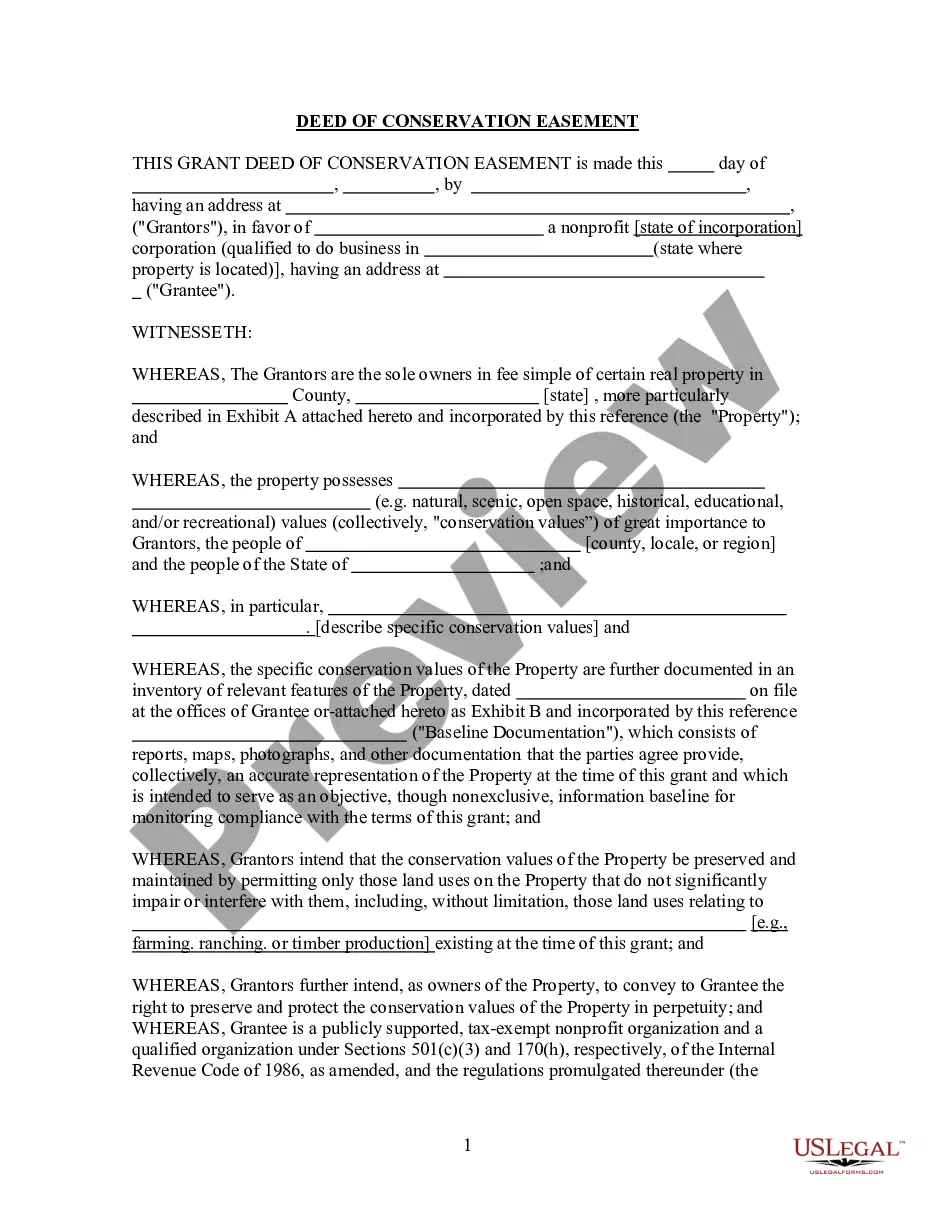
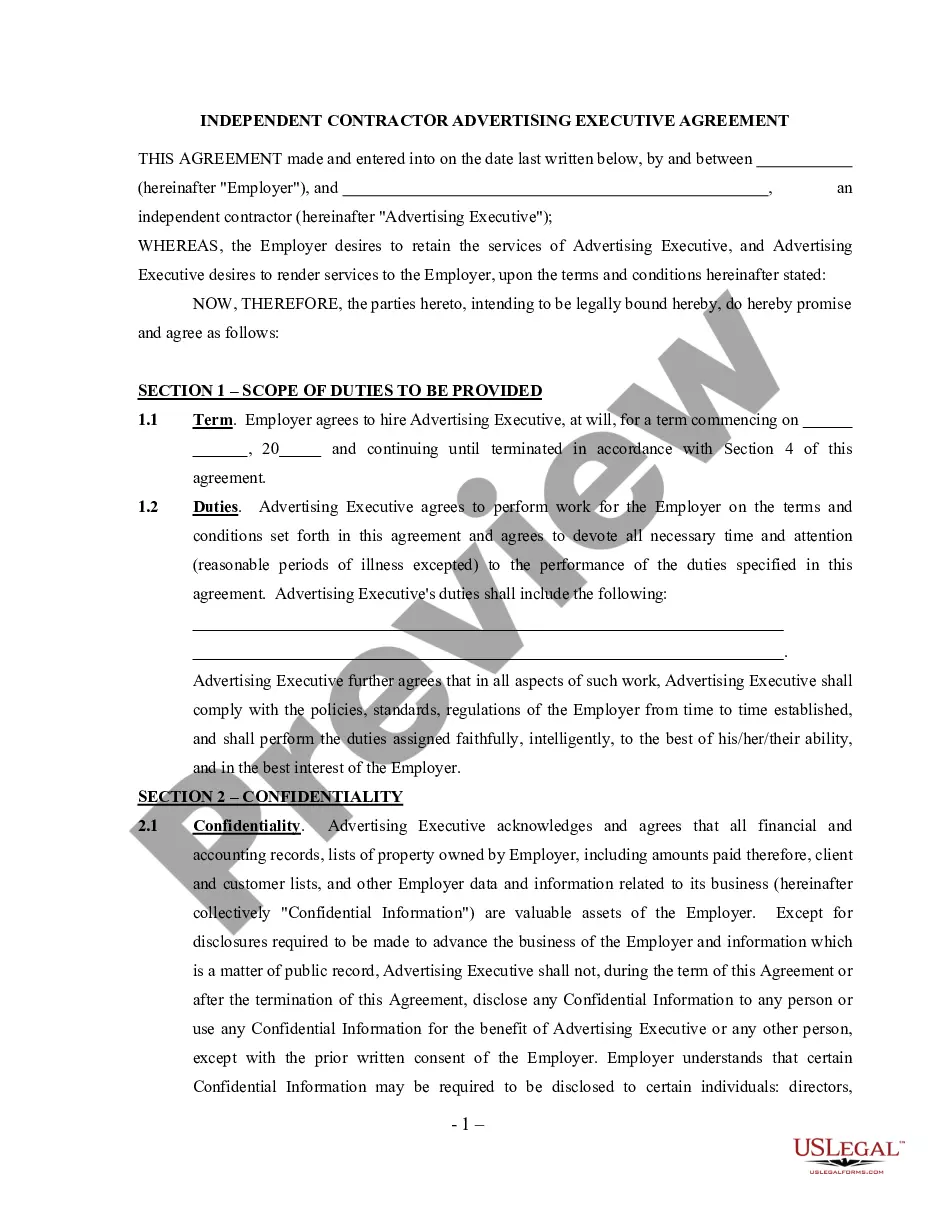
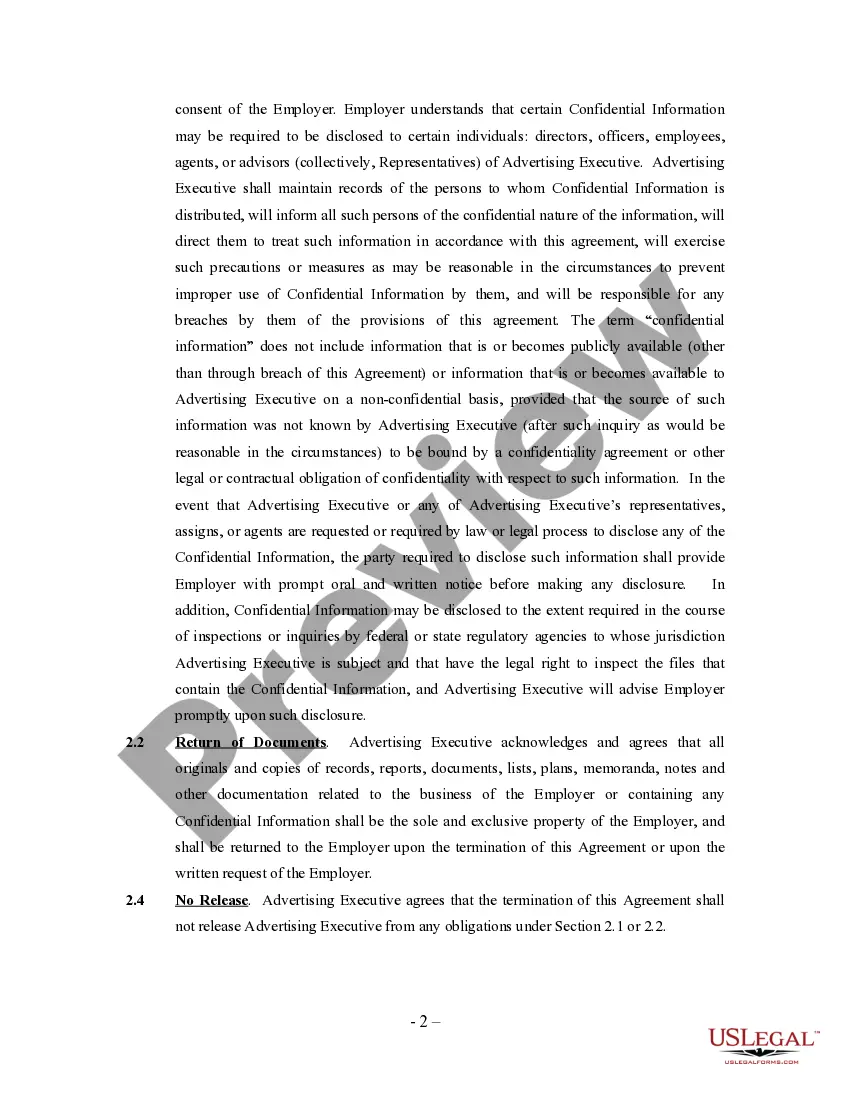
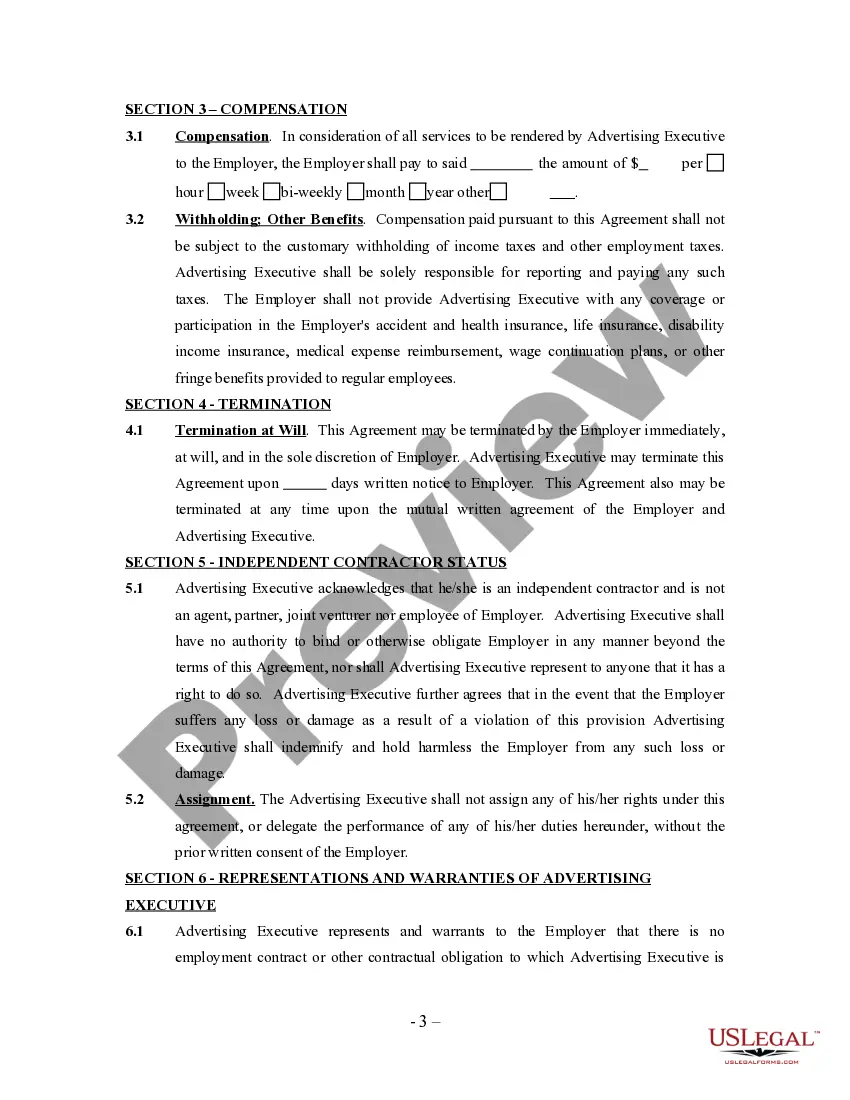
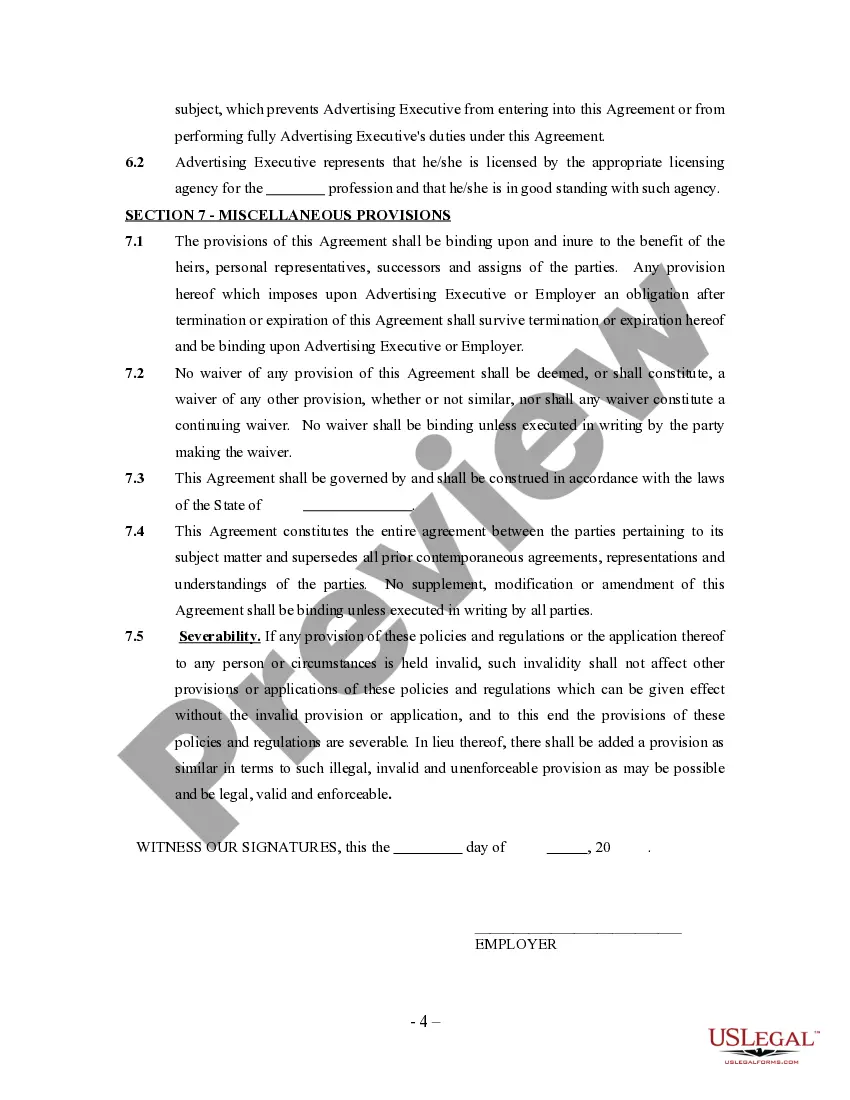
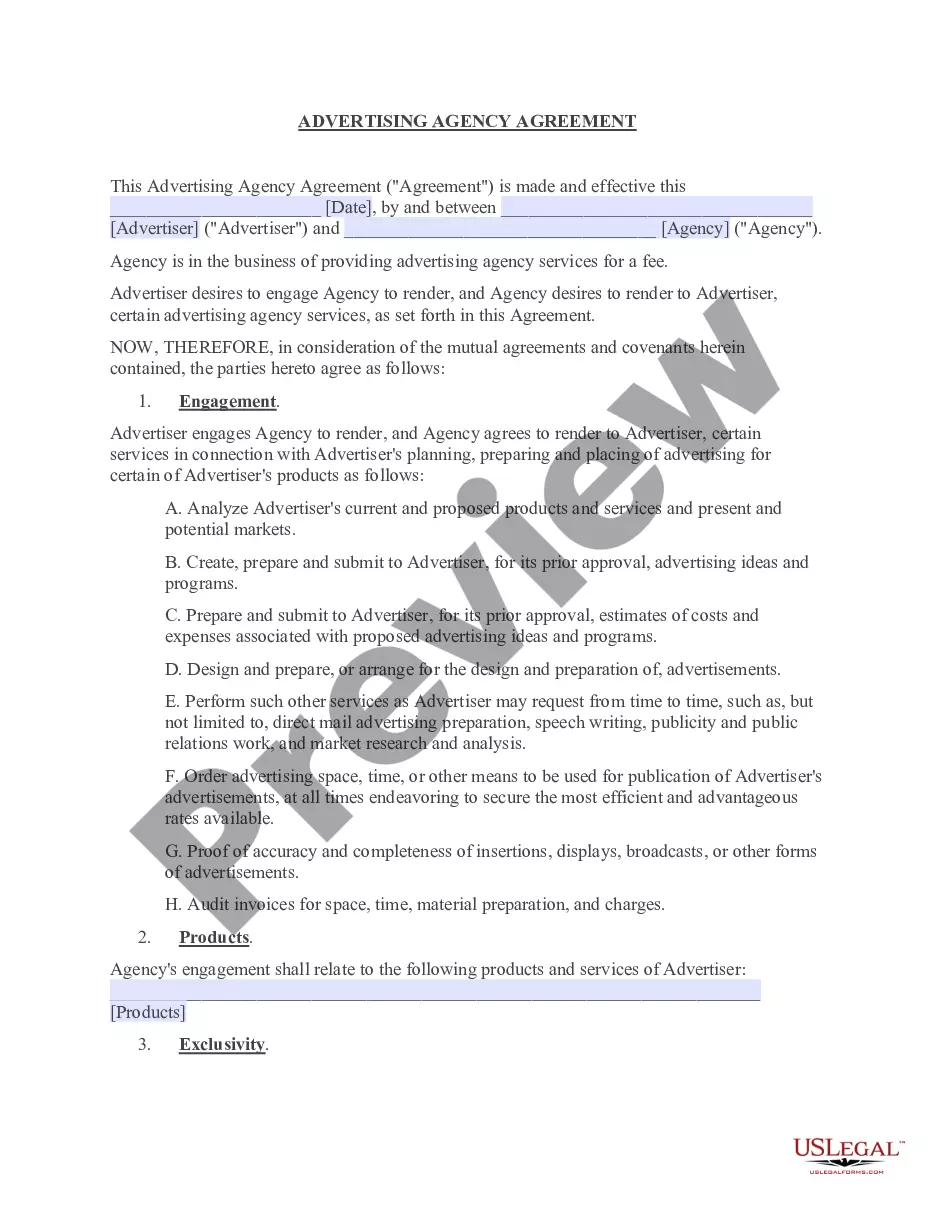
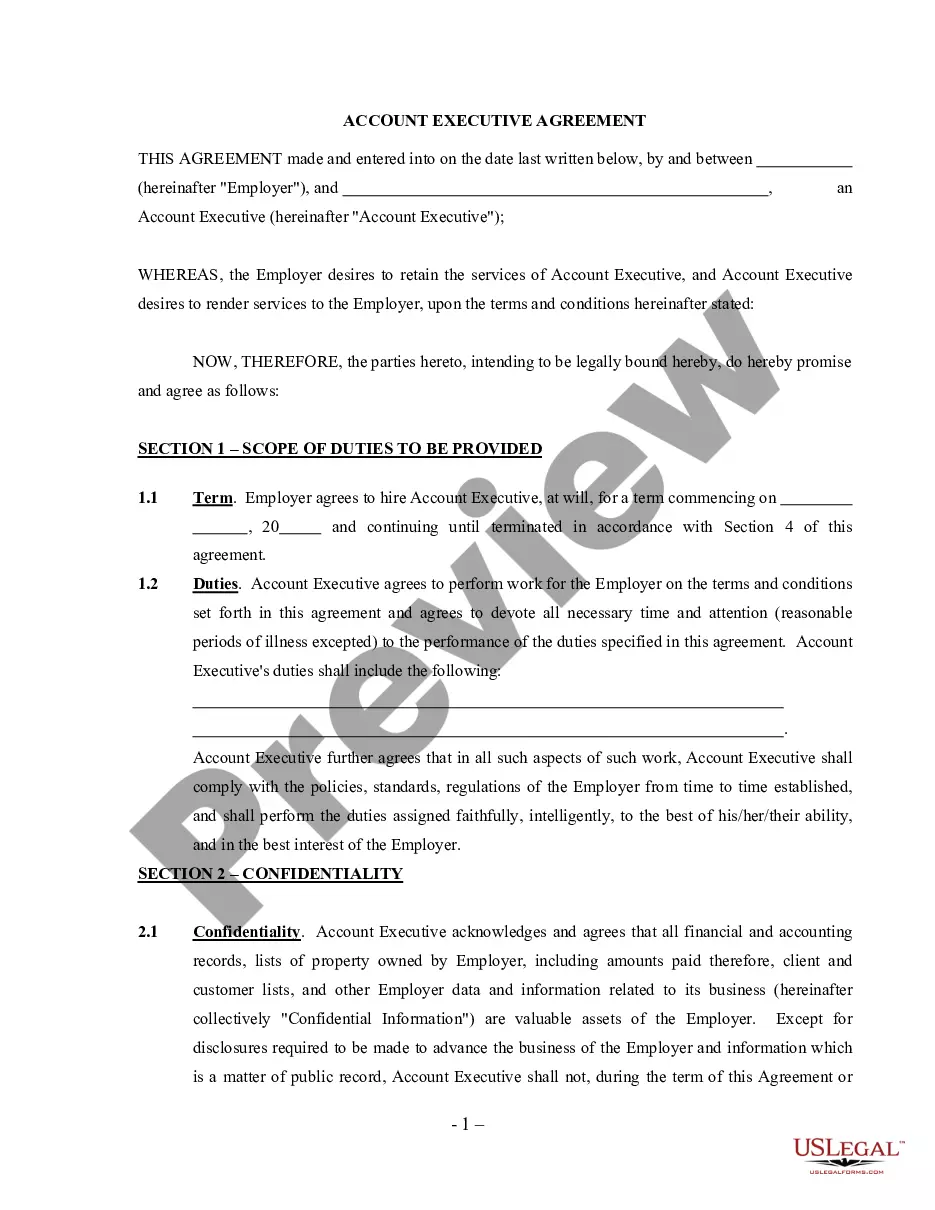
Employer hires an advertising executive on an independent contractor basis to provide advertising services for employer as specified in the contract.
District of Columbia Advertising Executive Agreement - Self-Employed Independent Contractor
State:
Multi-State
Control #:
US-INDC-229
Format:
Word;
Rich Text
Instant download
Description
Free preview

Get your form ready online
Our built-in tools help you complete, sign, share, and store your documents in one place.
Built-in online Word editor
Make edits, fill in missing information, and update formatting in US Legal Forms—just like you would in MS Word.
Export easily
Download a copy, print it, send it by email, or mail it via USPS—whatever works best for your next step.
E-sign your document
Sign and collect signatures with our SignNow integration. Send to multiple recipients, set reminders, and more. Go Premium to unlock E-Sign.
Notarize online 24/7
If this form requires notarization, complete it online through a secure video call—no need to meet a notary in person or wait for an appointment.
Store your document securely
We protect your documents and personal data by following strict security and privacy standards.

Make edits, fill in missing information, and update formatting in US Legal Forms—just like you would in MS Word.

Download a copy, print it, send it by email, or mail it via USPS—whatever works best for your next step.

Sign and collect signatures with our SignNow integration. Send to multiple recipients, set reminders, and more. Go Premium to unlock E-Sign.

If this form requires notarization, complete it online through a secure video call—no need to meet a notary in person or wait for an appointment.

We protect your documents and personal data by following strict security and privacy standards.
Looking for another form?






How to fill out Advertising Executive Agreement - Self-Employed Independent Contractor?
Selecting the appropriate legal document template can be challenging.
Clearly, there is a multitude of templates available online, but how do you find the legal document that you require.
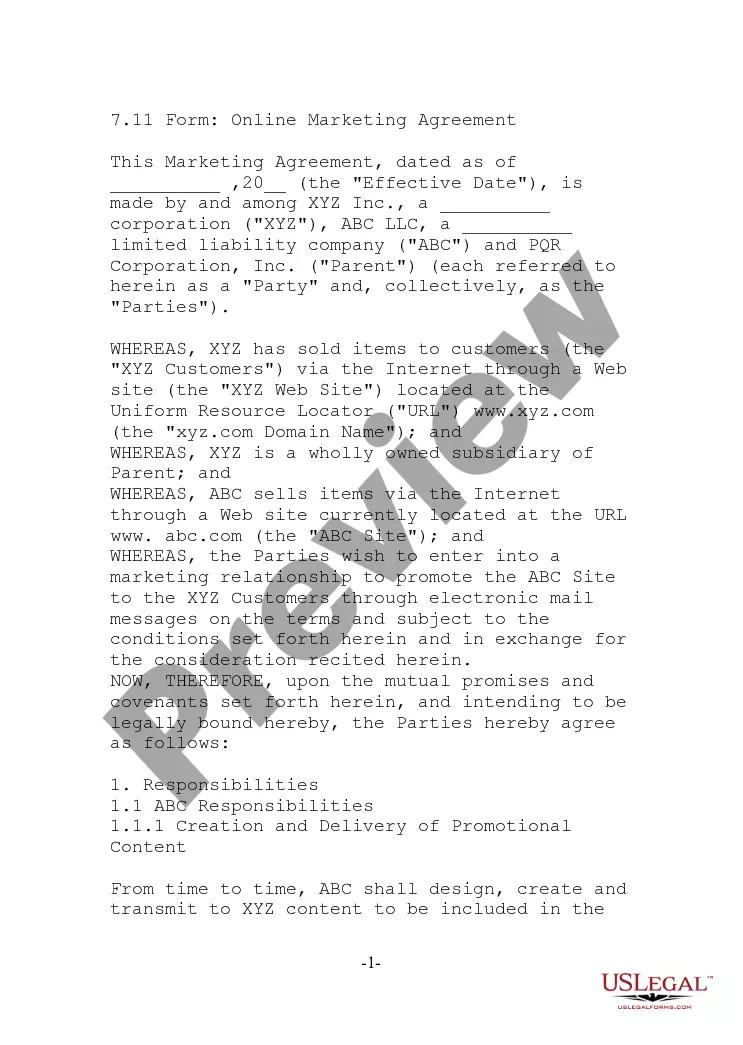
Utilize the US Legal Forms website. The service offers thousands of templates, including the District of Columbia Advertising Executive Agreement - Self-Employed Independent Contractor, which can be employed for professional and personal purposes.
You can review the form using the Review button and read the form details to confirm it’s suitable for you. If the form does not meet your needs, use the Search field to locate the right form. When you are confident that the form works, click on the Buy now button to acquire the form. Choose the payment plan you prefer and enter the required information. Create your account and pay for the order using your PayPal account or credit card. Select the file format and download the legal document template for your purpose. Finally, complete, edit, print, and sign the received District of Columbia Advertising Executive Agreement - Self-Employed Independent Contractor. US Legal Forms is the largest library of legal forms where you can find a variety of document templates. Use the service to obtain professionally-crafted documents that comply with state requirements.
- All the forms are reviewed by professionals and comply with federal and state regulations.
- If you are already registered, Log In to your account and click on the Download button to access the District of Columbia Advertising Executive Agreement - Self-Employed Independent Contractor.
- Use your account to browse through the legal forms you have purchased previously.
- Visit the My documents section of your account to retrieve another copy of the document you need.
- If you are a new user of US Legal Forms, here are simple instructions to follow.
- First, ensure you have chosen the correct form for your area/region.
Form popularity
FAQ
Yes, a nonprofit executive director can be classified as an independent contractor, provided they meet specific criteria. This classification can apply under the District of Columbia Advertising Executive Agreement - Self-Employed Independent Contractor. Nonprofits should ensure compliance with labor laws while considering the implications of this arrangement for their tax and operational practices.
The Pro Act aims to reclassify certain independent contractors as employees, but it does not completely eliminate independent contractors. It’s important to understand how the Pro Act interacts with the District of Columbia Advertising Executive Agreement - Self-Employed Independent Contractor. Being aware of these changes helps contractors adapt and ensures they comply with the law.
The recent federal rule establishes clearer guidelines for classifying workers as independent contractors. This rule impacts those involved in the District of Columbia Advertising Executive Agreement - Self-Employed Independent Contractor. It’s crucial for contractors to familiarize themselves with these criteria to ensure proper classification and compliance.
The new 1099 law mandates stricter reporting requirements for businesses that hire independent contractors. This change affects how income is reported under the District of Columbia Advertising Executive Agreement - Self-Employed Independent Contractor. Understanding these requirements helps contractors accurately report their earnings and reduces potential tax liabilities.
The IRS is increasing its scrutiny of 1099 employees, focusing on compliance with tax regulations. Under the District of Columbia Advertising Executive Agreement - Self-Employed Independent Contractor, it's essential to ensure proper classification to avoid misclassification penalties. Staying informed about IRS guidelines is crucial for maintaining compliance.
Yes, an independent contractor qualifies as a self-employed individual under the District of Columbia Advertising Executive Agreement - Self-Employed Independent Contractor. This means they operate their own business, providing services to clients without being tied to a single employer. As a self-employed contractor, they enjoy greater flexibility and control over their work.
Yes, an independent contractor is considered self-employed. This classification means that the individual operates their own business and is responsible for their own taxes. For those engaging in a District of Columbia Advertising Executive Agreement - Self-Employed Independent Contractor, it's essential to recognize the implications of this status. Understanding your role as a self-employed contractor can help you navigate contracts, taxes, and client relationships effectively.
When filling out an independent contractor agreement, begin by entering the names and addresses of all parties involved. Include a detailed description of the services provided, along with payment terms and deadlines. Don’t forget to incorporate any necessary clauses, such as confidentiality and dispute resolution. The District of Columbia Advertising Executive Agreement - Self-Employed Independent Contractor from US Legal Forms offers a structured format to assist you in completing this task effectively.
An independent contractor typically must complete several forms, including a W-9 for tax identification and an agreement detailing work terms. Sometimes, contractors may also need to provide proof of insurance or a business license, depending on the specific requirements of the client. To simplify this process, refer to the District of Columbia Advertising Executive Agreement - Self-Employed Independent Contractor template available on US Legal Forms.
The terms self-employed and independent contractor can be used interchangeably, but choosing one depends on context. If you're emphasizing your business independence, self-employed feels more broad and personal. On the other hand, using independent contractor highlights a formal relationship with clients or companies. Ultimately, both terms can relate to the District of Columbia Advertising Executive Agreement - Self-Employed Independent Contractor, so your choice could reflect your business style.