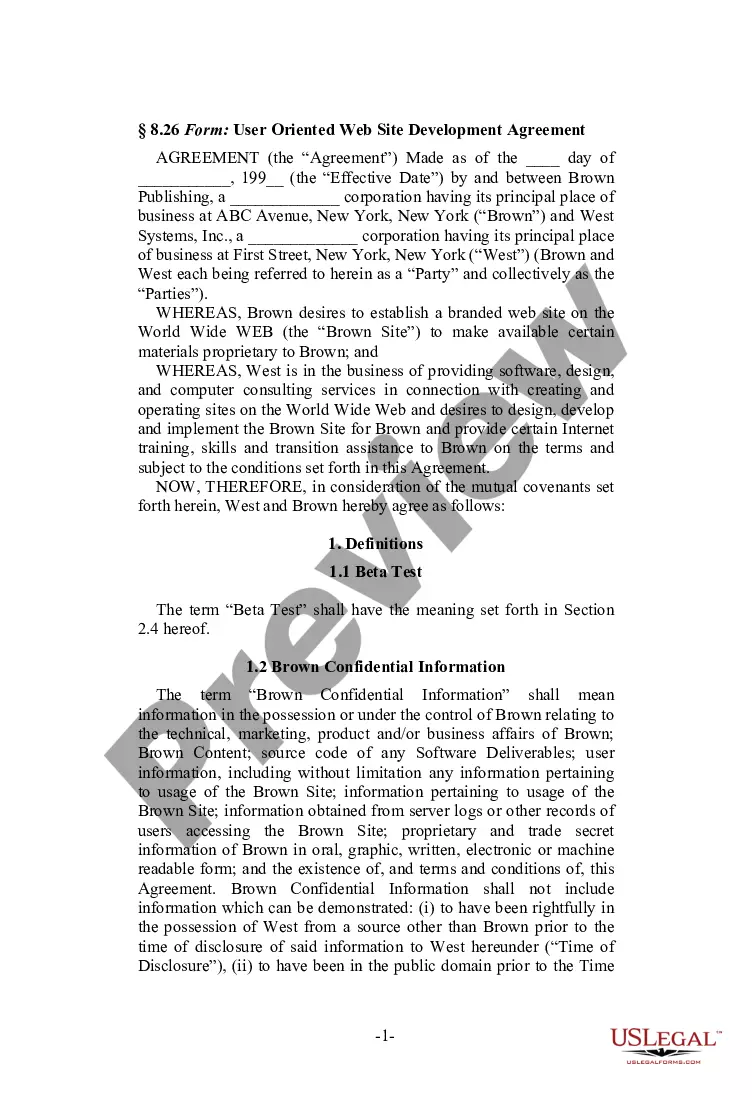
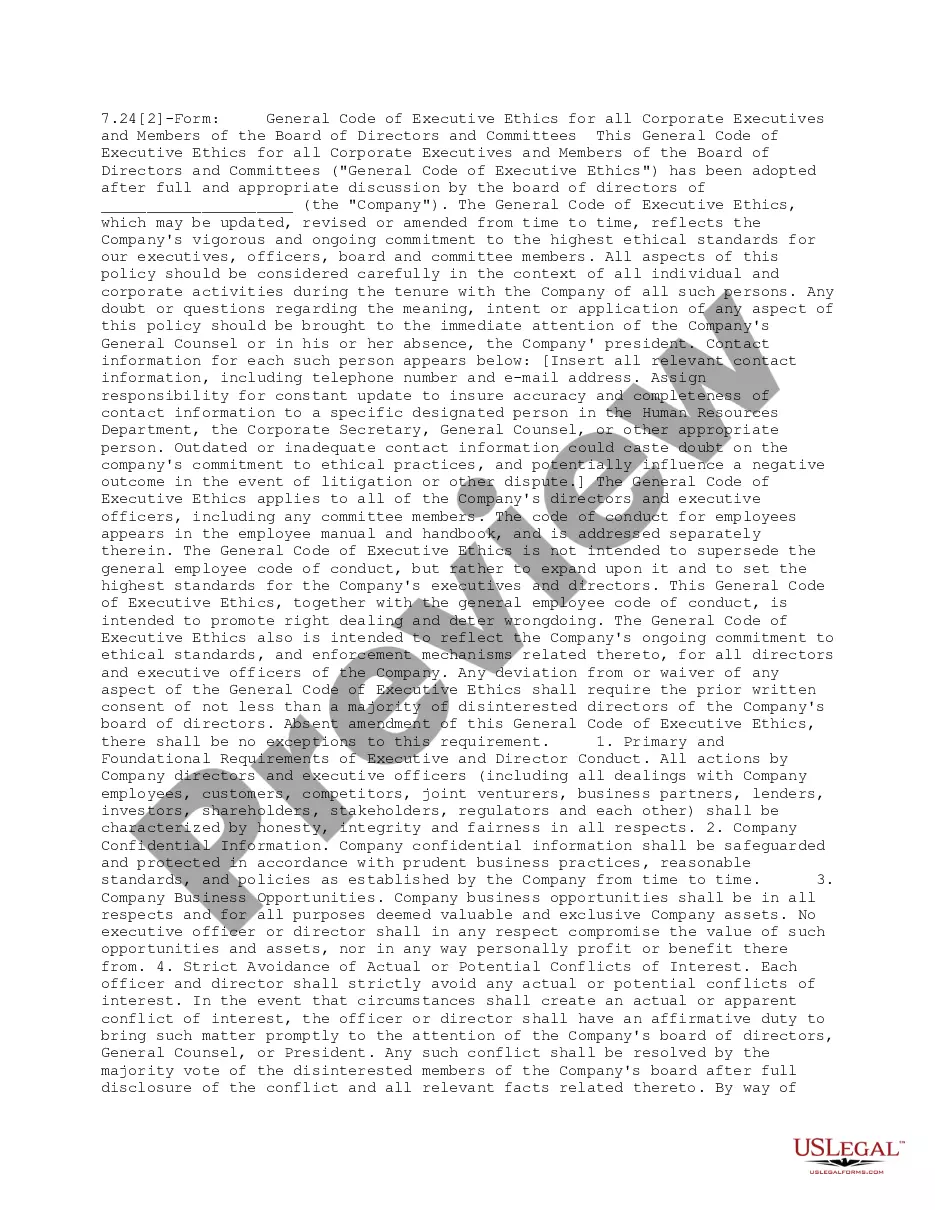
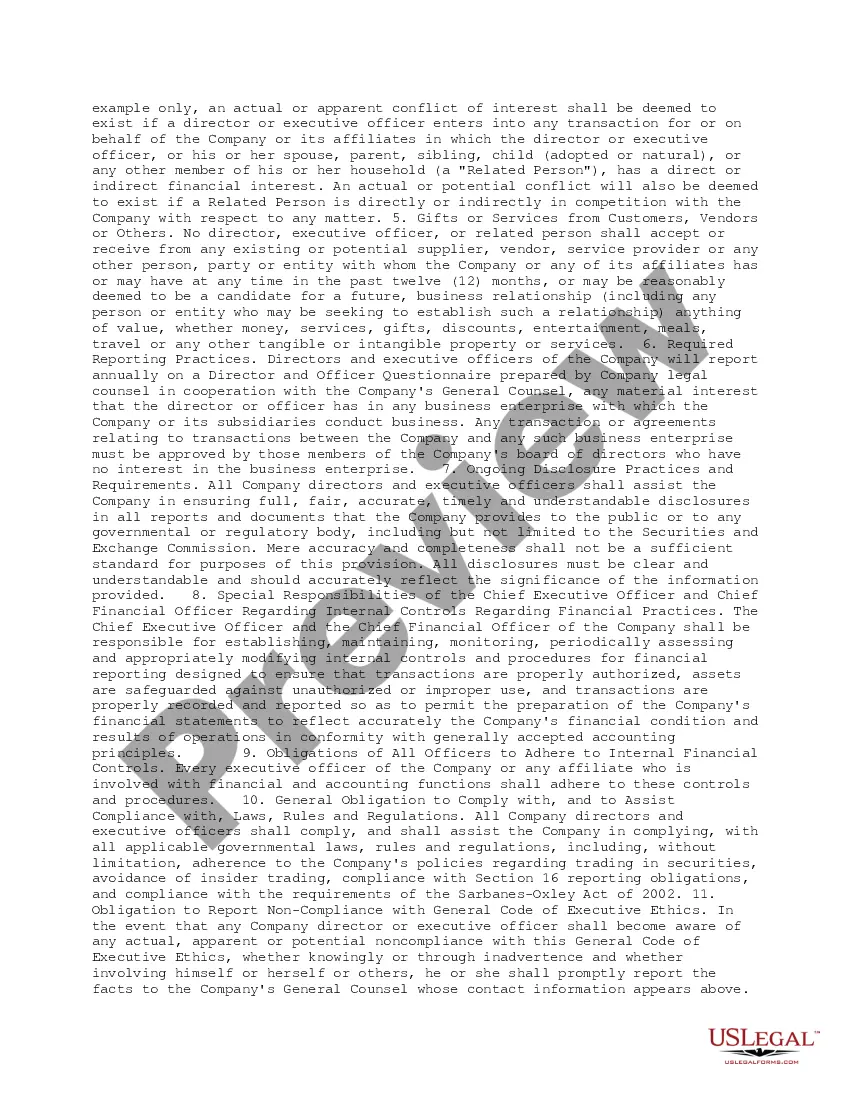
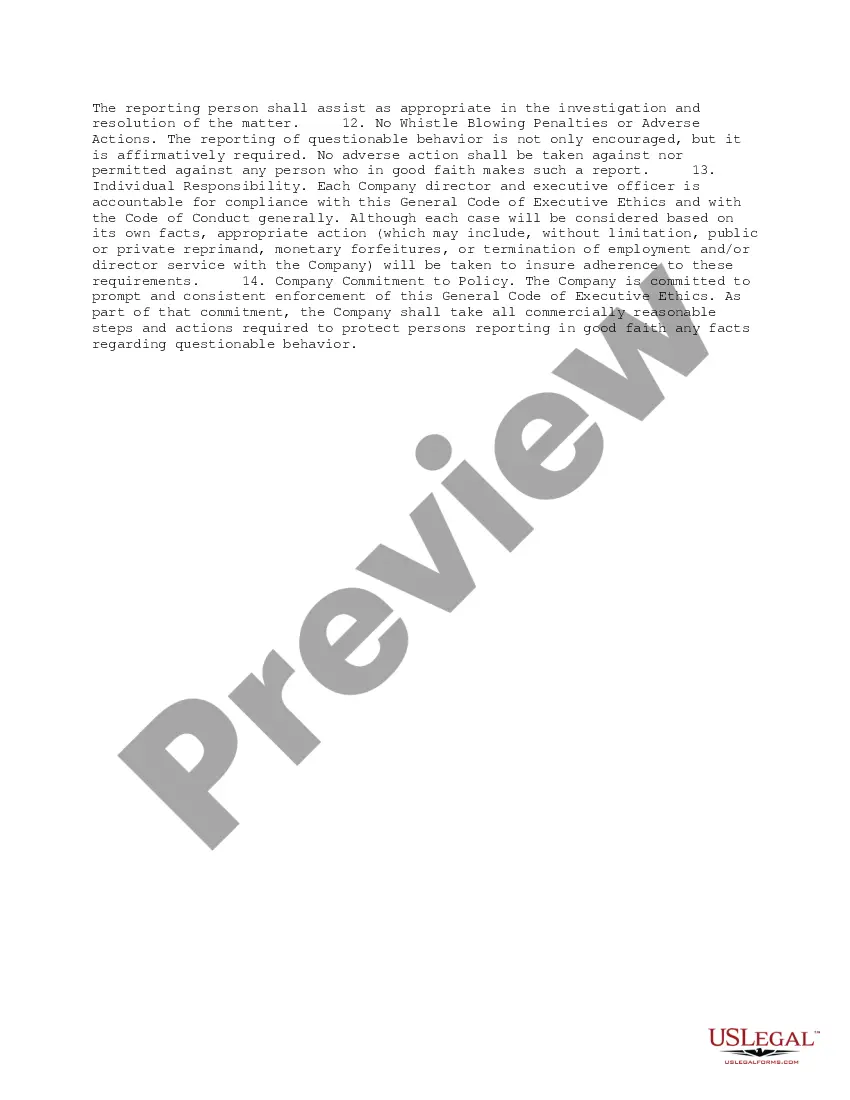
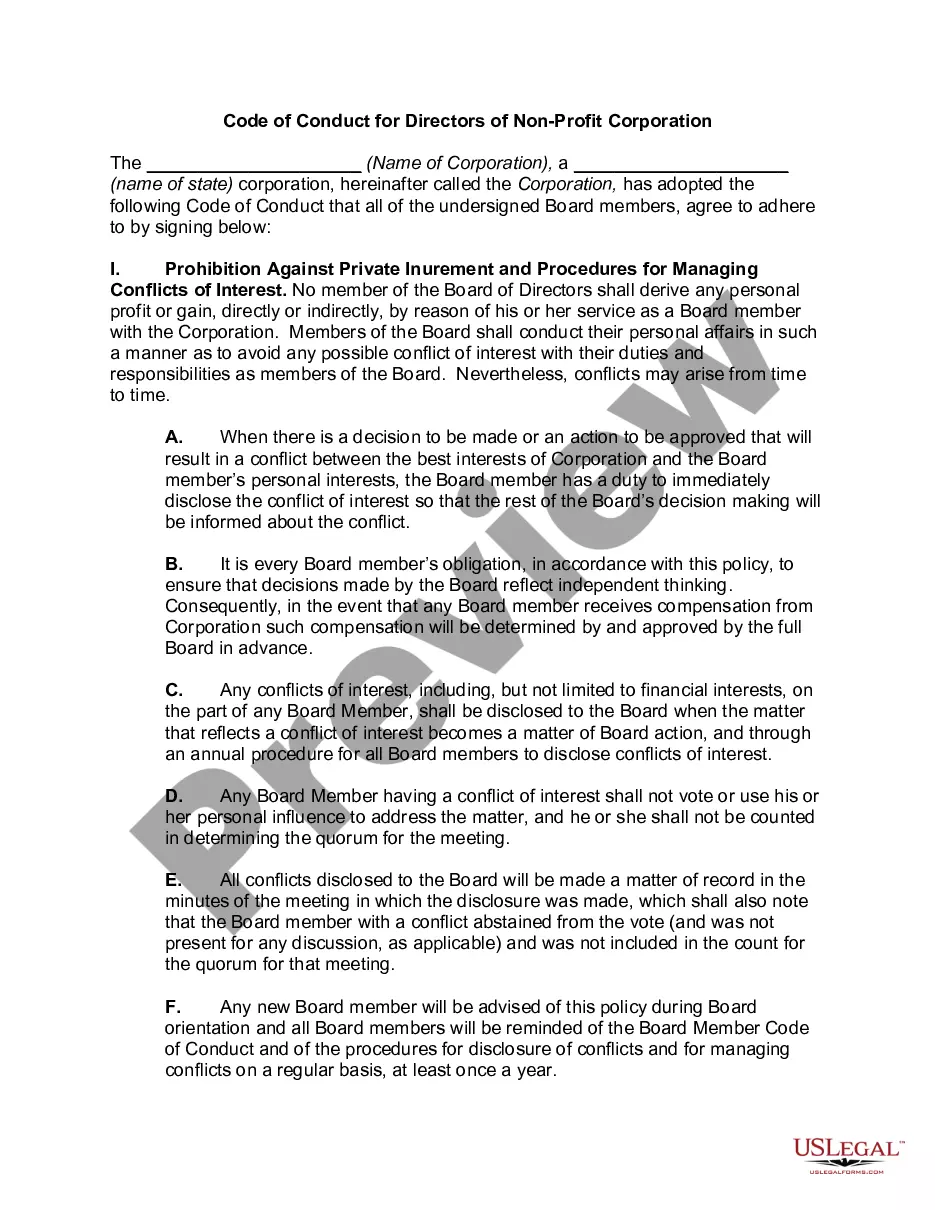
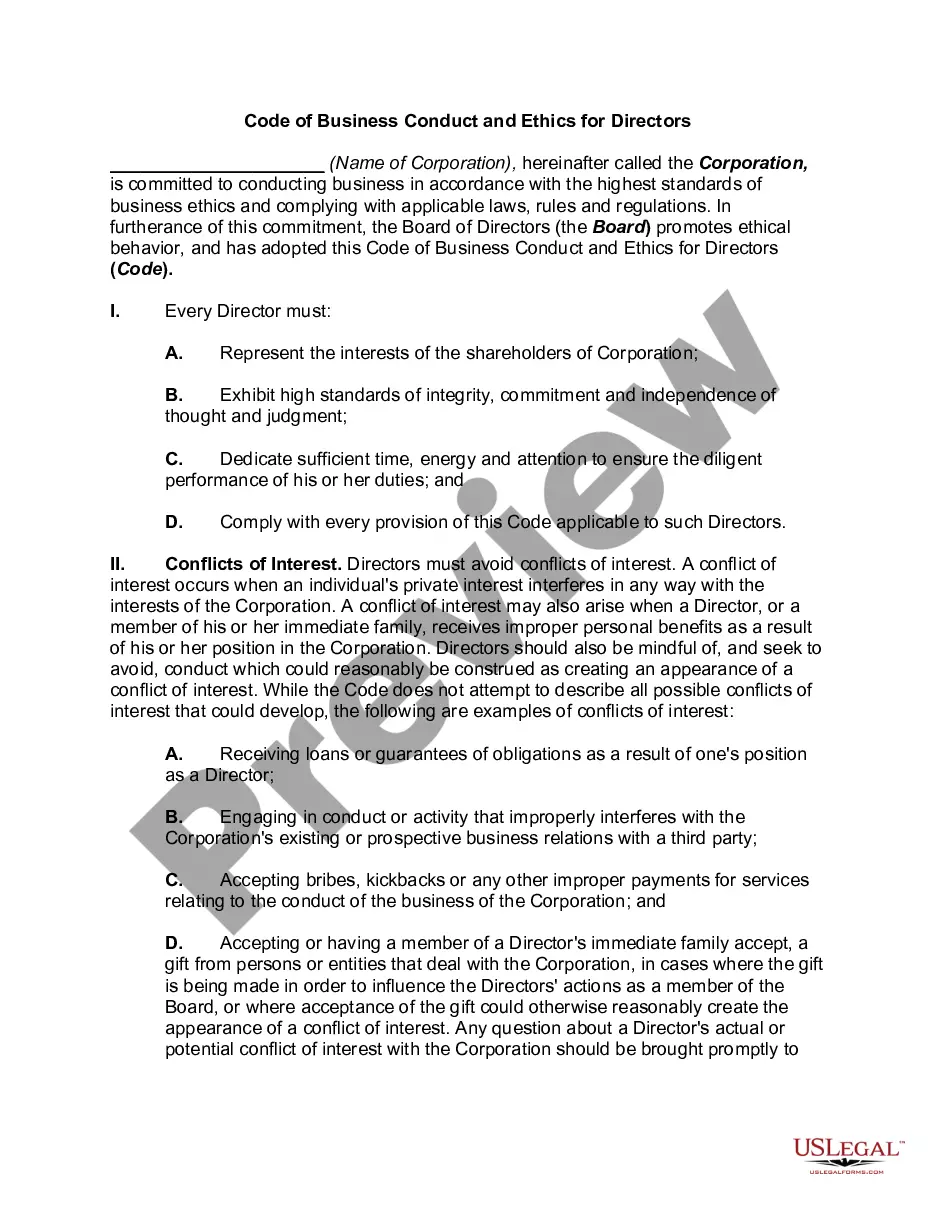
This due diligence form describes the General Code of Executive Ethics for all Corporate Executives and Members of the Board of Directors and Committees that has been adopted by the board of directors of a company. It reflects the company's vigorous and ongoing commitment to the highest ethical standards for its executives, officers, and board and committee members.
District of Columbia General Code of Executive Ethics for all Corporate Executives and Members of the Board of Directors and Committees
Category:
State:
Multi-State
Control #:
US-DD07242
Format:
Word;
PDF;
Rich Text
Instant download
Description
Free preview
Get your form ready online
Our built-in tools help you complete, sign, share, and store your documents in one place.
Built-in online Word editor
Make edits, fill in missing information, and update formatting in US Legal Forms—just like you would in MS Word.
Export easily
Download a copy, print it, send it by email, or mail it via USPS—whatever works best for your next step.
E-sign your document
Sign and collect signatures with our SignNow integration. Send to multiple recipients, set reminders, and more. Go Premium to unlock E-Sign.
Notarize online 24/7
If this form requires notarization, complete it online through a secure video call—no need to meet a notary in person or wait for an appointment.
Store your document securely
We protect your documents and personal data by following strict security and privacy standards.

Make edits, fill in missing information, and update formatting in US Legal Forms—just like you would in MS Word.

Download a copy, print it, send it by email, or mail it via USPS—whatever works best for your next step.

Sign and collect signatures with our SignNow integration. Send to multiple recipients, set reminders, and more. Go Premium to unlock E-Sign.

If this form requires notarization, complete it online through a secure video call—no need to meet a notary in person or wait for an appointment.

We protect your documents and personal data by following strict security and privacy standards.
Looking for another form?


How to fill out General Code Of Executive Ethics For All Corporate Executives And Members Of The Board Of Directors And Committees?
If you need to acquire, secure, or create official document templates, utilize US Legal Forms, the largest selection of legal forms available online.
Take advantage of the site’s user-friendly and efficient search feature to find the documents you require. Various templates for business and personal purposes are organized by categories and regions, or keywords.
Utilize US Legal Forms to access the District of Columbia General Code of Executive Ethics for all Corporate Executives and Board of Directors and Committee Members with just a few clicks.
Every legal document template you receive is yours indefinitely. You will have access to each form you saved in your account. Click on the My documents section and choose a form to print or download again.
Complete and acquire, then print the District of Columbia General Code of Executive Ethics for all Corporate Executives and Members of the Board of Directors and Committees with US Legal Forms. There are thousands of professional and state-specific templates available for your business or personal needs.
- If you are already a US Legal Forms user, Log In to your account and click the Download button to obtain the District of Columbia General Code of Executive Ethics for all Corporate Executives and Board of Directors and Committee Members.
- You can also access forms you previously saved from the My documents tab in your account.
- If this is your first time using US Legal Forms, follow the steps below.
- Step 1. Ensure that you have selected the form for the correct city/state.
- Step 2. Utilize the Preview feature to review the contents of the form. Be sure to read the details.
- Step 3. If you are not satisfied with the form, use the Search field at the top of the screen to find other variations of the legal form format.
- Step 4. Once you have found the form you need, click the Purchase now button. Choose your preferred payment plan and provide your details to create an account.
- Step 5. Process the transaction. You can use your credit card or PayPal account to complete the purchase.
- Step 6. Select the format of the legal form and download it to your device.
- Step 7. Fill out, modify, and print or sign the District of Columbia General Code of Executive Ethics for all Corporate Executives and Board of Directors and Committee Members.
Form popularity
FAQ
The five codes of conduct often include respect, integrity, accountability, transparency, and fairness. These codes establish a framework for ethical behavior that supports the principles of the District of Columbia General Code of Executive Ethics for all Corporate Executives and Members of the Board of Directors and Committees. Familiarizing your team with these codes can lead to improved compliance and organizational performance.
The code of conduct for executives outlines ethical expectations regarding accountability, transparency, and responsibility in decision-making. It emphasizes adherence to the District of Columbia General Code of Executive Ethics for all Corporate Executives and Members of the Board of Directors and Committees. This code promotes ethical leadership and guides executives to make decisions that reflect the organization's values.
The five rules of conduct generally include honesty, fairness, respect, compliance with laws, and accountability. These rules serve as a foundation for ethical behavior and relate directly to the District of Columbia General Code of Executive Ethics for all Corporate Executives and Members of the Board of Directors and Committees. Following these rules can enhance organizational culture and reduce the risk of ethical breaches.
A violation of the code of conduct occurs when an individual fails to adhere to the established ethical standards set forth by their organization and relevant regulatory bodies. Such violations may involve conflicts of interest, dishonesty, or failing to comply with the District of Columbia General Code of Executive Ethics for all Corporate Executives and Members of the Board of Directors and Committees. Addressing these violations is critical to uphold organizational integrity.
The five professional codes of conduct typically include confidentiality, competency, integrity, respect, and accountability. These codes guide behavior in a variety of professions and align with the standards set by the District of Columbia General Code of Executive Ethics for all Corporate Executives and Members of the Board of Directors and Committees. Adhering to these codes ensures professionalism and ethical decision-making.
Key components of an organization's ethics code of conduct often include principles of honesty, integrity, and fairness. These components support compliance with the District of Columbia General Code of Executive Ethics for all Corporate Executives and Members of the Board of Directors and Committees. By outlining expected behaviors, organizations help maintain a positive workplace culture and a strong reputation.
The code of ethics in corporate governance establishes guidelines for ethical behavior among all members of an organization. It serves to foster integrity and accountability within corporate structures, ensuring that actions align with the District of Columbia General Code of Executive Ethics for all Corporate Executives and Members of the Board of Directors and Committees. This code promotes transparency and enhances stakeholder trust.
Unprofessional conduct of a board member includes actions that violate ethical guidelines, such as misuse of company resources, failing to disclose conflicts of interest, or undermining the organization’s integrity. Such behaviors are contrary to the District of Columbia General Code of Executive Ethics for all Corporate Executives and Members of the Board of Directors and Committees. Addressing unprofessional conduct is crucial for maintaining trust and accountability within the board.
The code of conduct in the District of Columbia lays out specific ethical guidelines for government officials and board members. This code aims to prevent conflicts of interest and promote transparency, as outlined in the District of Columbia General Code of Executive Ethics for all Corporate Executives and Members of the Board of Directors and Committees. Understanding this code is essential for maintaining ethical standards in corporate governance.
Ethical standards for boards of directors include integrity, accountability, professionalism, and respect for all stakeholders. Each member is expected to adhere to the District of Columbia General Code of Executive Ethics for all Corporate Executives and Members of the Board of Directors and Committees to uphold these values. By following these standards, board members contribute to effective governance and enhanced corporate reputation.