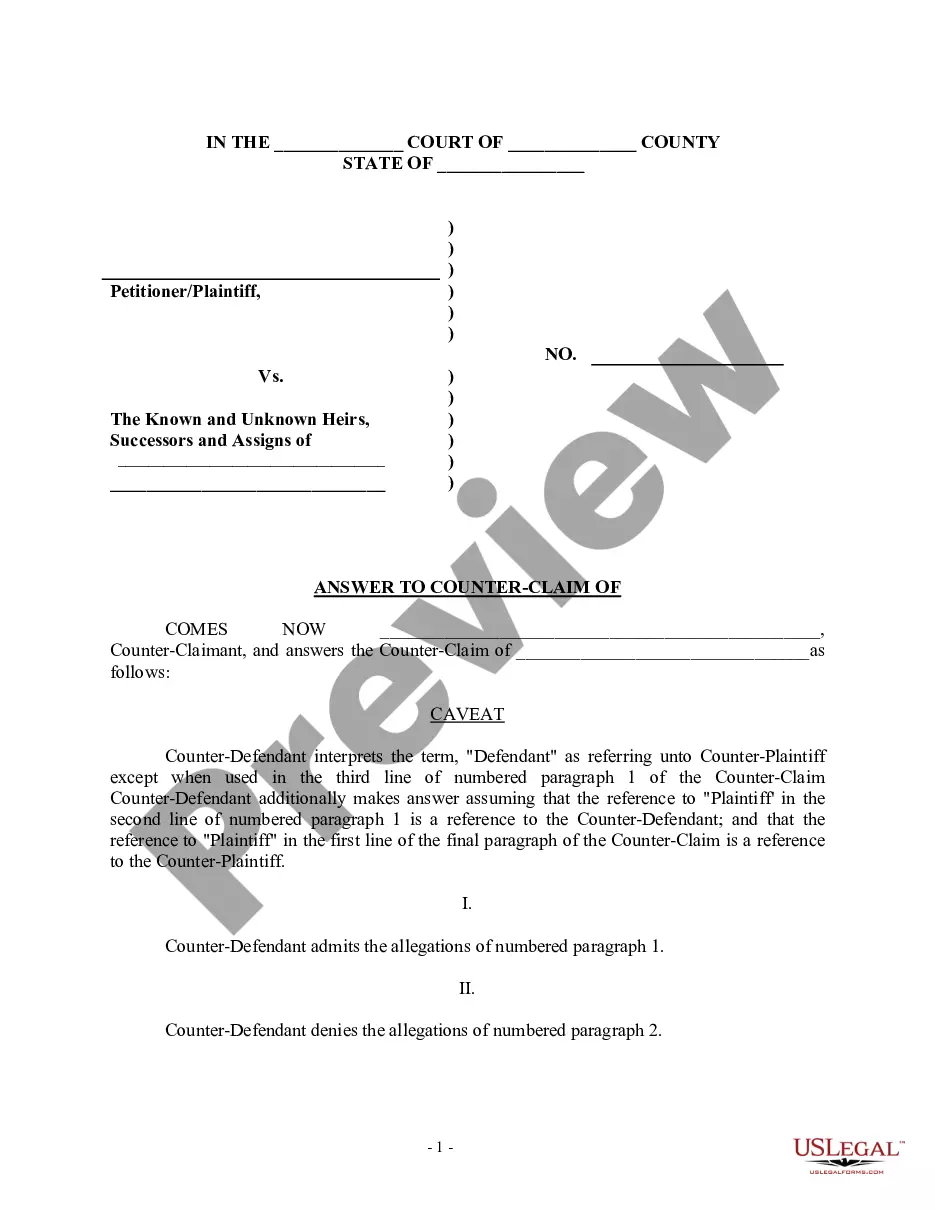
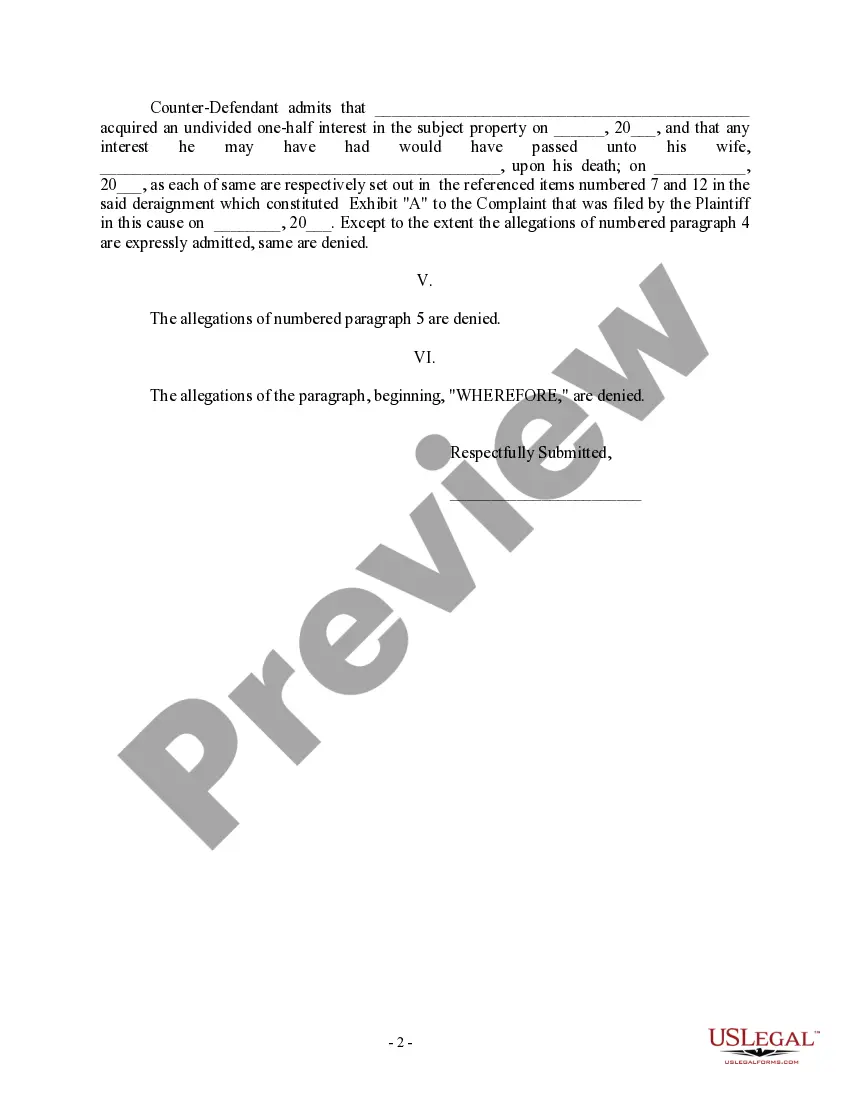
This form is an Answer to a Counter-Claim. The counter-claimant admits and denies certain allegations contained in the document.
District of Columbia Answer to Counterclaim
State:
Multi-State
Control #:
US-01591
Format:
Word;
Rich Text
142 downloads
Description
Free preview
Get your form ready online
Our built-in tools help you complete, sign, share, and store your documents in one place.
Built-in online Word editor
Make edits, fill in missing information, and update formatting in US Legal Forms—just like you would in MS Word.
Export easily
Download a copy, print it, send it by email, or mail it via USPS—whatever works best for your next step.
E-sign your document
Sign and collect signatures with our SignNow integration. Send to multiple recipients, set reminders, and more. Go Premium to unlock E-Sign.
Notarize online 24/7
If this form requires notarization, complete it online through a secure video call—no need to meet a notary in person or wait for an appointment.
Store your document securely
We protect your documents and personal data by following strict security and privacy standards.

Make edits, fill in missing information, and update formatting in US Legal Forms—just like you would in MS Word.

Download a copy, print it, send it by email, or mail it via USPS—whatever works best for your next step.

Sign and collect signatures with our SignNow integration. Send to multiple recipients, set reminders, and more. Go Premium to unlock E-Sign.

If this form requires notarization, complete it online through a secure video call—no need to meet a notary in person or wait for an appointment.

We protect your documents and personal data by following strict security and privacy standards.
Looking for another form?
How to fill out Answer To Counterclaim?
US Legal Forms - one of the largest collections of legal documents in the United States - offers a broad selection of legal form templates that you can download or print.
By using the site, you will access thousands of forms for business and personal purposes, organized by categories, states, or keywords. You can quickly find the latest versions of forms such as the District of Columbia Answer to Counterclaim.
If you already have a subscription, Log In and download the District of Columbia Answer to Counterclaim from the US Legal Forms library. The Download button will appear on every form you view. You can access all previously acquired forms in the My documents section of your account.
Complete the transaction. Use your credit card or PayPal account to finalize the transaction.
Select the format and download the form to your device. Edit. Fill out, modify, and print and sign the downloaded District of Columbia Answer to Counterclaim. Each template you added to your account does not have an expiration date and belongs to you indefinitely. Therefore, if you wish to download or print another copy, simply navigate to the My documents section and click on the form you need. Access the District of Columbia Answer to Counterclaim with US Legal Forms, one of the most extensive collections of legal document templates. Utilize thousands of professional and state-specific templates that meet your business or personal requirements.
- Make sure you have selected the correct form for your city/region.
- Click the Review button to check the form's content.
- Examine the form summary to ensure you have chosen the right form.
- If the form does not suit your needs, use the Search field at the top of the screen to find the one that does.
- If you are satisfied with the form, confirm your choice by clicking the Buy now button.
- Then, select the payment plan you prefer and provide your credentials to create an account.
Form popularity
FAQ
Rule 11. Signing of Pleadings, Motions, and Other Papers; Sanctions. (a) Signatures. (1) Every pleading, written motion, and other paper of a party represented by an attorney shall be signed by at least one attorney of record in his or her individual name, whose address shall be stated.
Rule 12-I(a) provides that a moving party must seek consent of other affected parties prior to the filing of a motion, except with respect to Rule 11 motions for imposition of sanctions. In these instances, a good faith effort to resolve the disputed issues is required.
If a pleading sets forth a claim for relief to which the adverse party is not required to serve a responsive pleading, the adverse party may assert at the trial any defense in law or fact to that claim for relief.
There are four defenses that may be waived if not made by a Rule 12 motion: Lack of Personal Jurisdiction (Rule 12(b)(2)); Improper Venue (Rule 12(b)(3)); Insufficiency of Process (Rule 12(b)(4)); and Insufficiency of Service of Process (Rule 12(b)(5).)
(A) A defendant must serve an answer within 21 days after being served with the summons and complaint.
A party may move for a more definite statement of a pleading to which a responsive pleading is allowed but which is so vague or ambiguous that the party cannot reasonably prepare a response. The motion must be made before filing a responsive pleading and must point out the defects complained of and the details desired.
You should respond to the counterclaim as though it were a Statement of Claim and you were drafting a Defence: respond to every paragraph ? you can do this paragraph by paragraph if necessary; deny any allegations of fact that you do not admit ? you will be deemed to admit facts that you forget to plead to; and.
Rule 12 substitutes the word "file" for serve and requires that the responsive pleading be filed within the time prescribed by this rule as opposed to serving the pleading as is the case under FRCP 12. By using this terminology, it is believed that arguments can be avoided as to when a pleading was served.