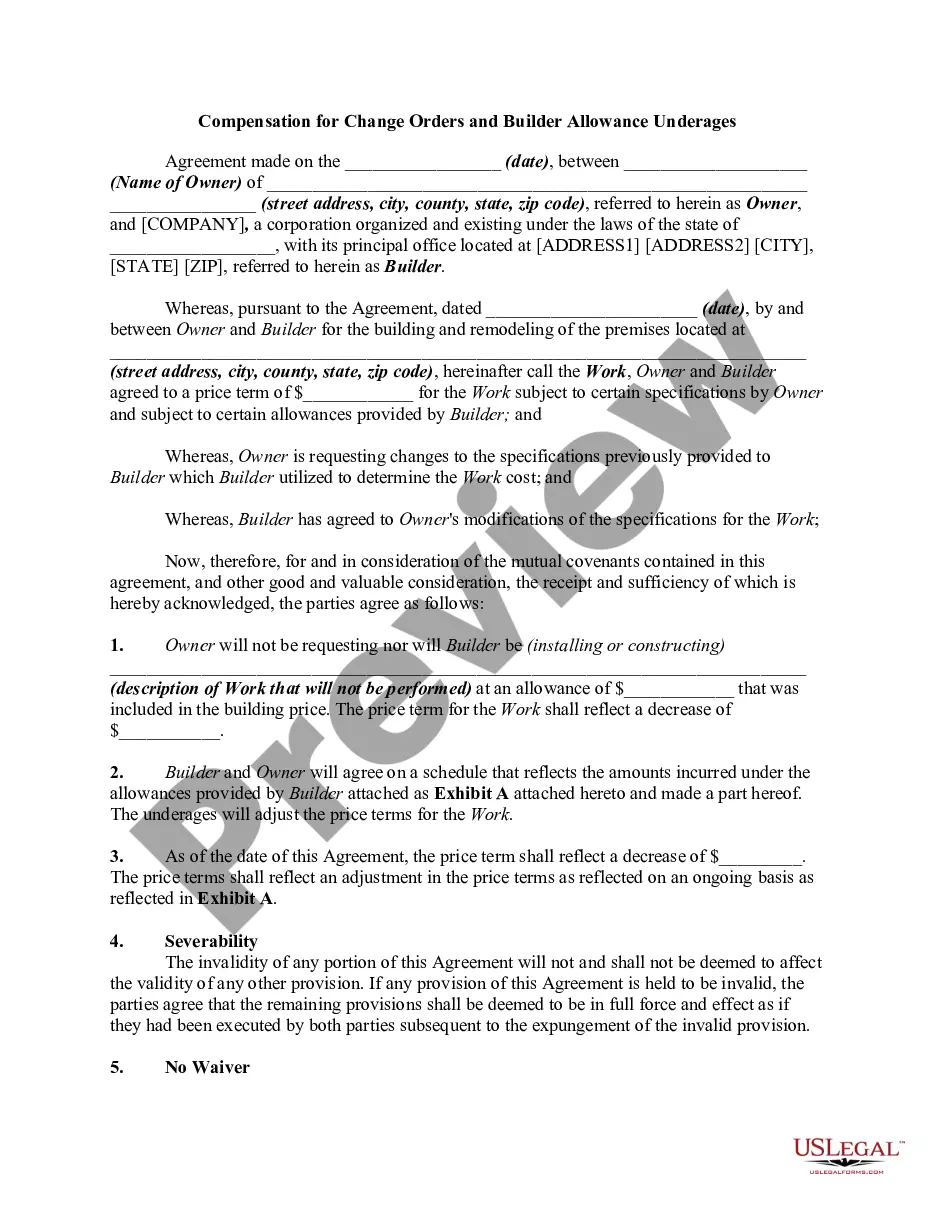
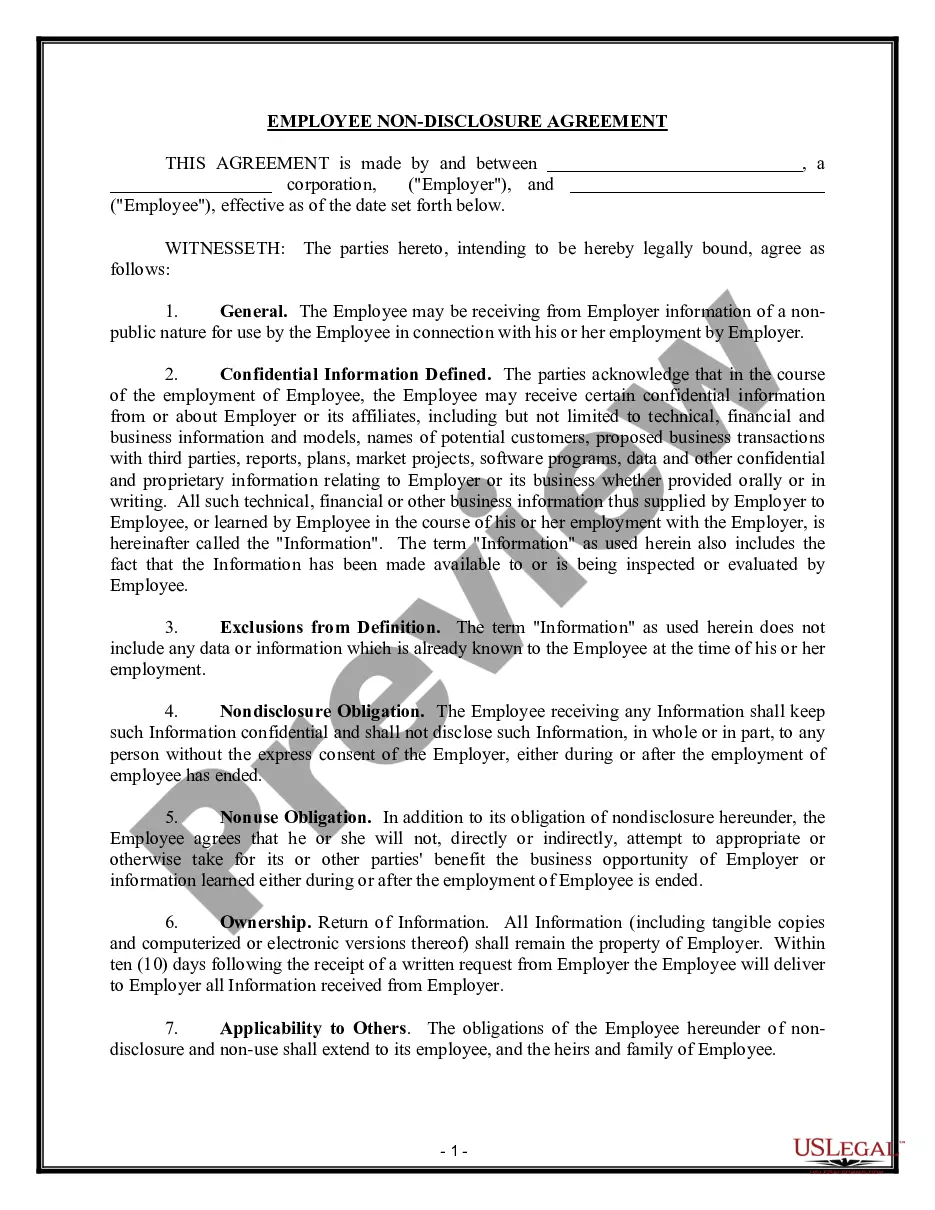
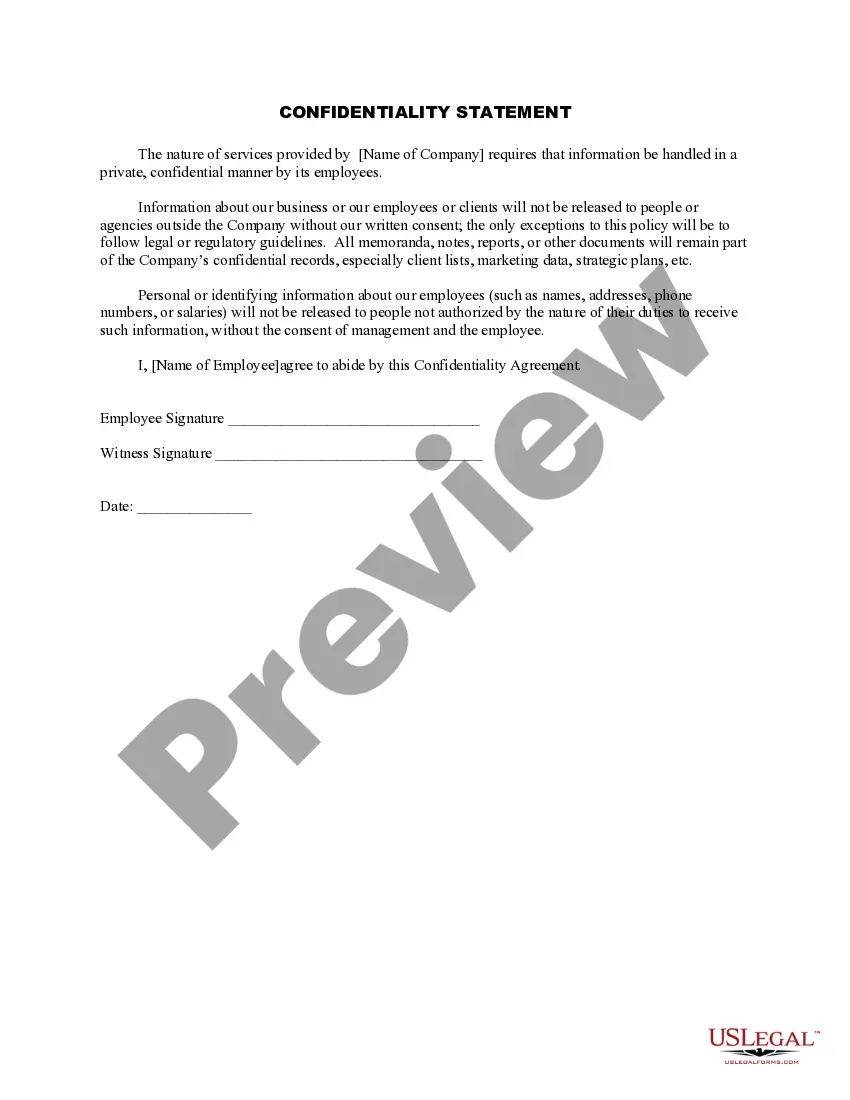
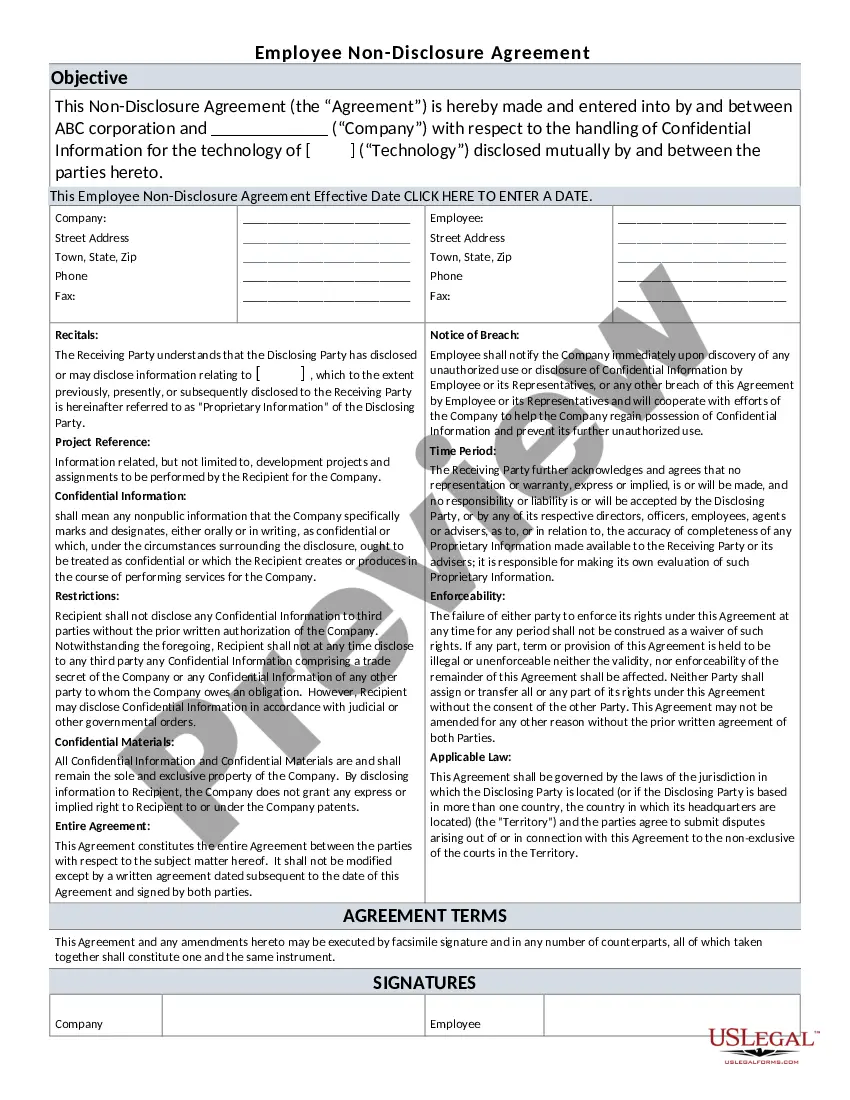
The employee may be receiving from the employer information of a non-public nature for use by the employee in connection with his or her employment. The employee receiving any information will keep such information confidential and agrees not to disclose such information, in whole or in part, to any person without the express consent of the employer, either during or after the employment of the employee has ended. In addition to its obligation of nondisclosure, the employee agrees that he or she will not, directly or indirectly, attempt to appropriate or otherwise take for its or other parties' benefit the business opportunity of employer or information learned either during or after the employment of employee is ended.
District of Columbia Employee Nondisclosure Agreement
State:
Multi-State
Control #:
US-00502
Format:
Word;
Rich Text
Instant download
Description
Free preview
Get your form ready online
Our built-in tools help you complete, sign, share, and store your documents in one place.
Built-in online Word editor
Make edits, fill in missing information, and update formatting in US Legal Forms—just like you would in MS Word.
Export easily
Download a copy, print it, send it by email, or mail it via USPS—whatever works best for your next step.
E-sign your document
Sign and collect signatures with our SignNow integration. Send to multiple recipients, set reminders, and more. Go Premium to unlock E-Sign.
Notarize online 24/7
If this form requires notarization, complete it online through a secure video call—no need to meet a notary in person or wait for an appointment.
Store your document securely
We protect your documents and personal data by following strict security and privacy standards.

Make edits, fill in missing information, and update formatting in US Legal Forms—just like you would in MS Word.

Download a copy, print it, send it by email, or mail it via USPS—whatever works best for your next step.

Sign and collect signatures with our SignNow integration. Send to multiple recipients, set reminders, and more. Go Premium to unlock E-Sign.

If this form requires notarization, complete it online through a secure video call—no need to meet a notary in person or wait for an appointment.

We protect your documents and personal data by following strict security and privacy standards.
Looking for another form?


How to fill out Employee Nondisclosure Agreement?
Finding the appropriate legal document template can be challenging. Certainly, there are numerous templates available online, but how do you locate the legal form you require? Utilize the US Legal Forms website. The service offers thousands of templates, including the District of Columbia Employee Nondisclosure Agreement, which can be used for both professional and personal purposes. All the documents are reviewed by experts and comply with federal and state regulations.
If you are already registered, Log In to your account and click on the Download button to retrieve the District of Columbia Employee Nondisclosure Agreement. Use your account to review the legal forms you have purchased previously. Navigate to the My documents section of your account to obtain another copy of the document you need.
If you are a first-time user of US Legal Forms, here are straightforward steps you should take: First, ensure you have selected the correct form for your city/county. You can examine the form using the Preview button and review the form description to confirm it is suitable for you. If the form does not meet your requirements, use the Search field to find the appropriate form. Once you are certain that the form is correct, click on the Purchase now button to acquire the form. Choose the payment plan you desire and enter the necessary information. Create your account and complete your purchase using your PayPal account or credit card. Select the file format and download the legal document template to your device. Finally, complete, modify, print, and sign the obtained District of Columbia Employee Nondisclosure Agreement.
Overall, US Legal Forms provides an efficient means to access and manage legal documents, ensuring compliance with legal standards.
- US Legal Forms is the largest repository of legal documents where you can find a variety of document templates.
- Use the service to download professionally crafted documents that adhere to state requirements.
- Discovering the right authorized papers web template can be a battle.
- Utilize the US Legal Forms web site.
- All the forms are examined by pros and fulfill federal and state specifications.
- Make certain you have chosen the proper develop for the town/county.
Form popularity
FAQ
Since NDAs are civil contracts, breaking one isn't technically a crime. However, it could come with severe financial penalties. Violating an NDA leaves you open to lawsuits from your employer, and you could be required to pay financial damages and possibly associated legal costs.
For example, NDAs that prevent an individual from reporting illegal or unethical activity in the workplace may be deemed unenforceable because they interfere with important public policy goals, such as maintaining the integrity of the workplace and preventing discrimination or harassment.
Companies can require new employees and job interviewees to sign NDAs to keep sensitive information private. For example, a sales or marketing engineer could sign an NDA that prevents them from taking any customer data to another employer or starting their own business.
If an employee violates an NDA, this is a breach of contract and employers can seek relief through litigation. Often, the NDA contains specific remedies available.
Most employers will not allow their employees to start work if they refuse to sign whatever policy forms they use at that company, including NDAs.
An employee confidentiality agreement, or non-disclosure agreement or an ?NDA,? makes it crystal clear to an employee that he or she cannot under any circumstance, with the exception of prior written approval, disclose company secrets.
To enforce a non-disclosure agreement, the employer seeking enforcement must demonstrate that the information at issue qualifies as trade secret or confidential information. The NDA should specify the exchange and type of confidential information that cannot be disclosed.
While the rules can certainly vary from state to state, most jurisdictions consider non-disclosure agreements to be enforceable as long as they are drafted and executed properly.