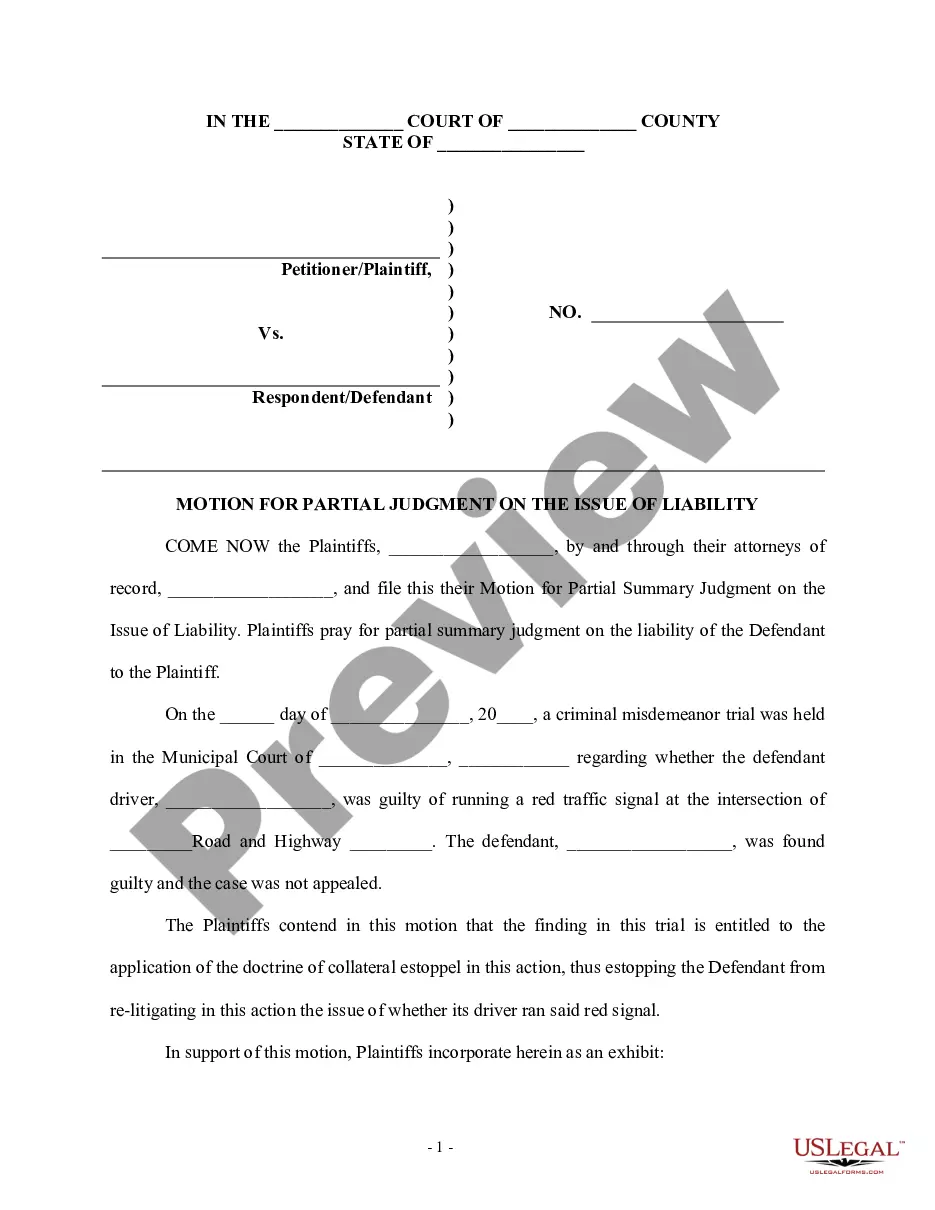
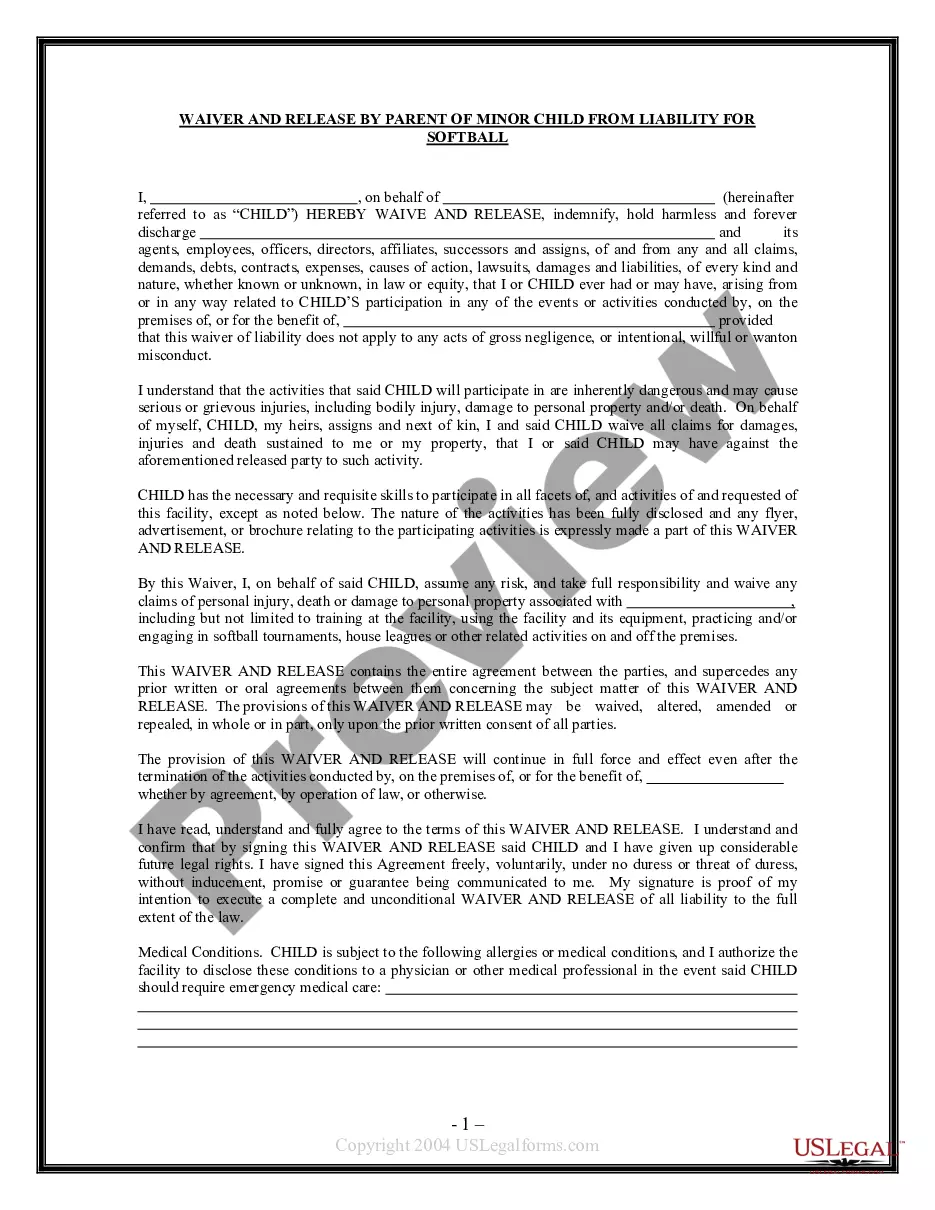
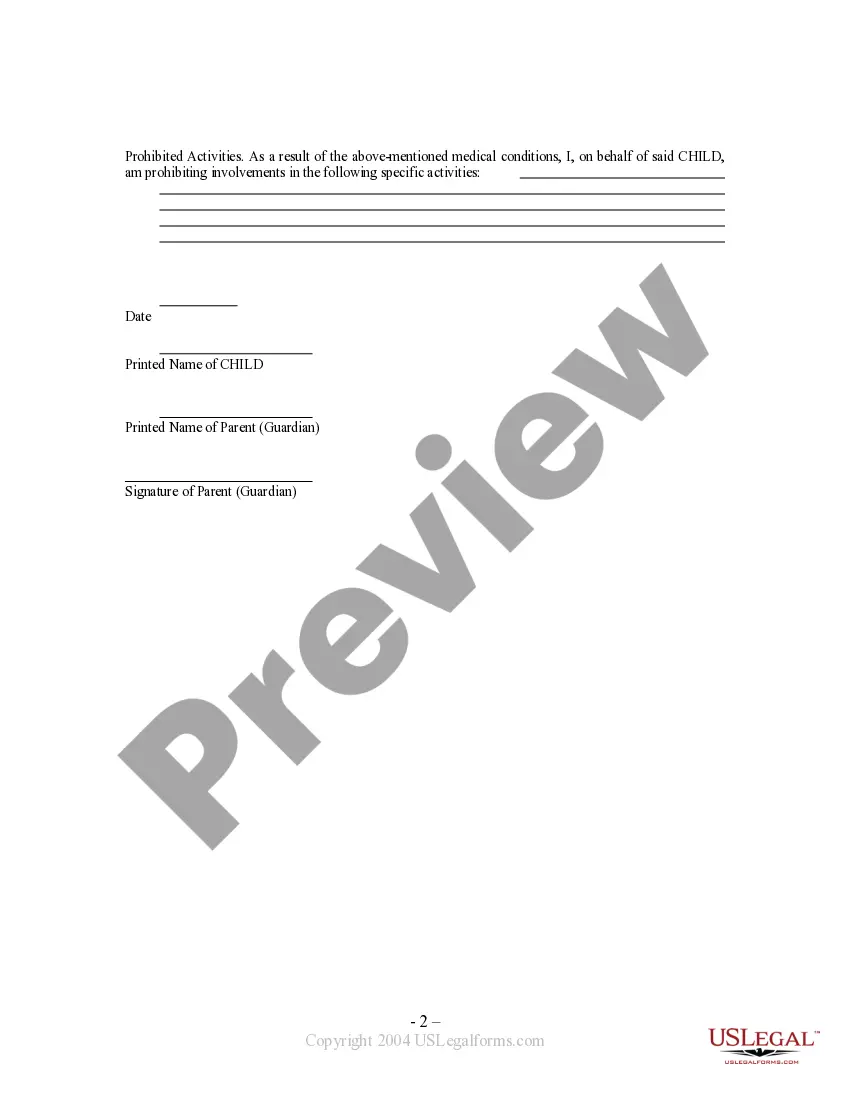
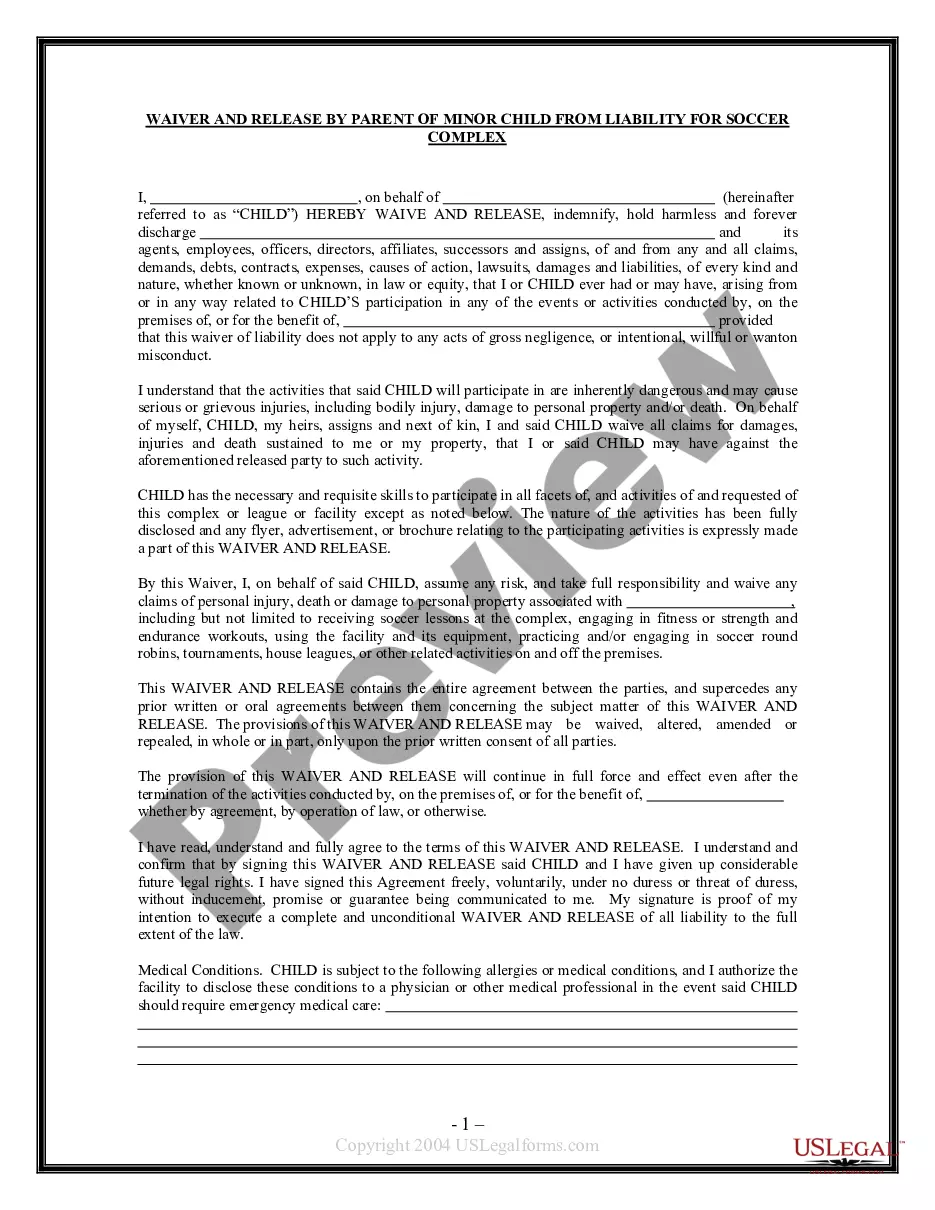
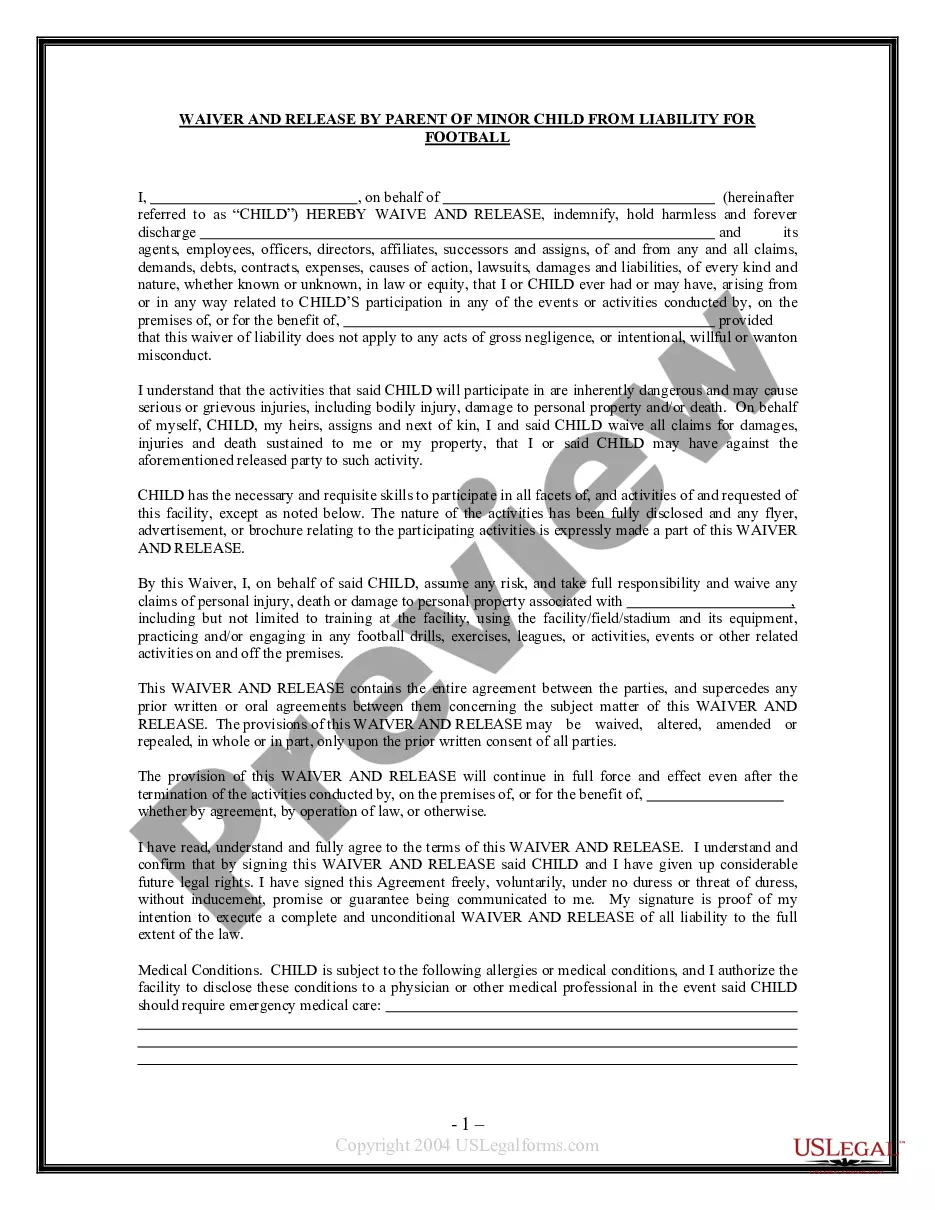
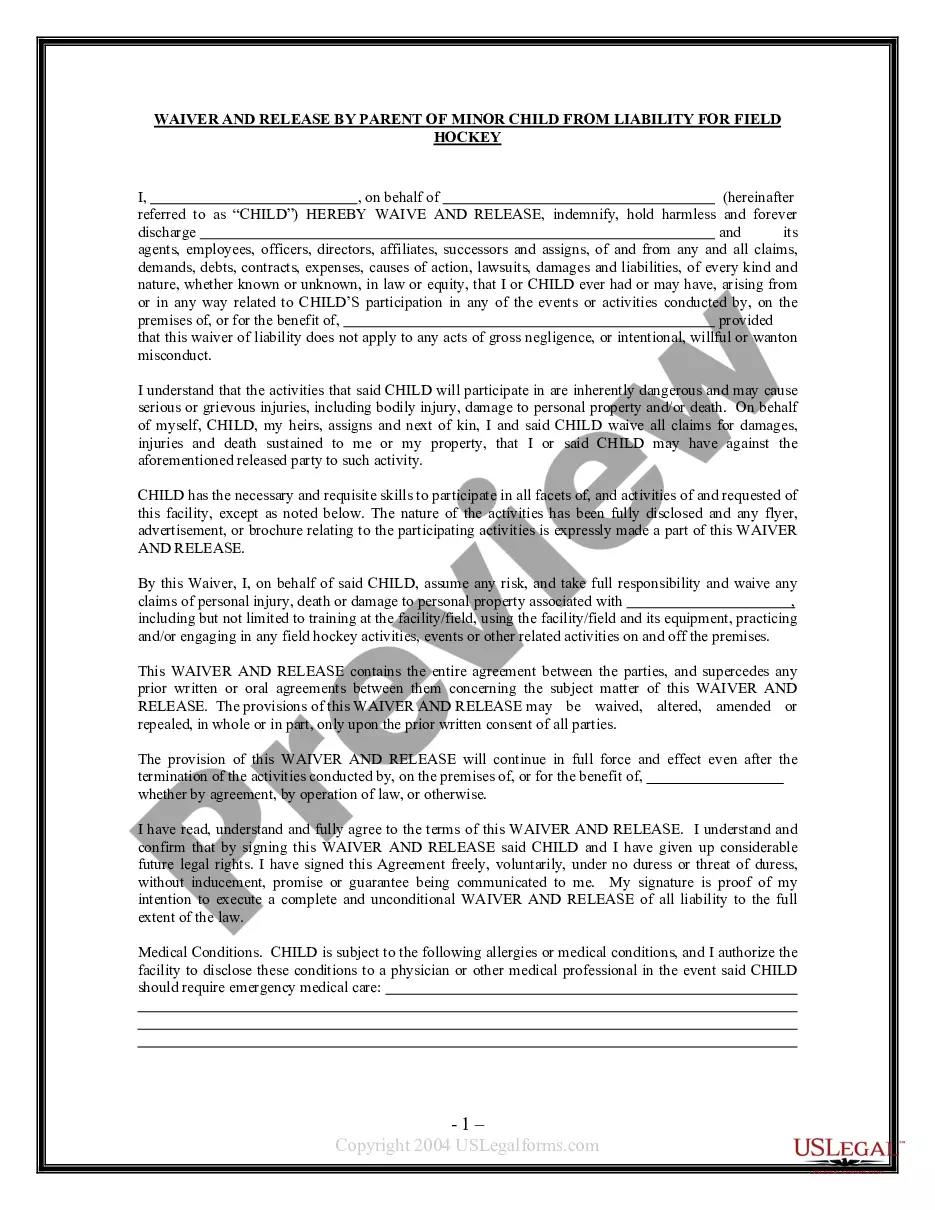
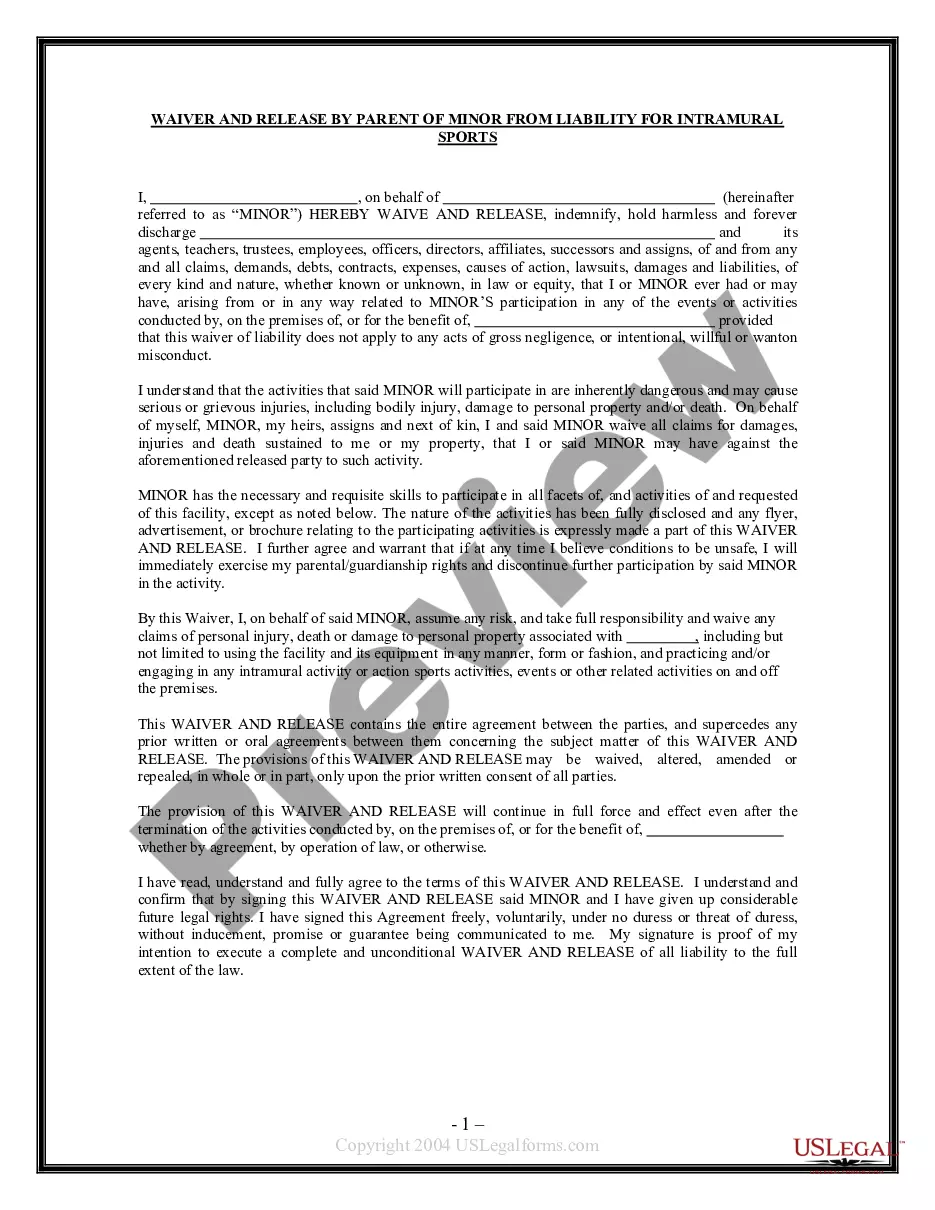
This form allows a parent or guardian to release a softball field from liability for injuries which may be incurred by a minor child while on the premises, taking part in activities, etc.
Connecticut Waiver and Release From Liability For Minor Child for Softball Field
Category:
State:
Multi-State
Control #:
US-WAV-38M
Format:
Word;
Rich Text
Instant download
Description
Free preview
How to fill out Waiver And Release From Liability For Minor Child For Softball Field?
US Legal Forms - one of the largest collections of legal documents in the country - provides a variety of legal form templates that you can obtain or create.
By utilizing the site, you can access a vast selection of forms for business and individual purposes, organized by categories, states, or keywords. You can find the latest versions of forms such as the Connecticut Waiver and Release From Liability For Minor Child for Softball Field in just moments.
If you are already a member, Log In and obtain the Connecticut Waiver and Release From Liability For Minor Child for Softball Field from the US Legal Forms library. The Download button will appear on every form you view. You can access all previously downloaded forms in the My documents section of your account.
Every template you add to your account has no expiration date and is yours indefinitely. Thus, if you wish to obtain or print another copy, simply visit the My documents section and click on the form you need.
Access the Connecticut Waiver and Release From Liability For Minor Child for Softball Field with US Legal Forms, the most extensive collection of legal document templates. Utilize a vast array of professional and state-specific templates that fulfill your business or personal requirements.
- Make sure you have chosen the correct form for your city/region. Click the Review button to check the form's content. Review the form summary to ensure you have selected the right form.
- If the form does not meet your requirements, utilize the Search field at the top of the screen to find one that does.
- Once you are satisfied with the form, confirm your choice by clicking the Get now button. Then, select the payment plan you prefer and provide your details to register for the account.
- Complete the transaction. Use your Visa or Mastercard or PayPal account to finalize the purchase.
- Choose the format and download the form to your device.
- Edit. Fill out, modify, and print and sign the downloaded Connecticut Waiver and Release From Liability For Minor Child for Softball Field.
Form popularity
FAQ
A waiver may be deemed unenforceable if it is vague, does not adequately inform participants of the risks, or is signed under duress. Additionally, the Connecticut Waiver and Release From Liability For Minor Child for Softball Field can be challenged if it attempts to release liability for gross negligence. It's crucial to ensure that your waiver is clear and comprehensive to withstand scrutiny.
Liability waivers can be legally binding if they are drafted properly and meet state laws. In Connecticut, the Connecticut Waiver and Release From Liability For Minor Child for Softball Field must be clear and specific about the risks involved. When executed correctly, these waivers provide a measure of protection against legal claims.
A waiver is a document that acknowledges the risks involved in an activity, while a release is an agreement that relinquishes the right to sue. Both are critical components of the Connecticut Waiver and Release From Liability For Minor Child for Softball Field, but they serve different purposes. Understanding these differences can help you better protect yourself and your organization.
Generally, waivers signed by minors are not legally binding. In Connecticut, a parent or guardian must sign the Connecticut Waiver and Release From Liability For Minor Child for Softball Field on behalf of the minor. This ensures that the adult understands the risks and agrees to the waiver, providing legal protection for the organizers.
Waivers do not completely prevent you from suing, but they can limit your ability to successfully claim damages. The Connecticut Waiver and Release From Liability For Minor Child for Softball Field aims to protect organizers from certain legal actions. However, in cases of gross negligence or willful misconduct, a waiver may not hold up in court.
Connecticut is not strictly a strict liability state; instead, it follows a comparative negligence rule. This means that if an injury occurs, liability may be assigned based on the degree of fault. Understanding how this interacts with the Connecticut Waiver and Release From Liability For Minor Child for Softball Field can help clarify responsibilities.
To write a liability waiver form, start by identifying the specific activity and potential risks involved. Clearly state that participants acknowledge these risks by signing the Connecticut Waiver and Release From Liability For Minor Child for Softball Field. It's also essential to include spaces for signatures and dates, ensuring it is understandable for parents and guardians.
Yes, liability waivers can be enforceable in Connecticut, provided they meet certain criteria. The Connecticut Waiver and Release From Liability For Minor Child for Softball Field must clearly outline the risks involved and be signed by a parent or guardian. Courts generally uphold waivers if they are written clearly and voluntarily signed.