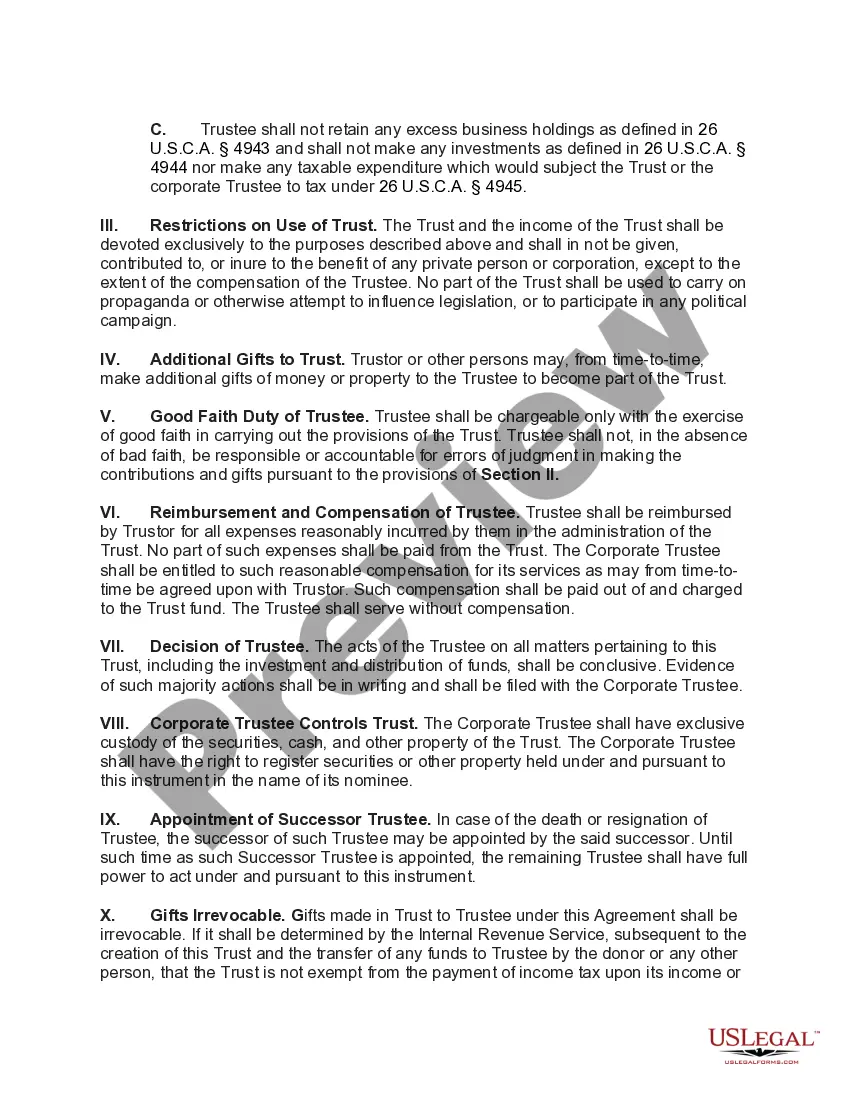
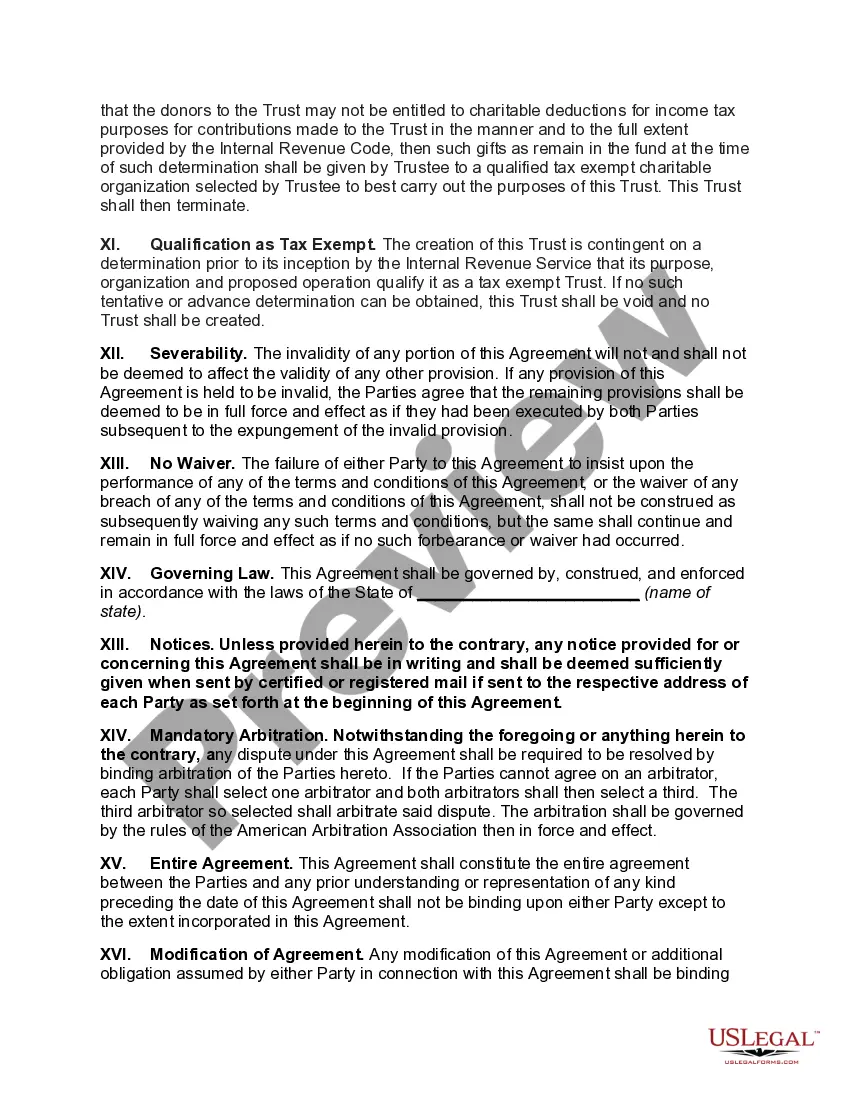
Connecticut Charitable Trust with Creation Contingent upon Qualification for Tax Exempt Status
Description
Get your form ready online
Our built-in tools help you complete, sign, share, and store your documents in one place.
Make edits, fill in missing information, and update formatting in US Legal Forms—just like you would in MS Word.
Download a copy, print it, send it by email, or mail it via USPS—whatever works best for your next step.
Sign and collect signatures with our SignNow integration. Send to multiple recipients, set reminders, and more. Go Premium to unlock E-Sign.
If this form requires notarization, complete it online through a secure video call—no need to meet a notary in person or wait for an appointment.
We protect your documents and personal data by following strict security and privacy standards.

Make edits, fill in missing information, and update formatting in US Legal Forms—just like you would in MS Word.

Download a copy, print it, send it by email, or mail it via USPS—whatever works best for your next step.

Sign and collect signatures with our SignNow integration. Send to multiple recipients, set reminders, and more. Go Premium to unlock E-Sign.

If this form requires notarization, complete it online through a secure video call—no need to meet a notary in person or wait for an appointment.

We protect your documents and personal data by following strict security and privacy standards.
Looking for another form?
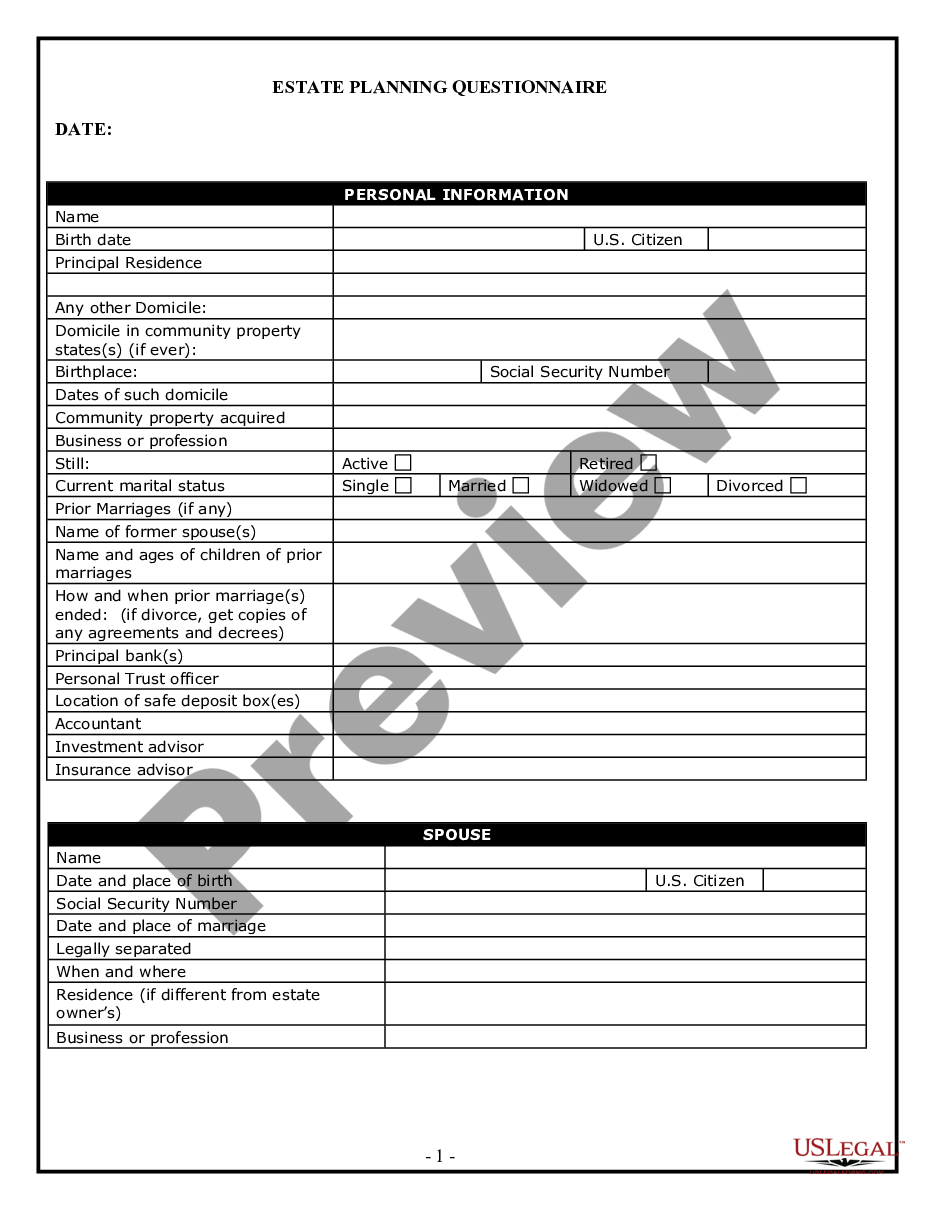




How to fill out Charitable Trust With Creation Contingent Upon Qualification For Tax Exempt Status?
You may dedicate multiple hours online seeking the legal documents template that complies with the state and federal stipulations you require.
US Legal Forms offers a multitude of legal forms that are vetted by experts.
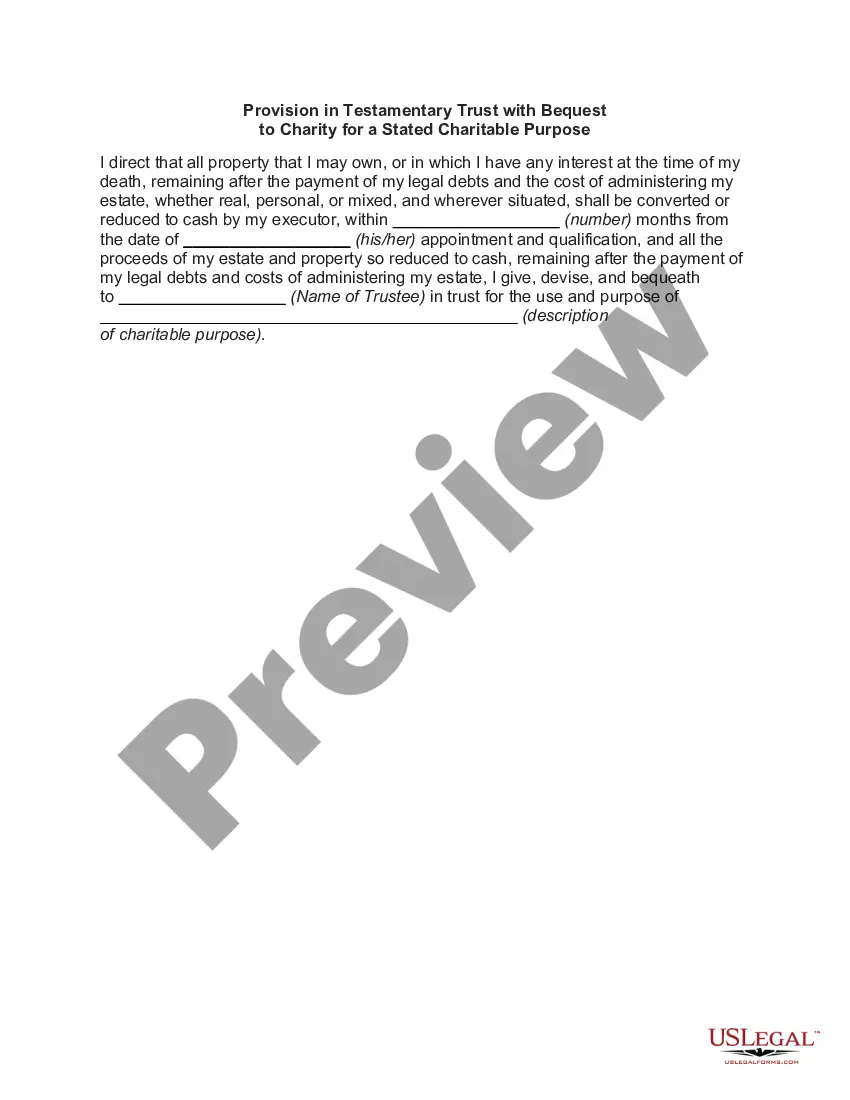
It is straightforward to obtain or print the Connecticut Charitable Trust with Creation Dependent on Eligibility for Tax Exempt Status from their services.
If possible, utilize the Review button to examine the document template as well.
- If you already possess a US Legal Forms account, you can Log In and hit the Download button.
- Subsequently, you can fill out, modify, print, or sign the Connecticut Charitable Trust with Creation Dependent on Eligibility for Tax Exempt Status.
- Every legal document template you acquire is your asset for an extended period.
- To retrieve another copy of any purchased form, navigate to the My documents section and click the corresponding button.
- If you are using the US Legal Forms website for the first time, follow the easy instructions provided below.
- Initially, ensure that you have selected the appropriate document template for your state/region.
- Review the form details to confirm you have selected the correct document.
Form popularity
FAQ
To form a 501(c)(3) in Connecticut, start by understanding the process of creating a Connecticut Charitable Trust with Creation Contingent upon Qualification for Tax Exempt Status. First, you should choose a unique name for your organization and ensure it complies with state regulations. Then, draft your Articles of Incorporation, describing your purpose and including specific language required for tax exemption. Lastly, submit your application to the IRS and file necessary forms with the state, which may include obtaining a local business license. For guidance throughout this process, consider using uslegalforms, which provides resources and templates to assist you.
Organizations organized and operated exclusively for religious, charitable, scientific, testing for public safety, literary, educational, or other specified purposes and that meet certain other requirements are tax exempt under Internal Revenue Code Section 501(c)(3).
Within the United States, you should find the 501(c)(3) tax code. When determining the nonprofit status of an organization, begin by using the IRS Select Check database. The IRS provides an Exempt Organization List on its website. You can also ask the nonprofit for proof of their status.
Exempt income is not subject to taxation. Some income may be exempt at the state level but taxed at a federal level. Income from some types of investments, like municipal bonds, qualifies as exempt income. Distributions from Roth 401(k)s and Roth IRAs are also tax-exempt.
For an organization to receive tax-exempt status, it must satisfy all IRS requirements. Generally, these are organizations that don't operate for profit and provide valuable services to the community such as a charity.
However, a charitable trust is not treated as a charitable organization for purposes of exemption from tax. Accordingly, the trust is subject to the excise tax on its investment income under the rules that apply to taxable foundations rather than those that apply to tax-exempt foundations.
For the purposes of PSLF, eligible not-for-profit organizations include a organizations that are tax exempt under section 501(c)(3) of the Internal Revenue Code (IRC), or other not-for-profit organizations that provide a qualifying service.
The IRS groups the 501(c)(9), 501(c)(4), and 501(c)(17) together when the latter two are employees' associations.
Exemption Requirements - 501(c)(3) Organizations To be tax-exempt under section 501(c)(3) of the Internal Revenue Code, an organization must be organized and operated exclusively for exempt purposes set forth in section 501(c)(3), and none of its earnings may inure to any private shareholder or individual.
Your organization must first apply to the Internal Revenue Service (IRS) to be granted exemption from federal income tax under section 501(a) of the Internal Revenue Code a determination letter from the United States Treasury Department that confirms it qualifies as an organization described in section 501(c)(3) or (13