Connecticut General Non-Competition Agreement

State:
Multi-State
Control #:
US-04098BG
Format:
Word; 
Rich Text
Instant download

Description

Before examining the reasonableness of a noncompetition agreement, courts first consider whether the agreement is ancillary, meaning connected and subordinate to another valid contract. If there is no such contract, the court will look to see if there was valid consideration to enforce such an agreement. If there is no adequate or independent consideration present, most courts will refuse to enforce such an agreement. This is to ensure that the noncompetition agreement is not an outright restraint on trade but, rather, the result of a bargained-for exchange that furthers legitimate commercial interests.


When a businessman sells his business, the purchaser may compete with him unless there is a valid restrictive covenant or covenant not to compete. The same is true when an employee leaves the employment of a company and begins soliciting customers of his former employer or competing with his employer in a similar way. When an ongoing business is sold, it is commonly stated in the sales contract that the seller shall not go into the same area or begin a similar business within a certain geographical area or for a certain period of time or both. Such an agreement can be valid and enforceable.


Restrictions to prevent competition by a former employee are held valid when they are reasonable and necessary to protect the interests of the employer. Courts will closely examine covenants not to compete signed by individuals in order to make sure that they are not unreasonable as to time or geographical area.


When a restriction of competition is invalid because it is too long or covers too great a geographical area, Courts will generally do one of two things. Some Courts will trim the restrictive covenant down to a period of time or geographical area that the Court deems reasonable. Other Courts will refuse to enforce the restrictive covenant at all and declare it void.


Caution: Statutory law in a few states completely prohibit covenants not to compete unless the covenant meets the state's statutory guidelines.
Free preview
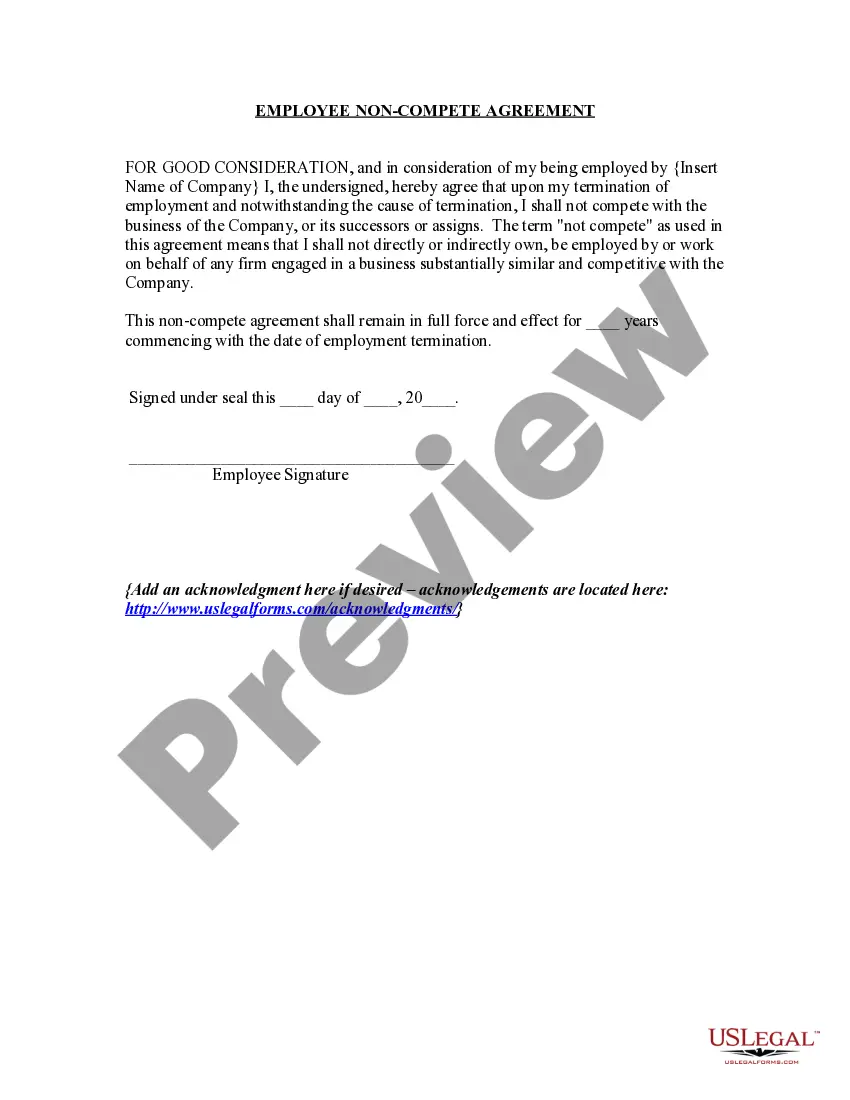
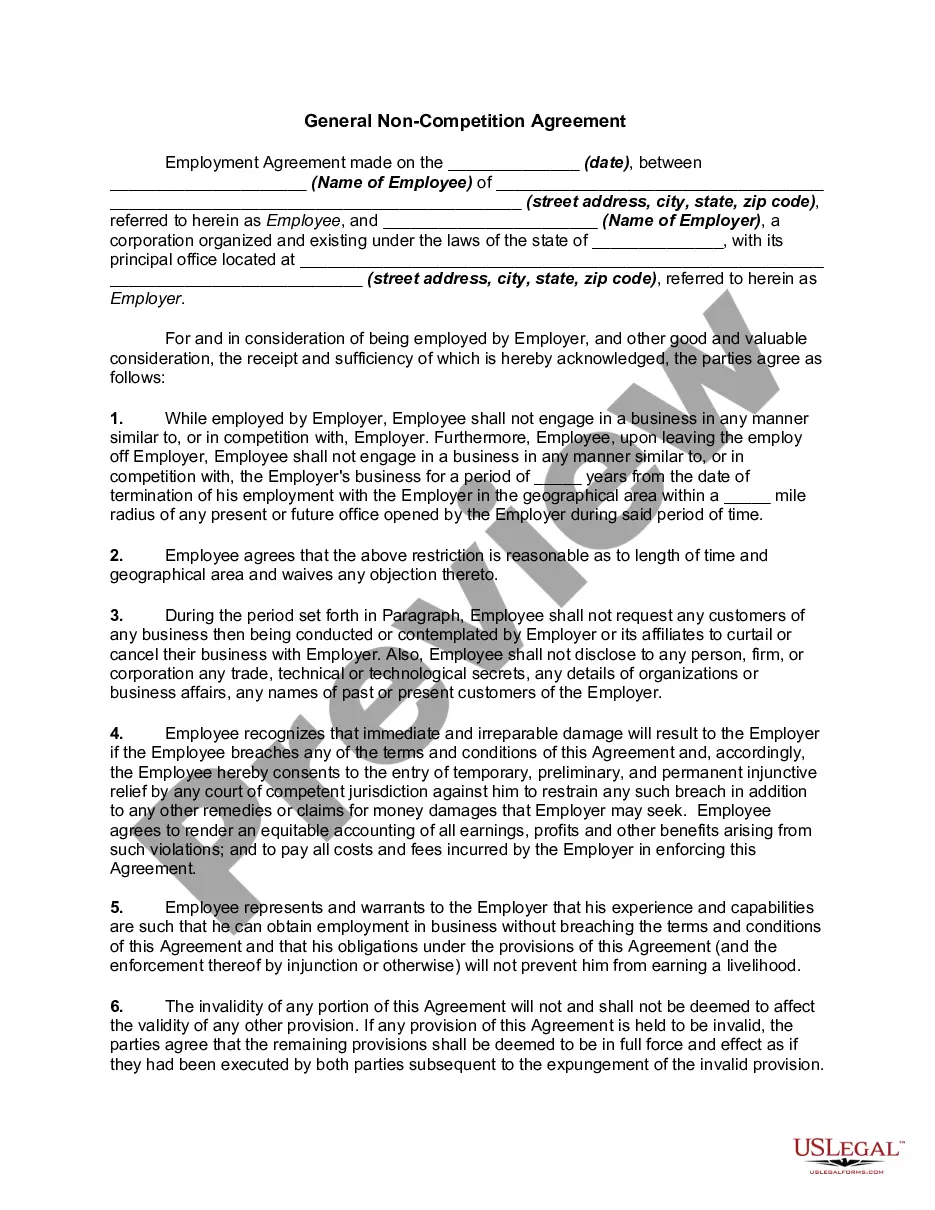
  • Preview General Non-Competition Agreement
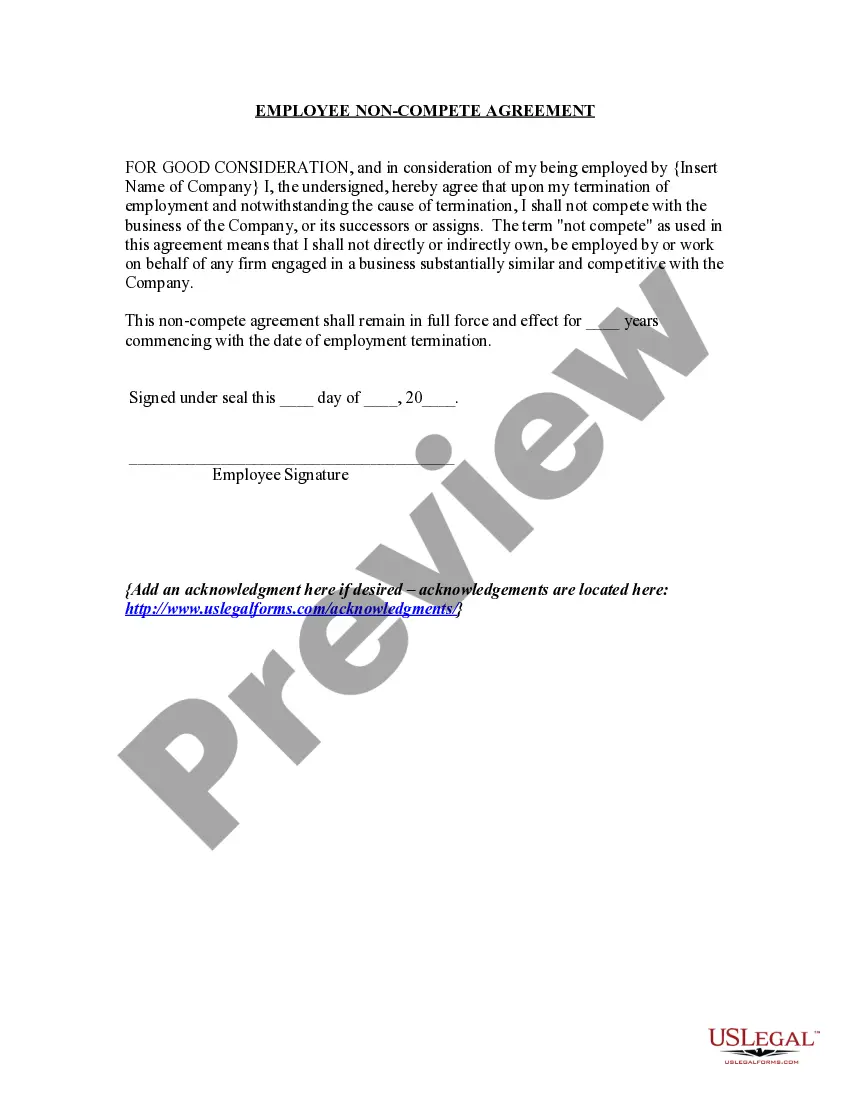
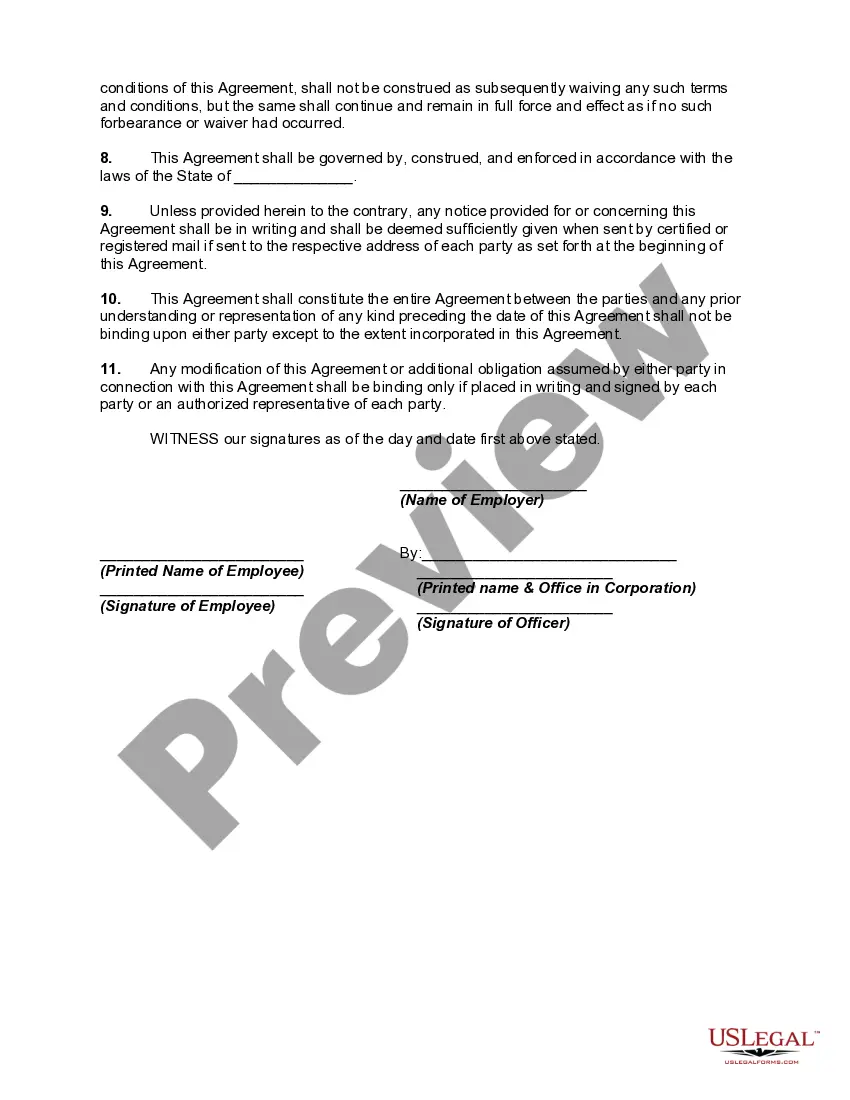
  • Preview General Non-Competition Agreement

How to fill out General Non-Competition Agreement?

US Legal Forms - one of the most prominent collections of legal documents in the United States - offers a selection of legal document templates that you can download or print.

By using the website, you can access thousands of forms for business and personal purposes, categorized by classifications, states, or keywords.

You can obtain the most recent versions of forms such as the Connecticut General Non-Competition Agreement within moments.

Read the form description to confirm that you have chosen the correct form.

If the form does not meet your needs, utilize the Search box at the top of the screen to find one that does.

  1. If you possess a monthly subscription, Log In and download the Connecticut General Non-Competition Agreement from the US Legal Forms library.
  2. The Download button will appear on every form you view.
  3. You can access all previously stored forms in the My documents section of your account.
  4. To use US Legal Forms for the first time, here are some straightforward instructions to get started.
  5. Make sure you have selected the appropriate form for your area/state.
  6. Click the Preview button to review the content of the form.

Form popularity

FAQ

Typically, the only way to fight a non-compete agreement is to go to court. If you are an employee (or former employee) who signed such an agreement, this means you must violate the agreement and wait to be sued. It may be that your former employer has never sued another employee to enforce the non-compete agreement.

Duration: Post-termination restrictive covenants that exceed 6 months are unlikely to be enforceable unless the employee is in a very senior, executive or key business role (see further under Question 6).

Connecticut does not have any statute or regulation governing non- competes generally. Employers cannot require certain security guards to enter into an agreement preventing them from engaging in the same or similar job: 220e At the same location where they were employed. 220e For another employer.

Non-compete agreements are typically considered enforceable if they: Have reasonable time restrictions (generally less than one year) Are limited to a certain geographic area (specific cities or counties, rather than entire states)

You Can Void a Non-Compete by Proving Its Terms Go Too Far or Last Too Long. Whether a non-compete is unenforceable because it covers too large of a geographical area or it lasts too long can depend on many factors. Enforceability can depend on your industry, skills, location, etc.

In Connecticut, non-compete provisions in physician employment agreements, also known as restrictive covenants, have long been considered reasonable restrictions on competition and enforceable.

California - Non-compete clauses are not enforceable under California law. However, LegalNature's non-compete agreement may still be used to prohibit the employee from soliciting customers and other employees away from the employer.

- The two most common settings for legitimate non-competition agreements are the sale of a business and an employment relationship. When a non-compete agreement is ancillary to the sale of a business, it is enforceable if reasonable in time, geographic area, and scope of activity.

Connecticut courts can modify or blue pencil the terms of the restrictions and enforce them as modified. However, the non-compete agreement must state the intent to make the terms severable (Gartner Group, Inc., 1992 WL 4766, at 5). Connecticut courts do not blue pencil if the terms are not severable.

Providing restrictive covenants are not void for restraint of trade and required to protect legitimate business interests, they will be viewed as legally binding.

Trusted and secure by over 3 million people of the world’s leading companies

Connecticut General Non-Competition Agreement