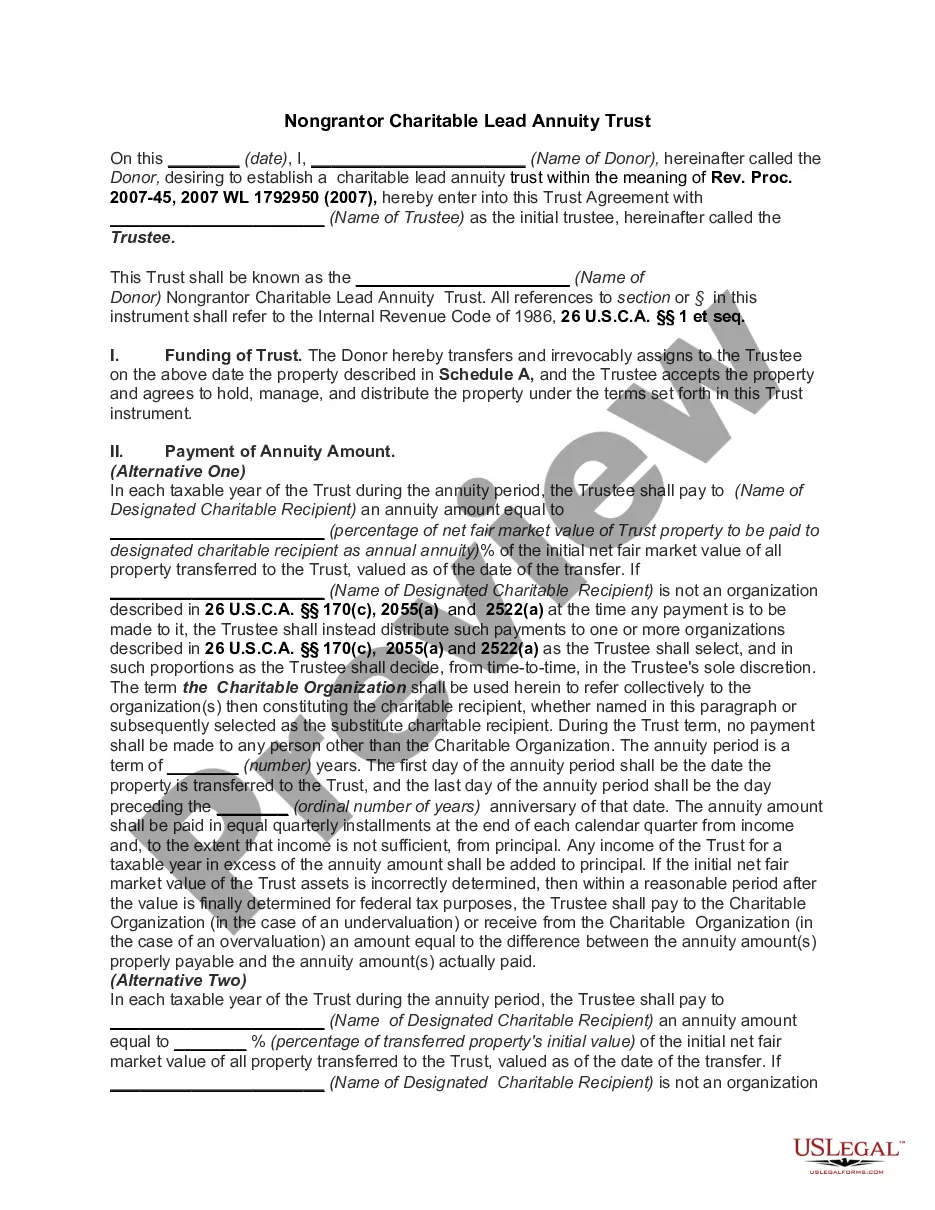
In a charitable lead trust, the lifetime payments go to the charity and the remainder returns to the donor or to the donor's estate or other beneficiaries. A donor transfers property to the lead trust, which pays a percentage of the value of the trust assets, usually for a term of years, to the charity. Unlike a charitable remainder trust, a charitable lead annuity trust creates no income tax deduction to the donor, but the income earned in the trust is not attributed to donor. The trust itself is taxed according to trust rates. The trust receives an income tax deduction for the income paid to charity.
Connecticut Charitable Inter Vivos Lead Annuity Trust
Instant download
Description
Free preview




















How to fill out Charitable Inter Vivos Lead Annuity Trust?
You may spend hours online searching for the legal template that meets your state and federal requirements.
US Legal Forms provides a vast array of legal documents that have been reviewed by experts.
You can easily download or print the Connecticut Charitable Inter Vivos Lead Annuity Trust from the service.
If available, use the Preview button to review the template as well.
- If you possess a US Legal Forms account, you can Log In and hit the Obtain button.
- Afterward, you can complete, modify, print, or sign the Connecticut Charitable Inter Vivos Lead Annuity Trust.
- Every legal template you purchase is yours permanently.
- To obtain another copy of the purchased document, visit the My documents section and click the corresponding button.
- If you are using the US Legal Forms site for the first time, follow the simple instructions below.
- First, ensure you have selected the correct template for the county/city of your choice.
- Check the document description to confirm you have chosen the right template.
Form popularity
FAQ
The downsides of a charitable remainder trust often focus on its structure and limitations. For instance, you cannot change the beneficiaries once the trust is established, which limits flexibility. Additionally, if you wish to make changes to the trust terms, it usually involves more complex legal processes which can be cumbersome and costly.
A charitable trust's disadvantages may include the inability to access assets once they are placed in the trust. Additionally, the complexity of the legal and tax implications can lead to unexpected difficulties. Lastly, the administrative responsibilities involved in managing the trust could require time and resources that some individuals may find burdensome.
Creating a charitable remainder trust typically involves defining the trust's terms and selecting the assets to fund it. It’s important to work with a skilled attorney who understands the nuances of a Connecticut Charitable Inter Vivos Lead Annuity Trust. With proper guidance, you can structure the trust to benefit both charitable organizations and your personal financial goals effectively.
The disadvantages of a charitable lead trust include its irrevocable nature, meaning that once you create it, you can't easily alter your decision. Additionally, if you need to access the funds or assets within the trust, they are not available for your personal use. Also, the administrative costs can add up over time, making it vital to consider your long-term financial goals.
While a charitable lead trust, including the Connecticut Charitable Inter Vivos Lead Annuity Trust, can provide tax benefits, it also has drawbacks. One significant disadvantage is the complexity of setting up and maintaining the trust, which can require legal assistance. Furthermore, once you contribute assets to the trust, you cannot change the beneficiaries easily. It's crucial to weigh these factors carefully.
At the end of a charitable lead trust, the remaining assets are transferred to the beneficiaries specified in the trust document. In the case of a Connecticut Charitable Inter Vivos Lead Annuity Trust, this usually means that family members or other heirs receive the remaining assets. This process allows you to support charitable causes while ensuring your loved ones benefit from your financial planning.
The main difference lies in the flow of benefits. A charitable lead trust, such as the Connecticut Charitable Inter Vivos Lead Annuity Trust, pays income to charities for a specified term before distributing the remainder to beneficiaries. In contrast, a charitable remainder trust pays income to the donor or other non-charitable beneficiaries, with the remainder going to charity. This creates distinct tax implications and planning opportunities for individuals.
Connecticut Charitable Inter Vivos Lead Annuity Trusts (CLATs) are designed to provide financial support to charities while offering tax advantages to donors. The trust distributes a fixed annuity amount to designated charities over a set period. At the end of this term, the remaining assets pass to the donor's beneficiaries. This structure helps you support your favorite causes and reduces your estate tax burden.
In Connecticut, any trust, including a Connecticut Charitable Inter Vivos Lead Annuity Trust, that generates taxable income must file CT 1041. This includes trusts that have unearned income or distributions to beneficiaries. Executors of estates and trustees are responsible for ensuring that the trust meets tax filing requirements. If you're uncertain about your obligations, consider using uslegalforms for assistance in understanding and filing your tax forms.
To set up a trust fund in Connecticut, you should first determine the type of trust that fits your goals, such as a Connecticut Charitable Inter Vivos Lead Annuity Trust. Next, consult with an estate planning attorney who can help you draft the trust document and ensure compliance with state laws. After that, you'll need to fund the trust by transferring assets into it. Utilizing a platform like uslegalforms can simplify this process by providing the necessary legal forms and guidance.