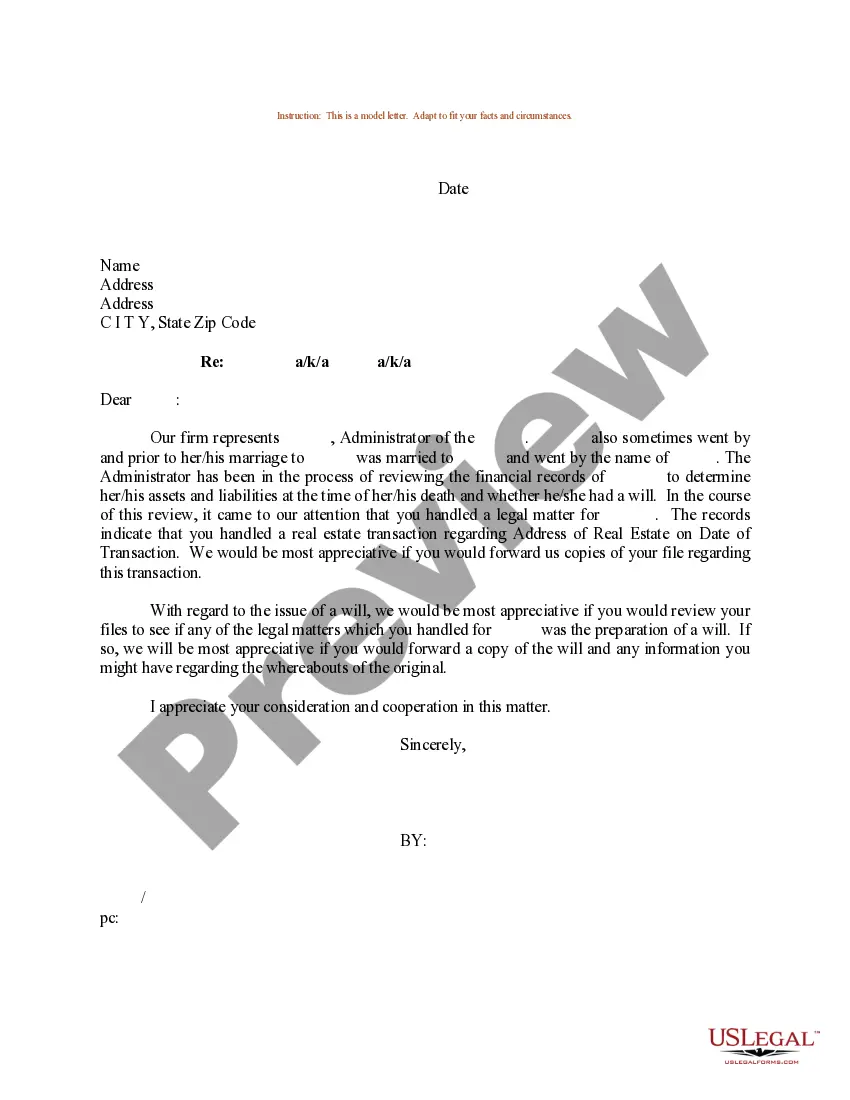
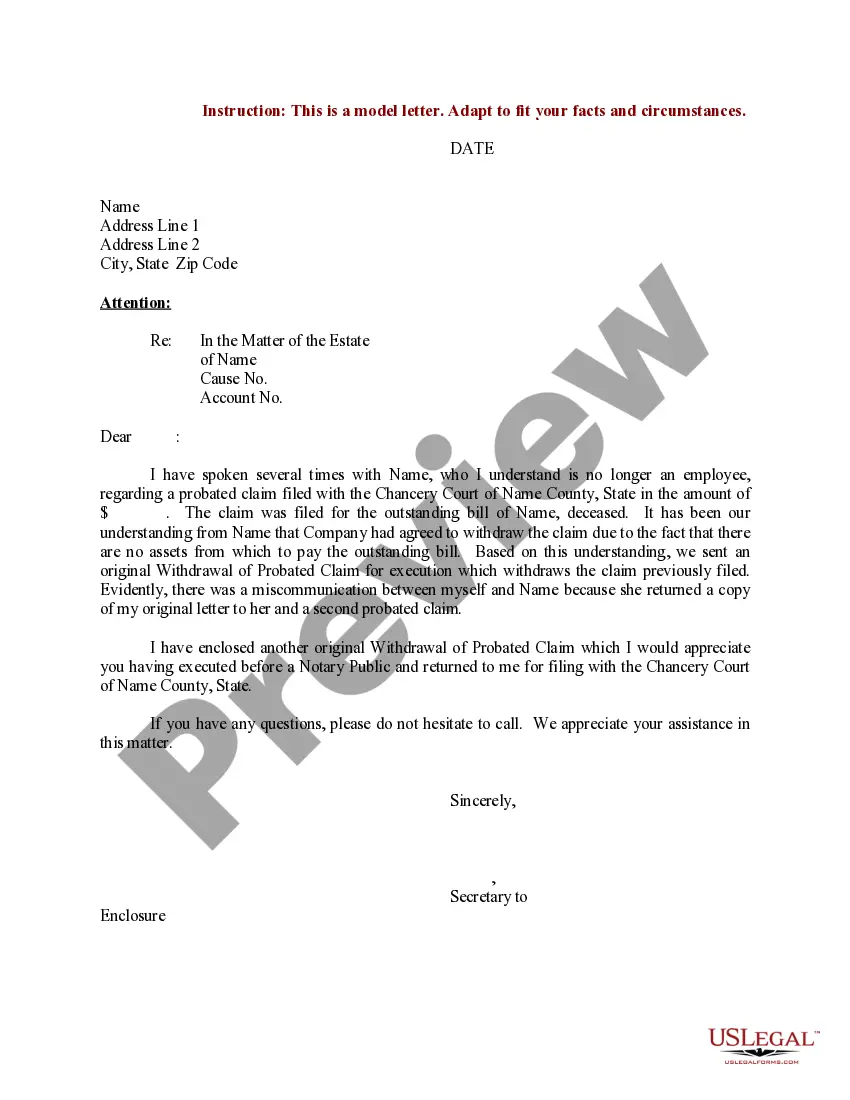
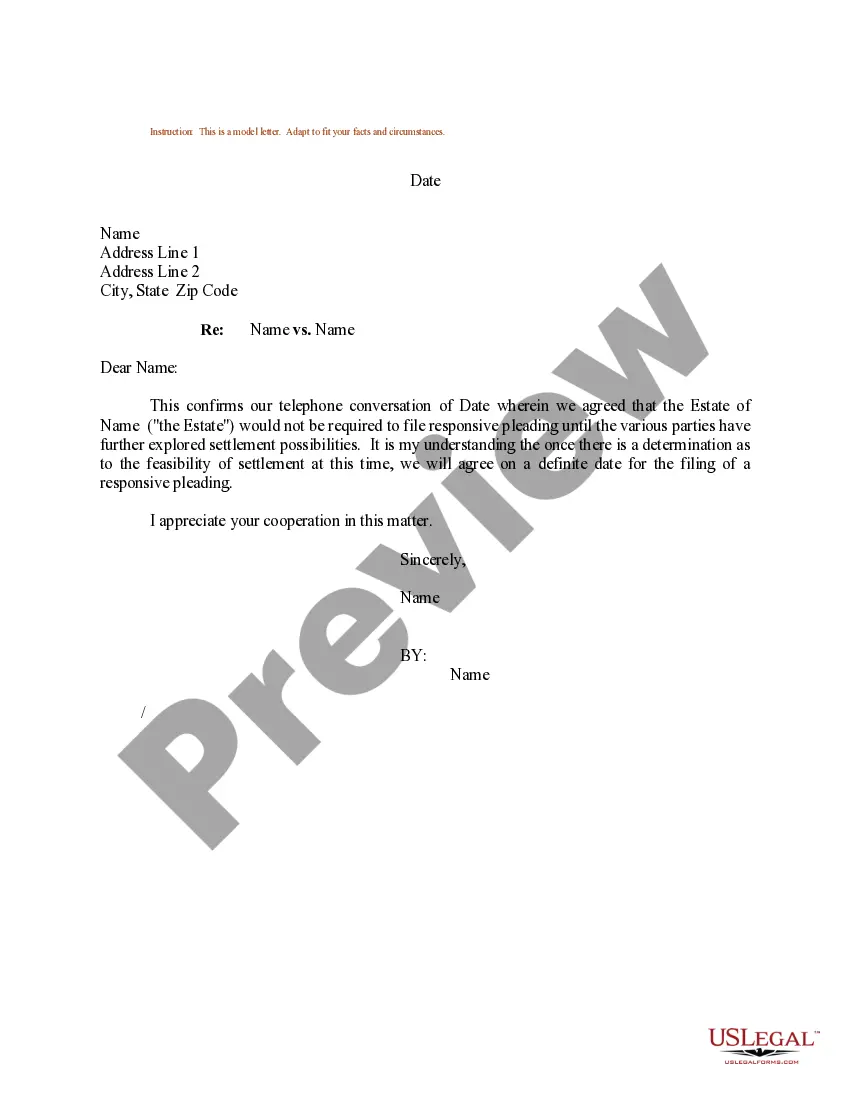
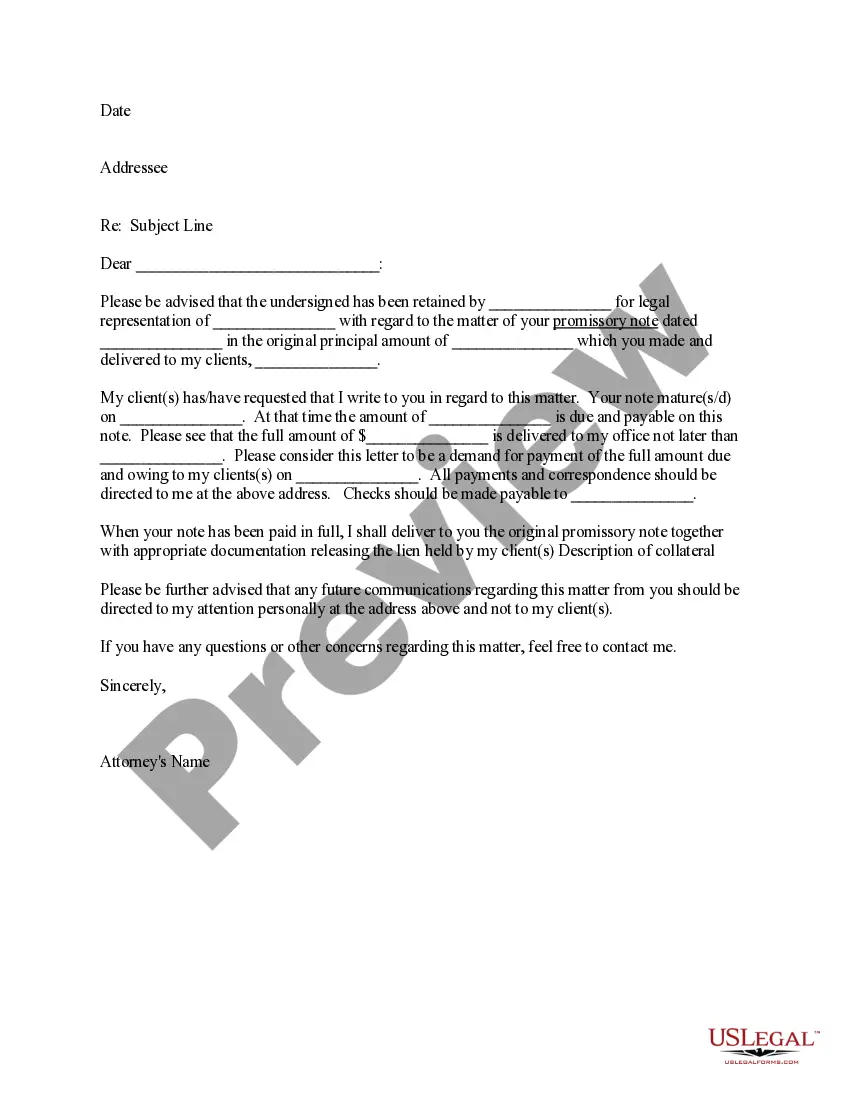
Connecticut Sample Letter for Claim Settlement Against Decedent's Estate
Description


Get your form ready online
Our built-in tools help you complete, sign, share, and store your documents in one place.
Make edits, fill in missing information, and update formatting in US Legal Forms—just like you would in MS Word.
Download a copy, print it, send it by email, or mail it via USPS—whatever works best for your next step.
Sign and collect signatures with our SignNow integration. Send to multiple recipients, set reminders, and more. Go Premium to unlock E-Sign.
If this form requires notarization, complete it online through a secure video call—no need to meet a notary in person or wait for an appointment.
We protect your documents and personal data by following strict security and privacy standards.

Make edits, fill in missing information, and update formatting in US Legal Forms—just like you would in MS Word.

Download a copy, print it, send it by email, or mail it via USPS—whatever works best for your next step.

Sign and collect signatures with our SignNow integration. Send to multiple recipients, set reminders, and more. Go Premium to unlock E-Sign.

If this form requires notarization, complete it online through a secure video call—no need to meet a notary in person or wait for an appointment.

We protect your documents and personal data by following strict security and privacy standards.
Looking for another form?

How to fill out Sample Letter For Claim Settlement Against Decedent's Estate?
If you want to collect, obtain, or print sanctioned document templates, utilize US Legal Forms, the largest array of legal forms available online.
Make use of the site's straightforward and user-friendly search to find the documentation you require.
A range of templates for business and personal use are categorized by groups and states, or keywords. Use US Legal Forms to acquire the Connecticut Sample Letter for Claim Settlement Against Decedent's Estate in just a few clicks.
Every legal document template you purchase is yours for a long time. You have access to every form you acquired in your account. Click on the My documents section and choose a form to print or download again.
Complete and obtain, and print the Connecticut Sample Letter for Claim Settlement Against Decedent's Estate with US Legal Forms. There are countless professional and state-specific forms you can utilize for your business or personal needs.
- If you are already a US Legal Forms user, Log In to your account and click the Download button to get the Connecticut Sample Letter for Claim Settlement Against Decedent's Estate.
- You may also access forms you previously acquired in the My documents section of your account.
- If you are using US Legal Forms for the first time, follow the instructions below.
- Step 1. Ensure you have selected the form for the correct city/state.
- Step 2. Use the Preview option to review the form's details. Don't forget to check the description.
- Step 3. If you are not satisfied with the form, use the Lookup field at the top of the screen to find alternative versions of the legal form template.
- Step 4. After finding the form you need, click the Purchase now button. Choose the pricing plan you prefer and enter your information to create an account.
- Step 5. Process the transaction. You can use your Visa, MasterCard, or PayPal account to complete the purchase.
- Step 6. Select the format of your legal form and download it to your device.
- Step 7. Fill out, edit, and print or sign the Connecticut Sample Letter for Claim Settlement Against Decedent's Estate.
Form popularity
FAQ
Section 30.12 Executor or administrator to send copy of inventory, status update, financial report or account and affidavit of closing to each party and attorney (a) Except as provided in subsection (c), the executor or administrator of an estate shall send a copy of the inventory, each supplemental or substitute ...
In Connecticut, creditors have up to 2 years from the date of death to notify the estate of any debt claims, or until the normal statute of limitations on the debt would expire, whichever comes sooner (see CT Gen Stat § 45a-375).
In Connecticut, a claim must be in writing and, when the fiduciary requires, the claimant must present proof by an affidavit that the claim is justly due and that all prior payments thereon have been credited and, if applicable, identify any security held by the creditor related to the debt.
If the decedent's solely-owned assets include no real property and are valued at less than $40,000 ? which meets Connecticut's ?small estates limit? ? then the assets and property of the estate can be settled without full probate, under a much shorter and easier process.
For instance, in Connecticut, if the decedent's solely-owned assets include no real property and are valued at less than $40,000 ? which is the state's ?small estates limit? ? then the estate can be settled without full probate, under a much shorter and more simplified process.
The Estate Settlement Timeline: Although Connecticut law does not specify a particular deadline for this, it is generally advisable to do so within a month to avoid unnecessary delays in the probate process.
PC-213. Affidavit of Closing of Decedent's Estate (Rev. 7/20) PC-234. Fiduciary's Notice to Creditors to Present Claims (Rev.
All assets that were owned by the decedent in his sole name must be reported to the probate court. To do so, the executor must file an inventory form listing the solely-owned assets and their date-of-death values with the probate court within two months of appointment.
