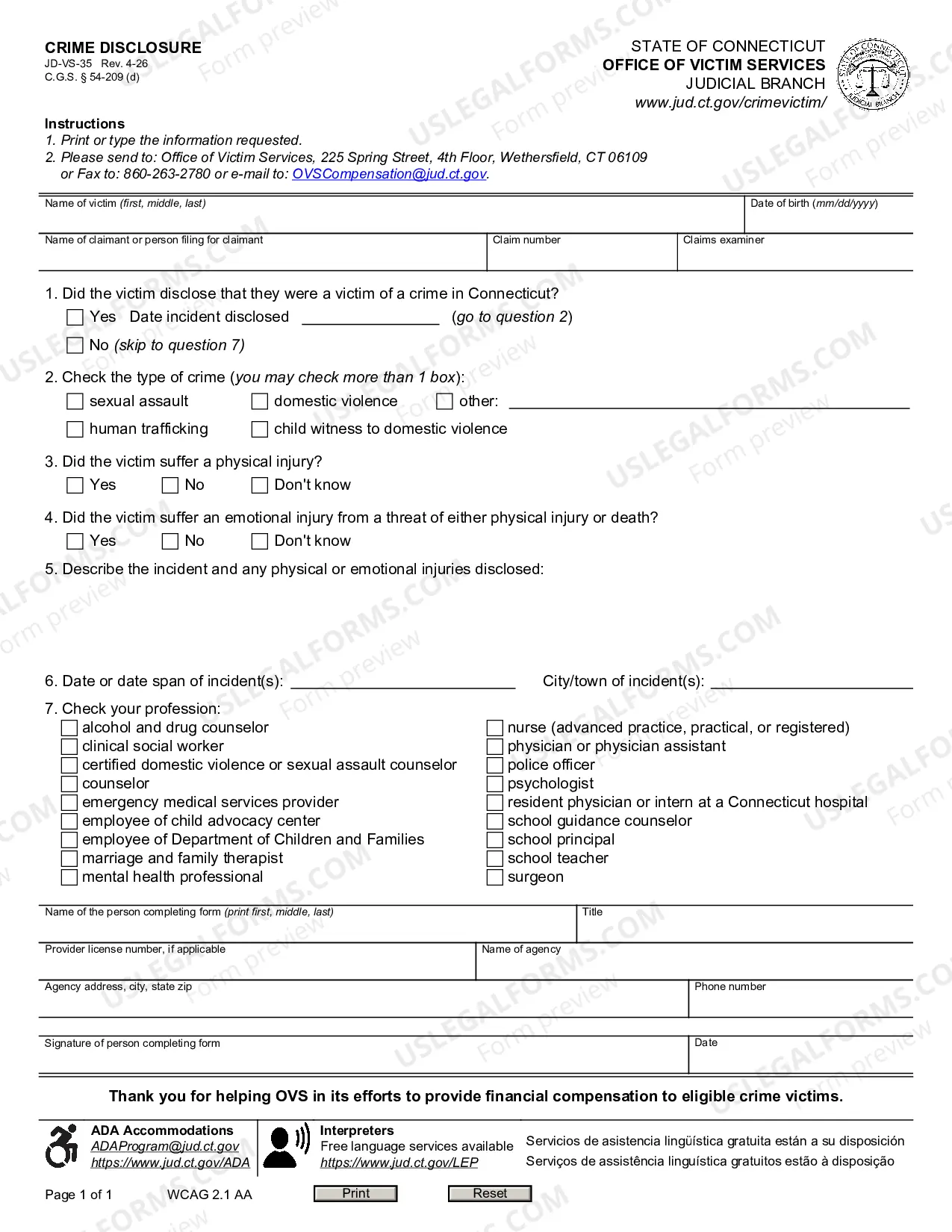
Connecticut Crime Disclosure is a public service offered by the Connecticut Department of Emergency Services and Public Protection. It provides citizens with access to incident and arrest records, as well as other information related to crime in the state. The service is divided into two categories: incident and arrest records, and crime mapping. Incident and arrest records offer citizens access to information regarding criminal offenses reported to law enforcement agencies in Connecticut. These records are searchable by the public and contain details about the date and location of the incident, the type of crime committed, and the arresting agency. Crime mapping, on the other hand, provides citizens with the ability to view crime incidents as they happen in their area. The crime mapping tool allows users to search by address, city, and zip code to view crime figures and visuals of crime incidents within a certain radius. The data displayed includes the type of crime, the location of the incident, and the date and time of the incident. Overall, Connecticut Crime Disclosure provides citizens with the ability to access incident and arrest records, as well as crime mapping information for their area.
Connecticut Crime Disclosure
Description
Get your form ready online
Our built-in tools help you complete, sign, share, and store your documents in one place.
Make edits, fill in missing information, and update formatting in US Legal Forms—just like you would in MS Word.
Download a copy, print it, send it by email, or mail it via USPS—whatever works best for your next step.
Sign and collect signatures with our SignNow integration. Send to multiple recipients, set reminders, and more. Go Premium to unlock E-Sign.
If this form requires notarization, complete it online through a secure video call—no need to meet a notary in person or wait for an appointment.
We protect your documents and personal data by following strict security and privacy standards.

Make edits, fill in missing information, and update formatting in US Legal Forms—just like you would in MS Word.

Download a copy, print it, send it by email, or mail it via USPS—whatever works best for your next step.

Sign and collect signatures with our SignNow integration. Send to multiple recipients, set reminders, and more. Go Premium to unlock E-Sign.

If this form requires notarization, complete it online through a secure video call—no need to meet a notary in person or wait for an appointment.

We protect your documents and personal data by following strict security and privacy standards.
Looking for another form?




How to fill out Connecticut Crime Disclosure?
How much duration and resources do you typically allocate for creating formal documents.
There’s a superior alternative to obtaining such forms than employing legal professionals or investing hours searching the internet for a suitable template.
Establish an account and pay for your subscription. You can complete the payment using your credit card or through PayPal – our service is entirely secure for this.
Download your Connecticut Crime Disclosure onto your device and complete it either on a printed hard copy or electronically.
- Review the document content to verify it aligns with your state legislation.
- To do this, read the document description or utilize the Preview option.
- If your legal document does not fulfill your requirements, locate another using the search bar at the top of the page.
- If you are already a member of our service, Log In and download the Connecticut Crime Disclosure.
- If not, proceed to the next steps.
- Press Buy now when you discover the suitable blank. Select the subscription plan that best meets your needs to access our library’s complete service.
Form popularity
FAQ
To retrieve court records in Connecticut, you can utilize both in-person visits and online tools. Start by accessing the Connecticut Judicial Branch’s website, where you will find case lookup services that can help you locate records. Being familiar with Connecticut Crime Disclosure will help you understand what documents are available publicly. If you encounter any challenges, USLegalForms offers straightforward assistance in accessing and completing necessary paperwork for your needs.
Connecticut is recognized as a full disclosure state, meaning it actively promotes transparency regarding criminal records. This means that many criminal records are accessible to the public, aligning with the principles of Connecticut Crime Disclosure. However, certain records may be restricted or sealed under specific circumstances. For a clearer understanding of what is available, consider consulting USLegalForms for detailed guidance.
To obtain court documents in Connecticut, you should visit the appropriate courthouse or check online resources. Accessing documents can often be done through the Connecticut Judicial Branch website, where you can find case information and request copies. Remember, understanding Connecticut Crime Disclosure is essential when evaluating these documents, as it helps you navigate what information is publicly available. USLegalForms can also simplify the process by providing necessary forms and guidance.
States with the best crime rates often include those known for community engagement and effective law enforcement strategies. States like Maine, New Hampshire, and Vermont usually top the lists for low crime incidents. If you are considering relocation or just want to stay informed, using Connecticut Crime Disclosure can provide comparisons and insights. Understanding crime rates across states helps you make better choices for yourself and your family.
The Connecticut crime rate reflects a combination of violent and property crimes occurring throughout the state. While overall rates may fluctuate, the state has made strides in crime reduction in recent years. For accurate and up-to-date information on the Connecticut crime rate, users can access the Connecticut Crime Disclosure. Appreciating this data equips citizens with the knowledge to be proactive about safety.
Connecticut is considered relatively safe, though crime rates can vary significantly by area. Many cities have implemented community programs aimed at decreasing crime. For a thorough understanding of safety in your specific location, consult the Connecticut Crime Disclosure data. This can guide your decision-making and offer peace of mind.
Connecticut sees thousands of reported crimes each year, with some years showing a gradual increase while others show a decline. The Connecticut Crime Disclosure reports can provide precise numbers and insights into these trends. Staying informed helps individuals and communities address crime effectively and enhance safety measures. For comprehensive crime data, exploring these resources is essential.
In Connecticut, Bridgeport has historically reported the highest crime rate. This is often attributed to various socio-economic factors. Residents looking for detailed crime statistics can refer to Connecticut Crime Disclosure resources for updated information. Understanding crime trends in specific areas can help you make informed decisions about safety.