Connecticut Notice to Lessor Exercising Option to Purchase
Overview of this form
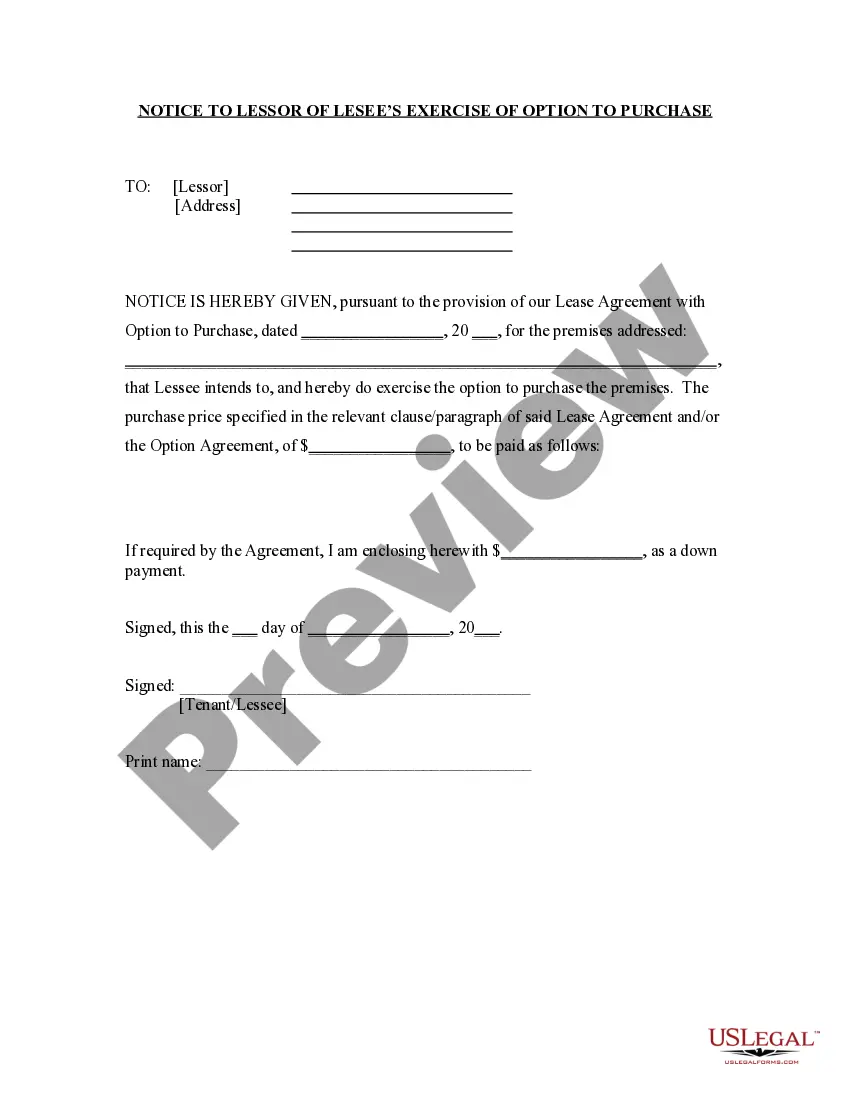
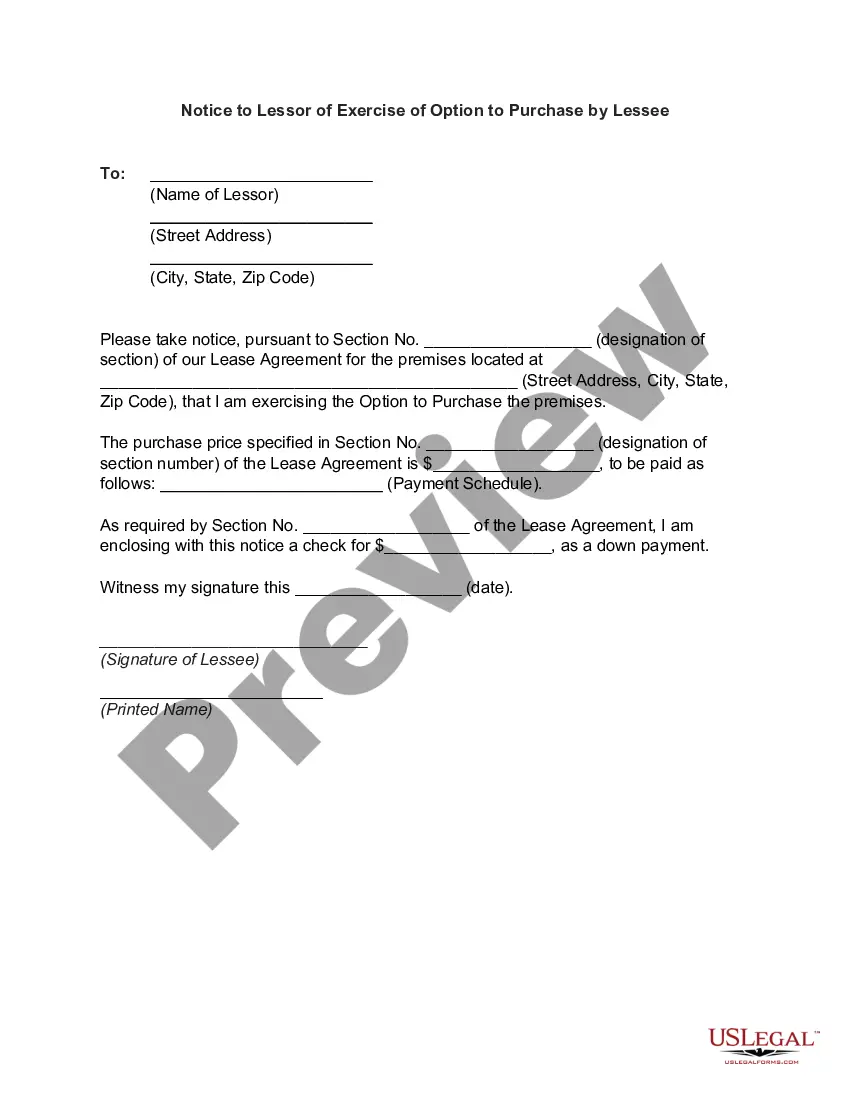
The Notice to Lessor Exercising Option to Purchase is a legal document that informs a landlord of a tenant's intention to exercise their right to purchase the property as outlined in their lease agreement. This notice acts as formal communication and ensures compliance with relevant state laws. Unlike other lease documents, this form specifically addresses the tenant's option to buy the property, which may not be explicitly covered in standard lease agreements.
What’s included in this form
- Identification of the parties involved: tenant (lessee) and landlord (lessor).
- Statement of intent by the tenant to exercise the option to purchase.
- Specific purchase price as detailed in the lease agreement.
- Instructions on how the tenant plans to pay the purchase price.

Common use cases
This form should be used when a tenant wishes to exercise an option to purchase property as stipulated in their lease agreement. It is applicable when the tenant has previously negotiated an option to buy the property and is ready to formally notify the landlord of their decision. Common situations include leases with an embedded purchase option or when a tenant intends to take ownership of a property they have been renting.
Who can use this document
- Tenants with a lease that includes an option to purchase clause.
- Landlords who need formal communication regarding a tenant's intent to buy the property.
- Real estate professionals assisting tenants or landlords in property transactions.
Instructions for completing this form
- Identify the tenant's name and address, and include the landlord's name and address.
- Clearly state the intention to exercise the option to purchase the property.
- Fill in the purchase price as specified in the lease agreement.
- Provide details on how the purchase price will be paid (e.g., lump sum, financing).
- Include the signature of the tenant/lessee to validate the notice.
Notarization requirements for this form
This form does not typically require notarization unless specified by local law. However, having it notarized can add an extra layer of authenticity and may be beneficial in legal situations.
Get your form ready online
Our built-in tools help you complete, sign, share, and store your documents in one place.
Make edits, fill in missing information, and update formatting in US Legal Forms—just like you would in MS Word.
Download a copy, print it, send it by email, or mail it via USPS—whatever works best for your next step.
Sign and collect signatures with our SignNow integration. Send to multiple recipients, set reminders, and more. Go Premium to unlock E-Sign.
If this form requires notarization, complete it online through a secure video call—no need to meet a notary in person or wait for an appointment.
We protect your documents and personal data by following strict security and privacy standards.

Make edits, fill in missing information, and update formatting in US Legal Forms—just like you would in MS Word.

Download a copy, print it, send it by email, or mail it via USPS—whatever works best for your next step.

Sign and collect signatures with our SignNow integration. Send to multiple recipients, set reminders, and more. Go Premium to unlock E-Sign.

If this form requires notarization, complete it online through a secure video call—no need to meet a notary in person or wait for an appointment.

We protect your documents and personal data by following strict security and privacy standards.
Typical mistakes to avoid
- Failing to notify the landlord within the required timeframe established in the lease.
- Not including the correct purchase price or payment details.
- Omitting necessary signatures from the tenant, which may invalidate the form.
Advantages of online completion
- Convenience of downloading and completing the form at your own pace.
- Editability allows for customization based on specific lease agreements.
- Access to attorney-drafted documents ensures legal compliance and reduces errors.
Summary of main points
- The Notice to Lessor Exercising Option to Purchase formally notifies the landlord of a tenant's intent to buy the property.
- It is essential for tenants under lease-option agreements to use this form to ensure legal compliance.
- Providing complete and accurate information is crucial to avoid disputes.
Looking for another form?


Form popularity
FAQ
In options trading, "to exercise" means to put into effect the right to buy or sell the underlying security that is specified in the options contract.If the holder of a call option exercises the contract, they will buy the underlying security at a stated price within a specific timeframe.
The option may be exercised only if funds become available within the 60-day period. In the event that sufficient funding is not available within the 60 day period, the Government waives the right to exercise the option, thereby rendering any additional requirements subject to full and open competition requirements.
Early exercise is only possible with American-style option contracts, which the holder may exercise at any time up to expiration.Most traders do not use early exercise for options they hold. Traders will take profits by selling their options and closing the trade.
Exercise notice. A broker's notification from a client who wants to exercise a right to buy or sell (depending on the type of contract) the underlying security of the option contract.
As it turns out, there are good reasons not to exercise your rights as an option owner. Instead, closing the option (selling it through an offsetting transaction) is often the best choice for an option owner who no longer wants to hold the position.
Early exercise is only possible with American-style option contracts, which the holder may exercise at any time up to expiration. With European-style option contracts, the holder may only exercise on the expiration date, making early exercise impossible. Most traders do not use early exercise for options they hold.
Exercising an option is beneficial if the underlying asset price is above the strike price of the call option on it, or the underlying asset price is below the strike price of a put option. Traders don't need to exercise the option. Exercising an option is not an obligation.
If the option is exercised, the writer of the option contract is obligated to purchase the shares from the option holder. "Exercising the option" means the buyer is opting to take advantage of the right to sell the shares at the strike price.