Connecticut Complaint (Personal Injury due to Negligence)
About this form
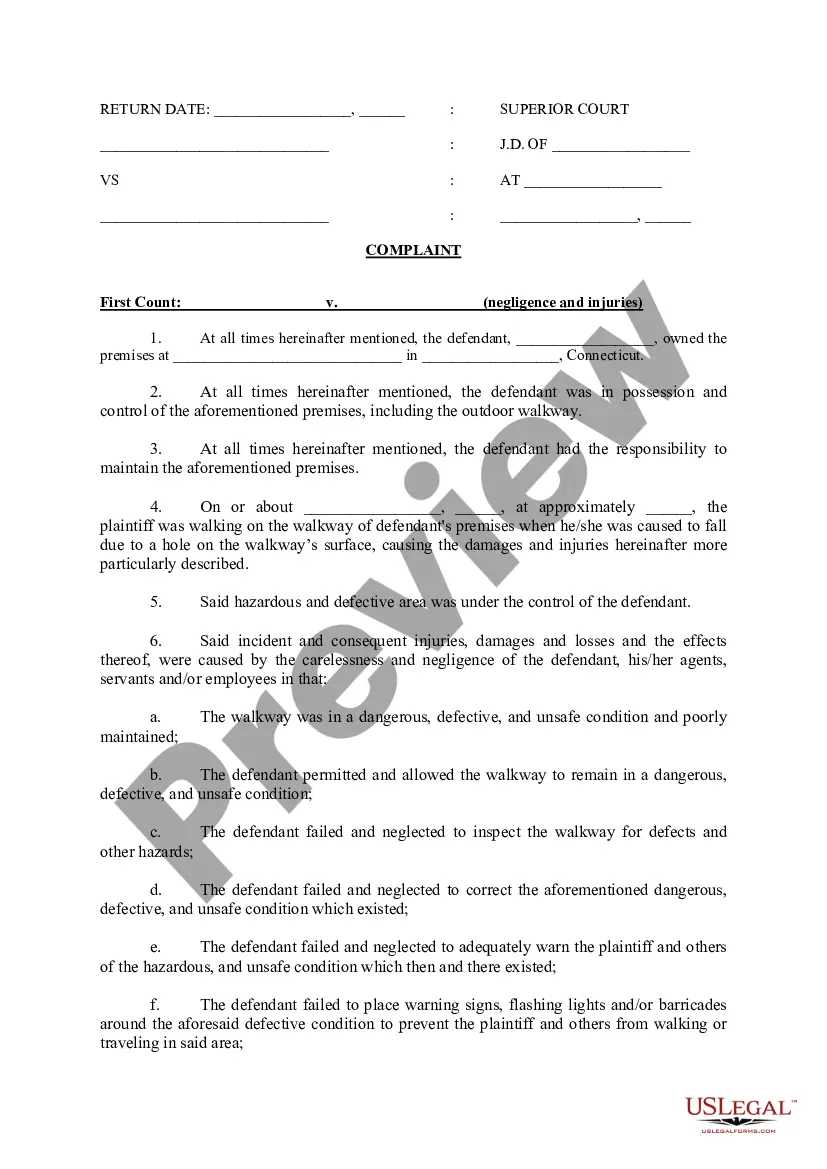
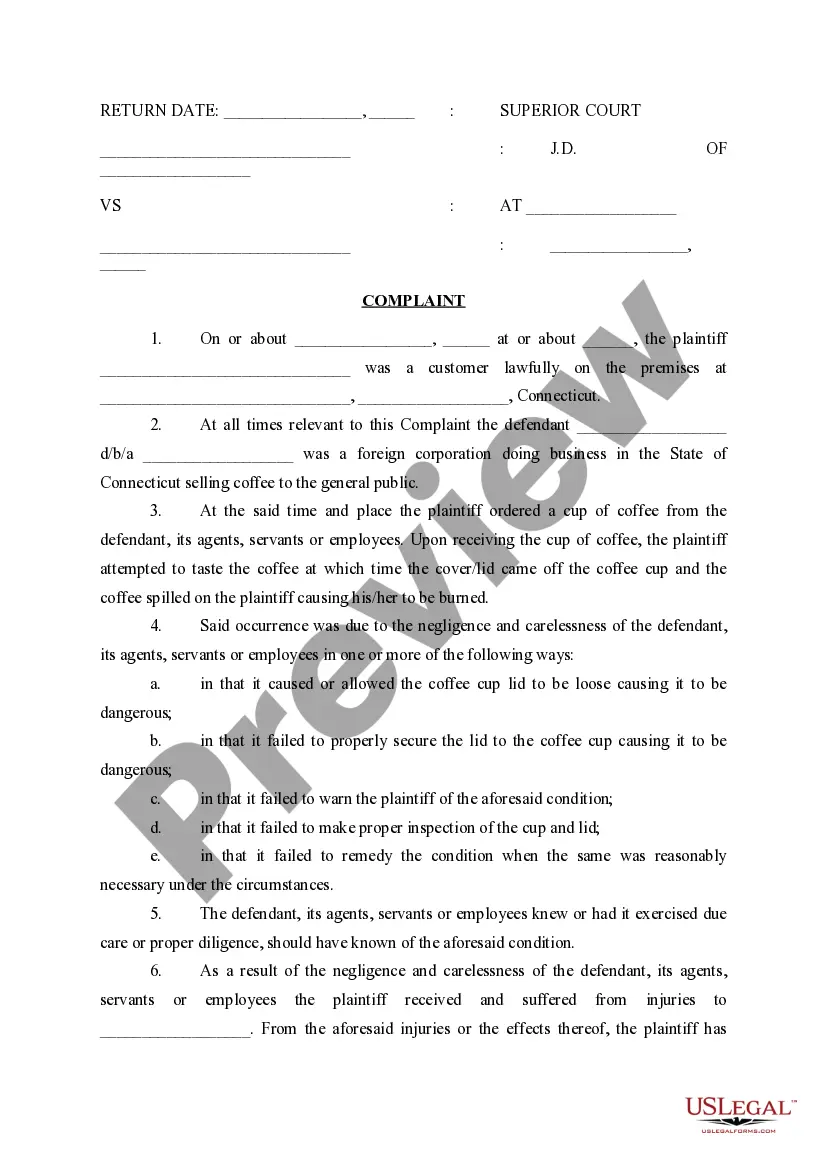
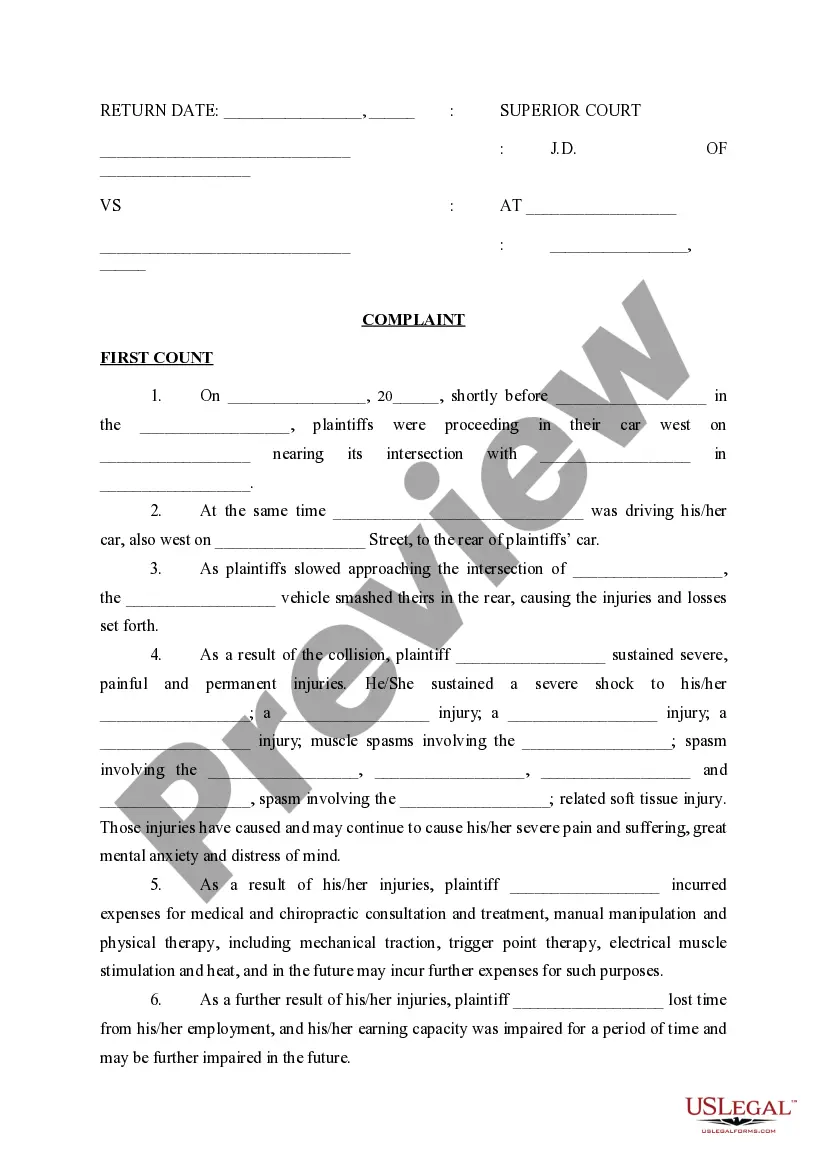
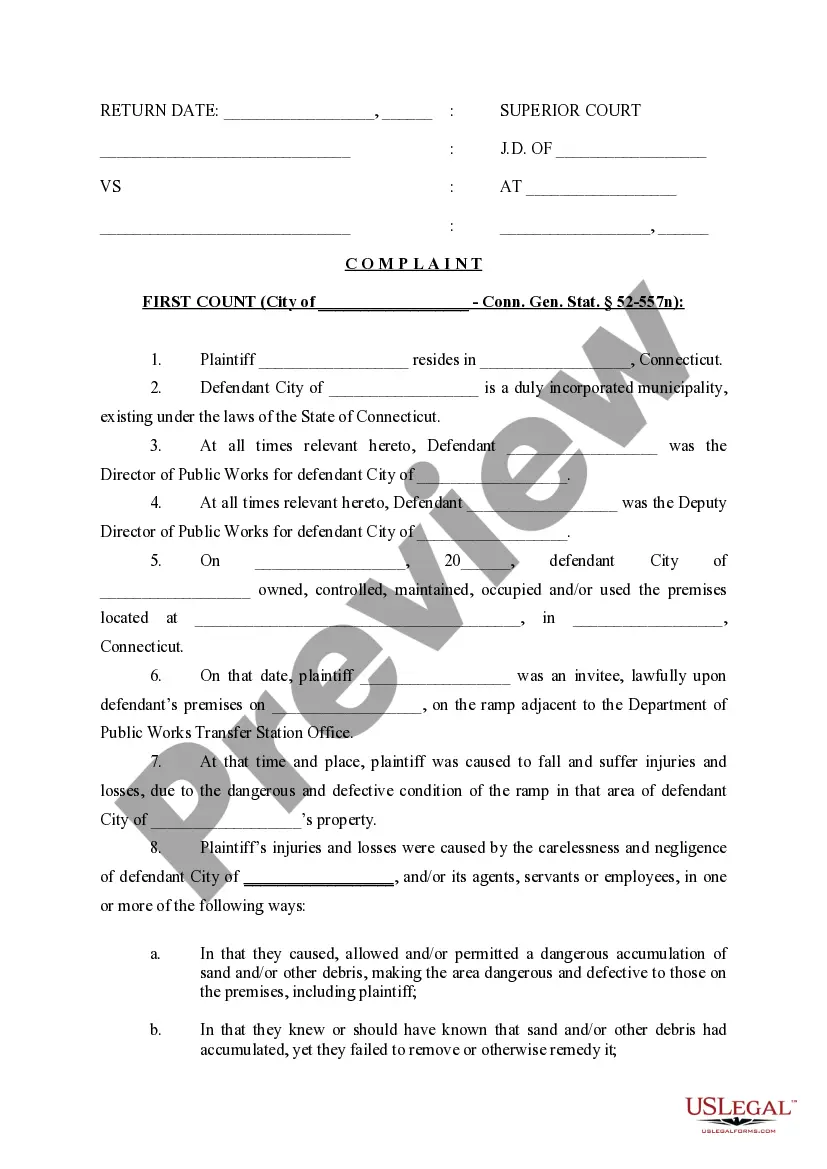
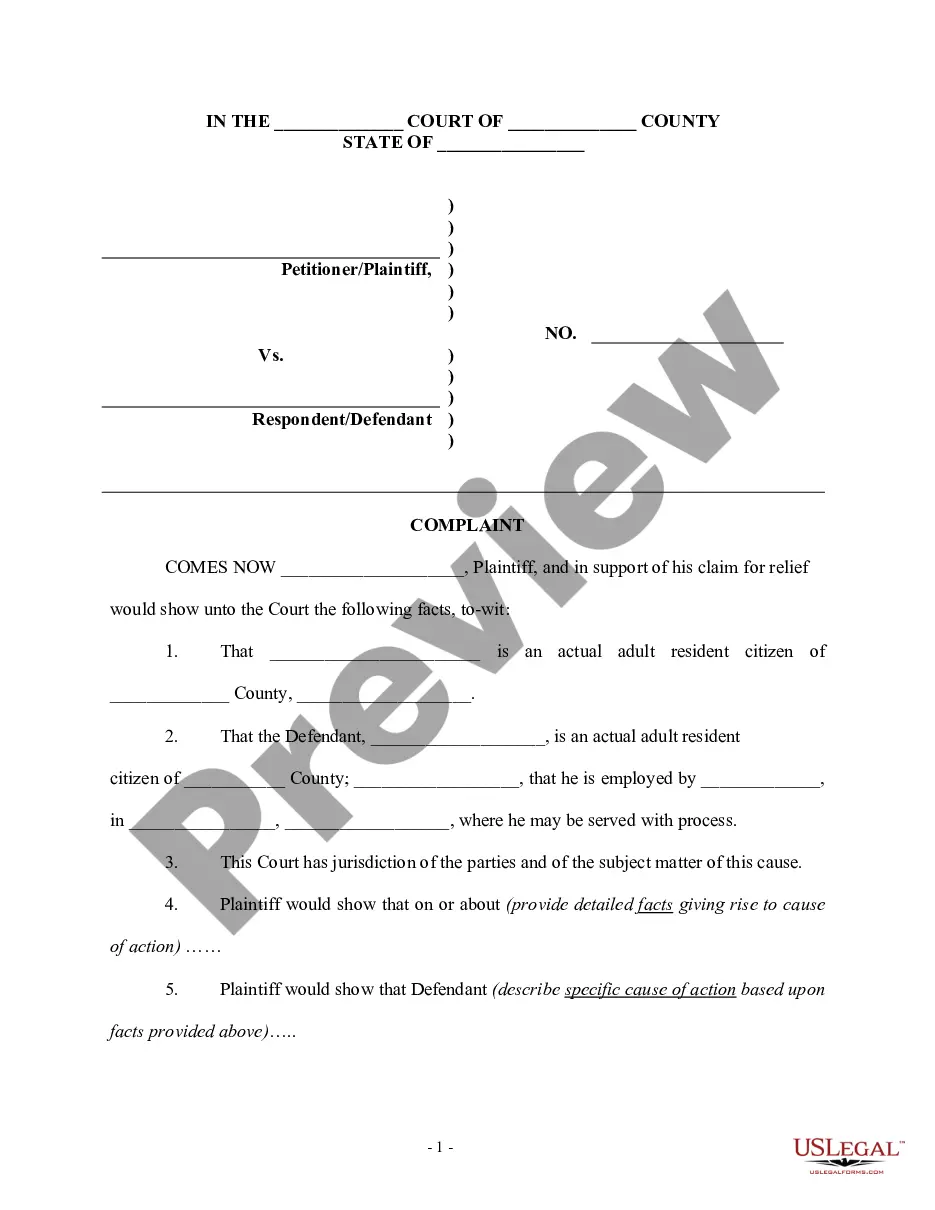
The Complaint (Personal Injury due to Negligence) is a legal document used in personal injury cases where an individual suffers injuries on another person's property due to negligence. This form serves to initiate legal proceedings, outlining the plaintiff's claims against the defendant for damages sustained. It falls under the broader category of premises liability claims, distinguishing it from other types of personal injury lawsuits.
What’s included in this form
- Identification of the parties involved, including the plaintiff and defendant.
- Details regarding the premises and the nature of the incident.
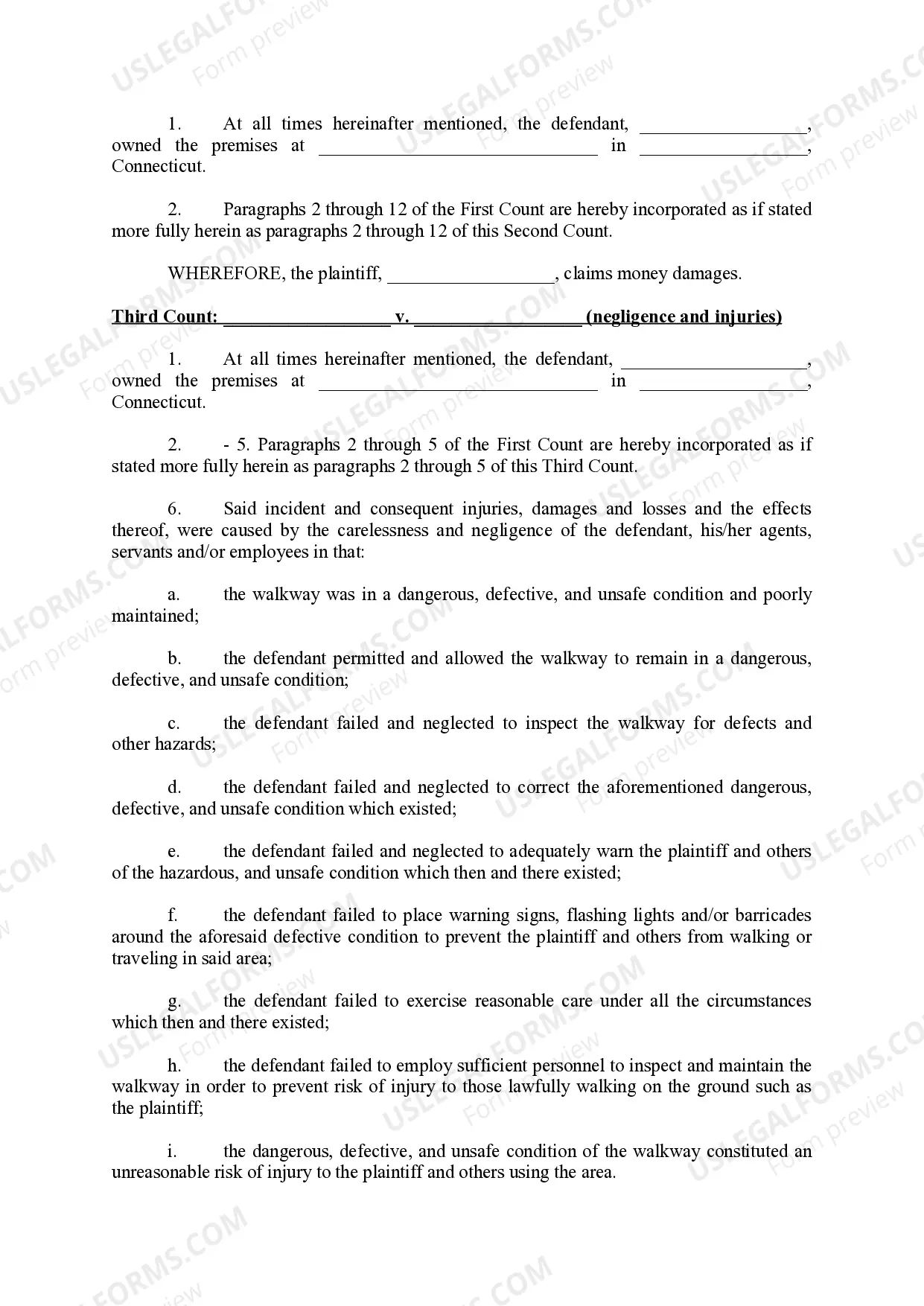
- Claims of negligence and descriptions of the hazardous conditions.
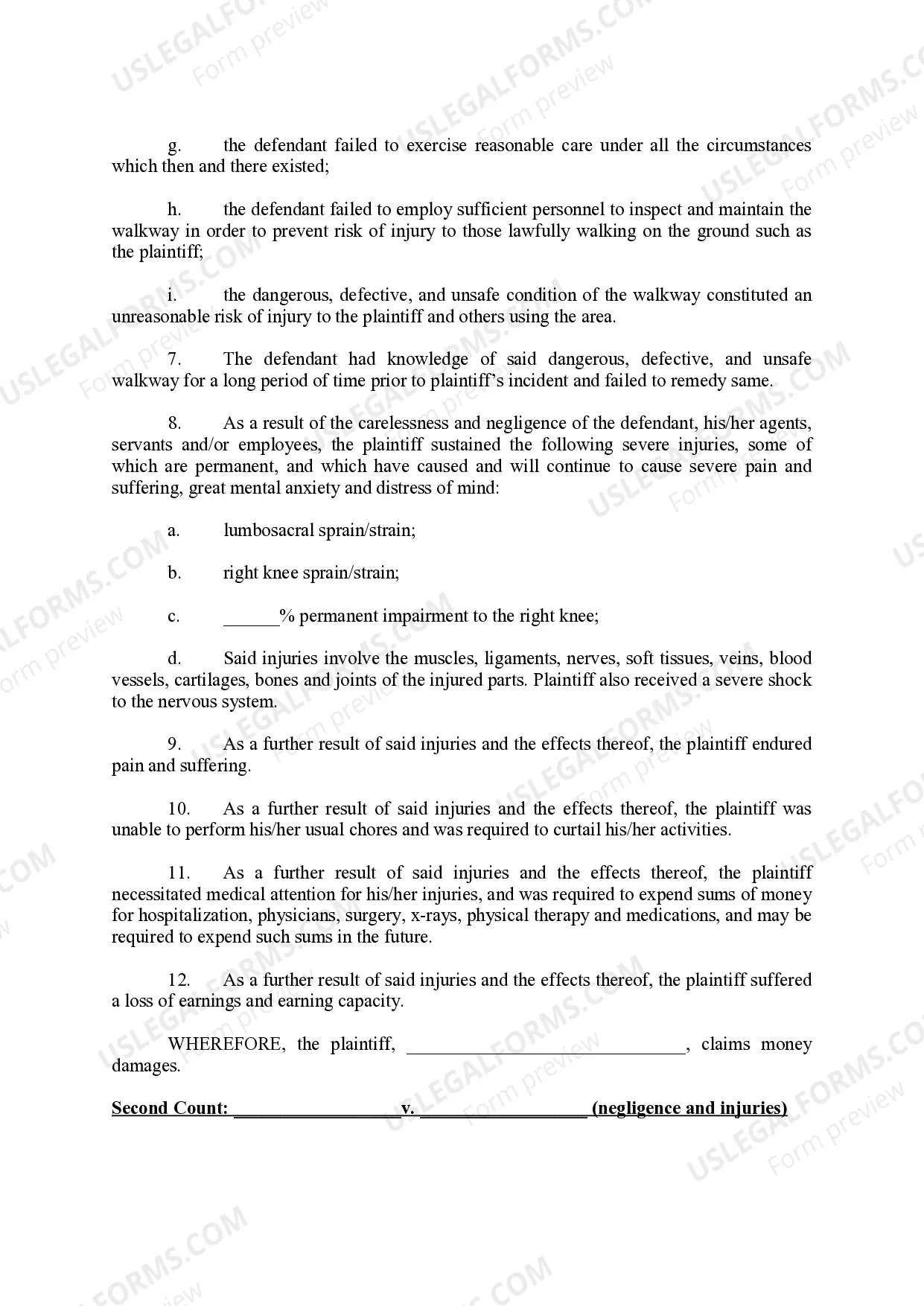
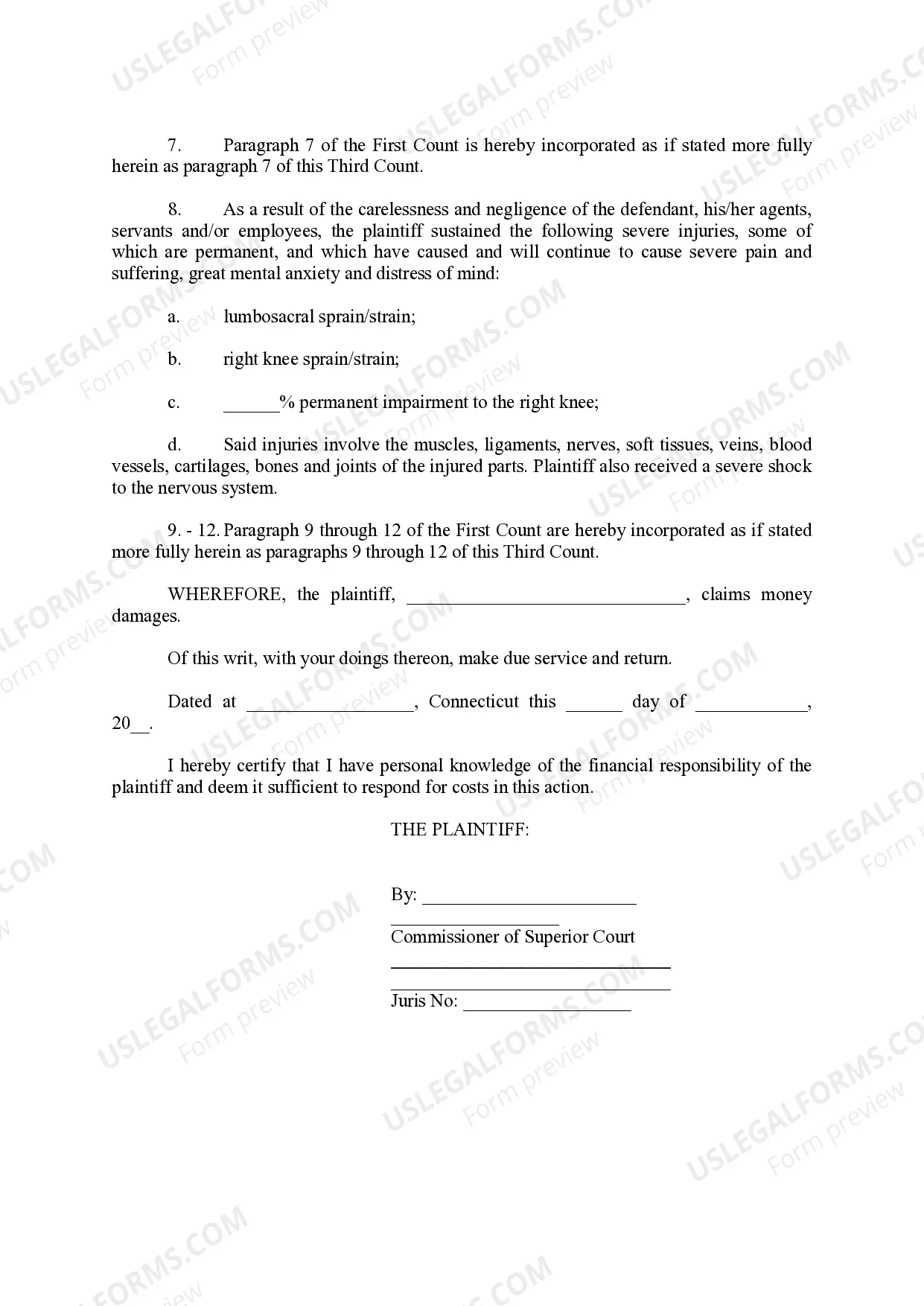
- Specification of the injuries sustained and the impact on the plaintiff's life.
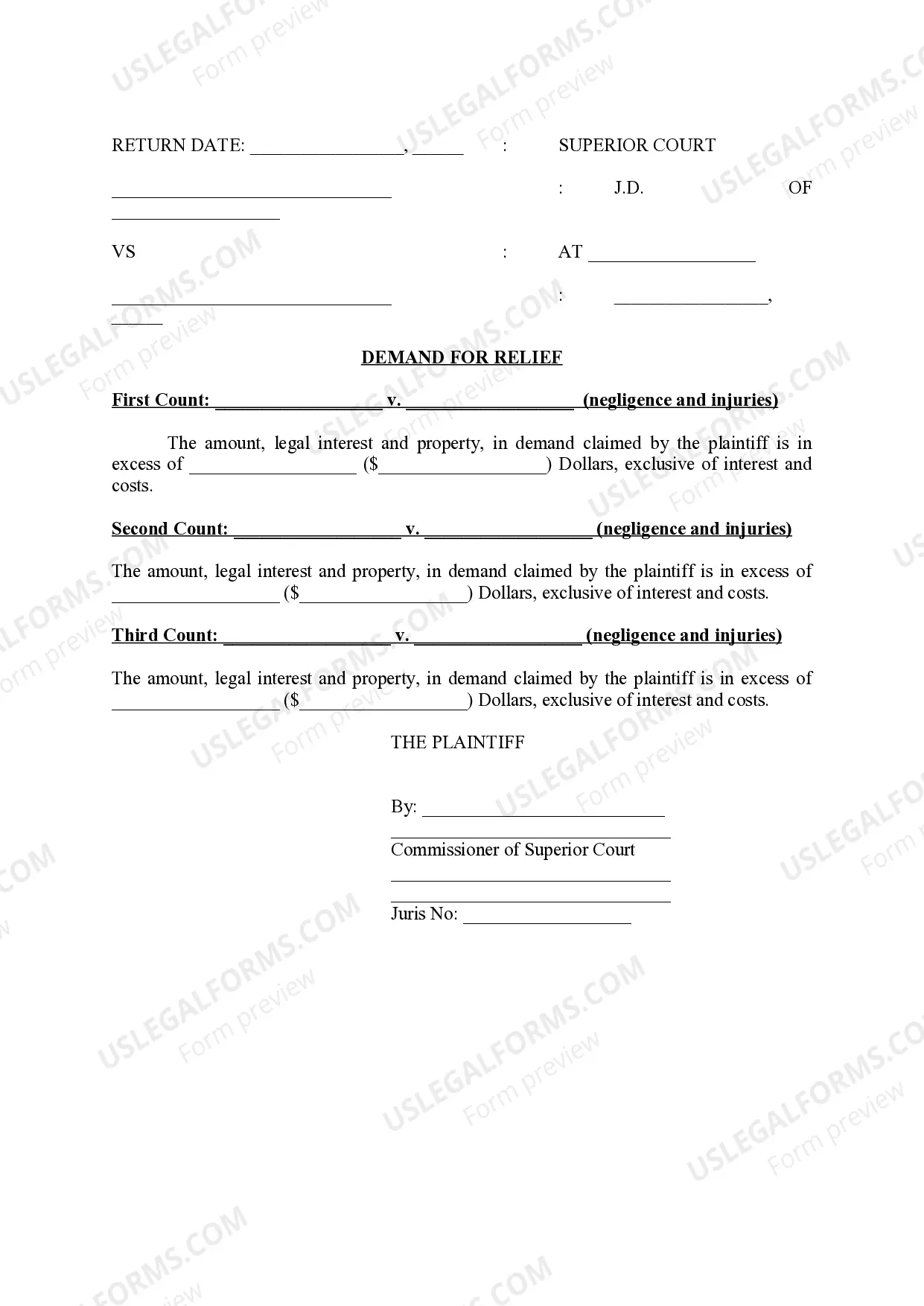
- Demand for monetary damages, including medical expenses and lost earnings.
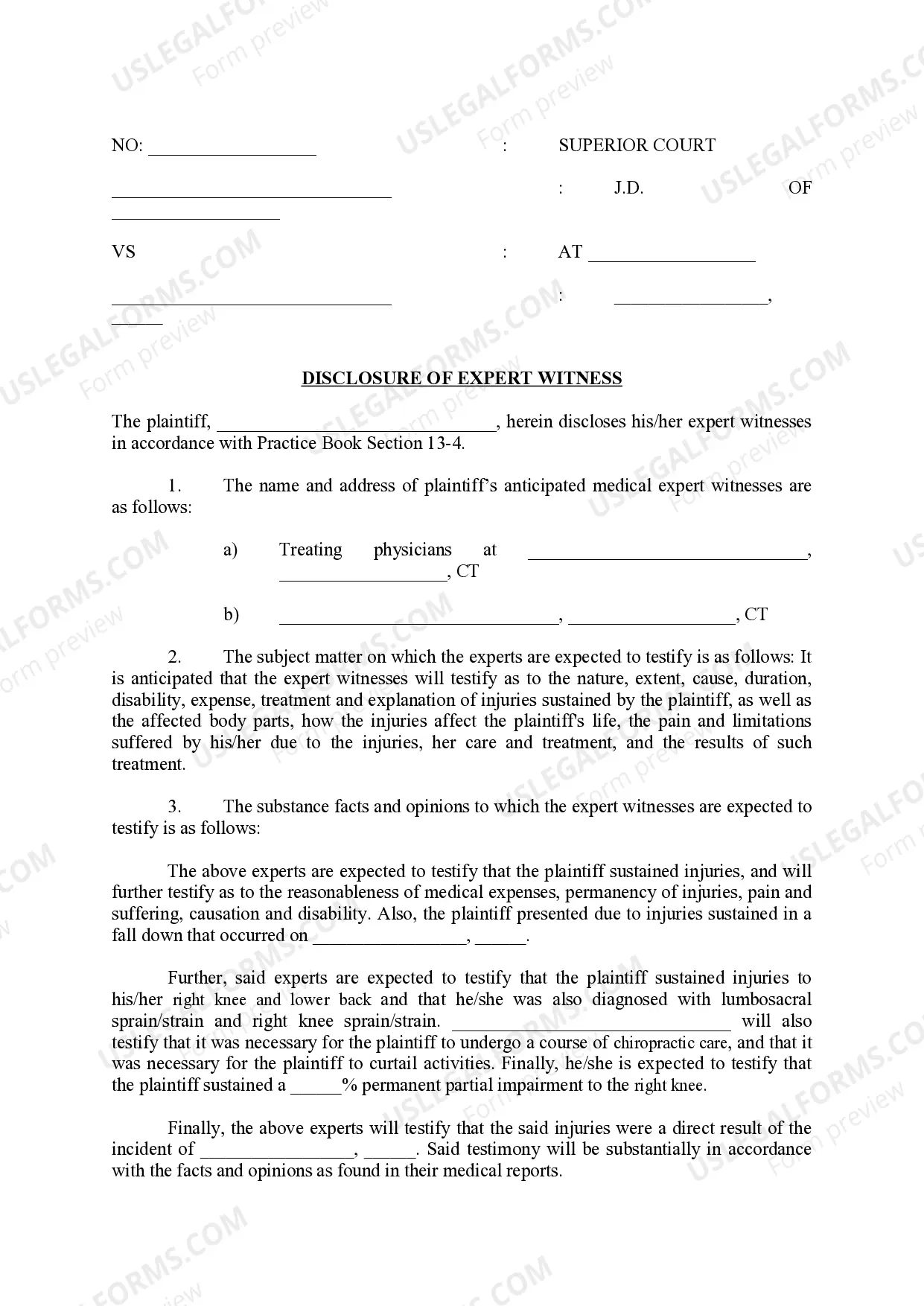
- Disclosure of expert witnesses expected to testify in the case.

When to use this document
This complaint should be used when an individual is injured while on someone elseâs property due to the property ownerâs failure to maintain safe conditions. If you have suffered an injury from a slip, trip, or fall caused by a dangerous condition such as potholes, broken walkways, or inadequate warnings about hazards, using this form will help you assert your rights and seek compensation for your injuries.
Who should use this form
- Individuals who have sustained injuries on another's property due to negligence.
- Those looking to claim damages for medical expenses and lost wages related to their injuries.
- Litigants wishing to seek legal redress for conditions that caused their injuries.
Completing this form step by step
- Identify the parties by entering the names and addresses of the plaintiff and defendant.
- Describe the incident, including the date, time, and specifics of the injuries sustained.
- Detail the negligence claims against the defendant, specifying how the unsafe condition caused the injury.
- List the injuries and damages incurred as a result of the incident, including emotional and financial impacts.
- Include information on any expert witnesses and their expected testimony related to the case.
Is notarization required?
Notarization is not commonly needed for this form. However, certain documents or local rules may make it necessary. Our notarization service, powered by Notarize, allows you to finalize it securely online anytime, day or night.
Get your form ready online
Our built-in tools help you complete, sign, share, and store your documents in one place.
Make edits, fill in missing information, and update formatting in US Legal Forms—just like you would in MS Word.
Download a copy, print it, send it by email, or mail it via USPS—whatever works best for your next step.
Sign and collect signatures with our SignNow integration. Send to multiple recipients, set reminders, and more. Go Premium to unlock E-Sign.
If this form requires notarization, complete it online through a secure video call—no need to meet a notary in person or wait for an appointment.
We protect your documents and personal data by following strict security and privacy standards.

Make edits, fill in missing information, and update formatting in US Legal Forms—just like you would in MS Word.

Download a copy, print it, send it by email, or mail it via USPS—whatever works best for your next step.

Sign and collect signatures with our SignNow integration. Send to multiple recipients, set reminders, and more. Go Premium to unlock E-Sign.

If this form requires notarization, complete it online through a secure video call—no need to meet a notary in person or wait for an appointment.

We protect your documents and personal data by following strict security and privacy standards.
Mistakes to watch out for
- Failing to provide specific details about the incident, which can weaken your case.
- Not accurately identifying the responsible parties involved.
- Overlooking the need to attach supporting documents, such as medical records or witness statements.
- Neglecting to specify the exact damages sought, potentially limiting recovery.
- Submitting the complaint without proper signatures or required notarization.
Why complete this form online
- Convenience of downloading and completing the form at your own pace.
- Ease of editing fields to accurately reflect your specific circumstances.
- Access to reliable templates drafted by licensed attorneys, ensuring legal compliance.
- Ability to save your work and return to it when ready to complete the filing process.
Looking for another form?
Form popularity
FAQ
In Connecticut, the negligence standard requires proof that the defendant failed to act with the level of care that a reasonable person would under similar circumstances. This standard focuses on how the actions or inactions of a person compare to what is expected in a given situation. When pursuing a Connecticut Complaint (Personal Injury due to Negligence), it is important to clearly illustrate how the defendant's behavior fell short of this standard. Seeking assistance from platforms like UsLegalForms can help you navigate these legal requirements effectively.
The three core requirements for negligence consist of duty, breach, and damages. You need to establish that the defendant owed you a duty of care, then show that they breached that duty through their actions. Finally, it is vital to demonstrate that this breach resulted in actual harm or damages. When filing a Connecticut Complaint (Personal Injury due to Negligence), understanding these requirements is essential in presenting an effective case.
The four rules of negligence include duty, breach, causation, and harm. Firstly, you must establish that the defendant had a legal duty to act in a certain way. Secondly, you need to prove that they breached that duty. Thirdly, connect this breach to the harm caused, showing that the breach directly resulted in injuries. Finally, the claimant must have suffered damages, which can be physical, emotional, or financial, reinforcing the importance of the Connecticut Complaint (Personal Injury due to Negligence) in protecting your rights.
Proving contributory negligence involves showing that the injured party also acted in a way that contributed to their own injury. In a Connecticut Complaint (Personal Injury due to Negligence), this means demonstrating that the plaintiff's own actions played a role in the accident. For example, if the victim ignored safety warnings and was partly responsible for the incident, this can affect the outcome of the case. Understanding these intricacies is crucial for building a strong case.
To prove negligence in a Connecticut Complaint (Personal Injury due to Negligence), you must establish four key elements: duty, breach, causation, and damages. First, show that the defendant owed a duty of care to the victim. Next, demonstrate how the defendant breached that duty, leading to your injuries. Finally, you need to prove that the breach directly caused your damages, including any medical expenses and pain suffered.
In a personal injury lawsuit, you must establish that the defendant owed you a duty of care and subsequently breached that duty, leading to your injury. To do this, present clear evidence that they acted irresponsibly or failed to take necessary precautions. This evidence is crucial to supporting your Connecticut Complaint (Personal Injury due to Negligence). US Legal Forms can help you prepare the essential documentation to present your case clearly and effectively.
To file a claim for negligence in Connecticut, you must first gather relevant evidence to support your case. Start by documenting the incident, collecting witness statements, and obtaining medical records, if applicable. Once you have this information, you can complete a Connecticut Complaint (Personal Injury due to Negligence) form, which outlines the details of your claim. Utilizing platforms like US Legal Forms can simplify this process, providing you with the necessary forms and guidance to file effectively.
In Connecticut, the statute of limitations for filing a negligence claim is generally two years from the date of the incident. This time frame is critical because, after two years, you may lose your right to seek compensation. To ensure you meet all deadlines, consider using US Legal Forms to help you file your Connecticut Complaint (Personal Injury due to Negligence) promptly and accurately.
The four elements of a negligence claim include duty, breach, causation, and damages. First, the defendant must have a duty to act responsibly. Second, they must breach that duty through negligent actions. Third, their breach must cause your injury, leading to the fourth element, which is the damages you have incurred. Understanding these elements is crucial when preparing your Connecticut Complaint (Personal Injury due to Negligence), and US Legal Forms can provide the necessary guidance.
An example of a negligence claim might involve a car accident where one driver fails to stop at a red light, resulting in another driver being injured. In this case, the at-fault driver’s failure to heed traffic signals shows negligence. Once you understand your situation better, you can craft your Connecticut Complaint (Personal Injury due to Negligence) with help from resources like US Legal Forms.