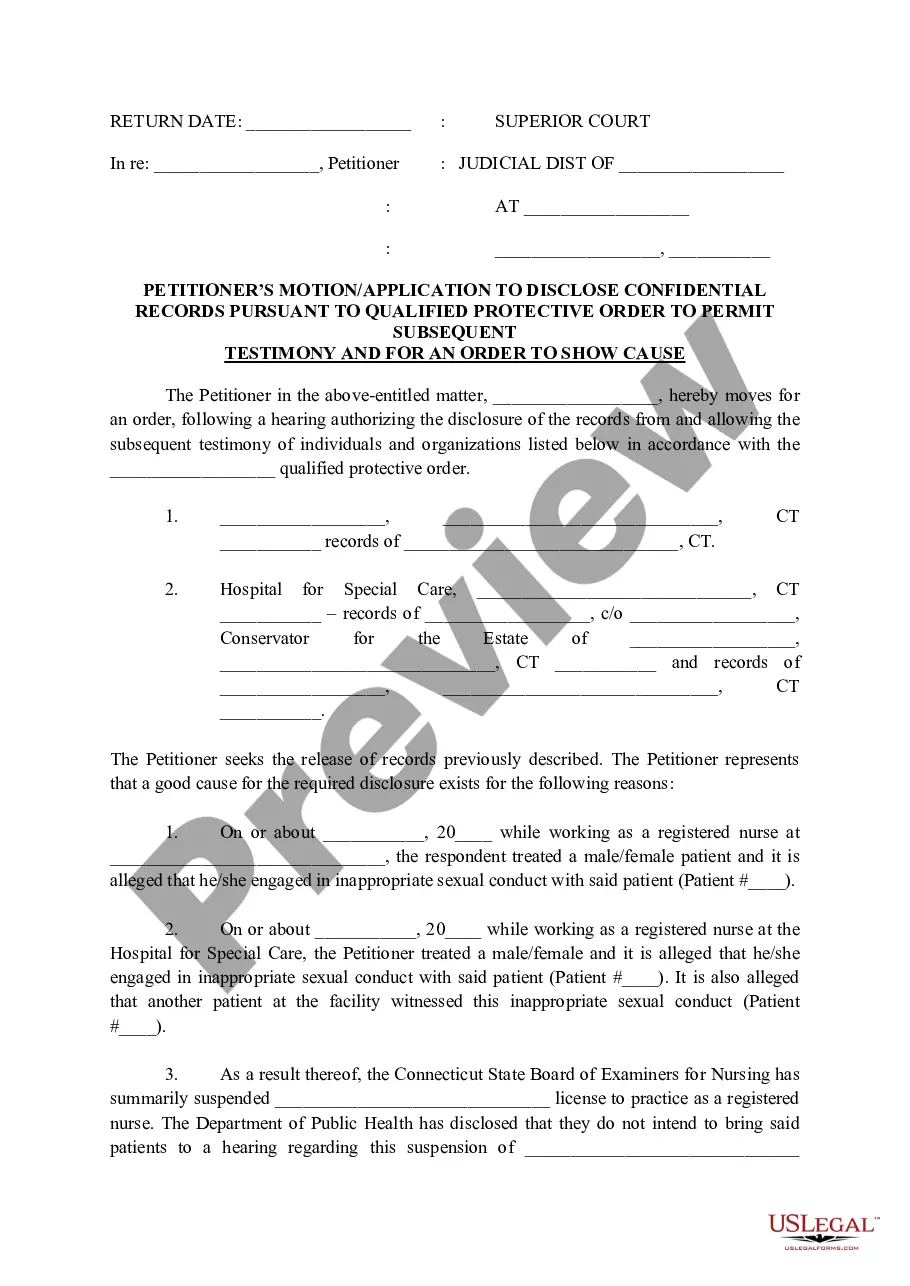
Connecticut Petitioner's Motion/Application to Disclose Confidential Records Pursuant to Qualified Protective Order to Permit Subsequent Testimony and for an Order to Show Cause
Overview of this form
This form, known as the Petitioner's Motion/Application to Disclose Confidential Records, serves as a legal request for the release of personally identifiable confidential information. It is essential when such information needs to be disclosed either with the informed consent of the individual involved or by virtue of specific exceptions to the consent requirement. This form is a critical tool in legal proceedings to ensure that relevant records can be used appropriately, particularly in cases involving allegations of misconduct, while safeguarding the privacy of the individuals involved.
What’s included in this form
- Return date for the court hearing.
- Identification of the petitioner and relevant judicial district.
- Details about the specific confidential records being requested.
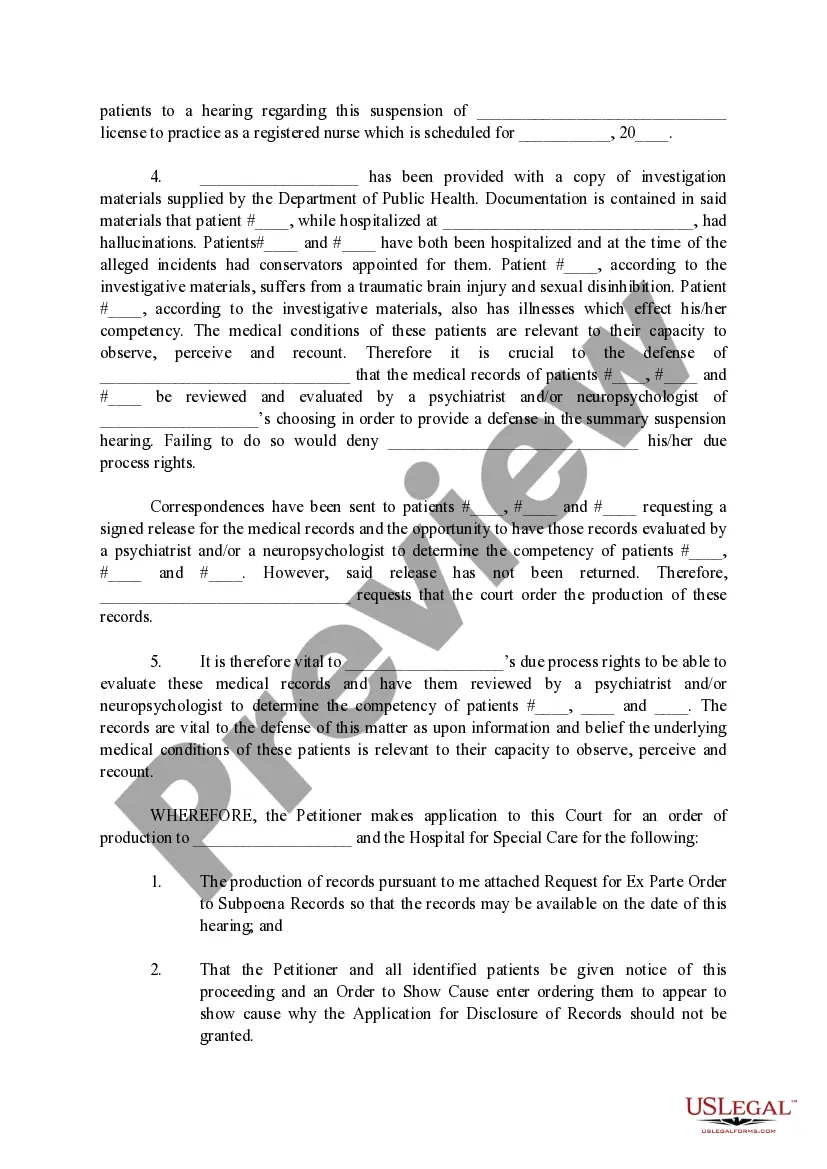
- Arguments justifying the need for disclosure based on good cause.
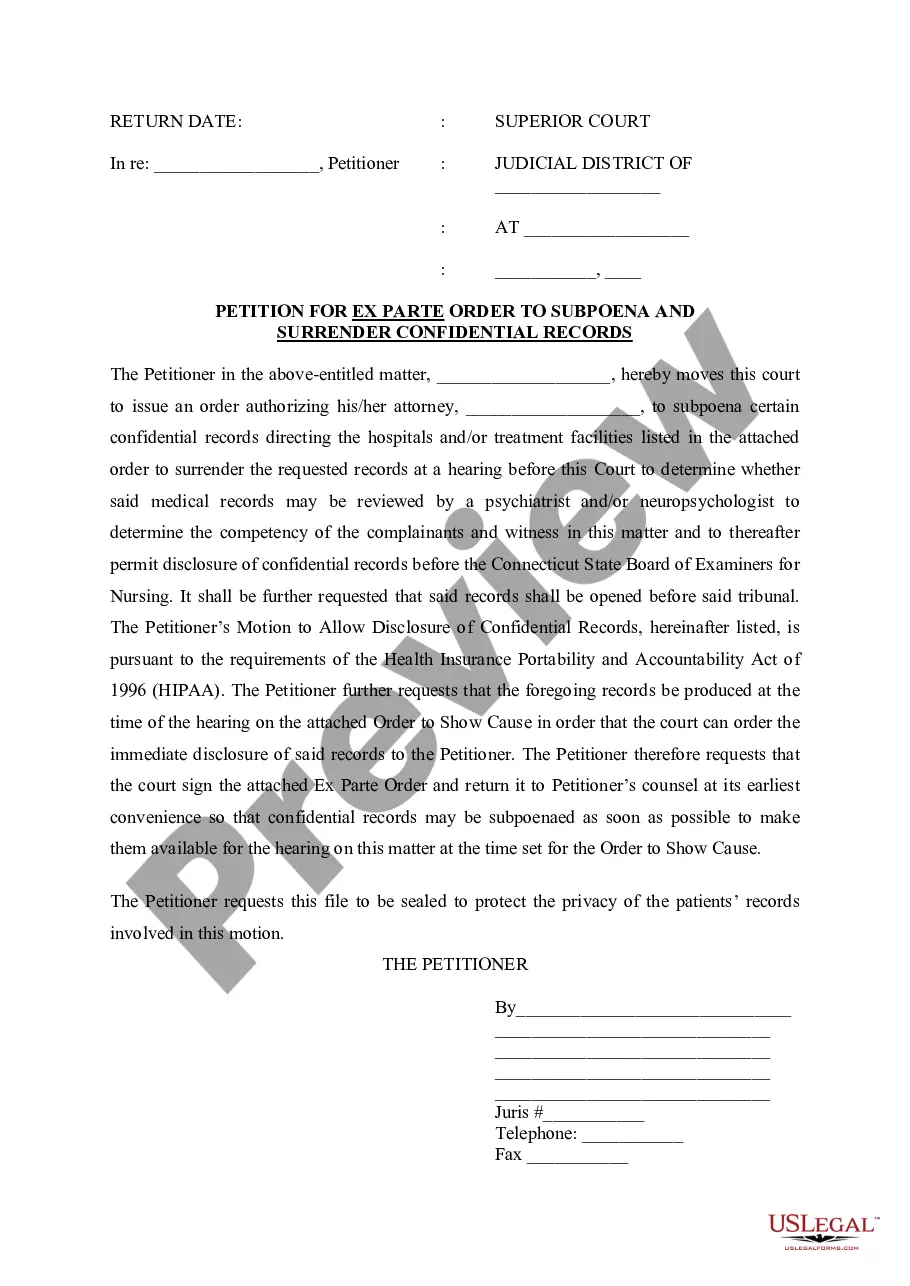
- Request for an order to produce records and notify involved parties.

When this form is needed
This form should be used when there is a need to access confidential medical or personal records as part of a legal defense or proceeding. It is particularly applicable in situations where allegations of misconduct are present, and the medical records of individuals involved may provide critical information related to their competency or ability to testify. This may arise in cases involving professional licensing, negligence claims, or any legal action where understanding the context of prior incidents is necessary for due process.
Intended users of this form
- Petitioners involved in legal proceedings requiring access to confidential records.
- Attorneys representing clients in cases involving allegations of misconduct.
- Guardians or conservators seeking records for individuals unable to consent.
- Healthcare professionals under investigation needing to disclosure records for their defense.
Steps to complete this form
- Enter the return date and identify the judicial district where the case is heard.
- Fill in the name of the petitioner and provide detailed information on the records being requested.
- Articulate the good cause for the disclosure, including any relevant background information related to the allegations.
- Request specific orders concerning the production of records and notices to be sent to involved parties.
- Sign the form and provide contact information for the petitioner or attorney representing the case.
Does this form need to be notarized?
This form does not typically require notarization unless specified by local law. Ensure all signatures are valid, and verify with your jurisdiction for any specific requirements.
Get your form ready online
Our built-in tools help you complete, sign, share, and store your documents in one place.
Make edits, fill in missing information, and update formatting in US Legal Forms—just like you would in MS Word.
Download a copy, print it, send it by email, or mail it via USPS—whatever works best for your next step.
Sign and collect signatures with our SignNow integration. Send to multiple recipients, set reminders, and more. Go Premium to unlock E-Sign.
If this form requires notarization, complete it online through a secure video call—no need to meet a notary in person or wait for an appointment.
We protect your documents and personal data by following strict security and privacy standards.

Make edits, fill in missing information, and update formatting in US Legal Forms—just like you would in MS Word.

Download a copy, print it, send it by email, or mail it via USPS—whatever works best for your next step.

Sign and collect signatures with our SignNow integration. Send to multiple recipients, set reminders, and more. Go Premium to unlock E-Sign.

If this form requires notarization, complete it online through a secure video call—no need to meet a notary in person or wait for an appointment.

We protect your documents and personal data by following strict security and privacy standards.
Mistakes to watch out for
- Failing to provide a clear justification for the requested disclosure.
- Missing signatures or contact information which could delay proceedings.
- Not specifying all parties that should receive copies of the order.
- Overlooking deadlines related to court submissions.
Advantages of online completion
- Convenience of downloading and completing the form from anywhere.
- Editable templates allowing for customized information input.
- Access to forms drafted by licensed attorneys, ensuring compliance with legal standards.
- Instant access to updates or revisions in legal form requirements.
Legal use & context
- This Motion/Application serves a crucial role in legal defense by allowing for the examination of medical records relevant to a case.
- Understanding statutory limitations and confidentiality laws is essential when requesting such disclosures.
- Proper completion and submission of this form can significantly impact legal proceedings and protect due process rights.
Key takeaways
- The form is critical for accessing confidential records in legal scenarios.
- Justification for disclosure must be clearly articulated.
- Ensure all required signatures and details are included to avoid delays.
- This form is aligned with Connecticut's legal processes; verify local requirements if used in other jurisdictions.
Looking for another form?



Form popularity
FAQ
A motion for protective order refers to a party's request that the court protect it from potentially abusive action by the other party. Such a request is often made in relation to discovery, as when one party seeks discovery of the other party's trade secrets.
What happens if someone applies for a restraining order against me? An AVO is not a criminal charge. It will not appear on your criminal record.
What is a Protective Order or Confidentiality Agreement? The primary purpose of a protective order or confidentiality agreement is to designate procedures agreed upon by all parties to facilitate the protection of confidential and/or privileged information.
The use of privileged information is not only inadmissible at trial it is not even discoverable.Information that is merely confidential, however, must be turned over in response to a discovery request and can be introduced in court as evidence.
In civil litigation, an order that prevents the disclosure of certain information. A party or person, such as a non-party recipient of a subpoena, may move for a protective order by showing good cause that the court should not permit the requested discovery because the discovery request is: Annoying.
A party or non-party may designate information disclosed during a deposition or in response to written discovery as Confidential by so indicating in said responses or on the record at the deposition and requesting the preparation of a separate transcript of such material.
It is confidential. It is used so that your restraining order can be entered into a statewide computer system that lets the police know about your order.
Parties also may agree to enter into a protective order (also referred to as a confidentiality order) to keep confidential information protected from disclosure outside of the case. The parties may agree to provisions:For designating discovery material confidential after a party inadvertently produces it.