Colorado Employee Vacation Request
Description

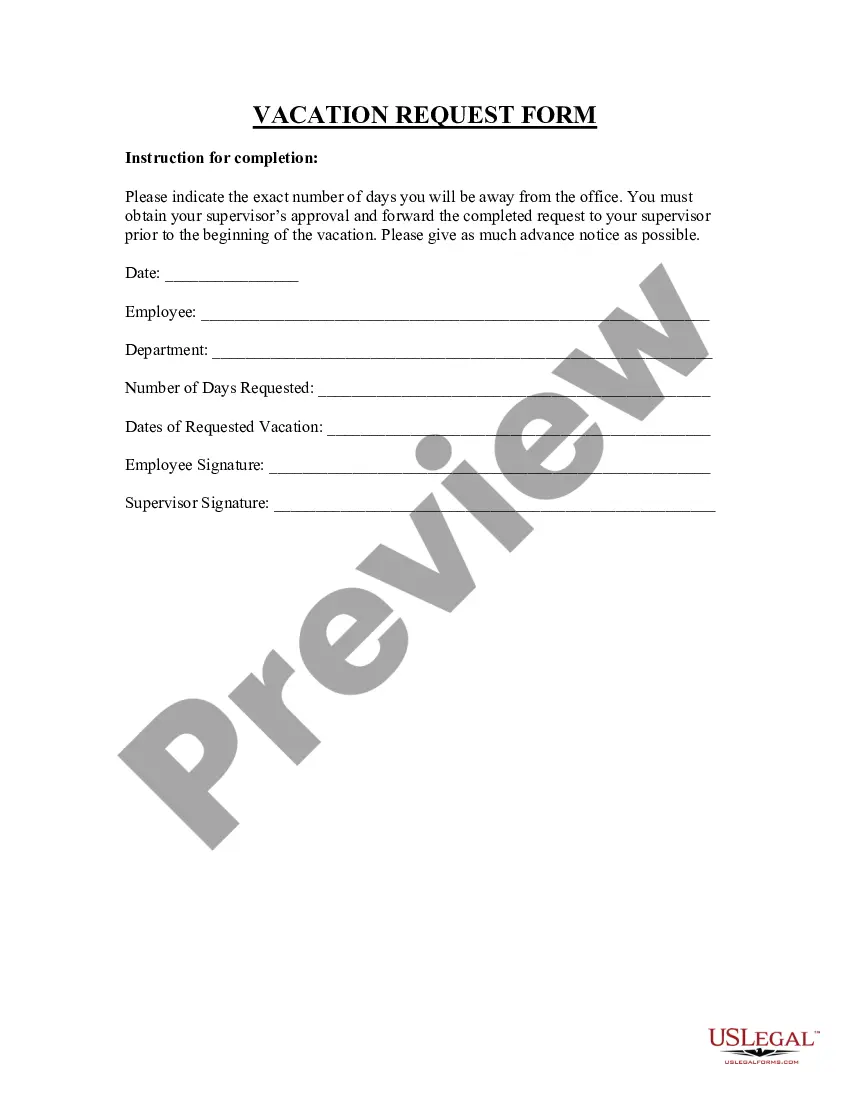
Get your form ready online
Our built-in tools help you complete, sign, share, and store your documents in one place.
Make edits, fill in missing information, and update formatting in US Legal Forms—just like you would in MS Word.
Download a copy, print it, send it by email, or mail it via USPS—whatever works best for your next step.
Sign and collect signatures with our SignNow integration. Send to multiple recipients, set reminders, and more. Go Premium to unlock E-Sign.
If this form requires notarization, complete it online through a secure video call—no need to meet a notary in person or wait for an appointment.
We protect your documents and personal data by following strict security and privacy standards.

Make edits, fill in missing information, and update formatting in US Legal Forms—just like you would in MS Word.

Download a copy, print it, send it by email, or mail it via USPS—whatever works best for your next step.

Sign and collect signatures with our SignNow integration. Send to multiple recipients, set reminders, and more. Go Premium to unlock E-Sign.

If this form requires notarization, complete it online through a secure video call—no need to meet a notary in person or wait for an appointment.

We protect your documents and personal data by following strict security and privacy standards.
Looking for another form?


How to fill out Employee Vacation Request?
Have you ever found yourself in a situation where you need documents for both business or personal purposes almost every day.
There are numerous legal document templates available online, but finding reliable ones isn’t easy.
US Legal Forms offers a vast collection of form templates, such as the Colorado Employee Vacation Request, which are designed to meet state and federal standards.
Once you find the correct form, click Download now.
Choose the pricing plan you prefer, fill in the necessary information to create your account, and pay for the transaction using either PayPal or a credit card.
- If you are already familiar with the US Legal Forms website and have an account, simply Log In.
- Then, you can download the Colorado Employee Vacation Request template.
- If you do not have an account and want to start using US Legal Forms, follow these steps.
- Find the form you need and ensure it is for the correct city/region.
- Use the Review option to scrutinize the form.
- Check the description to confirm you have selected the right form.
- If the form isn’t what you’re looking for, utilize the Search field to locate the form that meets your needs.
Form popularity
FAQ
If you are requesting time off covered by FMLA or CFRA, the employer cannot legally deny your request for time off. However, if you request sick time, vacation time, or PTO, the employer can legally deny your request for time off. Having your vacation time or PTO request denied can be frustrating.
§ 8-4-101(14)(a)(III), already defines wages and compensation to include vacation pay, the combined effect of the statute, the Nieto decision, and the new Wage Protection Rules is that any policy or agreement providing for the forfeiture of accrued PTO is illegal in Colorado.
If an employer provides paid vacation for an employee, the employer shall pay upon separation from employment all vacation pay earned and determinable in accordance with the terms of any agreement between the employer and the employee.
Unused Vacation Pay in ColoradoState law in Colorado does not require employers to provide vacation pay. However, justices held that if employers decide to provide vacation pay, accrued time cannot be forfeited once it has been earned. Which means all earned vacation time must be paid out to employees upon separation.
Employers may restrict or even dictate how and when employees may take their vacation days. Employers may require their workers to use their accrued vacation time for any absence. In some industries, forced vacation during slow business periods is standard practice.
Law and Policy Group Colorado high court bans use-it-or-lose-it vacation policies. Colorado employers that provide vacation cannot include a forfeiture provision in the policy, the state supreme court has ruled.
The essential difference between the two is that PTO covers any paid time away from work where the employee is not working; in contrast, vacation time refers to paid time off that's taken for the employee to take a break with or without their family. It's generally requested (and approved) in advance.
Determine the need. A manager may request an employee take leave for many reasons.Consult with Human Resources.Arrange a meeting with the employee to determine his reasons for not taking leave.Explain the need for leave.Include a mandated leave policy in your employee handbook.
Under PTO policies, employees generally are not required to specify which type of time off they are using. Unlike vacation, pay for absences due to illness does not fall under Colorado's definition of wages, and there is no obligation to pay out unused paid sick time under the HFWA.
In general, yes, employers may require the use of vacation/paid time off (PTO) and restrict its use. When there are no legal requirements, such as state and local paid sick leave laws, restrictions on the amount of notice required and the increments in which PTO may be used, are common.