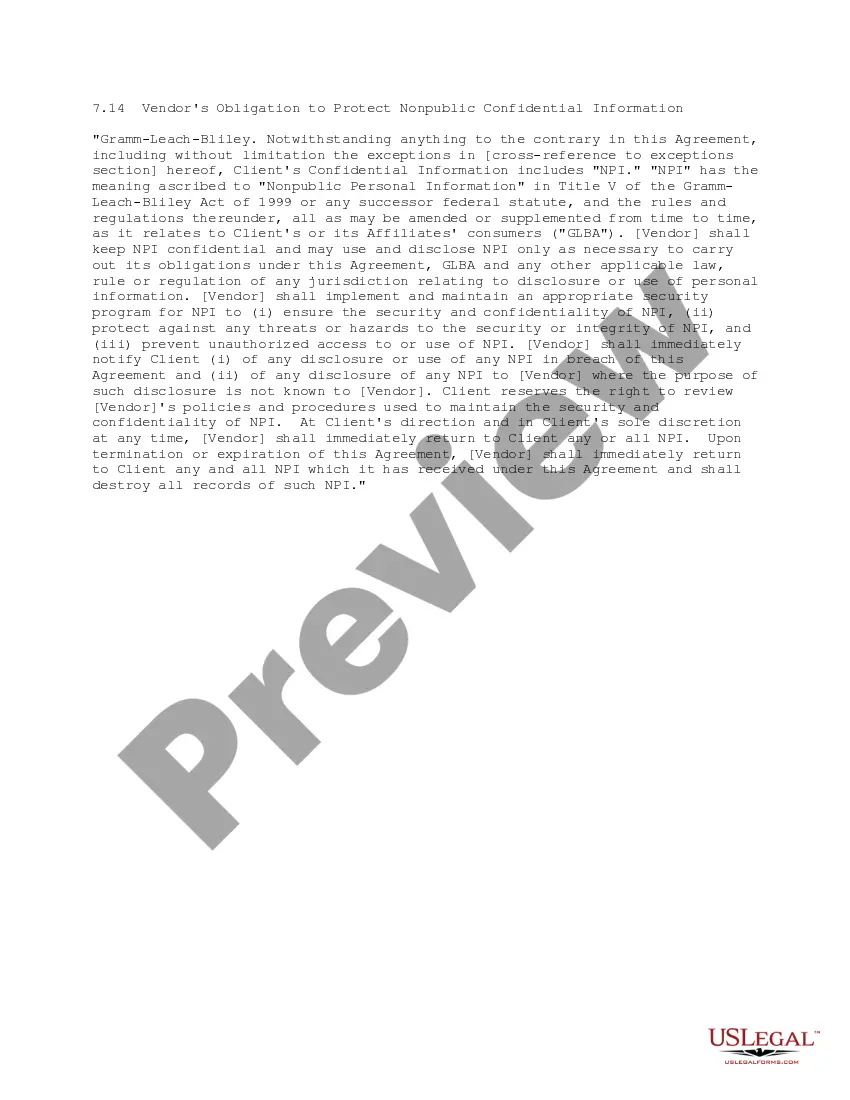
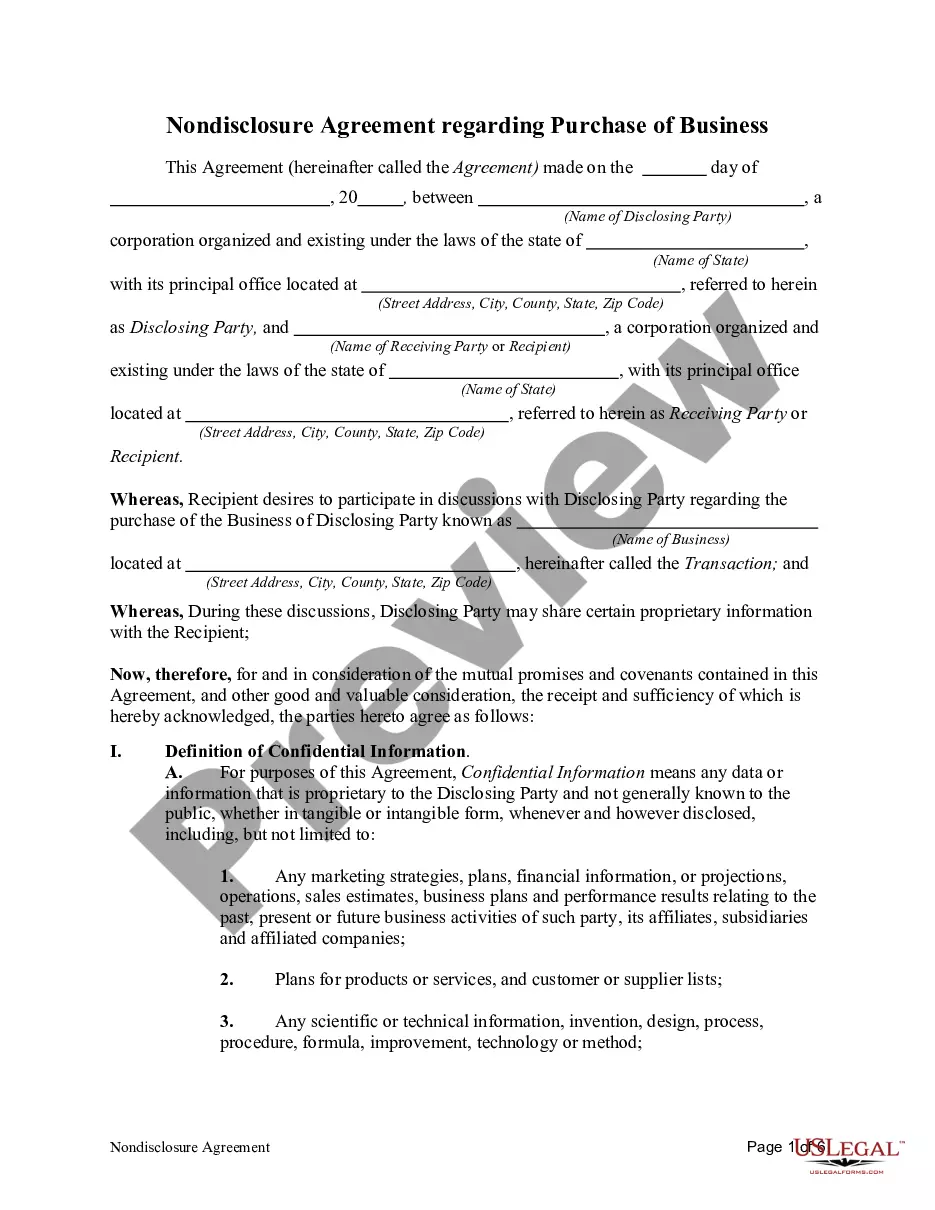
This form, a Vendor's Obligation to Protect Nonpublic Confidential Information, contains a clause for an agreement that establishes a vendors duty to protect private, personal, confidential or other sensitive information that it obtains during the course of its business relationship with the client company.
California Vendor's Obligation to Protect Nonpublic Confidential Information
Category:
State:
Multi-State
Control #:
US-IP0714
Format:
Word;
PDF;
Rich Text
Instant download
Description

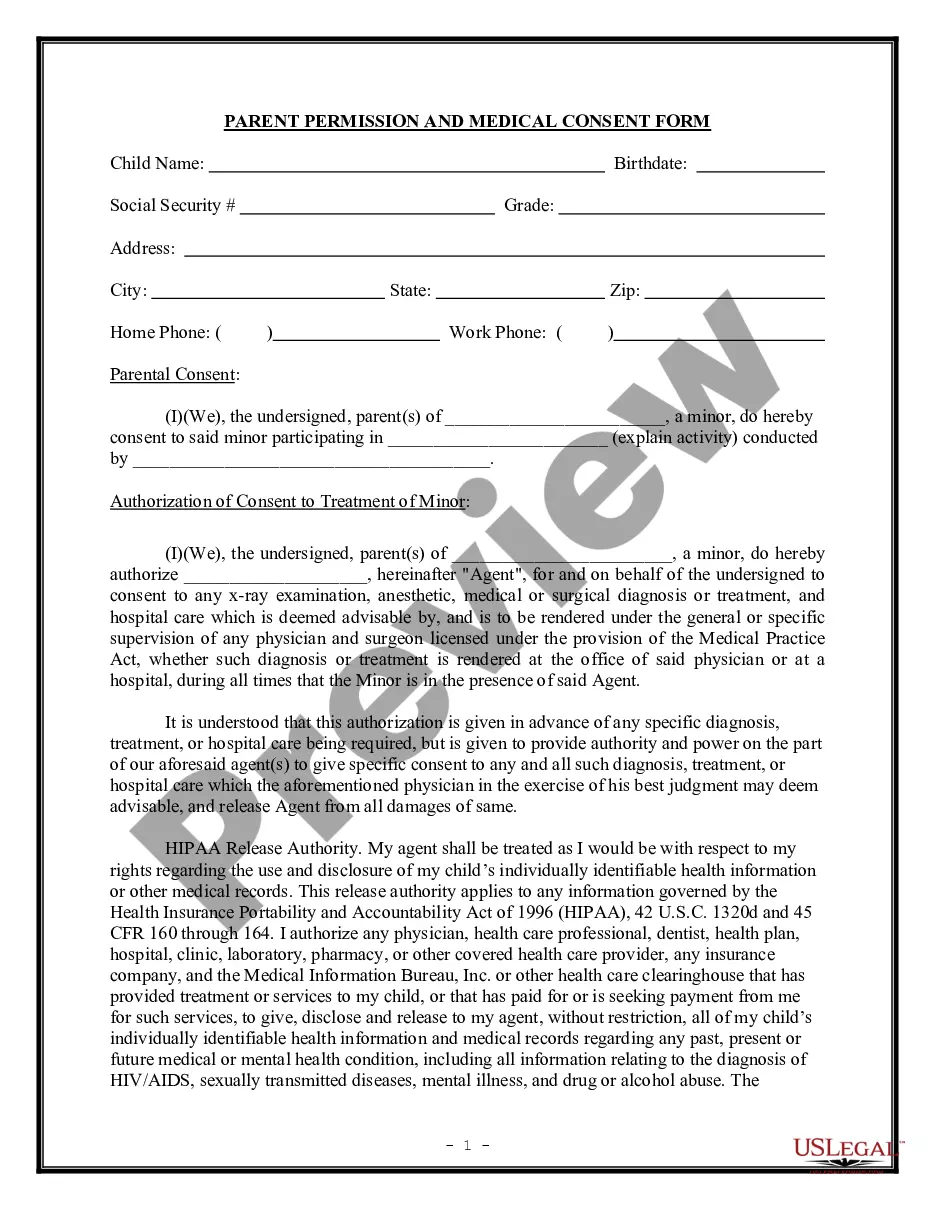
How to fill out Vendor's Obligation To Protect Nonpublic Confidential Information?
Are you currently in a position where you need documents for potential business or personal reasons almost every day.
There are numerous legal document templates available online, but finding reliable ones can be challenging.
US Legal Forms offers a vast collection of form templates, such as the California Vendor's Obligation to Protect Nonpublic Confidential Information, designed to comply with state and federal regulations.
Once you locate the correct form, simply click Purchase now.
Select the payment plan you prefer, fill in the necessary information to create your account, and complete the transaction using your PayPal or Visa or Mastercard.
- If you are already familiar with the US Legal Forms website and have an account, simply Log In.
- Then, you can download the California Vendor's Obligation to Protect Nonpublic Confidential Information template.
- If you do not have an account and wish to start using US Legal Forms, follow these steps.
- Find the form you need and ensure it is for the correct state/region.
- Use the Preview button to examine the form.
- Review the details to confirm that you have selected the correct form.
- If the form is not what you are looking for, use the Search area to find the form that fits your needs and requirements.
Form popularity
FAQ
The CCPA requires business privacy policies to include information on consumers' privacy rights and how to exercise them: the Right to Know, the Right to Delete, the Right to Opt-Out of Sale and the Right to Non-Discrimination.
1) The right not to have one's personal matters disclosed or publicized; the right to be left alone. 2) The right against undue government intrusion into fundamental personal issues and decisions.
On November 6, 2020, a majority of Californians voted to approve Proposition 24, the California Privacy Rights Act of 2020 (CPRA). The CRPA will go into effect on January 1, 2023, but will apply to all personal information (PI) collected on or after January 1, 2022. Security & Privacy Bytes provided more coverage.
Q. Does the CCPA apply to non-profits? No. The CCPA applies to businesses. The Act defines that term to include any legal entity (e.g., corporations, associations, partnerships, etc.)
This landmark law secures new privacy rights for California consumers, including: The right to know about the personal information a business collects about them and how it is used and shared; The right to delete personal information collected from them (with some exceptions);
The Act, also known as 2020 California Proposition 24, expands existing data privacy laws by allowing consumers greater control of their personal data and establishing the California Privacy Protection Agency. It passed, with a majority of voters approving the measure.
The CCPA requires business privacy policies to include information on consumers' privacy rights and how to exercise them: the Right to Know, the Right to Delete, the Right to Opt-Out of Sale and the Right to Non-Discrimination.
To fall within the scope of the CCPA, the business must also meet one of the additional three criteria:Have $25 million or more in annual revenue; or.Possess the personal data of more than 50,000 consumers, households, or devices or.Earn more than half of its annual revenue selling consumers' personal data.
- general CCPA compliance obligations of the business, including duties to: provide a clear and conspicuous opt-out link; provide a description of Consumer opt-out rights; effectuate and comply with opt-out requests in business systems; respect opt-out requests for 12 months before requesting that the Consumer