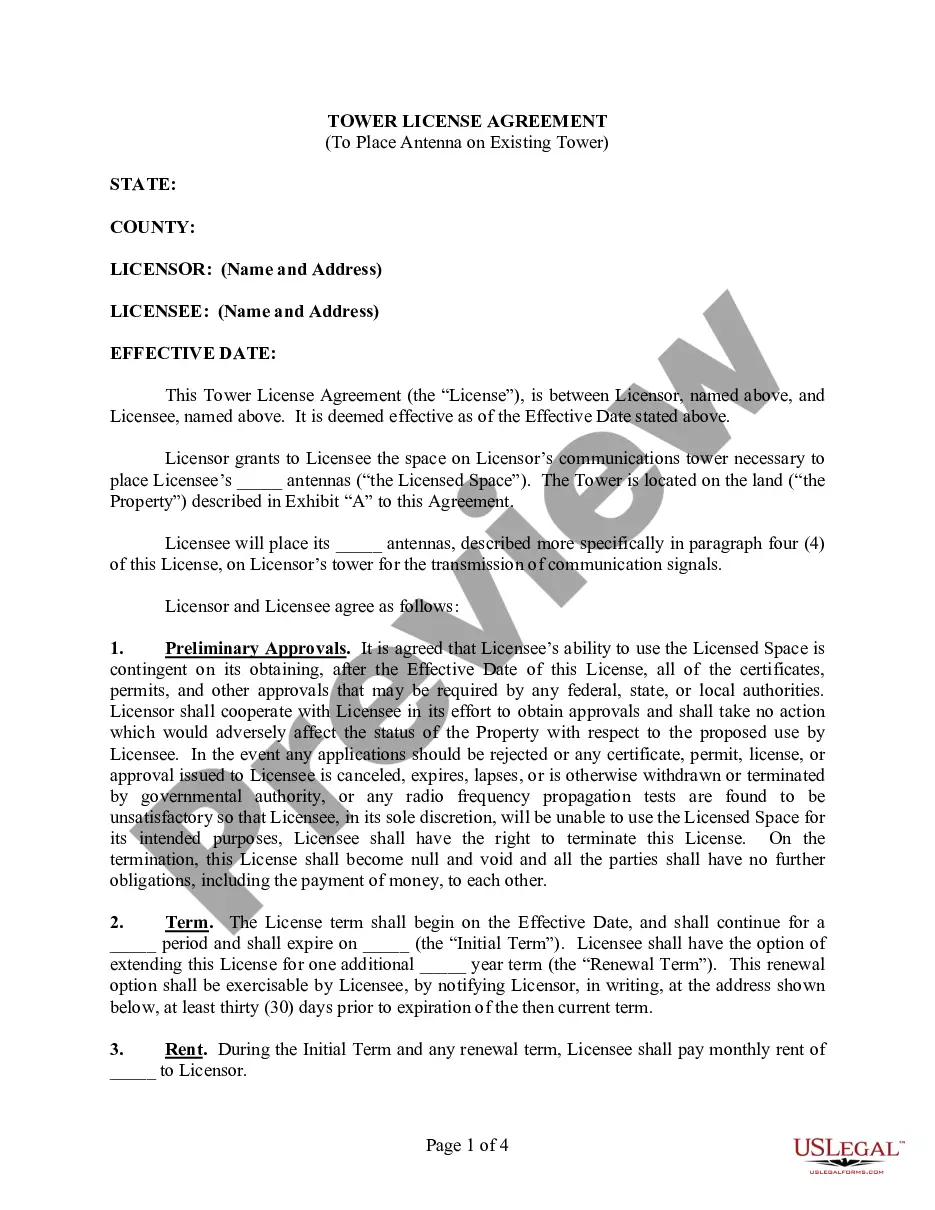
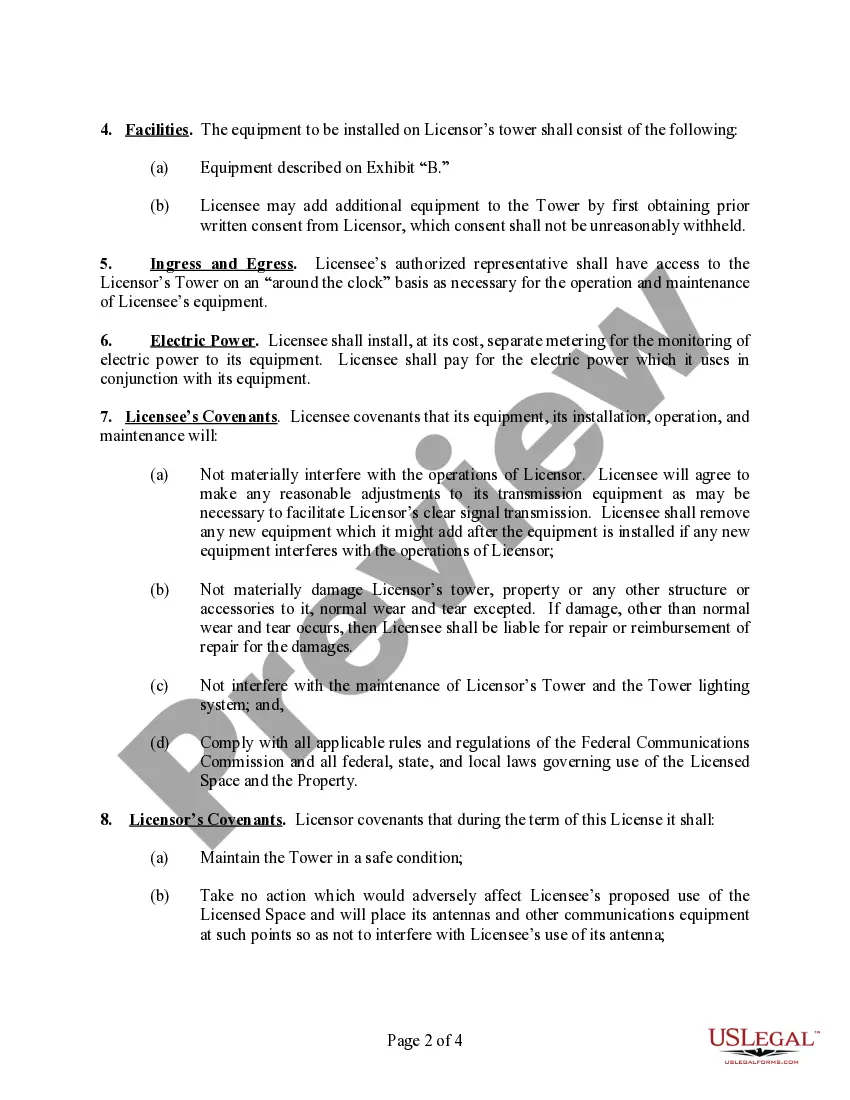
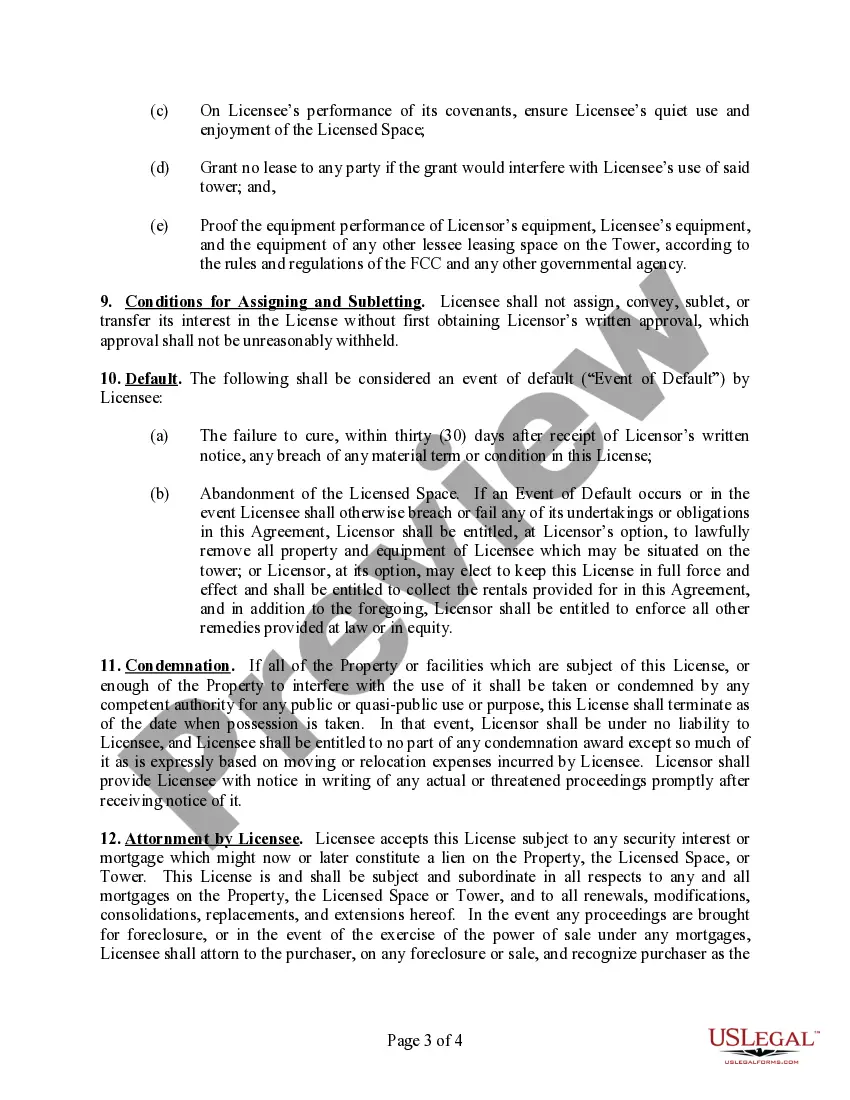
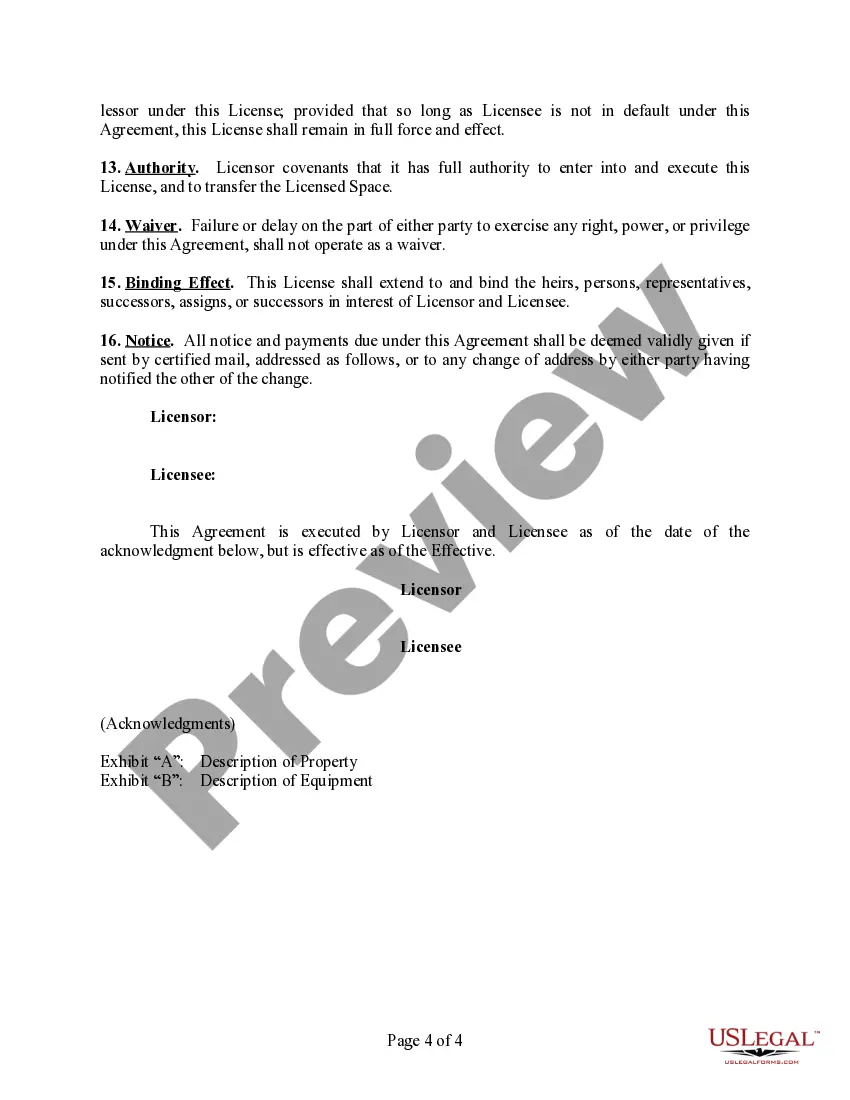
California Tower License Agreement (To Place Antenna on Existing Tower)
Description
Get your form ready online
Our built-in tools help you complete, sign, share, and store your documents in one place.
Make edits, fill in missing information, and update formatting in US Legal Forms—just like you would in MS Word.
Download a copy, print it, send it by email, or mail it via USPS—whatever works best for your next step.
Sign and collect signatures with our SignNow integration. Send to multiple recipients, set reminders, and more. Go Premium to unlock E-Sign.
If this form requires notarization, complete it online through a secure video call—no need to meet a notary in person or wait for an appointment.
We protect your documents and personal data by following strict security and privacy standards.

Make edits, fill in missing information, and update formatting in US Legal Forms—just like you would in MS Word.

Download a copy, print it, send it by email, or mail it via USPS—whatever works best for your next step.

Sign and collect signatures with our SignNow integration. Send to multiple recipients, set reminders, and more. Go Premium to unlock E-Sign.

If this form requires notarization, complete it online through a secure video call—no need to meet a notary in person or wait for an appointment.

We protect your documents and personal data by following strict security and privacy standards.
Looking for another form?
How to fill out Tower License Agreement (To Place Antenna On Existing Tower)?
Are you within a position in which you need documents for sometimes organization or individual functions virtually every day time? There are plenty of legal record layouts available on the Internet, but discovering ones you can depend on is not straightforward. US Legal Forms gives a large number of kind layouts, much like the California Tower License Agreement (To Place Antenna on Existing Tower), which are written to fulfill federal and state requirements.
In case you are previously informed about US Legal Forms website and get an account, basically log in. Next, you can obtain the California Tower License Agreement (To Place Antenna on Existing Tower) design.
Unless you provide an profile and need to start using US Legal Forms, adopt these measures:
- Obtain the kind you will need and make sure it is for your right town/region.
- Take advantage of the Preview key to check the form.
- Browse the explanation to actually have selected the proper kind.
- In case the kind is not what you`re trying to find, make use of the Research discipline to find the kind that fits your needs and requirements.
- Whenever you obtain the right kind, click on Buy now.
- Select the costs plan you desire, fill in the desired information to create your account, and buy the order making use of your PayPal or bank card.
- Select a hassle-free paper structure and obtain your copy.
Locate each of the record layouts you possess purchased in the My Forms menus. You may get a more copy of California Tower License Agreement (To Place Antenna on Existing Tower) at any time, if required. Just select the required kind to obtain or printing the record design.
Use US Legal Forms, the most comprehensive assortment of legal varieties, to save lots of time as well as prevent errors. The services gives professionally created legal record layouts that you can use for a range of functions. Produce an account on US Legal Forms and start creating your daily life a little easier.
Form popularity
FAQ
Who owns the cell tower? The telecom service provider retains ownership of all the equipment, including tower structures located on the property. In exchange for rent, property owners grant cell service providers with a 24×7 easement with access and unlimited space for the carrier's equipment.
Guidelines for Cellular Antenna Sites Although the FCC permits an effective radiated power (ERP) of up to 500 watts per channel (depending on the tower height), the majority of cellular or PCS cell sites in urban and suburban areas operate at an ERP of 100 watts per channel or less.
Unless the underlying jurisdiction does not require any zoning at all, most cell towers must be approved by the local land use office prior to being built.
To placate airline regulators, AT&T and Verizon have agreed to create a C-band ?buffer zone? around 50 airports. The cell carriers won't operate C-band cell towers within 1.3 miles (2100 m) of the end of any runway. They'll offer reduced C-band speeds for an additional 0.3 miles (540 m) beyond that.
The Government of Canada regulates the siting and construction of telecommunication antenna/tower systems under the Radiocommunication Act through Innovation, Science and Economic Development (ISED) Canada.
The Federal Communications Commission (FCC) regulates systems such as cell phone towers. Exposure levels from cell phone towers must comply with the FCC's radiofrequency (RF) radiation exposure guidelines, which were developed to protect the public from RF-related health risks.
The Federal Communications Commission (FCC) regulates systems such as cell phone towers. Exposure levels from cell phone towers must comply with the FCC's radiofrequency (RF) radiation exposure guidelines, which were developed to protect the public from RF-related health risks.
Cell tower companies are entities that own and operate cell towers. Tower companies either build or acquire towers from other tower companies or wireless providers.
