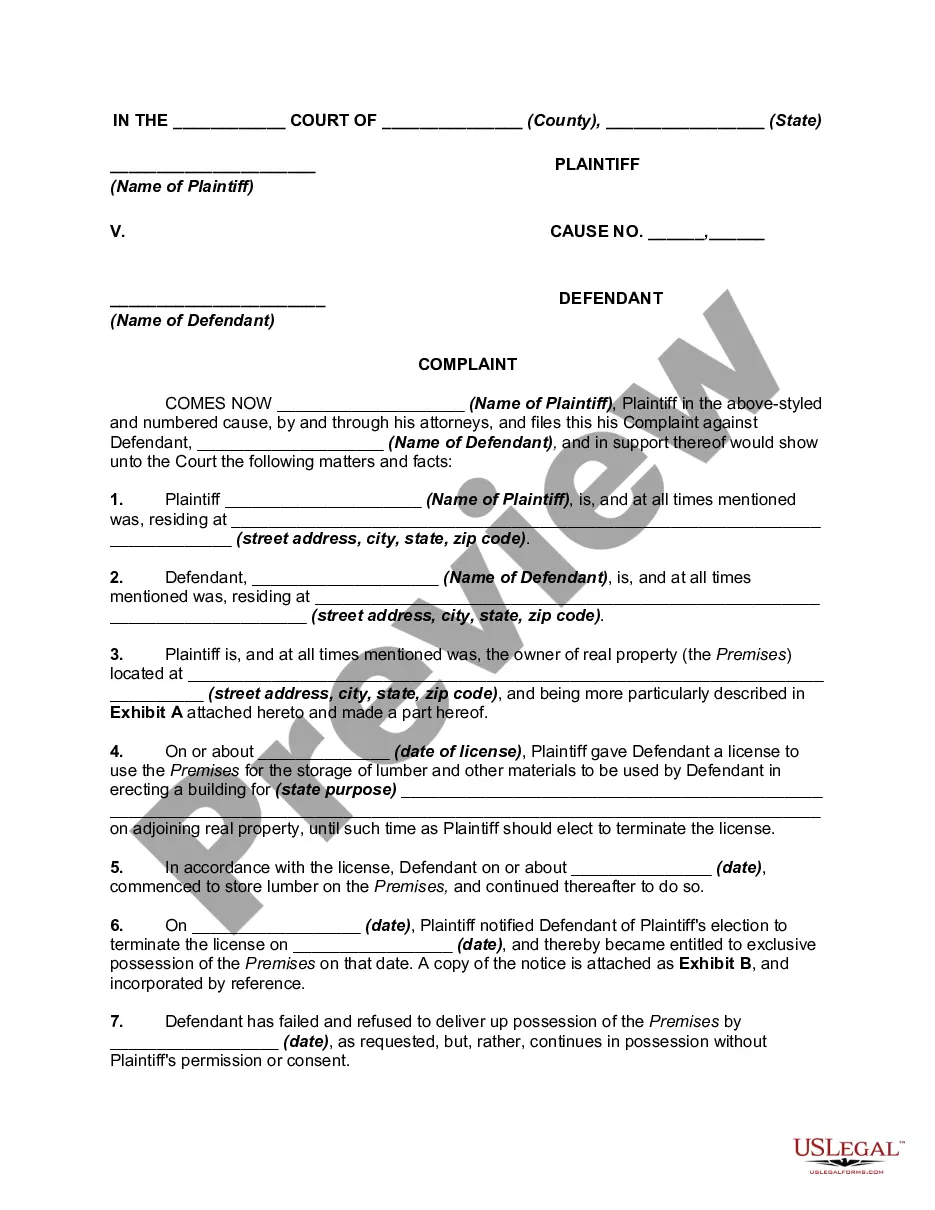
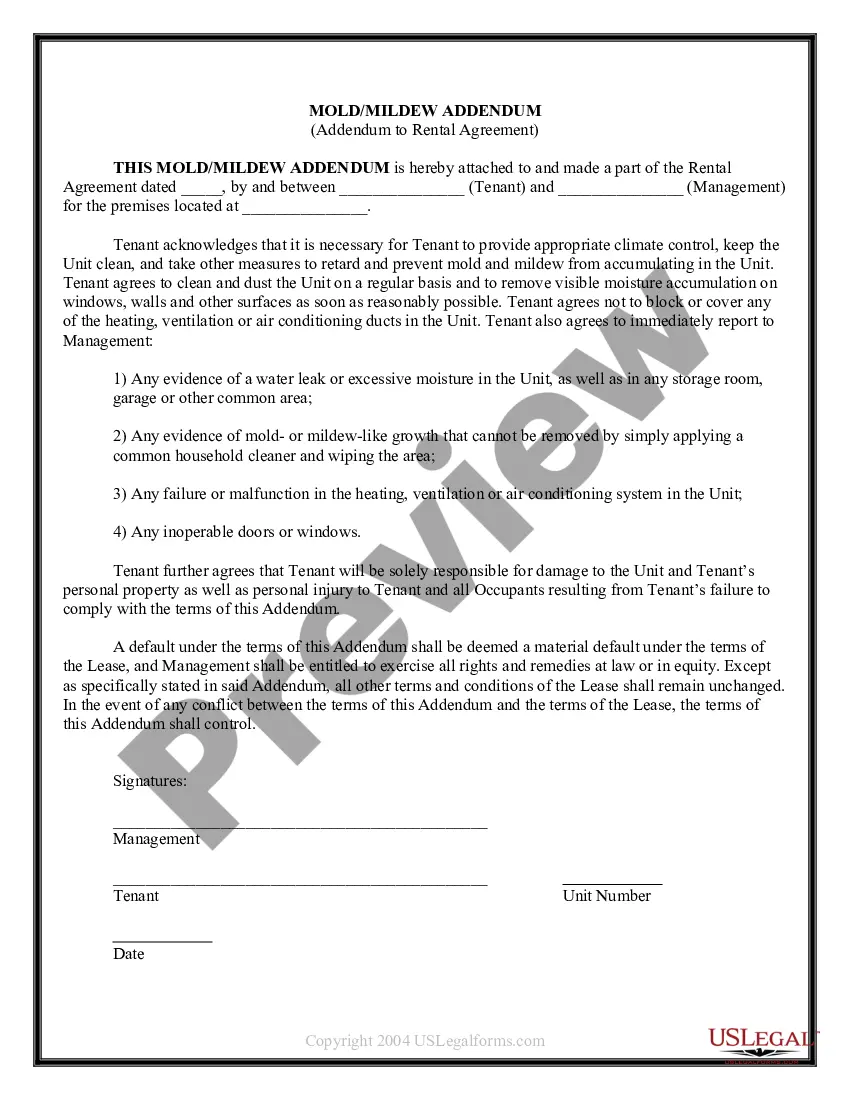
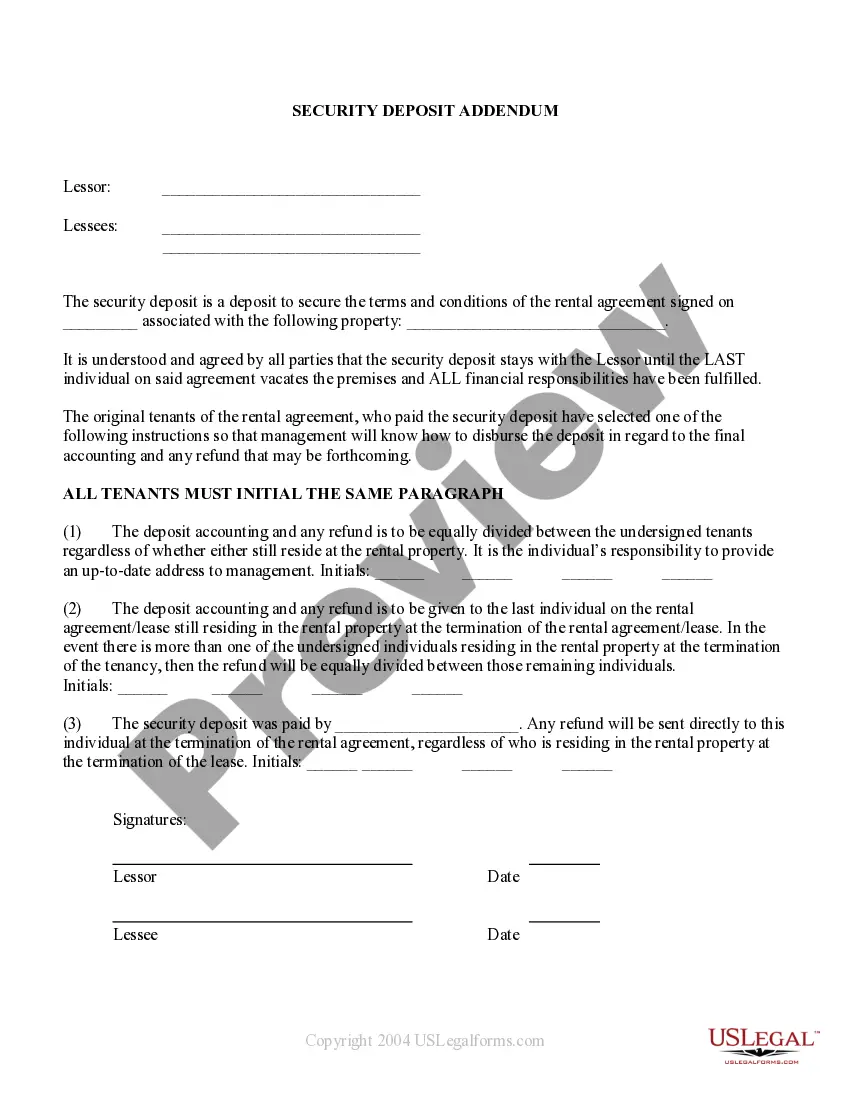
Addendum to rental agreement addressing mold/mildew issues.
California Addendum To Apartment Lease regarding Mold
State:
Multi-State
Control #:
US-891LT
Format:
Word;
Rich Text
147 downloads
Description
Get your form ready online
Our built-in tools help you complete, sign, share, and store your documents in one place.
Built-in online Word editor
Make edits, fill in missing information, and update formatting in US Legal Forms—just like you would in MS Word.
Export easily
Download a copy, print it, send it by email, or mail it via USPS—whatever works best for your next step.
E-sign your document
Sign and collect signatures with our SignNow integration. Send to multiple recipients, set reminders, and more. Go Premium to unlock E-Sign.
Notarize online 24/7
If this form requires notarization, complete it online through a secure video call—no need to meet a notary in person or wait for an appointment.
Store your document securely
We protect your documents and personal data by following strict security and privacy standards.

Make edits, fill in missing information, and update formatting in US Legal Forms—just like you would in MS Word.

Download a copy, print it, send it by email, or mail it via USPS—whatever works best for your next step.

Sign and collect signatures with our SignNow integration. Send to multiple recipients, set reminders, and more. Go Premium to unlock E-Sign.

If this form requires notarization, complete it online through a secure video call—no need to meet a notary in person or wait for an appointment.

We protect your documents and personal data by following strict security and privacy standards.
Looking for another form?


How to fill out Addendum To Apartment Lease Regarding Mold?
You might spend hours online seeking the legal document template that meets the state and federal requirements you have.
US Legal Forms offers a vast array of legal forms that have been reviewed by professionals.
You can effortlessly download or print the California Addendum To Apartment Lease related to Mold from my service.
If available, use the Preview button to review the document template as well.
- If you possess a US Legal Forms account, you can Log In and click the Download button.
- After that, you can complete, modify, print, or sign the California Addendum To Apartment Lease pertaining to Mold.
- Every legal document template you purchase is yours forever.
- To obtain another copy of a purchased form, go to the My documents tab and click the appropriate button.
- If you are visiting the US Legal Forms website for the first time, follow these straightforward instructions below.
- First, ensure that you have selected the correct document template for your county/town of choice.
- Check the form description to confirm you have selected the right form.
Form popularity
FAQ
According to California law, landlords are not required to test your rental property for specific levels of mold. However, as of 2016, California law does require that landlords repair or remediate any mold found in the rental home.
However, there is a law mandating that landlords take corrective action to rid the unit of any mold found there. This means he or she must not only remedy the mold issue, but also the underlying cause. If a tenant finds and makes the landlord aware of significant mold in a rental unit, this must be done within 30 days.
Abandon your rental unit. California law allows renters to move out of their rental unit if it is defective. Since mold breaches the implied warranty of habitability, rendering your unit substandard and a threat to your health and safety, it qualifies.
There is currently no federal law covering a landlord's responsibilities when it comes to mold. Also, aside from disclosure requirements (as discussed below), California doesn't have any laws that specifically address a landlord's duties or liability when it comes to mold prevention and remediation.
The state of California recognizes that the presence of toxic mold in a rental home or unit can lead to severe health problems in tenants, thereby violating the implied warranty of habitability.
How long does a landlord have to fix something? In California, State law gives landlords 30 days to fix habitability problems. Additionally, less time is given if the circumstances warrant prompter attention (e.g. a broken front door lock requires immediate attention).
Describe where the mould is and any damage to furniture or belongings. Once the problem has been reported, the landlord has to respond within 14 days. For landlords, when a tenant reports mould in the property, arrange an inspection to determine the cause of the mould and, where necessary, ensure repairs are made.
Courts in California have recognized two common legal self-help strategies that some tenants choose to pursue following a mold outbreak in their apartment or rental home. The first, known as rent withholding, is when tenants decide to stop paying rent, claiming the mold has made their apartment uninhabitable.
Yes, you can sue your landlord for black mold. Since toxic mold can be harmful to one's health and damage and/or destroy the structure of a building and its contents (i.e., personal property and belongings) the law allows tenants to hold their landlords responsible in certain situations.