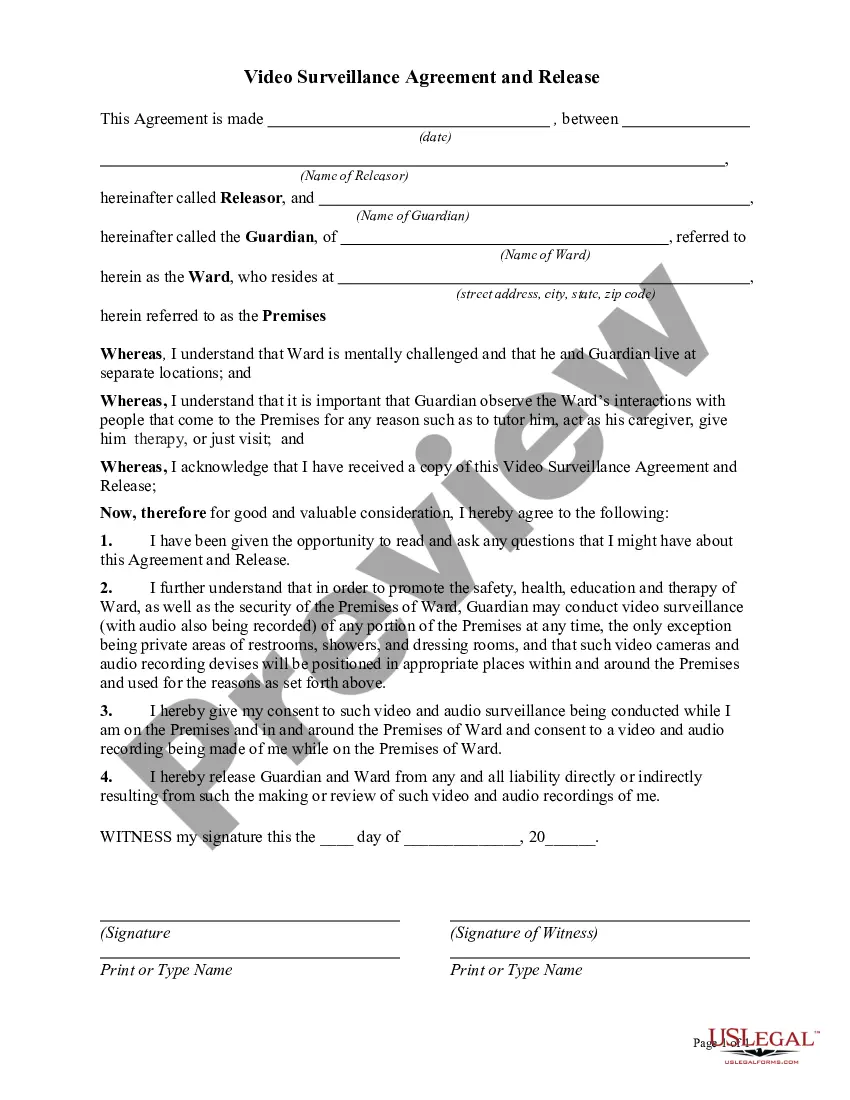
California Video Surveillance Agreement and Release
Description
Get your form ready online
Our built-in tools help you complete, sign, share, and store your documents in one place.
Make edits, fill in missing information, and update formatting in US Legal Forms—just like you would in MS Word.
Download a copy, print it, send it by email, or mail it via USPS—whatever works best for your next step.
Sign and collect signatures with our SignNow integration. Send to multiple recipients, set reminders, and more. Go Premium to unlock E-Sign.
If this form requires notarization, complete it online through a secure video call—no need to meet a notary in person or wait for an appointment.
We protect your documents and personal data by following strict security and privacy standards.

Make edits, fill in missing information, and update formatting in US Legal Forms—just like you would in MS Word.

Download a copy, print it, send it by email, or mail it via USPS—whatever works best for your next step.

Sign and collect signatures with our SignNow integration. Send to multiple recipients, set reminders, and more. Go Premium to unlock E-Sign.

If this form requires notarization, complete it online through a secure video call—no need to meet a notary in person or wait for an appointment.

We protect your documents and personal data by following strict security and privacy standards.
Looking for another form?
How to fill out Video Surveillance Agreement And Release?
US Legal Forms - among the most extensive collections of authorized templates in the United States - provides a vast selection of legal document forms you can obtain or print.
By using the website, you will find tens of thousands of forms for business and personal needs, categorized by types, states, or keywords.
You can access the latest versions of forms like the California Video Surveillance Agreement and Release in mere moments.
Check the form description to confirm that you have chosen the correct form.
Should the form not meet your needs, utilize the Search feature at the top of the screen to find one that does.
- If you already possess a membership, Log In to download the California Video Surveillance Agreement and Release from the US Legal Forms library.
- The Download button will appear on every form you view.
- You can access all previously downloaded forms from the My documents section of your account.
- If you are using US Legal Forms for the first time, here are simple steps to get you started.
- Ensure that you have selected the correct form for your city/state.
- Click the Preview button to review the content of the form.
Form popularity
FAQ
Generally, you do not need a license to install security cameras on your property. However, ensure that you comply with local laws and regulations regarding surveillance. For comprehensive guidelines, consider reviewing the California Video Surveillance Agreement and Release.
How to Block Neighbor's Security CameraGet some security cameras on your property.Check the camera if it's real or fake.Blind the camera.Hack the live camera.Talk to your neighbor.Talk to the police or a lawyer.Buy Camera Jammer Device.Place tall or growing trees to block the security cameras.More items...
The legality of recording conversations at work is a grey area, evolving all the time. The Employment Appeals Tribunal has allowed it in some cases but dismissed it in others. It depends on the circumstances of each case and how relevant the covertly recorded evidence might be to a case.
The key to remember is this: While employers do not have to allow recordings in the workplace, both employees and employers can legally make audio recordings, though with varying degrees of consent required depending on state law.
The problem, as you rightly pointed out, lies in the fact that you perceive that one of your neighbours' CCTV cameras is pointing directly at your property and this is a Privacy Issue. As far as the law goes in this regard, it would be covered by the Human Rights Act under your rights to privacy.
For the most part, your neighbor is legally allowed to have security cameras installed on their property, even if those cameras are aimed at your property. However, your neighbor does not have the right to record you or anyone else without consent in areas with reasonable expectation of privacy.
As long as the recorded videos don't infringe on your privacy and are for lawful purpose only (like monitoring suspects or prevent package thefts at the front door), it is legal for your neighbor to point a security camera at your property in plain view.
In California, it is a misdemeanor to record a conversation without the consent of all parties to the conversation, which can lead to fines of up to $2,500 and/or imprisonment for up to a year.
Simply put, it is illegal to record someone on their private property in any way. So, if you do want to take further steps to prevent your neighbour from recording you, you are well within your rights to do so.
While it is not against the law to use video surveillance cameras on your property for security, it is illegal when the recording can be considered an invasion of privacy, or recording someone in a context where it would be reasonable for them to expect privacy.