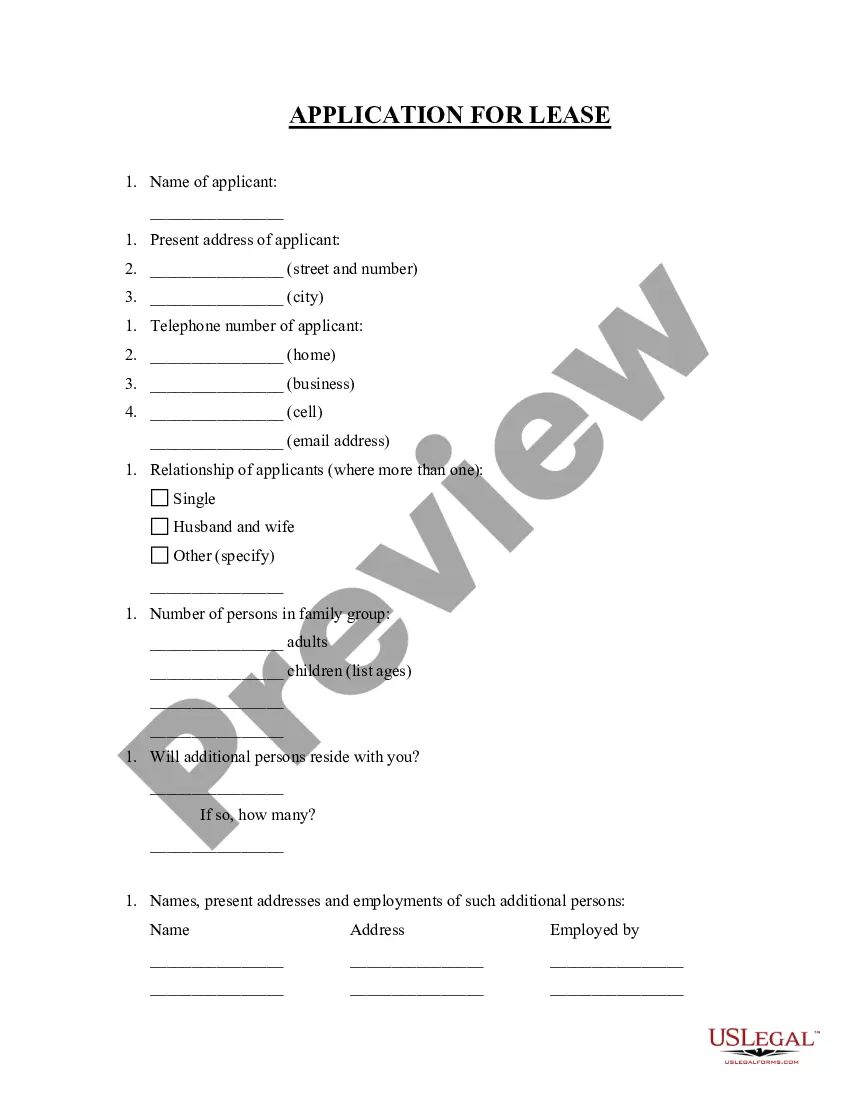
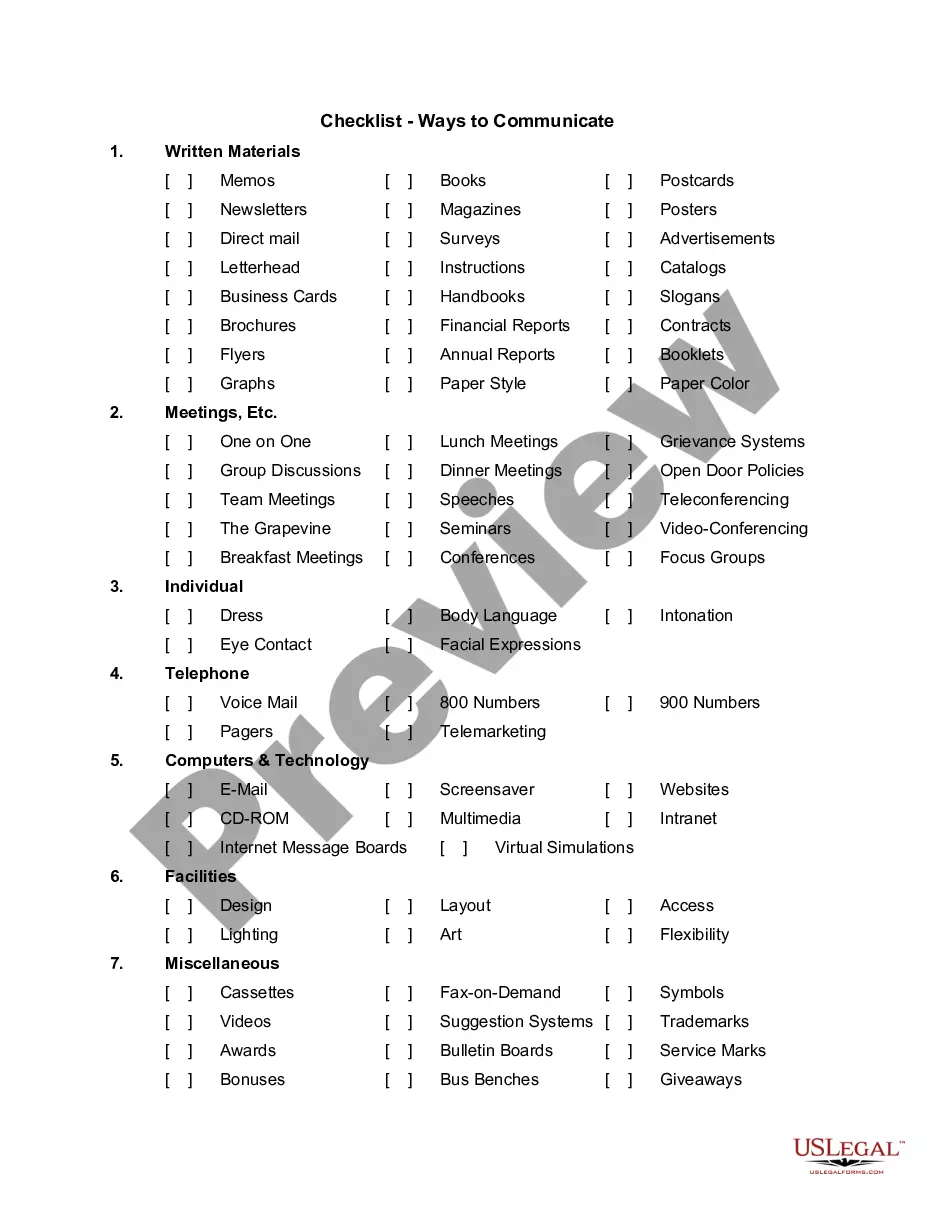
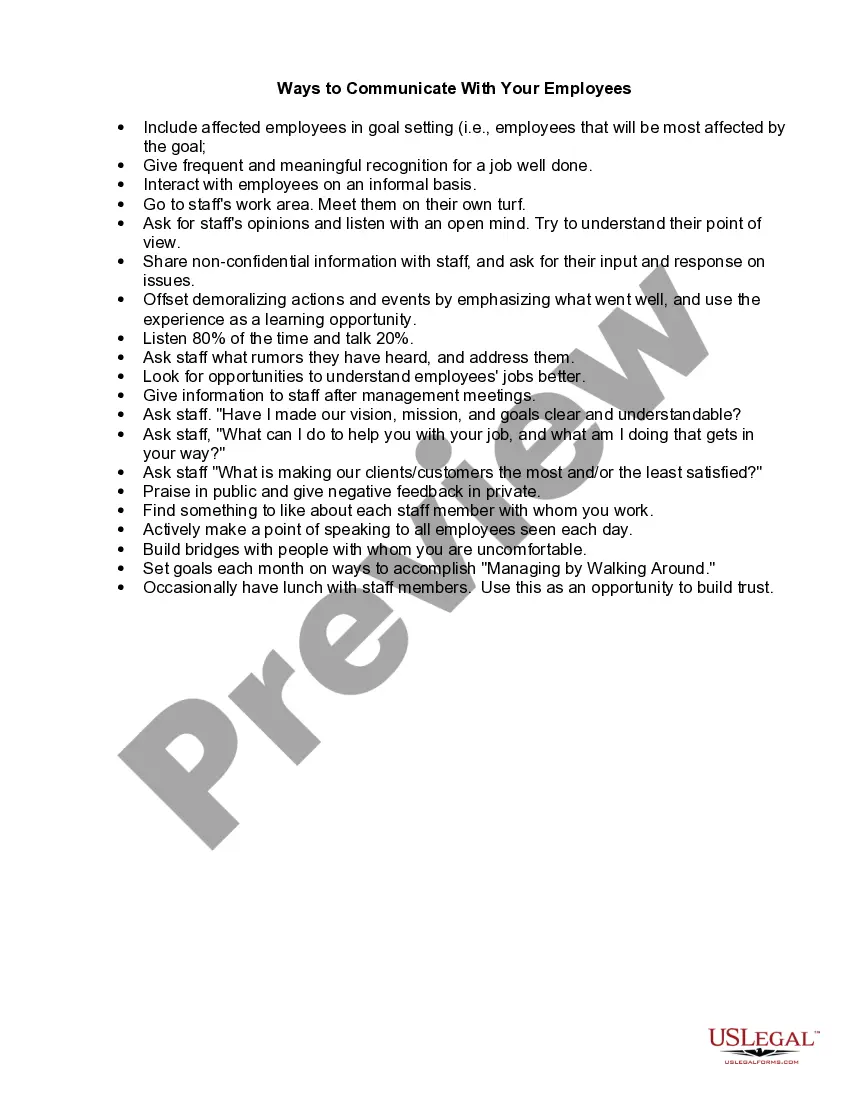
California Checklist - Ways to Communicate
Description

Get your form ready online
Our built-in tools help you complete, sign, share, and store your documents in one place.
Make edits, fill in missing information, and update formatting in US Legal Forms—just like you would in MS Word.
Download a copy, print it, send it by email, or mail it via USPS—whatever works best for your next step.
Sign and collect signatures with our SignNow integration. Send to multiple recipients, set reminders, and more. Go Premium to unlock E-Sign.
If this form requires notarization, complete it online through a secure video call—no need to meet a notary in person or wait for an appointment.
We protect your documents and personal data by following strict security and privacy standards.

Make edits, fill in missing information, and update formatting in US Legal Forms—just like you would in MS Word.

Download a copy, print it, send it by email, or mail it via USPS—whatever works best for your next step.

Sign and collect signatures with our SignNow integration. Send to multiple recipients, set reminders, and more. Go Premium to unlock E-Sign.

If this form requires notarization, complete it online through a secure video call—no need to meet a notary in person or wait for an appointment.

We protect your documents and personal data by following strict security and privacy standards.
Looking for another form?






How to fill out Checklist - Ways To Communicate?
It is feasible to allocate multiple hours online trying to locate the legal document template that satisfies the state and federal requirements you need.
US Legal Forms offers a vast array of legal forms that have been reviewed by professionals.
You can easily access or create the California Checklist - Strategies to Communicate from my support.
If available, utilize the Preview button to review the document template as well.
- If you already possess a US Legal Forms account, you can sign in and click the Obtain button.
- Subsequently, you may complete, modify, print, or sign the California Checklist - Strategies to Communicate.
- Every legal document template you acquire is permanently yours.
- To obtain an extra copy of any purchased document, navigate to the My documents tab and click the relevant button.
- If you are using the US Legal Forms website for the first time, adhere to the simple instructions below.
- First, ensure that you have selected the correct document template for the area/region of your choice.
- Review the document description to confirm that you have chosen the right form.
Form popularity
FAQ
These are the things everyone should think about before communicating. Whether it be drafting a blog, crafting a delicately worded email or working on a new campaign, a checklist can help you stay focused and ensure your communication is clear and effective.
As Mark Richards, HR manager at U.K. BestEssays, advises: An effective communication requires genuine listening, which requires five main aspects: center all your focus on the speaker, don't interrupt the speaker, leave your judgmental side apart, present your interest in his or her message by adding small comments
Steps to Communication PlanningStep 1 Perform a Situation Analysis.Step 2 Identify and Define Objectives / Goals.Step 3 Understand and Profile Your Key Audience.Step 4 Decide the Media Channels and Create a Strategy.Step 5 Create a Timetable for Publishing.Step 6 Monitor and Evaluate the Results.
The Five Main Components of a Strategic Brand Communications PlanIdentify the Audience: To WHOM do we need to communicate?Determine Goals and Objectives: WHY communicate?Develop Key Messages: WHAT do we need to communicate?Develop Tactical Plan: HOW will we communicate, to whom and when?More items...?
Every person has a unique communication style, a way in which they interact and exchange information with others. There are four basic communication styles: passive, aggressive, passive-aggressive and assertive. It's important to understand each communication style, and why individuals use them.
A checklist for how to build a project communication planDetermine the desired outcome of your communication.Select the appropriate communication channel.Identify the necessary stakeholders (audience)Determine who will be the voice of the communication.Prepare and deliver the message in a timely manner.More items...?27 July 2018
4 tips for Effective CommunicationEstablish and maintain eye contact. Eye contact plays a crucial role in communication.Try to send a clear message. There is a huge difference between just saying something, and saying something with intention.Be receptive to what others say.Wait for the other person to finish.
Communication Plan Examples A basic communication plan should include an analysis for the stakeholders you'd respond to and the procedures for what to include in those conversations. You might also include an overview of your business, potential communication challenges, and risk management strategy.
There are four main types of communication we use on a daily basis: verbal, nonverbal, written and visual. With all of these communication styles, it's most effective when you know how to actively listen, observe and empathize.
These are the things everyone should think about before communicating. Whether it be drafting a blog, crafting a delicately worded email or working on a new campaign, a checklist can help you stay focused and ensure your communication is clear and effective.