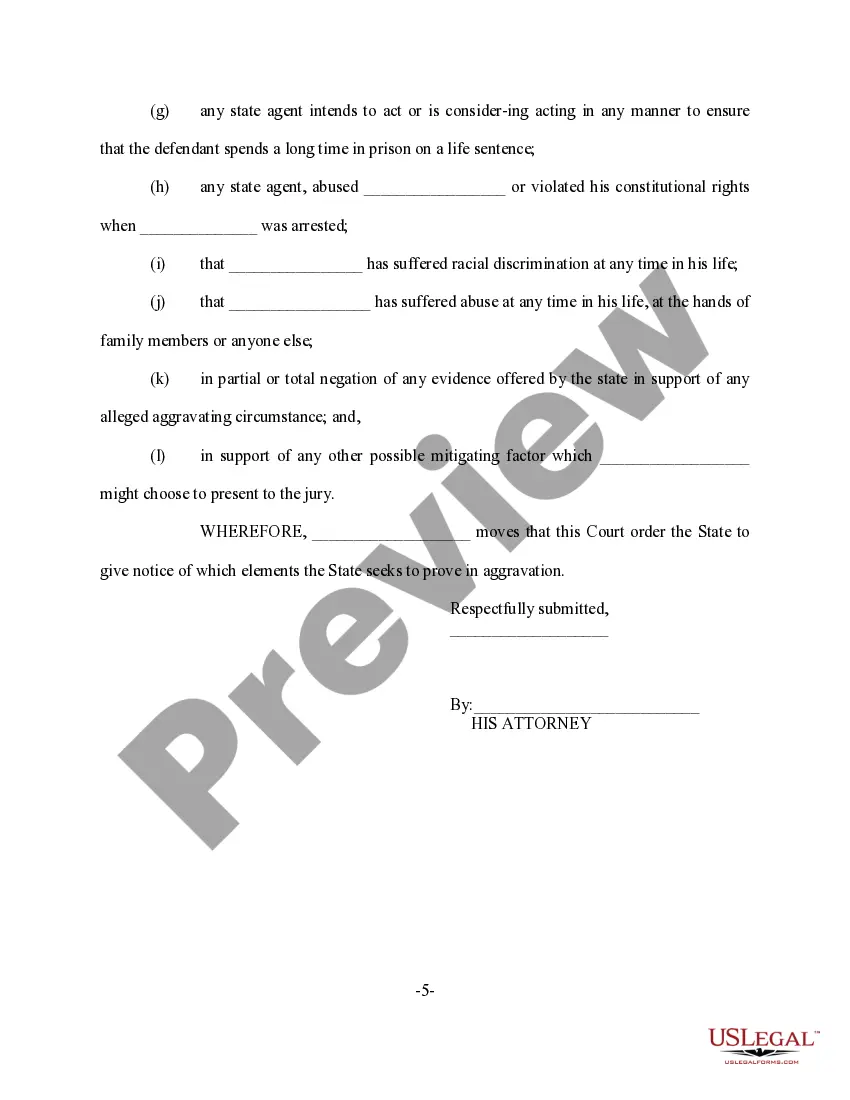
California Demand for Notice of Aggravating and for Disclosure of Evidence Supporting Mitigating Circumstances
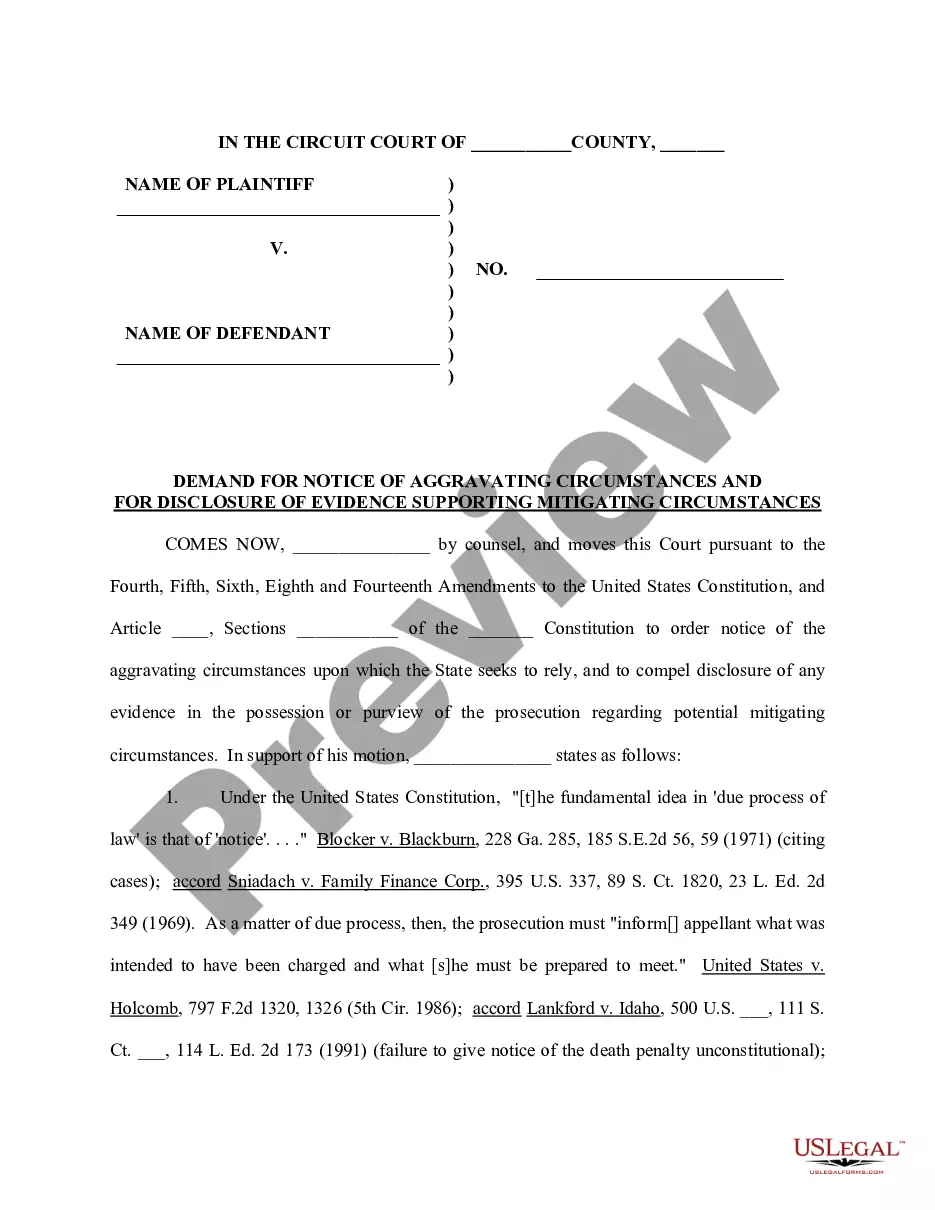
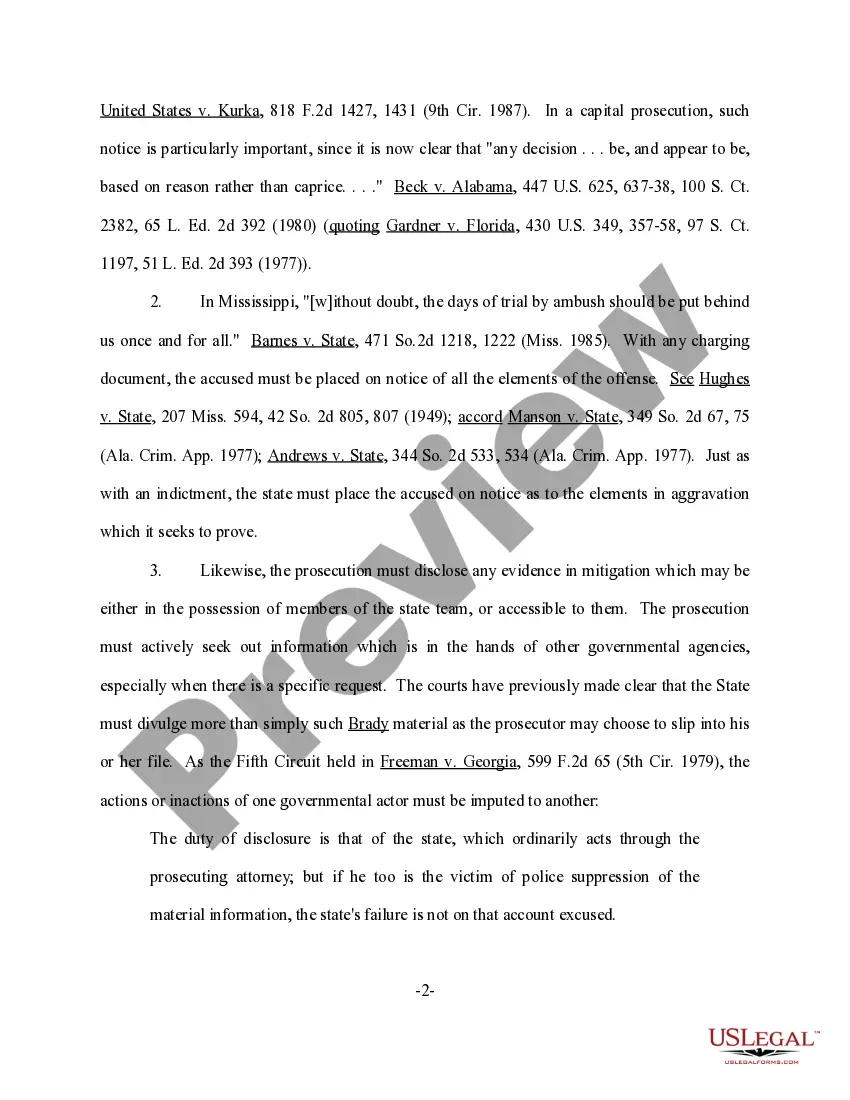
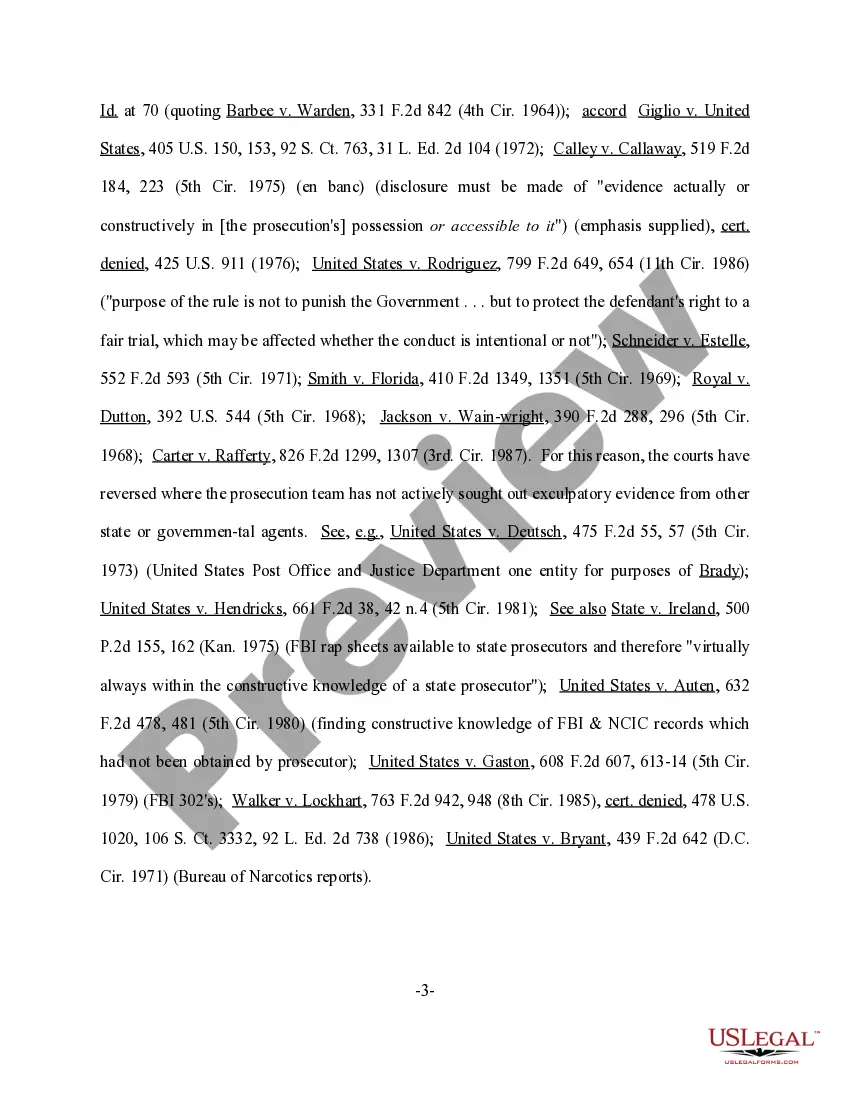
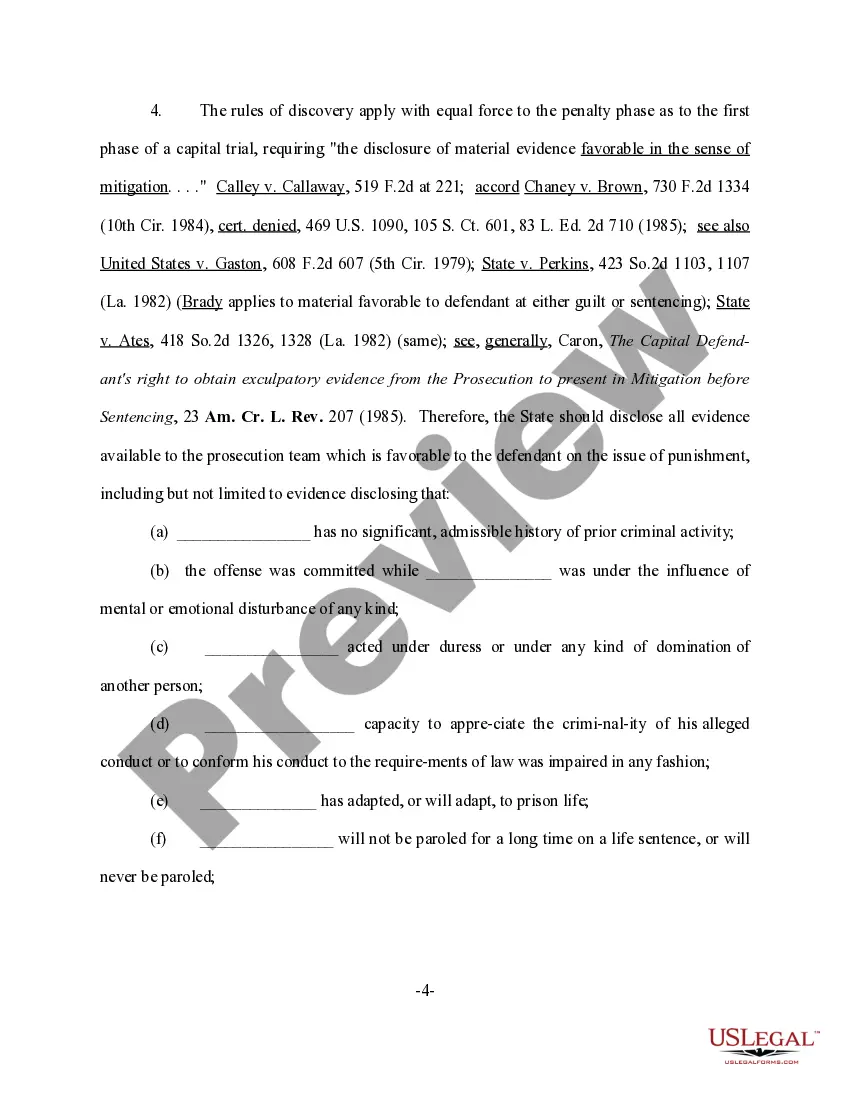
Description
Get your form ready online
Our built-in tools help you complete, sign, share, and store your documents in one place.
Make edits, fill in missing information, and update formatting in US Legal Forms—just like you would in MS Word.
Download a copy, print it, send it by email, or mail it via USPS—whatever works best for your next step.
Sign and collect signatures with our SignNow integration. Send to multiple recipients, set reminders, and more. Go Premium to unlock E-Sign.
If this form requires notarization, complete it online through a secure video call—no need to meet a notary in person or wait for an appointment.
We protect your documents and personal data by following strict security and privacy standards.

Make edits, fill in missing information, and update formatting in US Legal Forms—just like you would in MS Word.

Download a copy, print it, send it by email, or mail it via USPS—whatever works best for your next step.

Sign and collect signatures with our SignNow integration. Send to multiple recipients, set reminders, and more. Go Premium to unlock E-Sign.

If this form requires notarization, complete it online through a secure video call—no need to meet a notary in person or wait for an appointment.

We protect your documents and personal data by following strict security and privacy standards.
Looking for another form?
How to fill out Demand For Notice Of Aggravating And For Disclosure Of Evidence Supporting Mitigating Circumstances?
US Legal Forms - one of the most important collections of legal documents in the United States - offers a vast selection of legal template designs that you can download or print. By using the website, you can access thousands of forms for business and personal purposes, organized by categories, states, or keywords. You can obtain the latest editions of forms such as the California Request for Notice of Aggravating and for Disclosure of Evidence Supporting Mitigating Circumstances within minutes.
If you have a subscription, Log In and download the California Request for Notice of Aggravating and for Disclosure of Evidence Supporting Mitigating Circumstances from the US Legal Forms library. The Download button will appear on every form you view. You have access to all previously saved forms from the My documents section of your account.
If you are using US Legal Forms for the first time, here are straightforward instructions to get started: Ensure you have selected the appropriate form for your city/region. Click the Preview button to review the form's details. Check the form description to make sure you have chosen the correct form. In case the form does not meet your needs, utilize the Search field at the top of the screen to find one that does. If you are satisfied with the form, confirm your choice by clicking on the Purchase now button. Then, select the payment plan you prefer and provide your credentials to create an account. Process the transaction. Use your Visa or Mastercard or PayPal account to complete the transaction. Choose the format and download the form to your device. Make modifications. Fill out, edit, print, and sign the saved California Request for Notice of Aggravating and for Disclosure of Evidence Supporting Mitigating Circumstances.
- Every template you added to your account has no expiration date and is yours indefinitely.
- So, if you want to download or print another version, just go to the My documents section and click on the form you need.
- Access the California Request for Notice of Aggravating and for Disclosure of Evidence Supporting Mitigating Circumstances with US Legal Forms, the most extensive library of legal document templates.
- Utilize thousands of professional and state-specific templates that meet your business or personal requirements and specifications.
Form popularity
FAQ
There are two parts to CRC 4.421?factors relating to the crime and factors relating to the defendant. Some of the factors relating to the crime include: The use of great violence, infliction of great bodily harm, the threat of great bodily harm, a high degree of cruelty, viciousness, or callousness.
Mitigating factors include an ability for the criminal to reform, developmental disability, an addiction to illegal substances or alcohol that contributed to the criminal behavior, and past good deeds, among many others. Recognition of particular mitigating factors varies by jurisdiction.
As briefly discussed above, Rule 4.421 of the California Rules of Court spells out aggravating factors that a judge can use in determining a sentence, as most felonies have a range of penalties that can be imposed. There are two parts to CRC 4.421?factors relating to the crime and factors relating to the defendant.
Aggravating factors are those facts and circumstances surrounding the commission of the crime that may allow a judge to impose harsher punishment for the defendant. Under Rule 4.421, some common aggravating factors that can be considered include: Prior convictions.
Overview of Aggravating and Mitigating Factors Judges have some discretion with regard to sentencing, and a sentencing hearing allows both prosecutors and defendants the chance to present evidence for the court to consider. Aggravating factors may increase a sentence, while mitigating factors may decrease a sentence.
Mitigating circumstances include, but are not limited to, the defendant's age, extreme mental or emotional state at the time the crime was committed, developmental disability, and lack of a prior criminal record.
California Rules of Court, Rule 4.423 lists out nine factors in mitigation that a judge can consider in sentencing. These factors concern how defendant committed the crime, as well as six factors relating to the defendant.
Under the California Rules of Court, Rule 4.425, a court deciding to impose a cumulative sentence should consider the facts of the crimes, such as whether the crimes were independent of each other.