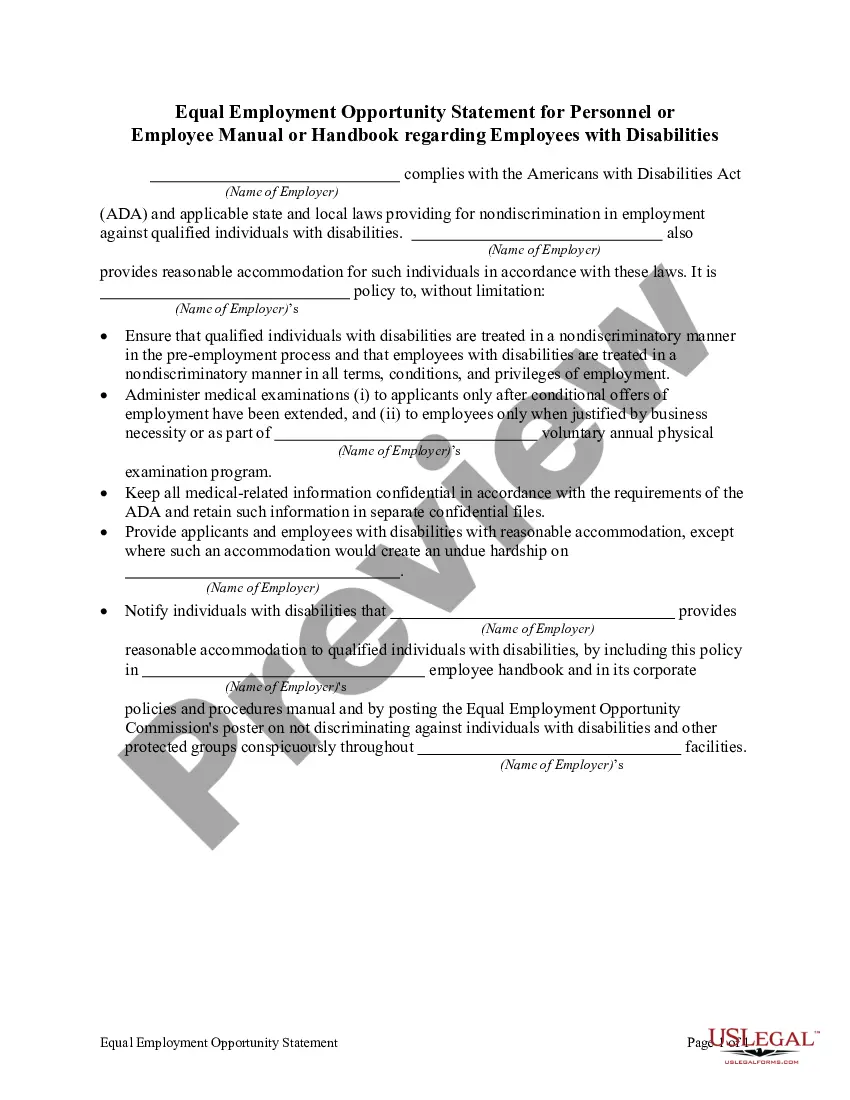
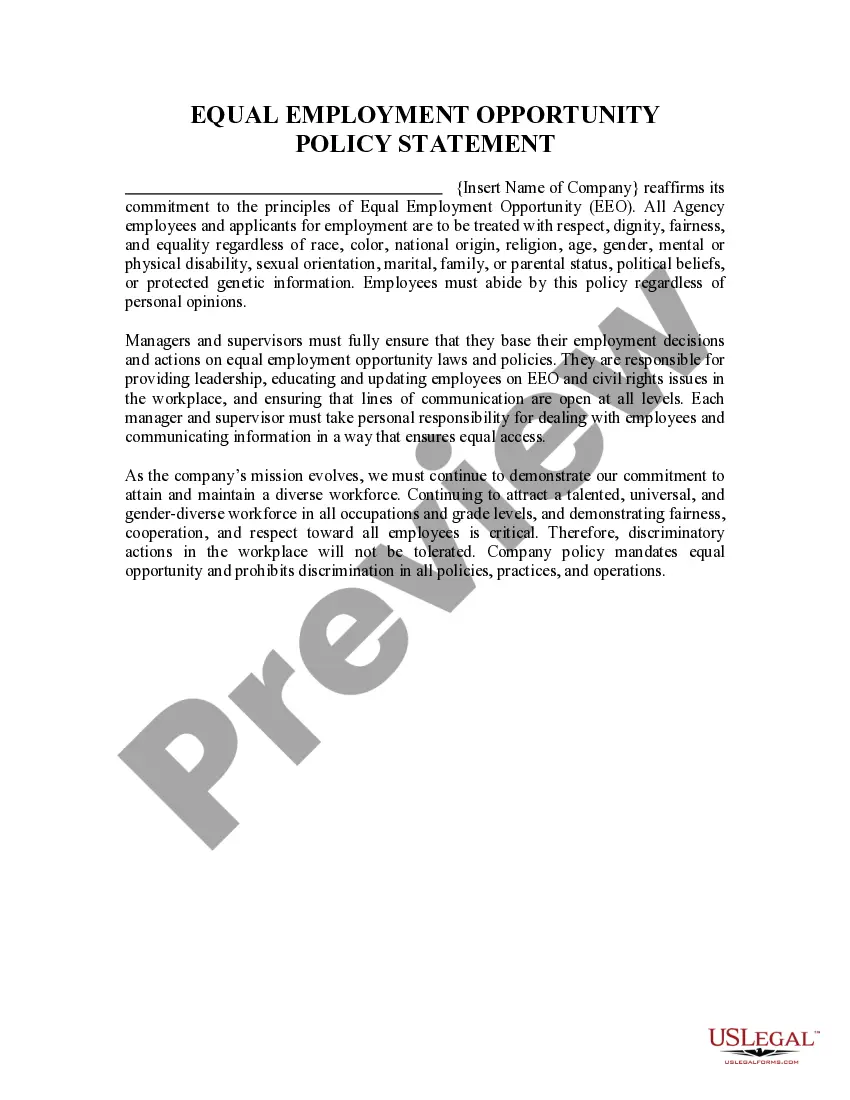
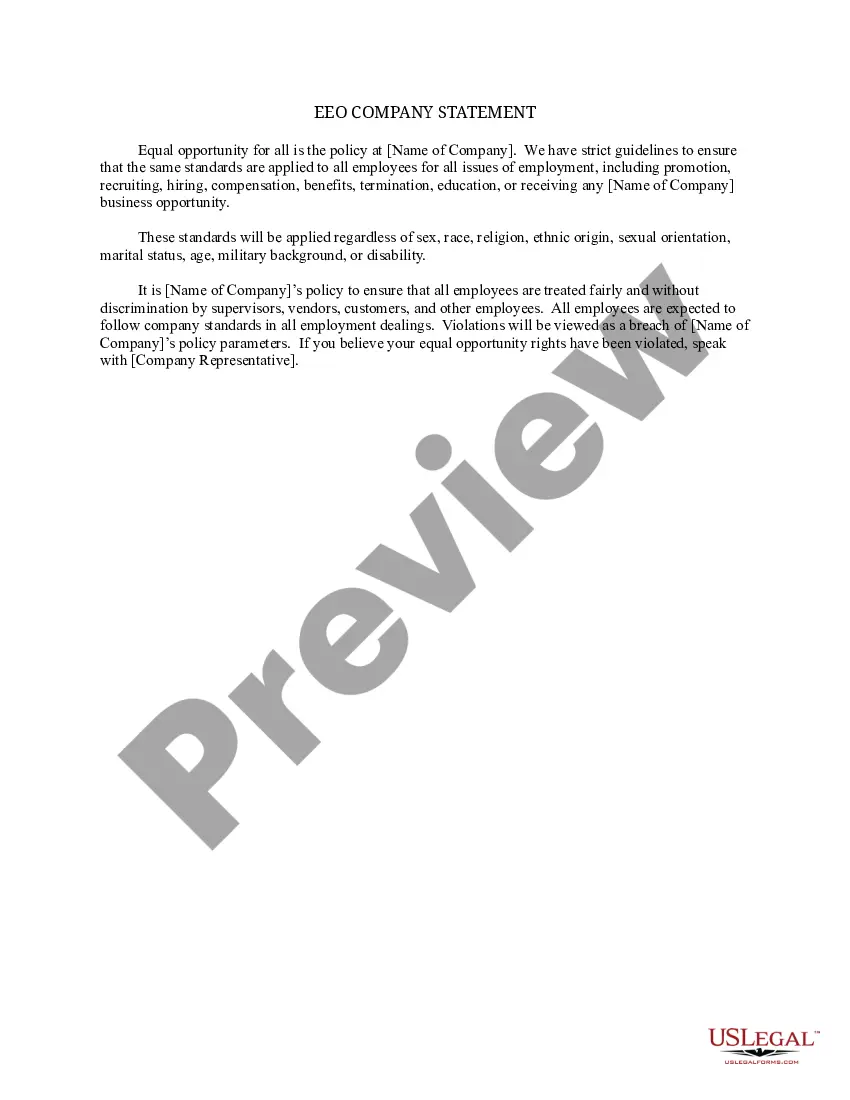
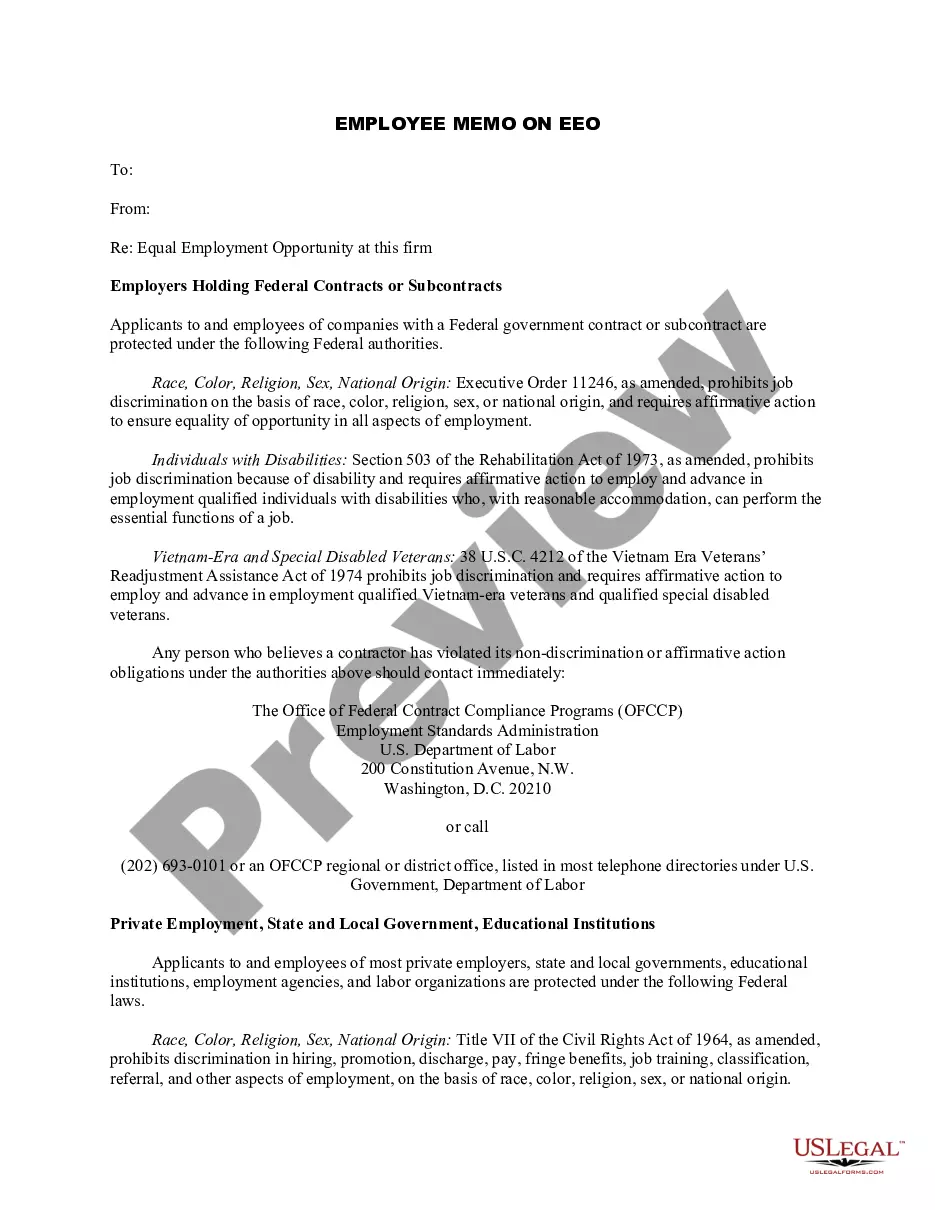
California Equal Employment Opportunity Statement for Personnel or Employee Manual or Handbook regarding Employees with Disabilities - EEOC
Description
Get your form ready online
Our built-in tools help you complete, sign, share, and store your documents in one place.
Make edits, fill in missing information, and update formatting in US Legal Forms—just like you would in MS Word.
Download a copy, print it, send it by email, or mail it via USPS—whatever works best for your next step.
Sign and collect signatures with our SignNow integration. Send to multiple recipients, set reminders, and more. Go Premium to unlock E-Sign.
If this form requires notarization, complete it online through a secure video call—no need to meet a notary in person or wait for an appointment.
We protect your documents and personal data by following strict security and privacy standards.

Make edits, fill in missing information, and update formatting in US Legal Forms—just like you would in MS Word.

Download a copy, print it, send it by email, or mail it via USPS—whatever works best for your next step.

Sign and collect signatures with our SignNow integration. Send to multiple recipients, set reminders, and more. Go Premium to unlock E-Sign.

If this form requires notarization, complete it online through a secure video call—no need to meet a notary in person or wait for an appointment.

We protect your documents and personal data by following strict security and privacy standards.
Looking for another form?





How to fill out Equal Employment Opportunity Statement For Personnel Or Employee Manual Or Handbook Regarding Employees With Disabilities - EEOC?
Selecting the most suitable legitimate document template can be challenging.
Of course, there are numerous templates accessible online, but how do you locate the specific document you need.
Utilize the US Legal Forms platform.
If you are a first-time user of US Legal Forms, here are simple instructions for you to follow: First, ensure you have selected the correct document for your city/state. You can preview the form using the Preview button and read the form description to confirm it is the appropriate one for you.
- The service provides thousands of templates, such as the California Equal Employment Opportunity Statement for Employees or Employee Manual or Handbook concerning Employees with Disabilities - EEOC, that you can use for business and personal needs.
- Each template is reviewed by experts and complies with federal and state requirements.
- If you are already registered, Log In to your account and click the Download button to obtain the California Equal Employment Opportunity Statement for Employees or Employee Manual or Handbook concerning Employees with Disabilities - EEOC.
- Use your account to view the legal templates you have previously purchased.
- Visit the My documents tab in your account and download an additional copy of the document you desire.
Form popularity
FAQ
To file an EEOC complaint in California, you need to follow a structured process that typically begins with gathering relevant information and documentation regarding your claim. You can then submit your complaint to the EEOC, often aided by the California Equal Employment Opportunity Statement for Personnel or Employee Manual or Handbook regarding Employees with Disabilities - EEOC to guide your rights and ensure accuracy. Seeking assistance from an expert or platform like uslegalforms can also streamline this process.
Direct evidence of discrimination includes clear and obvious instances that indicate bias against an employee based on a protected characteristic. This may involve statements made by supervisors or policies detailed in the California Equal Employment Opportunity Statement for Personnel or Employee Manual or Handbook regarding Employees with Disabilities - EEOC. Such evidence is crucial, as it can significantly bolster your discrimination claim in California.
Proving unfair discrimination requires gathering substantial evidence that supports your claim of being treated differently due to a protected characteristic. This could involve documenting instances of biased behavior, comparing your treatment to that of similarly situated colleagues, and citing relevant policies from the California Equal Employment Opportunity Statement for Personnel or Employee Manual or Handbook regarding Employees with Disabilities - EEOC. Legal guidance can also significantly assist in compiling strong evidence.
To prove discrimination in California, you must present evidence that demonstrates a direct connection between your protected status and the employer's adverse actions. This could include statements from colleagues, documented instances of differential treatment, or references to the California Equal Employment Opportunity Statement for Personnel or Employee Manual or Handbook regarding Employees with Disabilities - EEOC. Thorough documentation and witness testimonies are crucial in establishing your case.
Discrimination in California typically involves treating an employee or applicant unfavorably because of their race, gender, religion, and especially, their disability status. Under the California Equal Employment Opportunity Statement for Personnel or Employee Manual or Handbook regarding Employees with Disabilities - EEOC, the key elements include a valid reason for the adverse action and the individual's protected status. Knowing these elements helps you identify potential discrimination cases.
California has enacted laws aimed at strengthening protections against discrimination in the workplace, particularly regarding individuals with disabilities. These laws require employers to implement policies that support the California Equal Employment Opportunity Statement for Personnel or Employee Manual or Handbook regarding Employees with Disabilities - EEOC. As a result, companies are encouraged to review their employment practices and update manuals to ensure compliance with these new standards.
Creating an EEO statement involves outlining your commitment to equal opportunity, including specific language that reflects diversity and inclusion principles. When drafting your statement, ensure it aligns with the California Equal Employment Opportunity Statement for Personnel or Employee Manual or Handbook regarding Employees with Disabilities - EEOC. Consider using resources like US Legal Forms to access templates that can guide you in crafting an effective and compliant EEO statement.
The equal opportunity Act in California includes a series of laws aimed at preventing discrimination in the workplace. This Act aligns with the principles laid out in the California Equal Employment Opportunity Statement for Personnel or Employee Manual or Handbook regarding Employees with Disabilities - EEOC, promoting fairness and equal access for all individuals. Understanding this Act can help employers create a compliant and inclusive environment for their employees.
The EEOC position statement is a formal document provided by an employer in response to a claim of discrimination or harassment. This statement outlines the employer's viewpoint, supporting evidence, and any corrective actions they may have taken. It is essential to reference the California Equal Employment Opportunity Statement for Personnel or Employee Manual or Handbook regarding Employees with Disabilities - EEOC when formulating these statements to ensure compliance and fairness.
The California version of the EEOC is the Department of Fair Employment and Housing (DFEH). It oversees the enforcement of laws that prohibit discrimination in employment, housing, and public accommodations. Their guidelines support the California Equal Employment Opportunity Statement for Personnel or Employee Manual or Handbook regarding Employees with Disabilities - EEOC and ensure that employers uphold their obligations to foster inclusivity in the workplace.