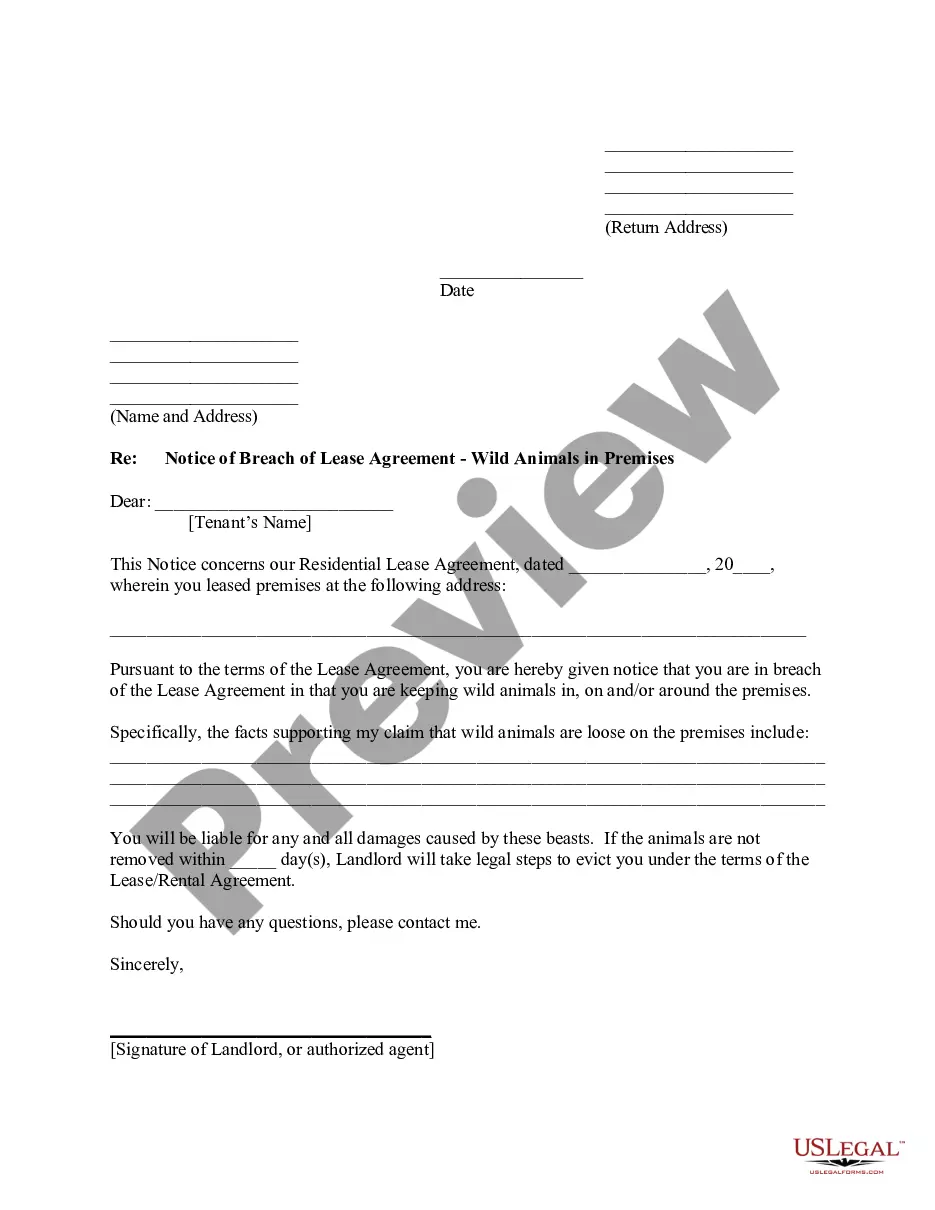
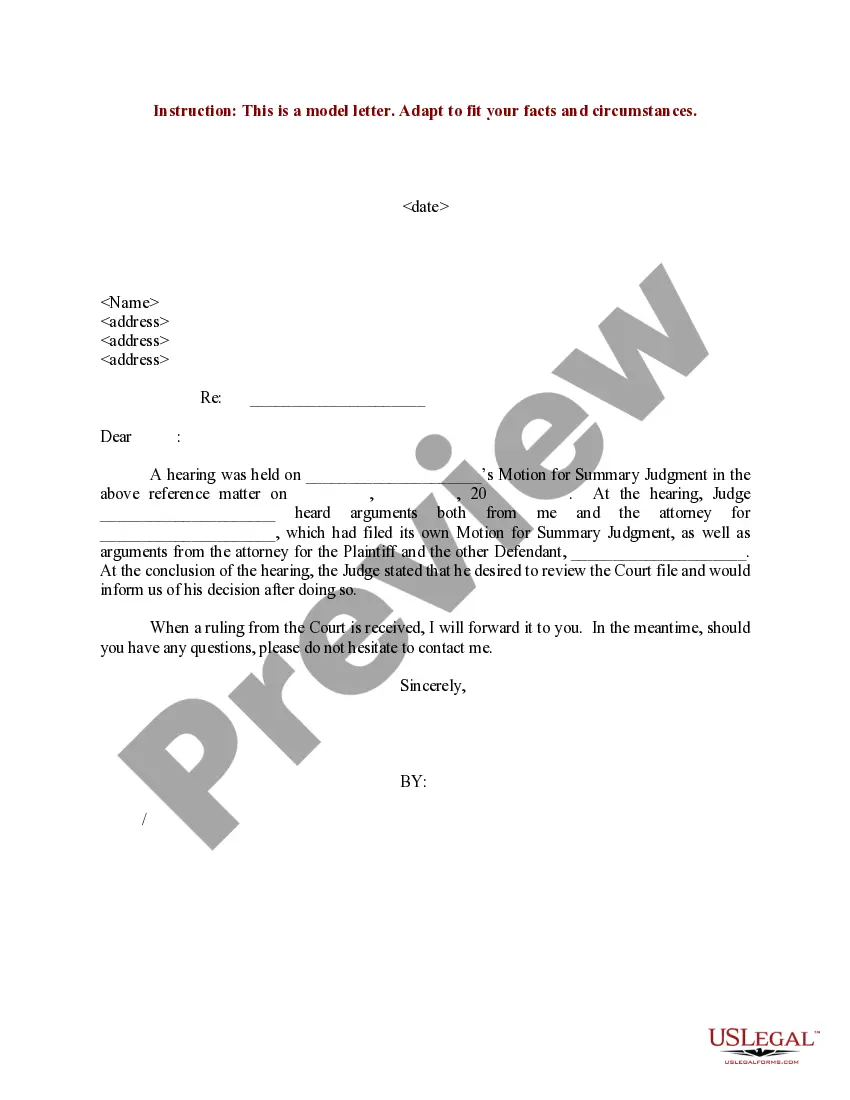
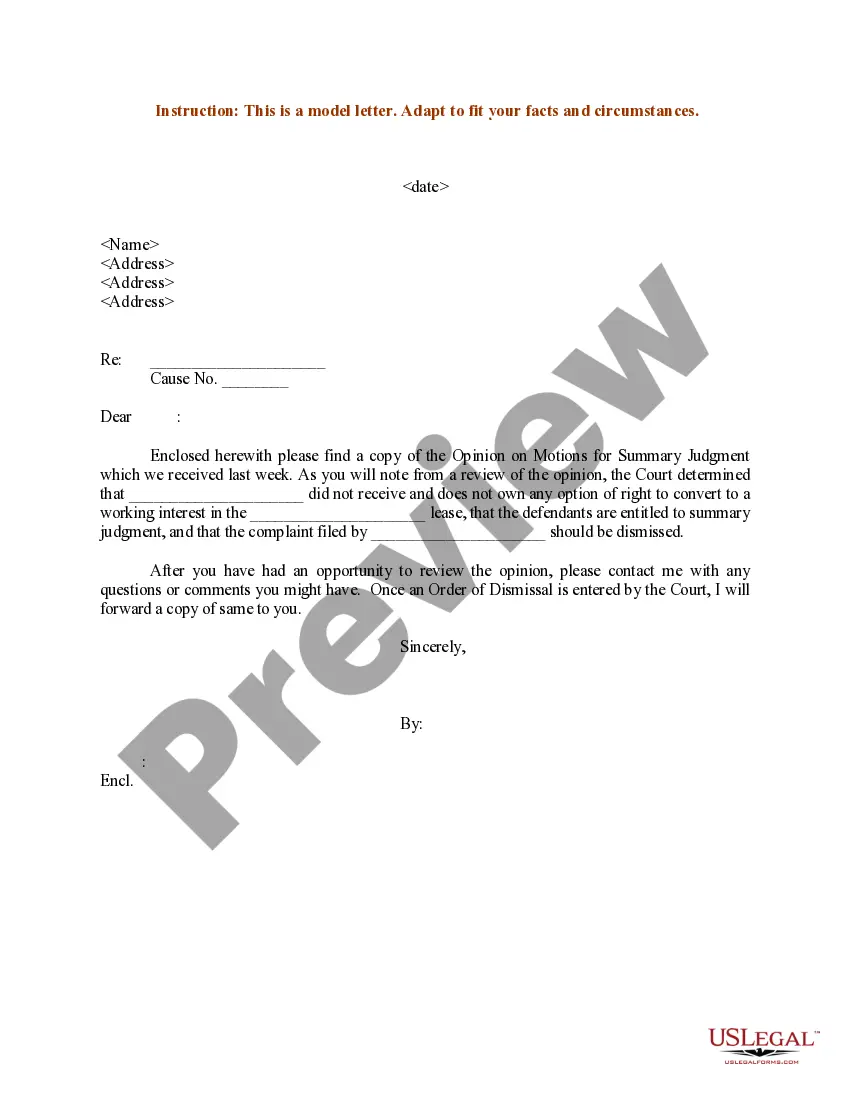
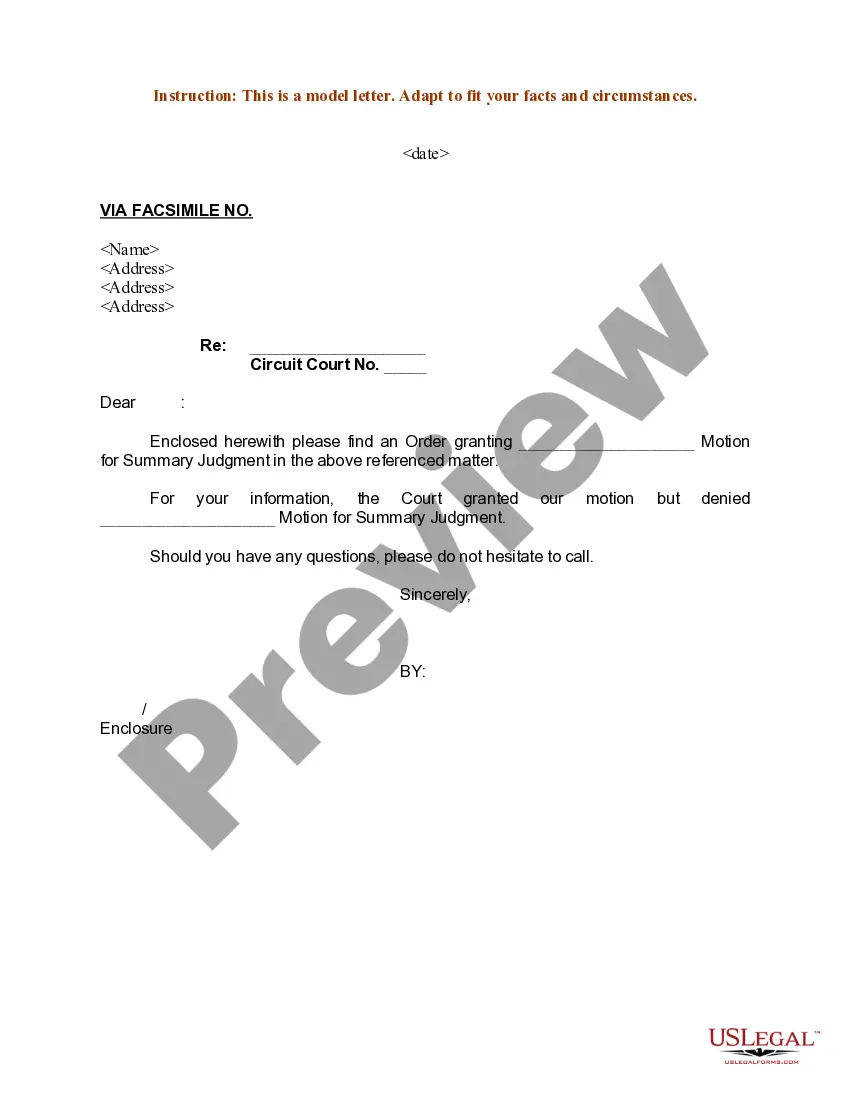
This form is a sample letter in Word format covering the subject matter of the title of the form.
California Sample Letter to Client concerning Hearing on Motion of Summary Judgment
Category:
State:
Multi-State
Control #:
US-0007LTR
Format:
Word;
Rich Text
Instant download
Description
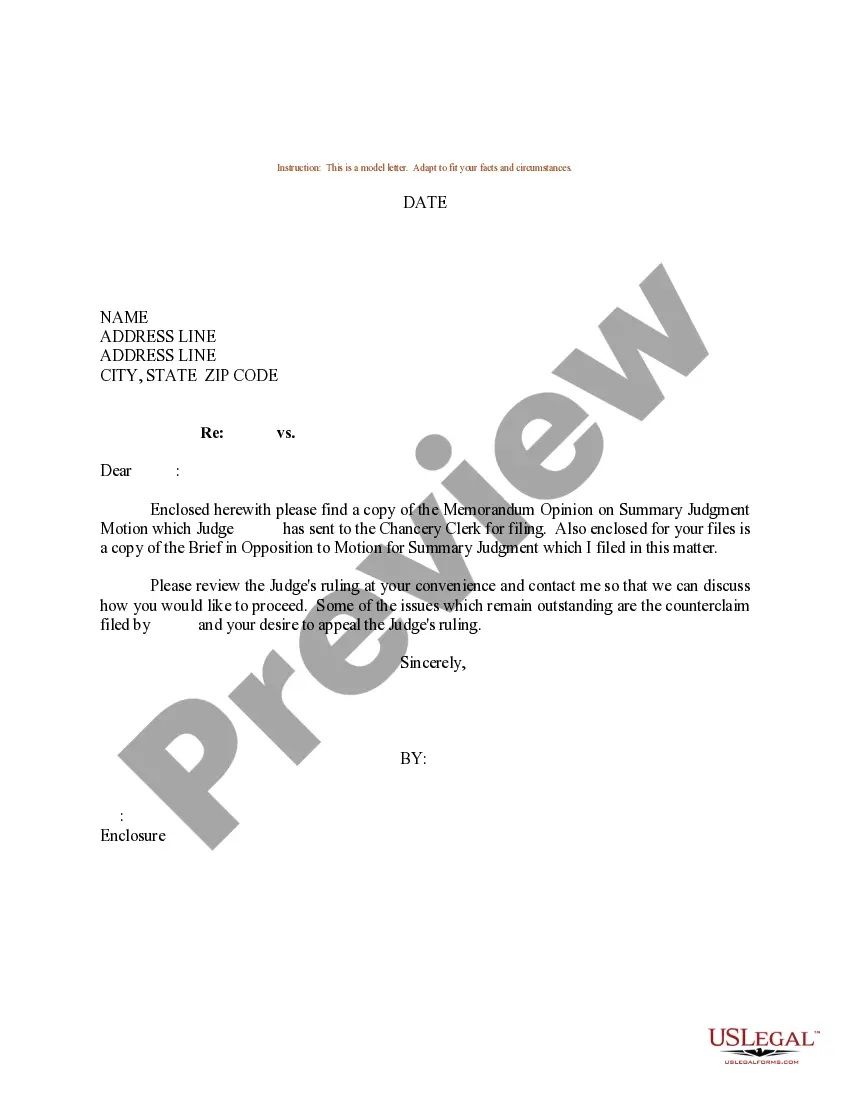
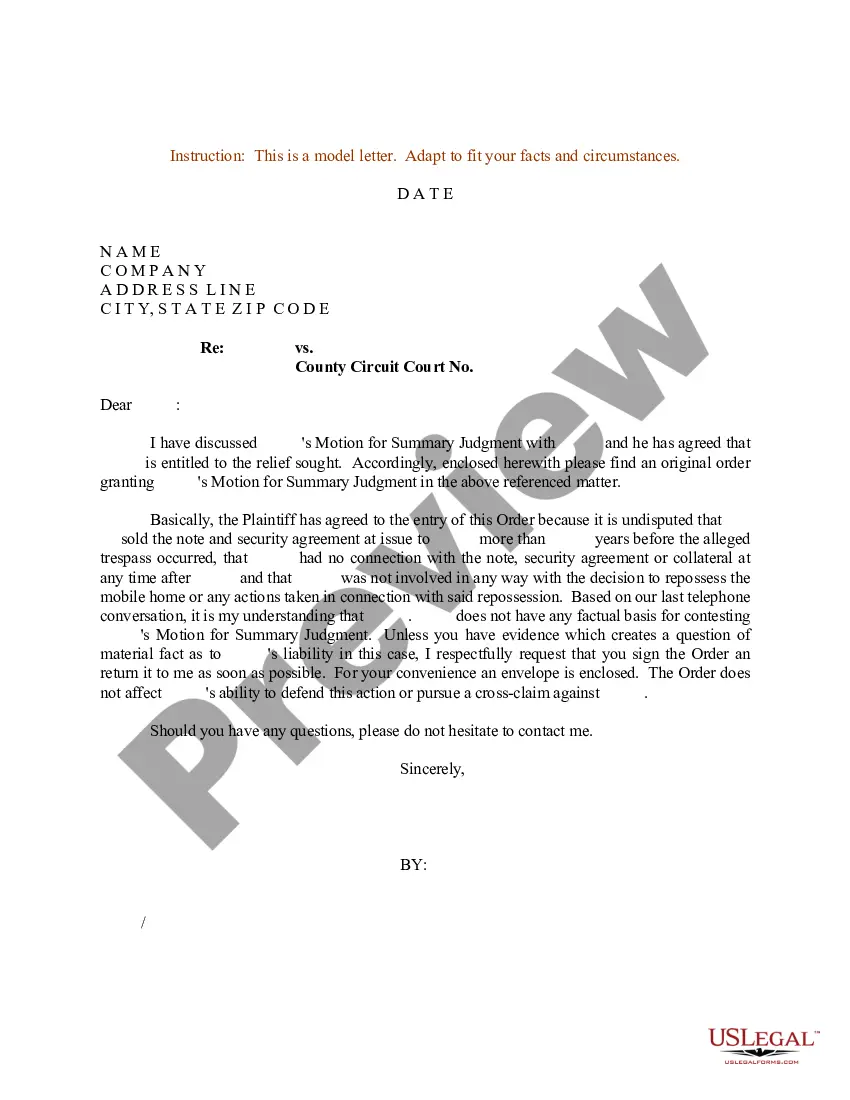
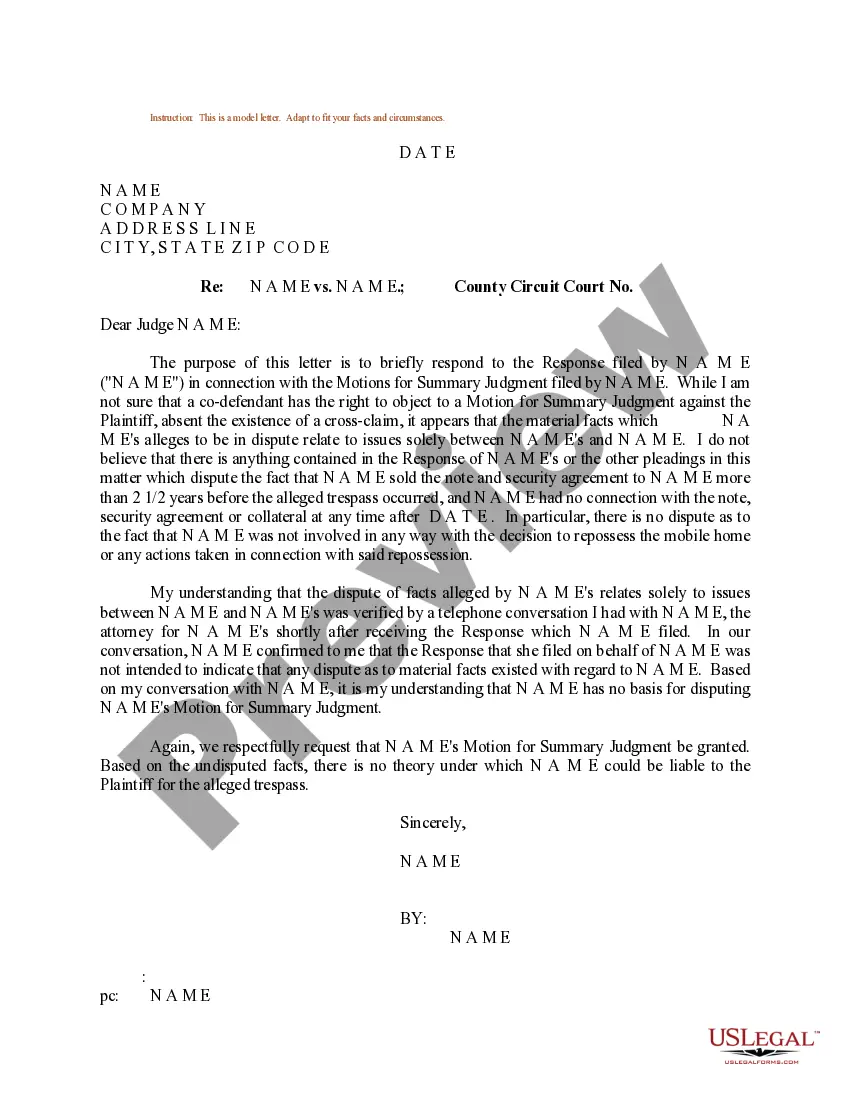
Get your form ready online
Our built-in tools help you complete, sign, share, and store your documents in one place.
Built-in online Word editor
Make edits, fill in missing information, and update formatting in US Legal Forms—just like you would in MS Word.
Export easily
Download a copy, print it, send it by email, or mail it via USPS—whatever works best for your next step.
E-sign your document
Sign and collect signatures with our SignNow integration. Send to multiple recipients, set reminders, and more. Go Premium to unlock E-Sign.
Notarize online 24/7
If this form requires notarization, complete it online through a secure video call—no need to meet a notary in person or wait for an appointment.
Store your document securely
We protect your documents and personal data by following strict security and privacy standards.

Make edits, fill in missing information, and update formatting in US Legal Forms—just like you would in MS Word.

Download a copy, print it, send it by email, or mail it via USPS—whatever works best for your next step.

Sign and collect signatures with our SignNow integration. Send to multiple recipients, set reminders, and more. Go Premium to unlock E-Sign.

If this form requires notarization, complete it online through a secure video call—no need to meet a notary in person or wait for an appointment.

We protect your documents and personal data by following strict security and privacy standards.
Looking for another form?





How to fill out Sample Letter To Client Concerning Hearing On Motion Of Summary Judgment?
You might spend hours online searching for the legal document template that fulfills the state and federal requirements you need.
US Legal Forms provides thousands of legal forms that can be reviewed by professionals.
You can easily download or print the California Sample Letter to Client regarding Hearing on Motion of Summary Judgment from our service.
If available, use the Preview button to look through the document template as well. If you wish to find another version of the form, use the Search field to discover the template that meets your needs. Once you have found the template you want, click Buy now to proceed. Choose the pricing plan you want, enter your details, and register for an account on US Legal Forms. Complete the transaction. You can use your credit card or PayPal account to purchase the legal document. Select the file format of the document and download it to your device. Make adjustments to your document if necessary. You can complete, modify, sign, and print the California Sample Letter to Client regarding Hearing on Motion of Summary Judgment. Download and print thousands of document templates using the US Legal Forms website, which offers the largest selection of legal forms. Utilize professional and state-specific templates to address your business or personal needs.
- If you already possess a US Legal Forms account, you may sign in and then click the Download button.
- Next, you can complete, modify, print, or sign the California Sample Letter to Client regarding Hearing on Motion of Summary Judgment.
- Each legal document template you purchase is yours for a long duration.
- To obtain another copy of any purchased form, visit the My documents tab and click the corresponding button.
- If this is your first time using the US Legal Forms website, follow the simple instructions below.
- First, ensure that you have selected the correct document template for your state/town that you choose.
- Check the form details to make sure you have selected the right form.
Form popularity
FAQ
The new deadline for filing a motion for summary judgment in California remains at 75 days before the scheduled hearing. However, it is essential to check for any local rules or changes that may apply. When preparing a California Sample Letter to Client concerning Hearing on Motion of Summary Judgment, remind your client to adhere to these timelines for a smooth process.
The statute governing motions for summary judgment in California is found under California Code of Civil Procedure Section 437c. This section outlines the procedures and requirements for filing such motions. Including references to this statute in a California Sample Letter to Client concerning Hearing on Motion of Summary Judgment can provide clarity and authority.
In response to a motion for summary judgment, you should file an opposition brief along with supporting evidence such as declarations and exhibits. This documentation should clearly address the arguments made in the motion. If you need to draft a California Sample Letter to Client concerning Hearing on Motion of Summary Judgment, guide your client on how to effectively structure their response.
The notice period for a motion for summary judgment in California is generally set at 75 days prior to the hearing date. This timeframe is crucial for parties to prepare their responses. When writing a California Sample Letter to Client concerning Hearing on Motion of Summary Judgment, make sure to highlight this important detail to keep your client well-informed.
To effectively argue against a motion for summary judgment, one must demonstrate that there are genuine issues of material fact that need to be resolved. This requires a thorough analysis of the evidence and legal arguments. A well-crafted California Sample Letter to Client concerning Hearing on Motion of Summary Judgment can outline the strategy to counter such motions effectively.
Evidence supporting a motion for summary judgment must be presented in a form that is admissible in court. This typically includes declarations, affidavits, and authenticated documents. When preparing a California Sample Letter to Client concerning Hearing on Motion of Summary Judgment, emphasize the importance of correct evidence formats to strengthen their case.
In California, the notice period for a motion for summary judgment is typically 75 days before the hearing. This allows the other party sufficient time to prepare their opposition. If you are drafting a California Sample Letter to Client concerning Hearing on Motion of Summary Judgment, ensure you clearly state this timeframe to keep your client informed.