California Affidavit- Surviving Spouse Succeeding to Title to Community Property by Right of Survivorship
Understanding this form
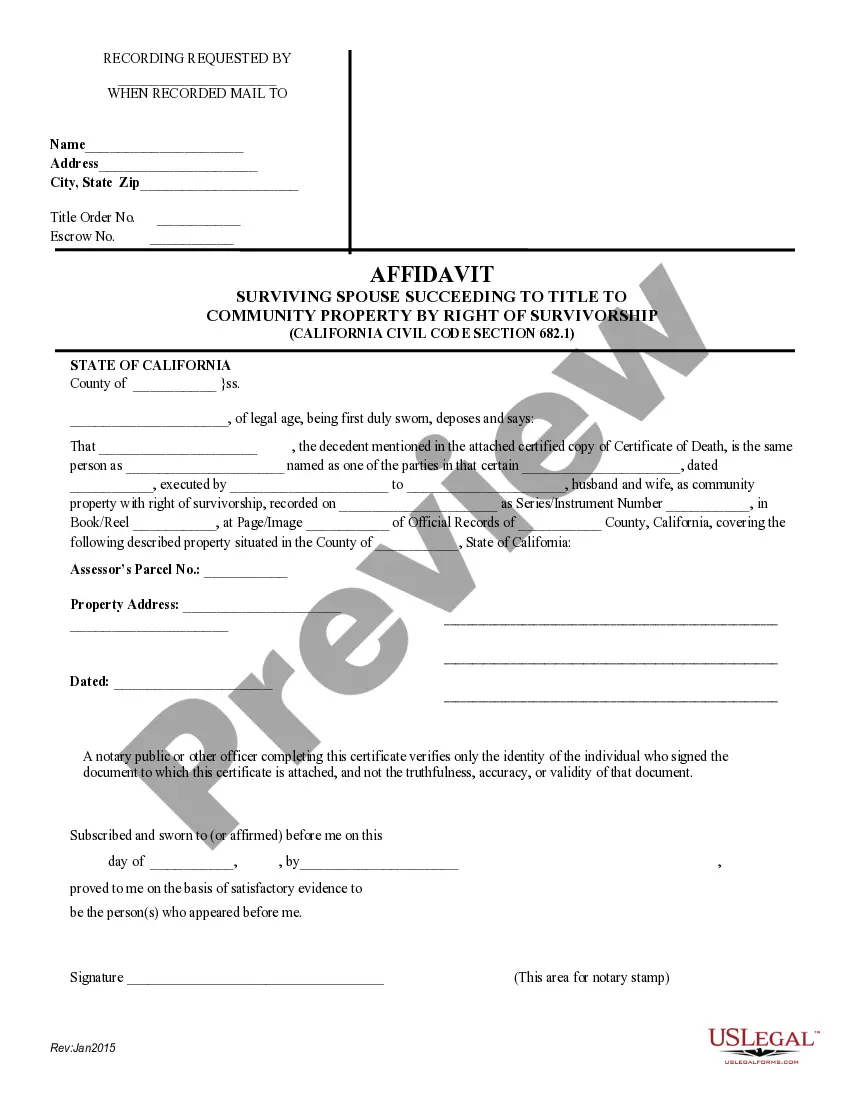
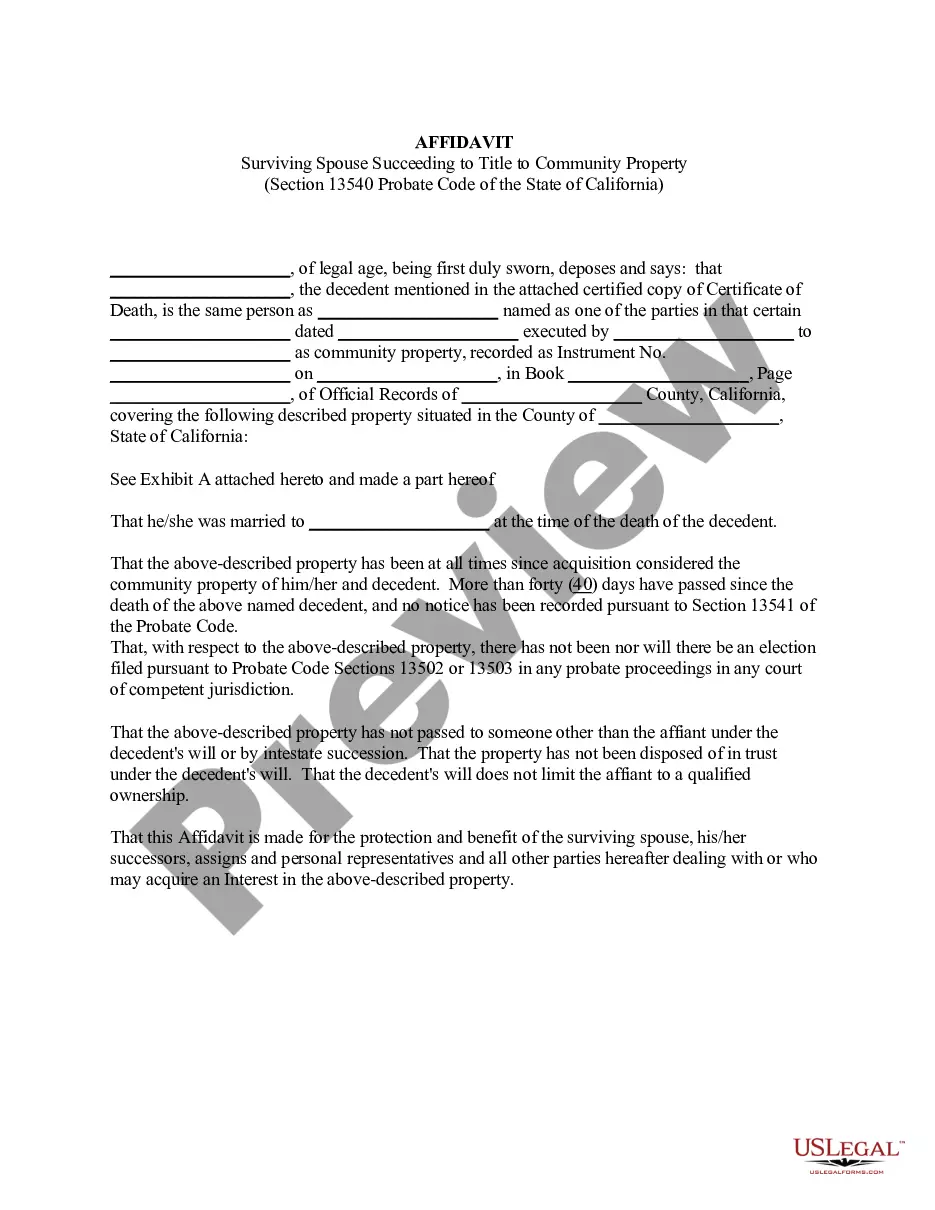
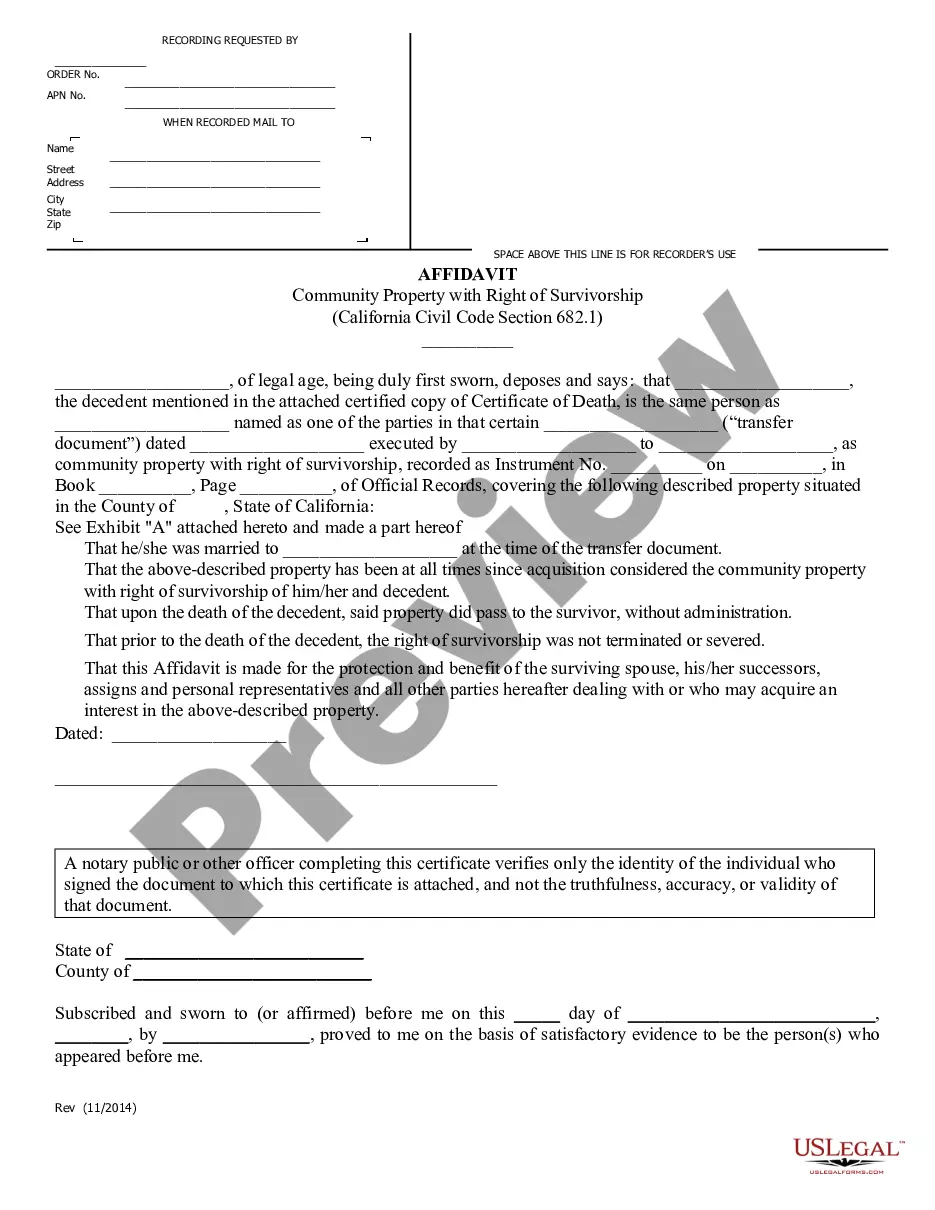
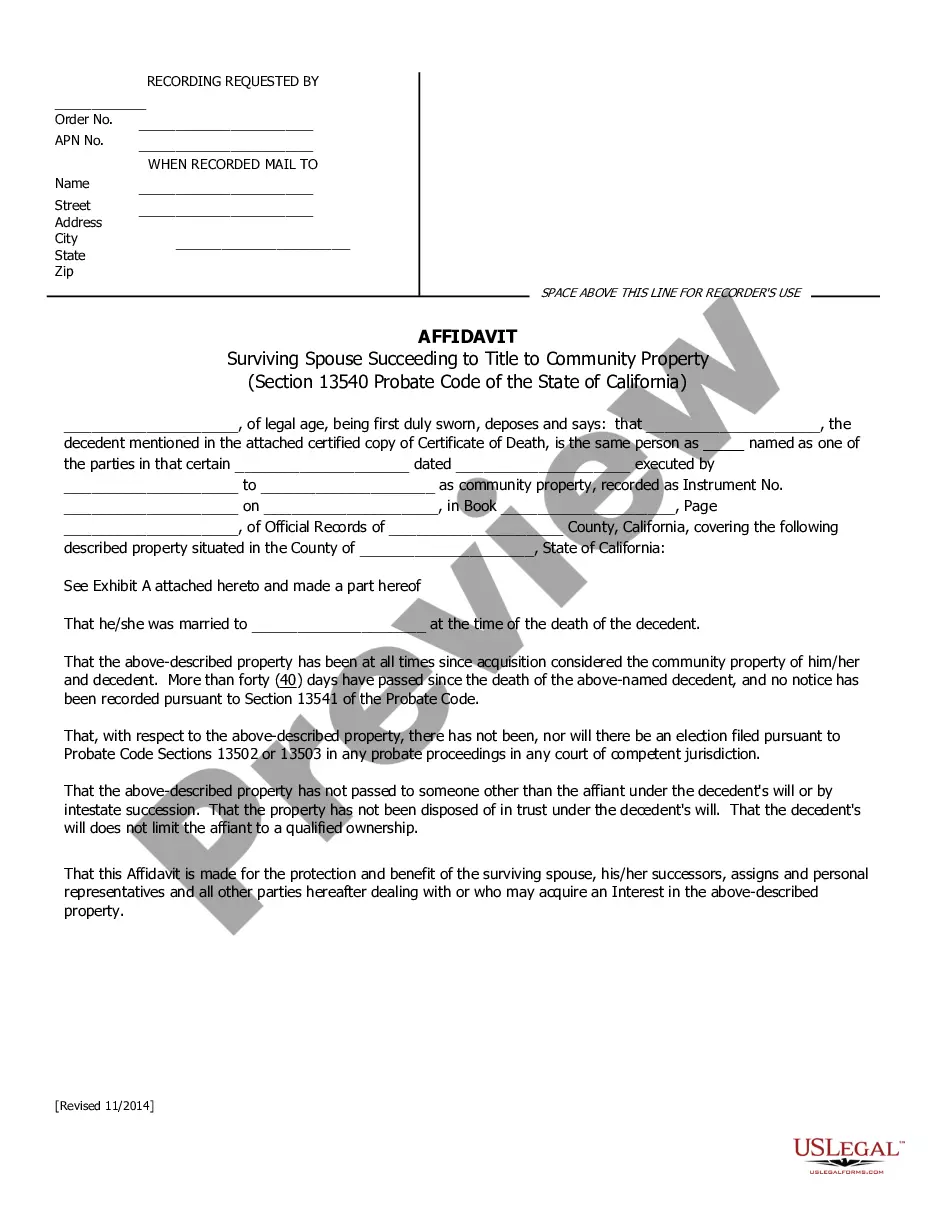
The Affidavit of Surviving Spouse Succeeding to Title to Community Property by Right of Survivorship is a legal document that establishes a surviving spouseâs right to inherit community property upon the death of their spouse. This form serves a specific purpose distinct from wills or trusts, as it focuses solely on the transfer of ownership of community property based on the right of survivorship, ensuring a clear legal transition without the need for probate proceedings.
Form components explained
- Name of the surviving spouse and the deceased spouse.
- Legal description of the community property.
- Date of the deceased spouseâs death.
- Signature and acknowledgment of the surviving spouse.
- Notarial acknowledgment if required.
When to use this document
This form is used when a spouse passes away and the surviving spouse needs to prove their right to inherit community property. It is particularly necessary in states that recognize community property laws, to ensure that the property can be transferred to the surviving spouse without additional complications.
Who this form is for
- Surviving spouses seeking to assert their rights to inherited community property.
- Individuals involved in the legal process of settling a deceased spouseâs estate.
- Estate administrators needing documentation for property transfer.
Completing this form step by step
- Identify the names of both the surviving spouse and deceased spouse.
- Clearly describe the community property involved, including all relevant details.
- Enter the date of the deceased spouseâs passing.
- Sign the affidavit in front of a notary public, if required by your state.
- Ensure all information is accurate before recording the affidavit with local authorities.
Does this form need to be notarized?
This form does not typically require notarization unless specified by local law. However, it is advisable to have the affidavit notarized to ensure its legal validity and to prevent complications during property transfer.
Get your form ready online
Our built-in tools help you complete, sign, share, and store your documents in one place.
Make edits, fill in missing information, and update formatting in US Legal Forms—just like you would in MS Word.
Download a copy, print it, send it by email, or mail it via USPS—whatever works best for your next step.
Sign and collect signatures with our SignNow integration. Send to multiple recipients, set reminders, and more. Go Premium to unlock E-Sign.
If this form requires notarization, complete it online through a secure video call—no need to meet a notary in person or wait for an appointment.
We protect your documents and personal data by following strict security and privacy standards.

Make edits, fill in missing information, and update formatting in US Legal Forms—just like you would in MS Word.

Download a copy, print it, send it by email, or mail it via USPS—whatever works best for your next step.

Sign and collect signatures with our SignNow integration. Send to multiple recipients, set reminders, and more. Go Premium to unlock E-Sign.

If this form requires notarization, complete it online through a secure video call—no need to meet a notary in person or wait for an appointment.

We protect your documents and personal data by following strict security and privacy standards.
Mistakes to watch out for
- Failing to accurately describe the community property.
- Not including the date of death of the deceased spouse.
- Omitting signatures or acknowledgments required by state law.
- Neglecting to notarize the affidavit when required.
Advantages of online completion
- Immediate access to templates drafted by licensed attorneys.
- Convenient downloading and printing options.
- Editable fields allow users to customize the form as needed.
- Compliance with state laws ensures reliability and accuracy.
Looking for another form?
Form popularity
FAQ
Disadvantages of community property with right of survivorship include a lack of control for the deceased spouse over asset distribution. This arrangement may prevent individuals from leaving specific assets to heirs or other beneficiaries outside the marriage. Furthermore, understanding the California Affidavit- Surviving Spouse Succeeding to Title to Community Property by Right of Survivorship can help couples navigate these challenges and make informed decisions about asset management.
In California, community property with right of survivorship refers to assets acquired during a marriage, which pass to the surviving spouse upon the other spouse's death. This legal arrangement simplifies asset transfer and avoids lengthy probate proceedings. Utilizing the California Affidavit- Surviving Spouse Succeeding to Title to Community Property by Right of Survivorship allows for a straightforward process, ensuring quick access to shared property.
One downside of community property with right of survivorship is that it can lead to unintended consequences if one spouse has children from a previous relationship. In such cases, the surviving spouse automatically inherits all community property, potentially excluding the deceased spouse's children from inheritance. Therefore, careful planning and use of the California Affidavit- Surviving Spouse Succeeding to Title to Community Property by Right of Survivorship is essential to prevent complications.
Yes, the right of survivorship generally overrides a will when it comes to community property. If one spouse dies, the surviving spouse automatically inherits the deceased spouse's portion of the property through the right of survivorship. This process occurs outside of probate, making it crucial for couples in California to understand their rights under the California Affidavit- Surviving Spouse Succeeding to Title to Community Property by Right of Survivorship.
The California Affidavit- Surviving Spouse Succeeding to Title to Community Property by Right of Survivorship is a legal document used when one spouse passes away. This affidavit allows the surviving spouse to claim the deceased spouse's share of community property without going through probate. It simplifies the transfer process, ensuring that the surviving spouse retains ownership of shared assets quickly and efficiently.
Filling out an affidavit of death and heirship involves providing personal details about the deceased, their heirs, and the relationship between them. Be sure to include any relevant property details that the heirs will inherit. The completed affidavit should be signed before a notary public to ensure legal validity. To make this process easier, consider using the California Affidavit- Surviving Spouse Succeeding to Title to Community Property by Right of Survivorship from USLegalForms, which guides you through the necessary steps.
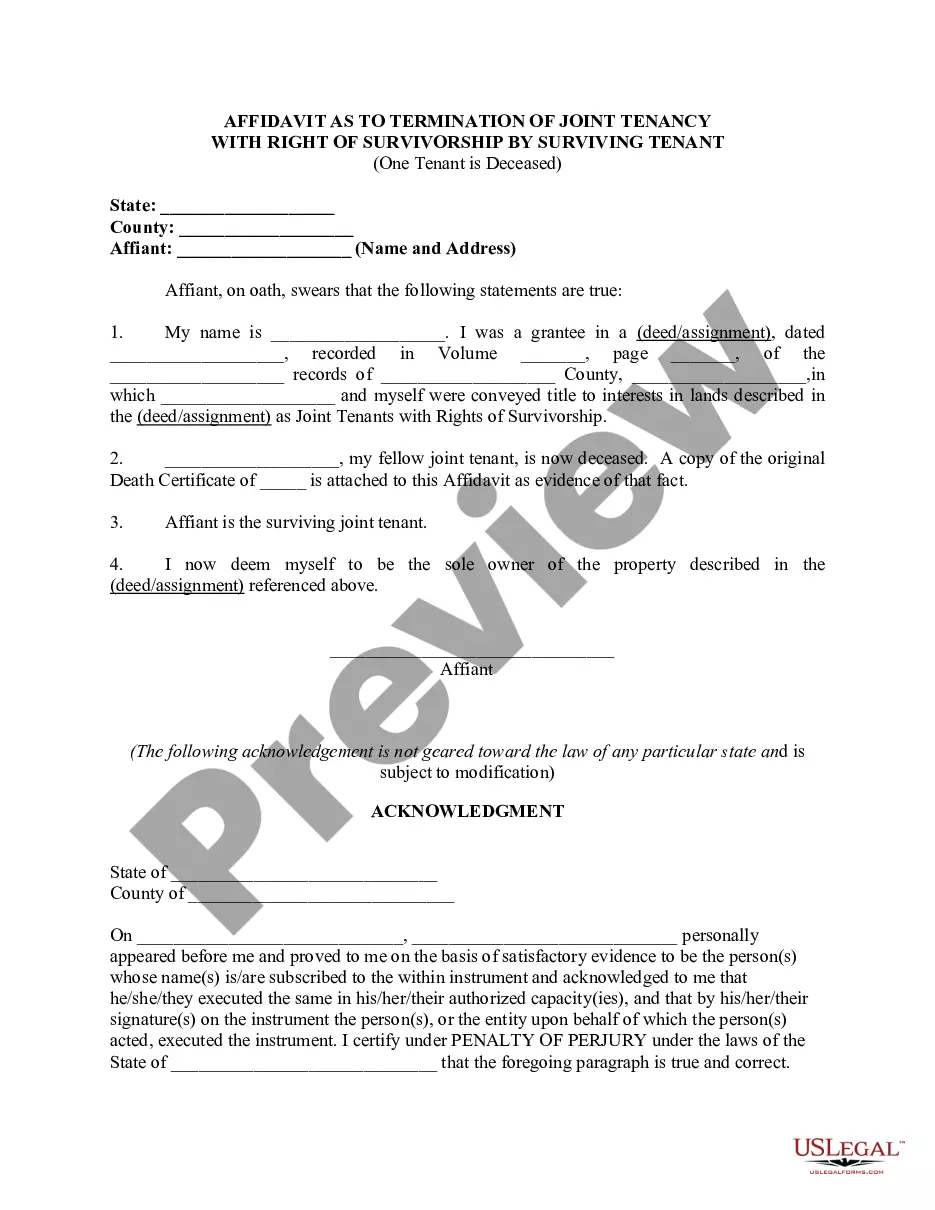
To complete an affidavit of death of a joint tenant in California, you must first gather necessary information, including details about the deceased joint tenant. The completed form must be signed in front of a notary public to validate the affidavit. After notarization, file this document with the county recorder’s office. This process can be streamlined using a California Affidavit- Surviving Spouse Succeeding to Title to Community Property by Right of Survivorship available on USLegalForms.
In California, when a spouse dies, community property typically transfers to the surviving spouse by right of survivorship. This means that the surviving spouse becomes the sole owner of the community property without the need for probate. To ensure this property transfer is handled correctly, the surviving spouse may need to complete a California Affidavit- Surviving Spouse Succeeding to Title to Community Property by Right of Survivorship. Using a reliable platform like USLegalForms can simplify this process.
In California, community property is divided equally between spouses upon the death of one spouse. The surviving spouse retains their half and may inherit the deceased spouse's half, particularly if there is no will. This division ensures that both spouses' contributions during the marriage are recognized. To address these matters efficiently, a California Affidavit - Surviving Spouse Succeeding to Title to Community Property by Right of Survivorship can be an effective tool.
When one owner of a jointly owned property dies in California, the property usually transfers to the surviving owner through the right of survivorship. This means the surviving owner gains full ownership without needing probate. If no right of survivorship exists, the deceased’s share may go to their heirs according to state laws. You may want to file a California Affidavit - Surviving Spouse Succeeding to Title to Community Property by Right of Survivorship to confirm this transfer.