California Partial Reconveyance
Overview of this form
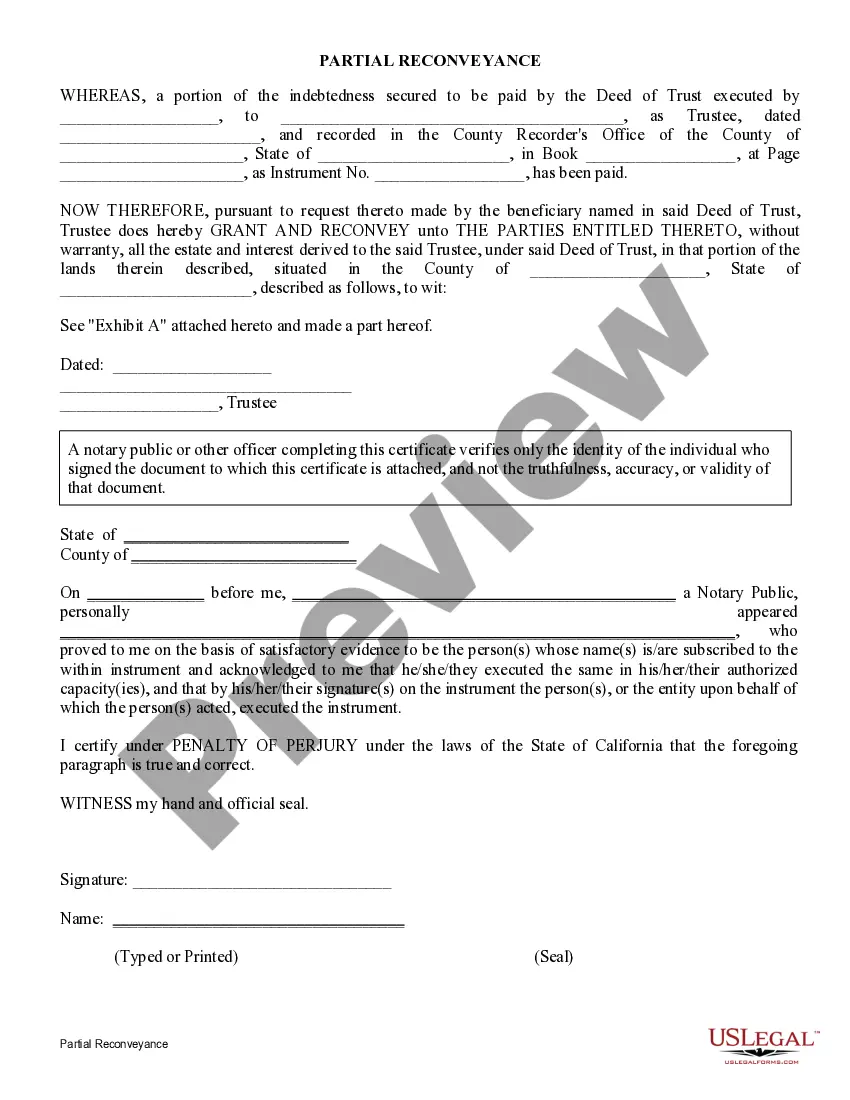
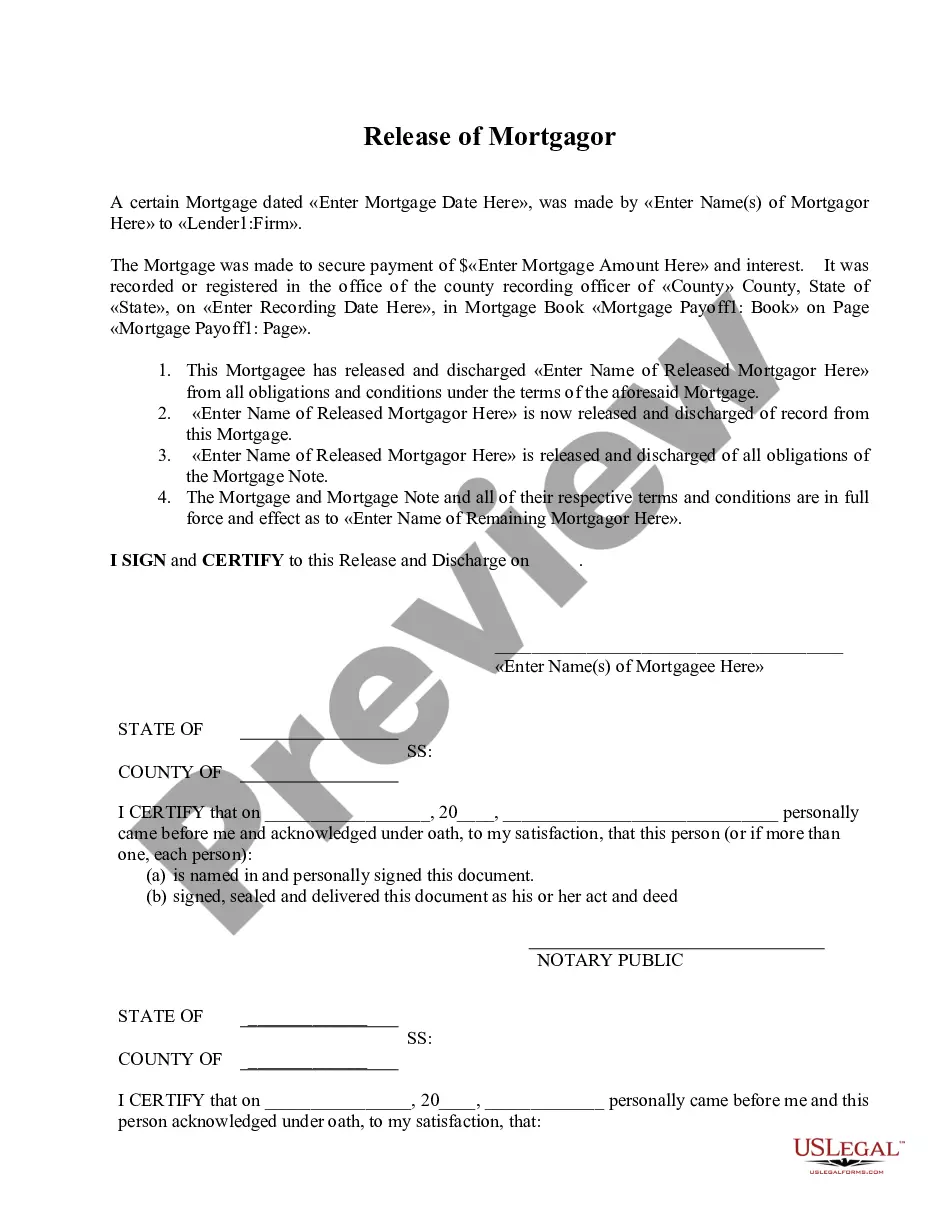
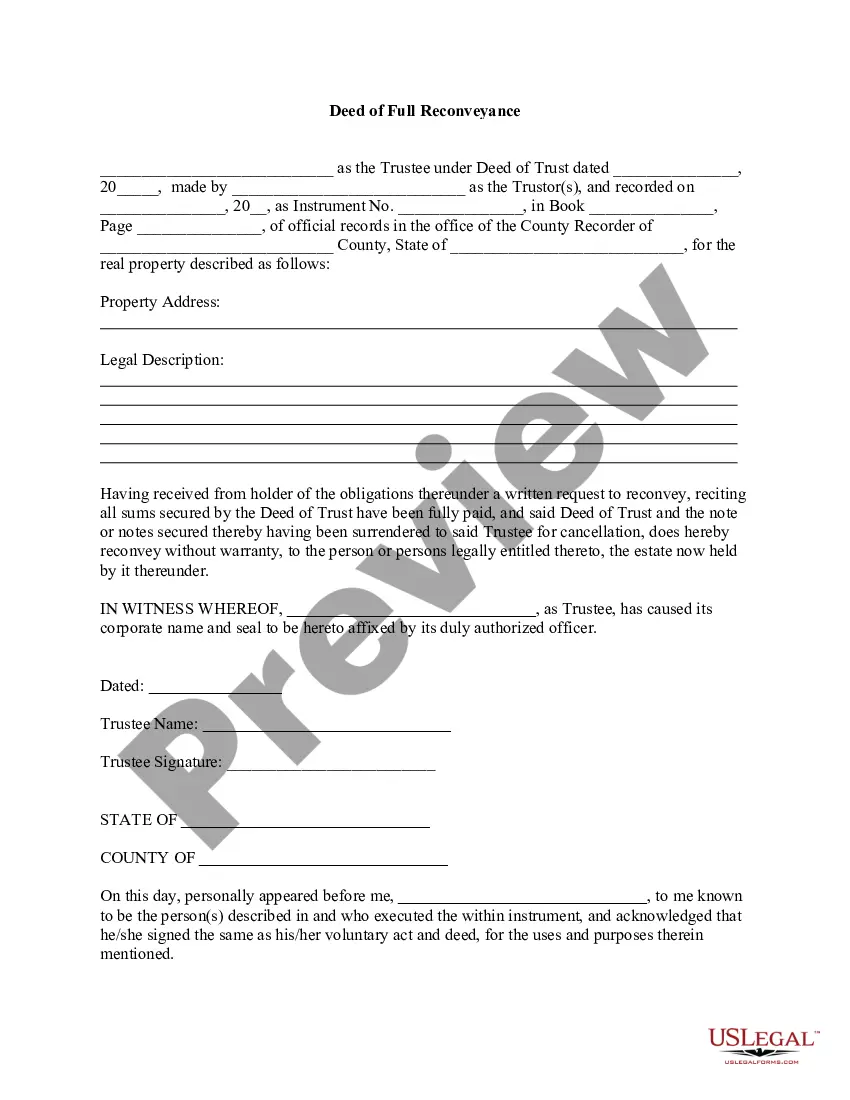
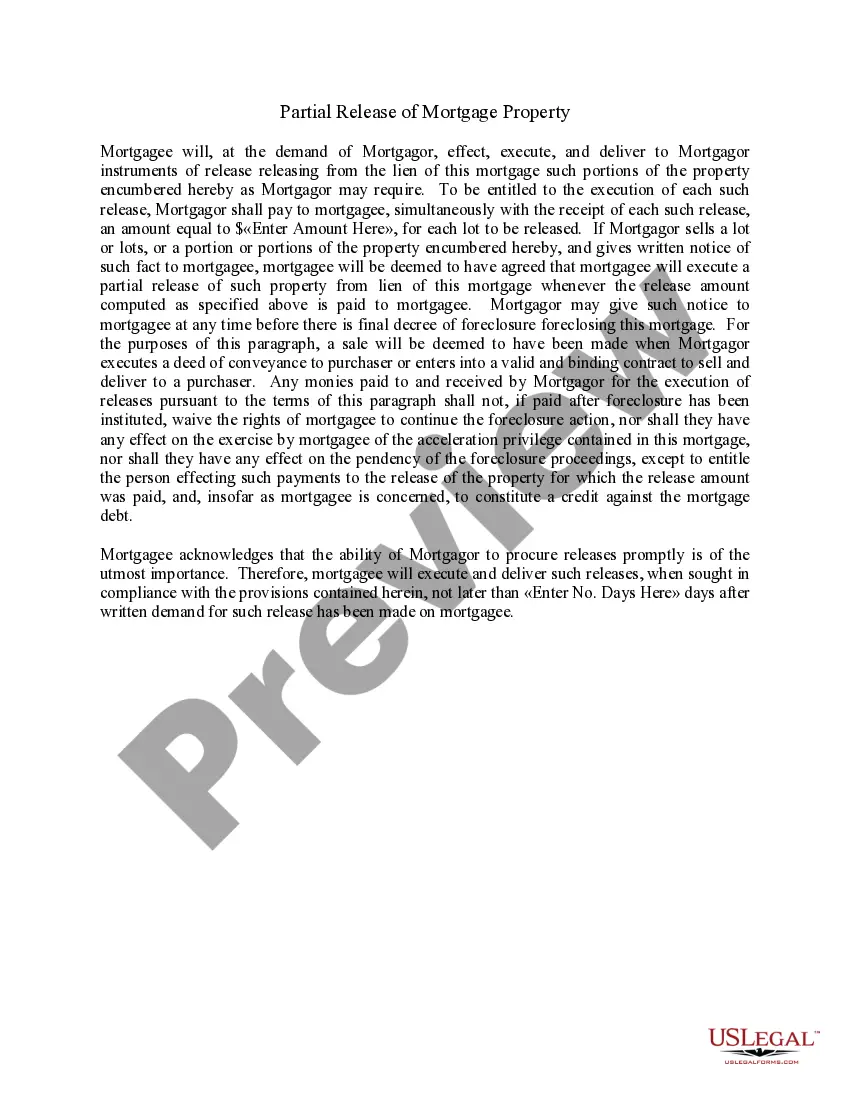
The Partial Reconveyance is a legal form used in property transactions to release part of the secured property from a deed of trust. When a borrower pays off a portion of their loan, this deed confirms the lender's acknowledgement and transfer of interest back to the borrower for the specified portion of the property. This process is crucial for ensuring that both the lender and the borrower maintain clear records of what property is secured against any remaining debt.
Key parts of this document
- Identification of the parties involved, including the borrower and trustee.
- Details of the original deed of trust, including date and recording information.
- Specification of the portion of the property being reconveyed.
- Signature and official seal of a notary public to validate the document.
- Attachment of Exhibit A, which includes a legal description of the property.
Common use cases
The Partial Reconveyance should be used when a borrower pays off a portion of a mortgage secured by a deed of trust. This form is common in situations involving home refinancing, partial property sales, or when securing financing against a specific part of a property. It ensures that the borrower's ownership rights are updated in accordance with their repayment progress.
Who can use this document
- Borrowers who have paid down part of their mortgage and need to document the reduction in encumbrance.
- Lenders or trustees seeking to acknowledge partial payments on a deed of trust.
- Real estate professionals managing transactions that involve partial releases of property.
- Homeowners wanting to clarify ownership within their property's documents.
How to prepare this document
- Identify the parties involved by filling in the names of the borrower and trustee.
- Provide details about the original deed of trust, including the date and recording information.
- Specify the exact portion of the property being reconveyed, referencing Exhibit A for legal descriptions.
- Sign and date the document as the trustee, ensuring it is notarized by a qualified official.
- Attach Exhibit A, which contains the detailed property description, to the completed form.
Notarization requirements for this form
Yes, this form must be notarized to be legally valid. Notarization confirms the identity of the signer and adds an additional layer of security to the document. US Legal Forms offers integrated online notarization services available 24/7, providing a secure video call option for convenience.
Get your form ready online
Our built-in tools help you complete, sign, share, and store your documents in one place.
Make edits, fill in missing information, and update formatting in US Legal Forms—just like you would in MS Word.
Download a copy, print it, send it by email, or mail it via USPS—whatever works best for your next step.
Sign and collect signatures with our SignNow integration. Send to multiple recipients, set reminders, and more. Go Premium to unlock E-Sign.
If this form requires notarization, complete it online through a secure video call—no need to meet a notary in person or wait for an appointment.
We protect your documents and personal data by following strict security and privacy standards.

Make edits, fill in missing information, and update formatting in US Legal Forms—just like you would in MS Word.

Download a copy, print it, send it by email, or mail it via USPS—whatever works best for your next step.

Sign and collect signatures with our SignNow integration. Send to multiple recipients, set reminders, and more. Go Premium to unlock E-Sign.

If this form requires notarization, complete it online through a secure video call—no need to meet a notary in person or wait for an appointment.

We protect your documents and personal data by following strict security and privacy standards.
Mistakes to watch out for
- Failing to include complete details of the original deed of trust.
- Not accurately describing the portion of the property being reconveyed.
- Omitting the notary signature and seal, which may invalidate the document.
- Forgetting to reference or attach Exhibit A, which is critical for legal clarity.
Why use this form online
- Convenience of filling out the form at home without the need for appointments.
- Editability allows users to customize the document as needed before finalizing it.
- Access to forms created by licensed attorneys ensures legal accuracy and reliability.
- Instant download avoids delays associated with traditional mail or in-person services.
Looking for another form?

Form popularity
FAQ
Practically, lenders and servicers may want to consider including in payoff demand statements an additional $150 in recording fees for a Substitution of Trustee and Full Reconveyance ($75.00 for each document ?title?), necessary for the release of the loan.
To record the reconveyed deed, the property owner must go to the office of the Registrar-Recorder in which the property is located. For example, if the property is located in Los Angeles County, the reconveyed deed must be taken to the Los Angeles County Recorder's Office.
The beneficiary is usually the lender or carry back seller. The beneficiary receives no legal interest in the property through the trust deed. Because of his secured relationship to the property, the beneficiary acquires an equitable interest to the extent permitted under the title rights given to the trustee.
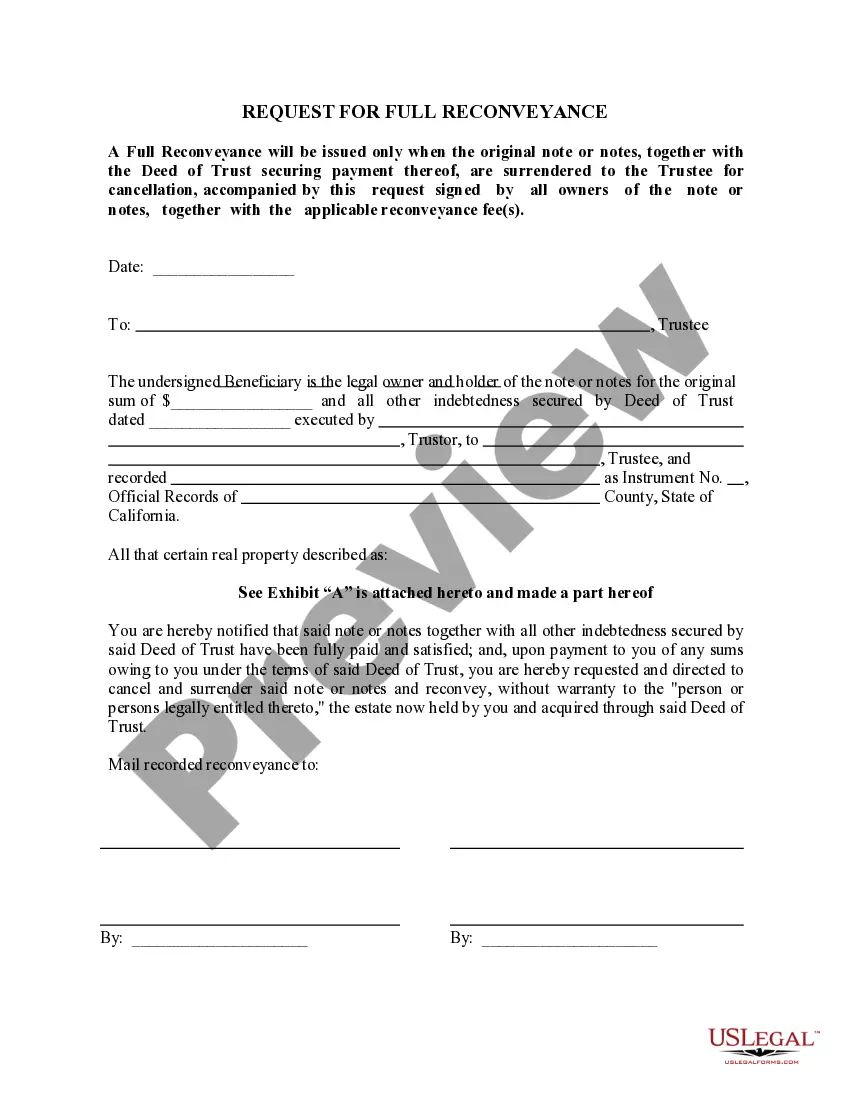
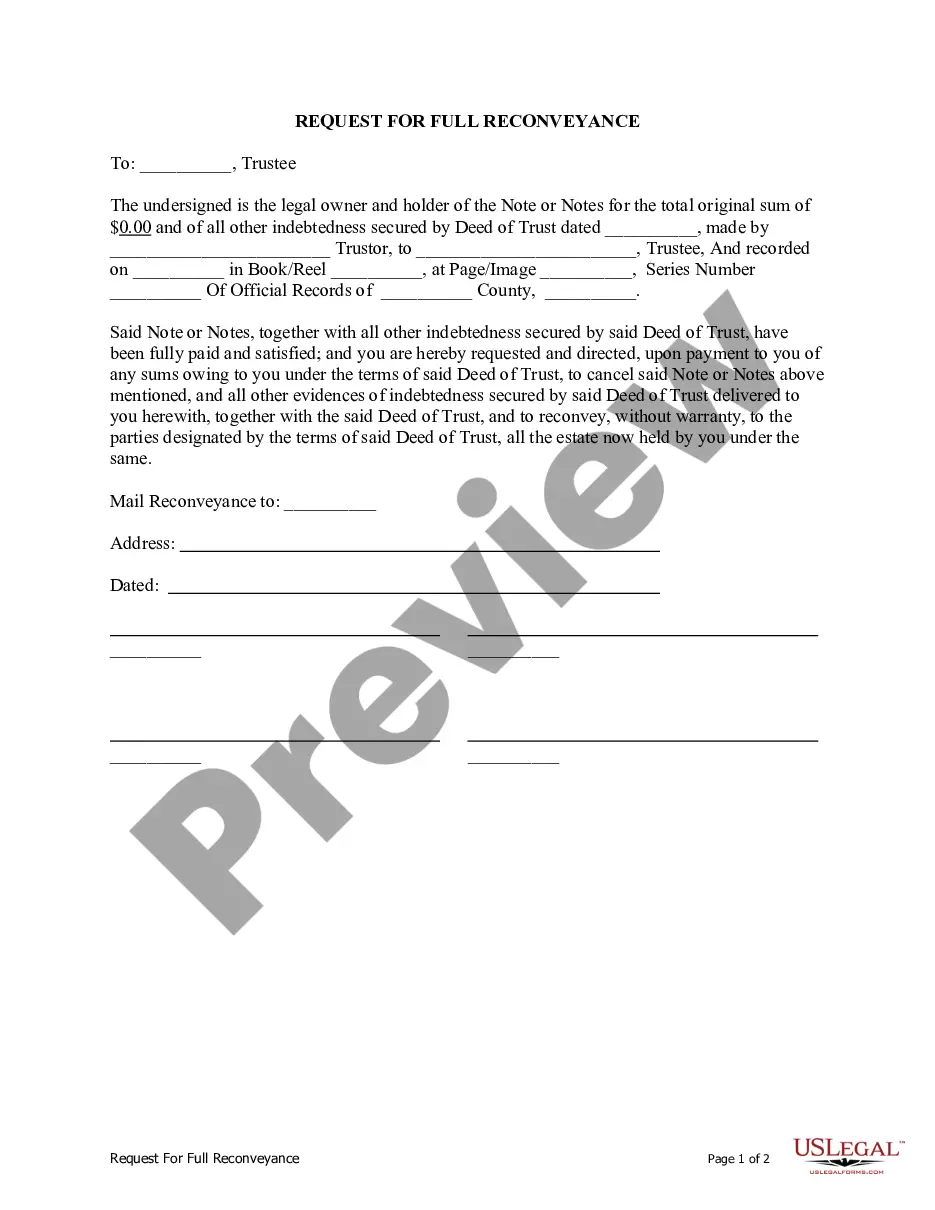
When a deed of trust/mortgage is paid in full, you can record a Full Reconveyance from the trustee stating publicly that the loan has been paid. The Full Reconveyance Form is completed and signed by the trustee, whose signature must be notarized.
A partial reconveyance is to reconvey a portion of the land subject to a deed of trust, not the loan amount.
Whether you get a deed of reconveyance, a full reconveyance or a satisfaction of mortgage document, it means the same thing: your loan has been repaid in full and the lender no longer has an interest in your property. In short, your home is finally all yours!
California Civil Code section 2941 (b)(1) requires the beneficiary, upon payoff, to ?execute and deliver to the trustee the original note, deed of trust, request for a full reconveyance?.? The trustee then executes and records the full reconveyance within 21 days of receipt of the documents from the beneficiary,